
Since the early records of the club were lost in the blitz during the last war, and since there are very few members who are accessible and whose association with the club goes back to those days; accounts of the very early years of the club are bound to be a little hazy.
The story of the founding of the club is an established part of Mendip folklore by now but, like most folklore, is probably greatly embellished. At any rate, a small group of fellow employees of our founder, “Harry” Stanbury formed themselves into a caving party in the summer of 1935 and visited Goatchurch. The trip was a success and, after acquainting themselves with the procedures of the existing societies, they decided to form a new club.
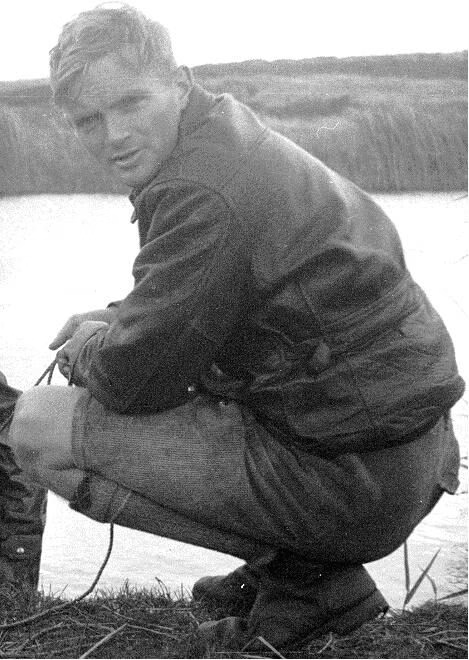
Initial membership was about a dozen, and an inaugural meeting was called later in the year at which a set of rules was drawn up, and the bat adopted as the emblem of the new Bristol Exploration Club. The basic phraseology of the aims and objects of the club in our present constitution comes straight from these original rules, and it is flattering to think that at least one other club – the Westminster – has drawn heavily upon this wording of 1935 in formulating their own constitution over twenty years later.
The few years between the founding of the club and the outbreak of war in 1939 found the infant club constructing tackle – rather differently from the methods we use today! – and running trips to most of the caves which existed on Mendip at the time. The membership remained small and steady, as the club made little or no attempt to persuade others to join them until they felt they had acquired enough experience to be able to offer new members a reasonable standard of caving knowledge.
At the outbreak of war, club membership was 15 – a figure which the subsequent call-up soon began to reduce, until it was hardly possible to get a caving trip together. The Emplex Caving Club, composed of employees from the Bristol Employment Exchange, found themselves in a very similar position, and in 1940 the two clubs agreed to combine. The combined clubs agreed to retain the name of Bristol Exploration Club.
Matters continued to get worse, even with the extra manpower provided by the merger, and by 1943, the club existed in little more than name. All its forces members were not available for caving, and the few left behind found it almost impossible to carry on.
Just when it seemed that activities would have to be wound up and hopefully started up again when the war was over, one or two additional cavers contacted Harry Stanbury, and a meeting was held at which it was decided to renew caving activities. The club membership numbers date from this meeting, at which ‘Dan’ Hasell was present. His membership number is 4, Harry Stanbury’s being 1.
The end of the war in 1945 found the club shaky but still functioning. On most occasions, since nearly all the early members lived in the Knowle area of Bristol, trips were organised from the Stanburys’ house in Redcatch Road; but on occasion, members would change at Maine’s Barn at Priddy. It was these visits to ‘The Barn’ by some members of the B.E.C. which were mainly responsible for the dramatic growth of the club during the next two years from a handful of cavers to one of the major caving clubs of Mendip.
Maine’s Barn in 1945 was the home of a collection of cavers from a variety of sources. The only actual club represented was the Bridgwater Caving Club, who were in the main employees of the Puriton explosive factory. Don Coase was one of these. Another of the organised groups was a small band of ex-U.B.S.S. cavers who had found the Burrington hut too far from the caves of the Priddy area in those days of little, if any, personal transport. This group provided members like ‘Sett’, ‘Postle’ Tompsett, ‘Pongo’ Wallis and ‘Alfie’.
As these cavers got to know each other, it became obvious that it would be a good thing if they all banded together into one club. The obvious choice was the B.C.C., but there were fears that this club would be disbanded as soon as the Puriton factory ran down on explosive manufacture. It was the few B.E.C. members who visited the barn – like, George Lucy – who provided an alternative club round which the inhabitants of the barn could rally and in the end, they all joined the B.E.C. This increase of membership was rapidly swollen by returning forces members, many of whom brought friends along with them. At about this time the Mendip Speleological Group were also absorbed into the B.E.C. and, by the end of 1946, membership had risen to 80 and the B.E.C. had become a major Mendip caving club.
The need for a permanent Headquarters was now becoming of great importance and, accordingly, money was lent to the club by some members and a small wooden hut purchased. This was the original Belfry, which started life as a sports pavilion on Purdown in Bristol and was taken to pieces and erected by the club next to the small stone hut by the slag heap near the Shepton Headquarters. (This was, of course, long before the Shepton arrived on Mendip). On Saturday, 1st February 1947, Don Coase spent the first night under the club’s own roof at the Belfry. Exact records have not been kept, but something approaching a total of 50,000 bed nights have been spent at Belfries by club members and guests since that date.
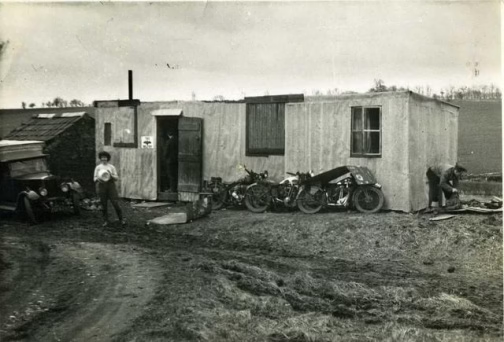
January 1947, the first issue of the Belfry Bulletin was published – Edited by Dan Hasell.
With the possession of a hut, the club continued to attract more members. An active group from Nottingham University were amongst these. The club now began to play a part in the discovery of new caves on Mendip. In the summer of 1947 Stoke Lane Slocker was transformed into a large cave by the discovery of Browne’s Passage by Pat Browne and the forcing of the sump by Don Coase, Pat Browne and ‘Sett’. It is a sobering thought to realise that ‘Sett’ is the only living survivor of this trip. At about the same time, club members assisted the Browne’s in digging out Browne’s Hole and the nearby Withybrook Swallet was entered by the club.
At about this time, the Bridgwater Caving Club was formally incorporated into the B.E.C. For many years after this, a B.C.C. membership card and key to Swildons used to hang in the old Belfry to commemorate this event. The significance of the Swildons key was that, in the days of Maine’s Barn, the rest of us could only get down Swildons by courtesy of the B.C.C. who had an official key.
By 1948, membership had risen to 98 and the club’s activities grew in proportion. A survey of Stoke Lane was exhibited at a caving exhibition held in the Bristol Museum; the Clifton Caving Club were absorbed into the B.E.C.; a London Section of the B.E.C. was formed and a new loan amongst members resulted in a new and bigger hut being purchased. The old original Belfry was bodily moved; towed down the road and re-erected on the present site and the ‘new’ Belfry built nearby. This was the hut which was finally destroyed by fire. Meanwhile, the club’s interests continued to expand an active Climbing Section spent most weekends in North Wales and elsewhere; the club supplied most of the Somerset Section of the Cave Diving Group, and club trips began to be organised to France and other European countries.
By 1949, the membership had reached 120 and the meetings at Redcatch Road had begun to suffer from overcrowding. The idea of holding meetings on a Thursday was so that club members could organise the coming weekend’s caving and climbing. A room was therefore hired at Redcliffe Church Hall, and remained for many years the focus of the club in Bristol. This year marked the end of the rapid post-war expansion of the club. From 1949 to 1961 membership remained virtually steady, dropping in most years by one or two until a low point of 110 members was reached in 1961. In 1950, the first annual dinner was held at the Hawthorns Hotel in Bristol. This year also saw a porch added to the ‘new’ Belfry by the Belfry Engineer – Tony Johnson.
In 1951, the club ran a stand in the ‘Our Way of Life’ exhibition in Bristol as part of the Festival of Britain arrangements. The stand aroused considerable interest. In this year, a number of changes were made in the way in which the club was run with the object of distributing the work of running the club amongst a greater number of people. The present system of club officers and the makeup of the club committee date from this time.
In 1953, accommodation on Mendip was again improved by the addition of a six foot length to the Belfry. This was used to enlarge the kitchen and the Women’s’ Room. This year also saw the most important discovery which the club has yet made. By permission of Mr. T.C. Cunane, excavation was started in the depression near the Belfry and after a few months continuous work, a cave system was entered in the October of that year. St. Cuthbert’s is too well known to need any further description or comment.
In 1953 and 1954, the club surveyed Redcliffe Caves in Bristol, presenting a copy of the survey to the city engineer. The work on this survey was written up and published as the first of the B.E.C. series of Caving Reports. Caving work of the time also included the opening of Hunters’ Hole in 1954.
During 1955, the land on which the Belfries stood came onto the market and was purchased by the club in 1956.
The future of the Belfries had been worrying members ever since the Town & Country Planning Act had come into force but now that the land belonged to the club, all was well and the renovation of the ‘new’ Belfry was put in hand.
Thus, during 1957, the Ladies’ Room and the Men’s’ Room were decorated and mains electricity connected to the Belfry. This year also marked the final demolition of the original Belfry, which had served the club so well, to make room for permanent stone building – the first permanent building to be erected by a caving club on Mendip. In this year, the B.B. first came out with a printed cover and the size was increased from four pages to six. On the caving front, the club assisted in the re-opening of Pen Park Hole in Bristol doing, in fact, about three quarters of the digging required to get in. After running one tourist trip, the club had to abandon its co-operation with the other societies involved owing to a disagreement with “the management”. This, however, was offset by the new discoveries in Cuthbert’s of The Maypole Series and the Rabbit Warren Extension.
January 31st, 1958, Don Coase died after an operation. A simple plaque in Cuthbert’s was erected by the club as a permanent reminder of his work. On the Whit Monday of the same year, ‘Herby’ Balch died. He was an honorary member of the club and the father of caving on Mendip.
Much work continued to be carried out in Cuthbert’s and on the Belfry. The new stone hut gradually grew and work was done Tankard hole and other smaller caves. Apart from this, 1960 saw no new activity of note – except possibly the claim that the Belfry was the only Mendip hut which never closed which accommodated more people than all the other caving huts combined – a state of affairs which will probably never occur again. Club ties and car badges were introduced at about this time.
By 1961 the stone Belfry had been completed externally. The internal fitting out scheme involved the construction of a shower, but this never came to pass.
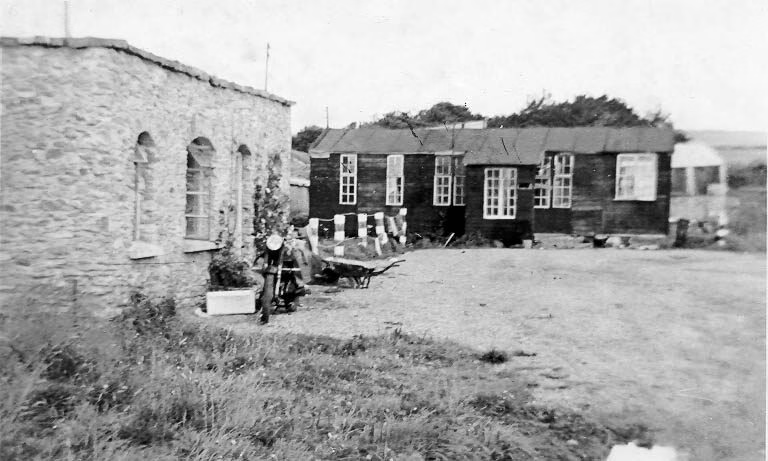
The next few years, from 1962 to 1965, were marked by steady if unspectacular progress. Membership, for some inexplicable reason, rose steadily over this period from 110 in 1962 to 185 in 1965, at which value it again stayed steady. In 1963, a record number of bed-nights was reached at the Belfry – an impressive total of 1,861. It is very doubtful whether this will ever again be reached and if so, not by such a relatively small band of ‘regulars’. During this period of time, much work was put into the Belfry and this was balanced by a steady amount of new discovery in Cuthbert’s – a good example being that of the Coral Series. Members of the club took leading parts in inter-club activities in communications and surveying. A new entrance was made to Cuthbert’s to avoid past snags due to flooding of the entrance. Sad events of the time were the untimely deaths of Jack Waddon on a practise dive in Mineries and Ian Dear, who left a sum of money in his will for the use of younger members caving or climbing abroad. A feature of the B.B. over this period was the regular contributions by ‘Stalagmite’ whose identity became a favourite guessing game amongst members and the B.B’s best kept secret.
In 1966, Belfry charges, which had remained constant ever since the Belfry first opened in 1947 at 1/- per night and had done so in spite of inflation because of the sheer number of people staying there, were at last raised to 1/6. Some discussion as to where to site the proposed new toilets led to a few members suggesting that a long term plan for the Belfry site would be a good idea. A semi-¬official team of three men was set up and at the 1966 A.G.M. This body was enlarged and made official. Also in 1966 the club bought the barn which it later sold to the Shepton who have made it into their new permanent headquarters. A new survey of Cuthbert’s was started at this time.
In 1967 the idea of a definitive report on Cuthbert’s was conceived by Dave Irwin and planned as the most ambitious documentation of a Mendip cave ever attempted. Work on this report began as a 15 part publication. A fund was started for a new permanent Belfry, and the Long Term Plan was passed by the 1967 A.G.M. This was started in 1968 by the cutting and opening of a new track for the local farmer. The early part of 1967 was marked by an outbreak of foot and mouth disease which led to the closure of most of the caves on Mendip. This lack of caving was made up for later in the year by the passing of the sump in Cuthbert’s and the opening of Cuthbert’s II. Publication of the Cuthbert’s report started this year and, at the A.G.M., it was announced that the fund for the building of a new Belfry now stood at £751.
On the evening of Monday, 15th September 1969, some visitors who were staying at the Belfry returned from a visit to the Hunters to find the building in flames. The Belfry was a write-off, although the main shell remained intact. Within days, a special committee had sorted out the necessary admin and got an insurance claim filed with the insurance company. They also prepared a report for the A.G.M. which, luckily, was only a few weeks away. Meanwhile, other club members had tidied up the site and organised the Stone Belfry into a temporary headquarters complete with sleeping and cooking arrangements – thus gallantly maintaining the tradition of a Belfry which never closed. At the A.G.M., the fact that there was already in existence a cut-and-dried plan for rebuilding which had already been passed by all the relevant authorities enabled the club to swing straight into action without any delay. After the A.G. M. and dinner, a party was held in the ruins of the Belfry.
On the 9th of May 1970 – two hundred and thirty six days after the fire – the present Belfry was ceremonially opened and the whole of the £3,000 or so which the building had cost was paid by the club without any form of help from any outside body whatsoever.
Almost inevitably, after an effort of this magnitude a period of relative quiet followed in 1971, which brings us to the present day. This point in time, as your present club historian sees it, is likely to prove one of the more difficult in the club’s history. We have got to learn how to and use our new headquarters properly: we have got to learn how to adapt to these times of rapid change; we may well have to adopt a more professional approach as befits our status as property owners. At the same time, we must somehow manage to preserve all that is best in our club – which, is in many ways unique. Luckily, there are signs that many club members – both on and off the present committee – are becoming aware of the situation and the need to find a formula which will enable the club to preserve its reputation for good fellowship and informality while at the same time running as an efficient organisation. Given the usual mixture of good luck and judgment which has brought us all the way from that small band of cavers who went down Goatchurch in 1935 to a body nearly two hundred strong whose assets run into thousands of pounds, we should be able to find our way once more round any snags which may arise – as we have done so often in the past.
In this account, a few people’s names have been mention from time to time. This should not be taken to mean that only those so listed have played exceptional parts in the formation and building up of the club. To list all those members who, through their hard work and enthusiasm have produced the club we have to-day would be an impossible task. Many more, who have played no direct part in the building and running of the club have nonetheless made equally important contributions in fostering the friendly atmosphere which has been so typical of the B.E.C. and which represents an asset as important if not more so than mere property or cash. All these people’s names should, by rights, be included but to do so would involve a list of most of the 700 odd members and past members of the club. If we are to have a spokesman to represent this great crowd of friendly and likeable characters, I will let George Weston speak for them in the words which he wrote to win our first song competition and with which he so unerringly laid a finger on the pulse of the club.
We are the B.E.C.
And this we must confess
Whatever is worth doing, we
Will do it to excess.
Providing that we continue to recognise what things are worth doing and to pursue them with the enthusiasm which more timid souls might regard as excess, we shall not go far wrong.