
In spite of the reduction in size compared to last month,
the flow of articles continues, for which the editor would like to thank all
responsible. The reason for the smaller
size of this issue is due to the attempt being made to get back to publication
date somewhat nearer the intended first Thursday of the month and this month
has been chosen as there is an article on the proposed Cuthberts Rescue trip
which would be pointless if read by members after the actual trip had taken
place.
The committee have asked that an appeal be included in this
B.B. for volunteers to come forward who would be prepared to and design the
necessary plumbing installation in the new changing hut, so that cavers may
have hot water and other luxuries on returning from a trip. The Hut Engineer and Hut Warden have been
kept very busy on improvements to the actual Belfry and so we need a new source
of willing hands (and brains!) to take on this extra job. With the high cost of labour nowadays, it
seems too much like flinging the clubs money away to have the work done
professionally and with modern plumbing there is no longer any need to master
the mystic art of making wiped joints before volunteering as a plumber. After all, the fact that the editor cant
type or spell doesnt stop the B.B. from being published. How about a couple of younger members having
a go?
Also requested to be announced in this B.B. is the fact that
Phil Townsend how holds a Tackle Store key previously held by Roy Bennett. Intending borrowers please note.
Alfie
Castle Farm Swallet
A weekend in intensive digging will be held at Castle Farm
Swallet over the Whitsun Holiday.
It is hoped that a strong working party will be present at
the dig on each of the three days of the holiday. There will be plenty of jobs to be done,
including digging, boulder removing and shoring.
Castle Farm Swallet holds considerable promise of a
discovery but this will only be realised if plenty of work is done on the site
it wont open up by itself! If you can
manage a day at this dig or even half a day, then get in touch with Gordon
Tilly, Mo Marriott or Dave Irwin and let them know which day you can
manage. Dont let Castle Farm Swallet
joining the ranks of the digs that have been abandoned due to lack of effort.
Other Caving Meets.
Pinetree Pot.
A trip (or trips) will be run to
Pinetree Pot on Sunday15th June. For
more details contact Caving secretary (Mo).
Derbyshire.
It is hoped to hold a caving meet
in Derbyshire on the last weekend in June or the first in July. More details will be announced later.
A Mock Rescue in St. Cuthberts
In the Merry Month of May, it is proposed to carry out a
mock rescue, in order to iron out the difficulties that would obviously arise
from such an event.
I would like to make it quite clear first of all, that this
programme will not necessarily be agreeable to everyone, but as it has been
left for me to organise (and quite rightly so) most of it will be based on my
own ideas and, as far as possible, those of other leaders.
Ideally it would be best if this rescue were supported in
the main only by St. Cuthberts Leaders who have speedy access to Mendip in
such an emergency. Obviously there is a
small nucleus of leaders who, being attached to telephones (not literally so)
would be called out first. It is these
members that the previous paragraph is particularly directed. Other than full leaders, there are very few
probationary leaders and ordinary cavers in Cuthberts at the moment, but these
would be very useful in an emergency and are encouraged to help in this mock
rescue.
The idea of specifying the people required is because
inevitably a load of cavers turn up, there being far more than is necessary for
the purpose in hand, who just clutter up the cave etc., making it difficult to
assess requirements. Further, it is no
advantage to have a whole band of cavers carrying out the mock rescue, only to
find that when the real thing occurs, most of them live in
above points apply to St. Cuthberts only.
Firstly, the Sperahed of leaders will be sorted out whose
names and phone numbers will be given to the M.R.O. These persons will, more or less, form the
initial rescue party, ahead of anyone else, their aim being to establish
contact with the victim as quickly as possible (probably carrying some form of
emergency rations) and to relay necessary action back to the surface. A further working party will then take down
any necessary equipment, stretcher, etc., and will proceed with the rigours of
rescue. Obviously a doctor will, if
needed (yet to be asked) go down with the working party. The above procedure will not be necessary for
the mock rescue, but is suggested in case of the real thing.
September Series has been decided on as the scene of the
rescue, because it is one of the main tourist routes and because it will
present the most difficult rescue problems.
Did I hear cries of abuse? Long Chamber Extension; Coral Series and Rocky Boulder have not been
overlooked but as only EXPERTS venture there at present, rescue problems for
that area will have to wait.
Unless anyone can turn up with an escalator, the route out
will be September Chamber High Chamber Upper Traverse Chamber Traverse
Chamber Pitch Lower Traverse Chamber Chain Pitch Gour Passage Gour
Passage Pitch Pulpit Pitch – New Entrance. By-Pass Passage was considered but ruled out as being, if not
impossible, a time wasting route.
The victim will be imagined suffering from broken neck or
spine injury, thereby making it necessary to carry him out strapped to a plank,
medical advice being sought at this point. The question of carrying sheet/stretcher will no doubt cause a lot of
argument. I believe we have a few
experts on this subject in the club and would appreciate their advice. One point of interest is that the P.C.G. have
designed a carrying sheet/stretcher which they have already used quite
successfully on several occasions in Buckfastleigh. I have a copy of the plans.
The question of rescue in St. Cuthberts opens up another
field to the experts in the club, that of communications. Help from this angle would obviously be of
great value in such a cave.
That seems to cover most of it, except for the date which is
the 31st of May.
Caving Secretary
A Caving Meet in
South Wales
The weekend arranged for the B.E.C. meet to
transport arrangements and a few minor navigational errors en route, the party
succeeding in reaching the cottages of the South Wales Caving Club at Penwyllt
on Friday night.
The support given to this caving meet was exceedingly
good. No less than 26 people spent the
weekend at Penwyllt, including wives and children of some of the members
present. It was also heartening to see
the younger element of the club well represented.
On Saturday, trips had been arranged to Ogof Ffynnon Ddu and
at about 10.30am two parties entered the cave. Kevin Abbey, Tony Meaden, Roy and Joan Bennet and myself under the
leadership of John Dryden and John Attwood, Ron King, Frank Jones, John Major
and Sue under the guidance of Gwynne Saunders. The trip into Ogof Ffynnon Ddu was extremely interesting and worthwhile,
being the first for most of the B.E.C. party. The trip commenced with a leisurely stroll through the spacious entrance
series, with one small diversion to examine some fine mud and stal. formations. Evidence of an abortive plan to commercialise
the cave was seen in this part, in the form of concrete floors, railings etc.,
although much of this has been destroyed or damaged by the stream when in
flood. At this point the presence of the
stream was heard as a distant rumble. We
were assured that the stream was running at normal level, although at a
distance it sounded ominously large. A
short descent through some well sculpted solution passages, with fine solution
pendants and spongework, brought us within sight of the stream. The rest of the
stream passage was accomplished, after some high level detours, by a series of
wire rope traverses high up in the stream rift. The noise from the stream was quite considerable even in normal
conditions; I should imagine that these wire traverses would be quite
spectacular when the cave is in flood. The final section of the traverse Bolt Travers led into Bolt Passage
and from there into the lofty dry passages of the Rawl Series. In this part of the cave, a certain
similarity to the large dry passages of Agen Allwedd could be seen, although
some members of the S.W.C.C. would probably hotly contest this. At any rate, the similarities ended when
formations were taken into consideration, there being no lack of formations in
this cave. Although one noticed a
certain lack of large flowstone formations, such as are seen more frequently on
Mendip, there was certainly no shortage of the more delicate forms, straws,
erratics, etc., and it was a pleasant change to visit a system where the
helictites are common. Most of the large
passages are well decorated with a profusion of helictites including the
famous fingers which must be familiar to anyone who has glanced through
British Caving.
The trip into the Rawl Series was completed with an
excursion to Starlight Chamber, which takes its name from the glittering
crystalline surface of its high roof. The party then retraced its steps into the Rawl Series and followed a
descending rift to meet the stream, just downstream of its point of emergence
from a large boulder choke. In this
region, the bulk of the water issues as a clear, fast flowing stream from a
small sump.
The party moved downstream for a short way, then entered the
Waterfall Series by a high traverse along the right wall. As the name implies, a subsidiary stream joins
the main stream at this point. The
Waterfall Series ascends steeply from the main stream, high and riftlike at
first but later broadening out into a series of high vaulted passages with a
number of large chambers. The features
to note in this part of the cave are the large amounts of Tufa (cave milk) and
the exceptional acoustics. The stream
passage was then rejoined and followed downstream almost to the lower boulder
choke. The downstream trip proved to be
one of the most exciting bits of the whole day, the stream meanders down a high
rift passage and the force of the water in the floor of the passage is quite
strong. Evidence of flooding can easily
be seen in the highly polished black rock along the walls of the stream
passage. Most members of the party were
quite content to wade through the swiftly flowing waters but one (who shall be
nameless) insisted on straddling the stream at every opportunity. This was rather unusual behaviour because
considering that he was wearing a wet suit. (Ive heard the song And her bathing suit never got wet but this is
ridiculous!). The caving trip was
finally completed by a short climb out of the stream passage and thence to the
surface via a curious elbow shaped pool called Plutos Path. This pool is about ten to fifteen feet deep
and is negotiated by a rather wide straddle. However, the agility of the B.E.C. proved to be up to standard and
nobody fell in, much to the disappointment of the leader, John Dryden. The parties left the cave at about 5pm after
a thoroughly enjoyable visit to a fine system.
The remainder of the caving party, Norman Petty, Dave
Quicken, Roger Stenner and Joyce and Brenda plus three lads form
the recesses of
stones throw from the S.W.C.C. cottages. The delights of this cave include a long flat-out crawl in a sand filled
passage, and a large and impressive main chamber. Saturday night was spent in the usual manner
at the Gwyn Arms, where we were treated to some fine singing by Oliver Lloyd
and company.
 Most of the party were up and about before 9am on Sunday
morning and preparing for their days recreation (?). Some spent the day walking on the moor land
around Penwyllt, while four others spent and enjoyable day in Ogof Ffynnon Ddu
under the guidance of Oliver Lloyd who took them into the Eagles Nest which
involves an interesting crawl through a very wet passage. Two of the walkers, John Major and Sue, also
managed a trip into Cwm Dwr. The
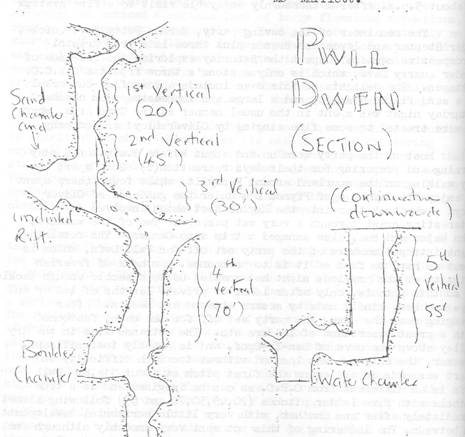
remaining eight intrepid members of the party set off for Pwl Dwfn, which is
about as hard to find as it is to pronounce. An hour of feverish activity on the previous night had enabled us to
assemble enough tackle to do this pothole, only after loans of private lengths
of ladder and rope kindly made by messrs Attwood and Meaden. After changing near the Gwyn, the party set
off for the cave, festooned with a great assortment of ladders etc. The entrance lies in the dry valley above
Dan-yr-Ogof, and is notably insignificant. However, the entrance was located without too much difficulty and a
start was made in laddering the first pitch about 11am. Pwll Dwfn is different from O.F.D. as can be
imagined and is a true pothole with five ladder pitches (20, 45, 30, 70 and 55)
following almost immediately after one another, with very little horizontal
development in between. The laddering of
this pot went very smoothly although one or two snags were encountered with the
general looseness in places. Water was
only a trickle and did not stop the five people form bottoming the pot. The final 55 pitch led into a blind pot at a
depth of 310 with a small lake chamber running off to one side. We were told that diving operations here had
met with no success. The exit went
without a hitch and the party set out for the main road at 6pm after a
memorable weekend of caving. Our thanks
are due to the South Wales Caving Club for their warm hospitality and their
assistance for finding guides for the excellent trips to Ogof Ffynnon Ddu.
Mo Marriott
*****************************************
Please DONT leave old caving gear around in the Changing
Hut. This applies particularly to WET
gear, which become rotten and COULD even start a fire by spontaneous
combustion. Any gear which looks as
though it has had it (even if it hasnt) will be thrown out!
We must apologise to our readers for the lack of our regular
writers Sett,
Caving Log and of course Stalagmite. We must also apologise to those three gentlemen or is it two gentlemen
and one lady? for not being able to include their usual features. Back to normal next month We hope! Editor.