
No, it is not Christmas again. Neither is it some national
day of rejoicing, like the Editors birthday or the thousandth anniversary of
the founding of the B.E.C. in Saxon times by Aleburp the Unsteady. If the nine page size of the B.B. is
celebrating anything, it must be the wonderful amount of material which, at the
moment, is coming in from members and others.
Instead of keeping some of this for next month, it is nearly
all being printed now, in the hope that this upsurge of writing is not a flash
in the pan, but might actually lead to a bigger B.B. on a regular thing.
The diversity and standard of the material is again very
encouraging to an editor who has been half starved for too long. As a result, you will find in this B.B. two
articles describing the new work in Mendip caves; extracts from the Caving Log;
a description of the last Climbing Sections trip to Cornwall, besides features
such as Stalagmite and Setts monthly problems. The odd notice and book review completes the
B.B. and the two caving articles are illustrated with maps.
With the proposed advent of a national caving magazine, the
future of club magazines may well seem open to question, apart from their value
as newsletters. On the other hand, club
magazines should reflect the particular club they serve and, if this present
production of good material continues, there should be no worry as to the place
of the B.B. in the future scheme of things.
Alfie
Recent Excavations in Lamb Leer
by Dave Palmer.
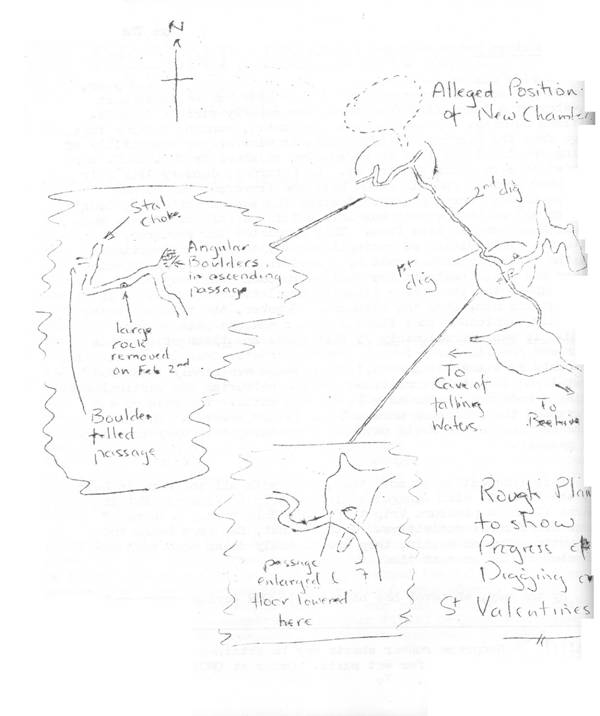
1. Concerning Excavations on St. Valentines Landing.
On Sunday, 5th January, a new M.N.R.C. dig was started on
St. Valentines Landing, the site being the tight mud filled passage and the
chamber leading to the terminal rift. The conditions in this passage were everything but ideal cramped position;
bad air and a pool of water it was necessary to lie. In view of this, it was decided to enlarge
the entrance to the passage, lower the floor level to drain the pool and make
for more space for subsequent operations. A large volume of mud and boulders was removed on Jan. 5th and 12th and
digging commenced in the ascending passage. The dig required three people. One digging and two passing back. Of these only the person at the face had good air. In fact the air was so bad at the second and
third digging positions that at times even a candle would not burn. However, on January 19th a breakthrough was
achieved giving access to approximately twenty feet of ascending passage with
some small formations ending in a choke of thin stal. floor and loose cave
earth with a two to three inch air space. The relative dryness of this new position led to a vigorous attack the
following week when a further breakthrough gave access to another sixty feet of
tight muddy passage ending in a T junction with one ascending passage blocked
at the start by one extremely large rock. There were signs of water action.
Reference to the late Prof. L.S. Palmers geoelectrical
survey (1957) showed that the position of the descending passage was approx.
above the rift leading from the large chamber which is alleged to exist.
On Sunday, February 2nd, a small party removed the large
boulder and entered the descending passage, which closed down after a short
distance and ended in another junction, one side being a tight stal. choke and
the other a constricted boulder filled passage where some progress may still be
possible. Work here continues (2.2.64).
2. South Western Inlet Passage
During visits to Lamb Leer in the later past of last year, a
passage was noticed entering the main chamber on the south west side, above the
large flowstone formation clearly visible from St. Valentines Landing. A traverse was also noted, running towards
this passage from the Windlass Platform and, in view of the possibility of
reaching the inlet via this traverse, two climbers from B.C.S.T. were persuaded
to come along and try it. On Saturday
12th January only one climber arrived and did about half the traverse, but he
was suffering from a morning after feeling (as was his mate, who didnt even
turn up) so the project was left until the following week, when both climbers
were in fine form. They completed the
traverse, despite the difficulties of having literally to yell instructions
above the fantastic racket made by a certain club who shall remain nameless and
who, incidentally decide to cook a mid-day meal directly under the
traverse ignoring completely the warnings of falling
stones etc., from the climbers. However,
the traverse being successfully completed, they fixed a ladder and the passage
was entered. It was approximately 75
feet above the floor of the main chamber and ran its forty five feet in length
directly over it, terminating in a thirty foot ascending aven. The passage was richly decorated with stal.
and flowstone formations and the colouring was particularly striking reds and
blacks as well as pure white. The
passage was photographed the following week and the ladder removed. The piton remains for anyone who feels
capable of reaching this very impressive inlet passage.
It is interesting to note that, even with all the work in
Lamb Leer, the M.N.R.C. also managed a digging trip to Vicarage Pot in Swildons
II and a pleasure trip to Balchs Hole to say nothing of various other small
activities. I think that, far from being
the least active club on Mendip, they are probably doing more than any other
club at the present time.
Easter in
Cornwall
by Roy Bennett
The usual Easter trip to
previous years with a maximum of nine people staying for part of the time. In spite of the optimistic forecasts by the
met office, Friday was quite wet. Undeterred by this, the assembled company walked to Wicca Pillar where Roy
Bennett and Brian Reynolds climbed in the rain while the Mossmans and Joan
Bennett went walking. One of the climbs
was enlivened by a large hold coming away in Brians hand. This produced the expected result and
produced a deep suspicion of certain statements in the guide book. (Granite is the only suitable rock for sea
cliff climbing because of its reliability etc.) As a diversion from these operations, some caving was done under a huge
pile of boulders near the Pillar.
Saturday was a little better, and various people went
walking or skived at St. Ives. The
climbing contingent, augmented by the inclusion of Phil Townsend, repaired to
Rosemary Cliff etc., where Brian top roped a tentatively hard route. After this,
was climbed. This was found to be quite
straightforward except for a chock stone which looked more difficult than it
actually was. While this was in
progress, Norman Petty and Dave Quickens went walking in search of an old tin
mine.
On Sunday the party went to Lands End where Norman and Joan
walked to Sennen viewing a stranded trawler being dismantled on the way. Only two climbs of any length are described
for this area and both were climbed after considerable argument as to their whereabouts. The first, Knights Climb, was rather
disappointing but the second, Hotel Buttress, was quite interesting. A severe variation was top roped to get the
feel of the rock and was found to be no harder than the last pitch of this
normally v. diff. climb.
On Monday the climbing party again reduced to two did an
interesting climb on Pordernack Point. This had a fine finish which looked orribly loose but wasnt. By this time the sun had ventured out and the
party headed home with reluctance.
*****************************************
NEXT TRIPS 18th
& 19th April
Details from Climbing Secretary.
Cuthberts Rocky Boulders, Coral Series and Long Chamber.
As discussed at the Cuthberts Leaders Meeting, the various
overlapping discoveries in this part of the cave have led to a considerable
confusion. Please note that a trip has
been arranged for: –
10am Sunday May 24th
and anyone who can contribute to the sorting out is invited
to join the party.
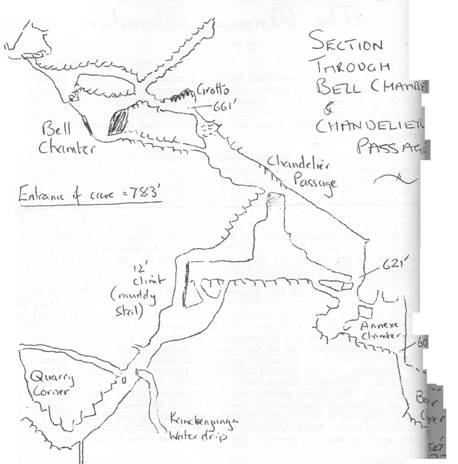
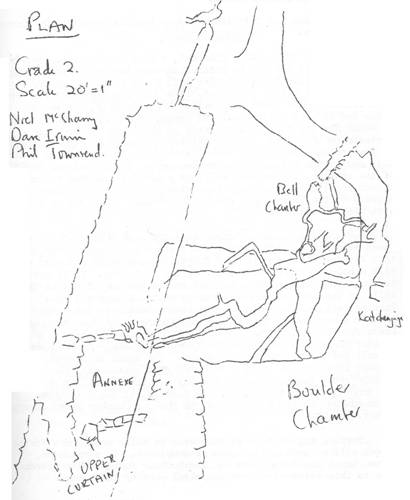
Cuthberts The Annexe Chamber Area
As recently mentioned by Mike Luckwill, the lesser known
parts of the Cuthberts System offers the caver unlimited sport and variety of
formations, the Annexe Chamber area being one of these. I do not pretend that any of this system is
new, but would be most interested to hear from these who recognise this
description and survey.
Climb to Annexe Chamber from the Boulder Chamber and pass
through squeeze under right hand wall of boulders leading to small chamber
(actually a large space between the boulders). To the right leads a fourteen foot climb. The left hand wall is stal. lined in its
upper reaches and this part should only be climbed on the right hand side. This climb leads to a large chamber some
hundred feet long by thirty feet wide, the floor of which is inclined at some
thirty degrees. When climbing through
this chamber, care must be taken not to disturb the loose scree and that good
footholds be found at all times due to the existence of holes and rifts in the
floor up to seventy feet deep.
To the left of the fourteen foot climb, a rift passage can
be seen leading to a ten foot climb and small chamber. Following the passage leads to a richly
decorated chamber with fine stal. formations. The highlights of this chamber are the cluster of helictites and the
crystal clear straws and flowstone. The
chamber splits three ways. The obvious
continuation of the passage very shortly becomes a fifteen foot climb to an
upper grotto. EXTREME CARE MUST BE TAKEN
WHEN CLIMBING, AS THE SUPERB CLUSTER OF HELICTITES LIE NEAR THE FOOTHOLDS. Perhaps a chain or fixed ladder could be
assembled at this point? The upper
grotto defies description but includes every type of formation imaginable, such
as Cats Whiskers nearly three inches long and a helictite tripod! The white gours should also receive a
mention. When entering this grotto
through the squeeze, a watch must be kept to prevent the fine straws from being
destroyed. A passage on the left leads
to a boulder ruckle with three obvious ways on.
Returning to Three Ways Chamber, a high level passage can
be seen on the left and can be entered through the narrow rift lower down in
the wall. Keeping to the left leads to a
fair sized boulder chamber with a fair stal. flow some six feet high and three
feet radius on the right hand wall. Unfortunately, one has to enter the chamber by its side and again, great
care must be taken to avoid soiling the beehive side on the right and the
fine curtains of the left. Another
interesting point in this chamber is the stream passage, now packed with large
loose boulders (is this one of the original stream passages?). To the extreme right of the chamber, in the
left wall, is a steeply inclined vadose trench leading to a bedding plane richly
decorated in places. Bearing to the
right leads one to the passage above the grotto with the white gours.
Returning once more to Three Ways Chamber a hole in the
floor leads to a narrow rift. After ten
feet, a right angle bend leads to a bedding plane inclined at thirty degrees
which suddenly ends with a hole in the floor above a twelve foot drop. It is advisable to use a rope belayed to a
boulder in the bedding plane, as the stal. walls of the drop are covered with a
layer of very wet mud. Turning left in
the passage below leads shortly to the large chamber above Annexe Chamber and
continuing right down the passage leads one to a junction. The right hand passage leads out to the
Boulder Chamber under the Quarry Corner overhang a place where it will not
pay anyone to hang about. The small
remaining passage leads to the steeply inclined rift overlooking the passage
above
Chamber. Two minor passages with
extensions lead (a) to the drip above
and (b) to overlook the Boulder Chamber above Quarry Corner.
Further exploration in this area is being made and a further
survey will be produced as soon as completed. In conclusion, please treat the formations and the boulder ruckle with
extreme care in this interesting and beautiful part of Cuthberts.
On The Hill
by Stalagmite
Many thanks to Geoff Bull of W.S.G. for his comments on the
effectiveness of miners in the Llethrydd Swallet Rescue. I shall maintain that my expressed opinion
that rescues should be left to cavers still holds good, and am pleased to see
that the eminent Cheramodytes of Wessex is in agreement. He was present at the rescue and is of the
opinion that the rescue sans N.B.C. could have been completed by dawn. Actual time out was 5.30pm.
This is, however, only the second letter disagreeing with
me, no one has agreed in print, but Im not downhearted.
There is a proposal afoot to make speleo affairs governed by
a national body. There is much feeling
amongst my contacts regarding this proposal generally, although the feeling is
that it must come sooner or later and when it does there will be no choice as to whether to join or not. There will, I imagine, be quite a number of
difficulties to overcome consider the uniting of Mendip clubs alone!
News of a bi-monthly professionally produced caving journal
for Mendip has reached me. One thing
bothers me about this is the copyright problem on material appearing in other
club journals.
By the time this goes to print the Family Club will; have
held their A.G.M. (according to my speleo diary). The next A.G.M. should be Cerberus on May 2nd
in Wells. The next major event is within
the club, where it is proposed to collate? enough leaders for Cuthberts to
attempt to find out what has been discovered when in and around Coral
series. I believe that this takes place
early in May. If there are enough
leaders left after this trip, there is rumour that the trial rescue which has
been due for about six years will eventually take place towards the end of May.
September Series has been mentioned to me as the stepping
off point. From what Ive heard from
idiots who have been to that part, it seems most unlikely that the attempt can
meet with success. Presumably at least
one of the leaders on the scene will have a key to the Tackle Store and will
sign S.T. 1 for the stretcher.
Joking apart, I think that the new tackle system is quite
sound (presumably the committee also does) but it does rather worry me all
this responsibility for ladders etc. I
wonder if we can get insurance against loss/theft of same?
A few welcome oldies have recently been seen on Mendip;
Alan Thomas caving in Hunters (Hole) and Alan Fincham in Hunters (
ideal with a weeks caving holiday and only wasting one day caving. Alan F. also paid his sub. The other rarity is the renewal of the
Palmer/Wheadon caving club, Mike Wheadon having been seen, by me at least, on
Mendip only about twice in the last eighteen months.
The M.C.G. have got a
new hut near the Stirrup Cup Café (we used to call it the Stomach Pump
Ed.) Although the Castle is nearer,
there is still a strong contingent who get to the Hunters. Recently there have been some lads, alas from
have got disgustingly slewed at Hunters and reports are that Ben is not
amused. Neither am I for that matter.
One last thought. Nick Barringtons new restaurant at Axbridge will be pleased to provide
dinner for you a t a price naturally.
*****************************************
The editor must apologise for not having found room this
month for the programme of dummy rescue in Cuthberts next month. He hopes to be able to publish the B.B. for
May in time for the article still to be of value.
New Books
.reviewed by Kevin
Abbey
Caves of South Wales
and the
7/6.
Written in the same style as
Caves of Mendip it includes a very complete list of Welsh and
make up a very good book.
The
A climbing book. A really frank account of the expedition
climbing
highest mountain. Well worth reading.
B.E.C. Caving Publications
Obtainable from Bryan Ellis, Knockauns, Comwich, Bridgwater,
Somerset.
|
No. 1 |
(Revised 1963) Surveying in |
by S.J. Collins. |
Price 3/- |
|
No. 3 |
(Revised 1962) The Manufacture |
by B.N. Ellis. |
Price 3/- |
|
No. 4 |
The Shoring of |
by S.J. Collins. |
Price 2/6 |
|
No. 9 |
Some Smaller |
by J.H. Tucker. |
Price 2/6 |
|
No.10 |
The B.E.C. Method of Ladder Construction. |
by D.A. Coase & N. Petty |
Price 3/- |
St. Cuthberts Surveys.
Provisional Plan (As published in Caving report No. 8) Price 2/6
Addendum No. 1 to Plan (September Series). Price 1/-
Extended Section of Major Passages. Price
2/6
Caving Report No. 6 Some Smaller
Vol. I (Priddy Area) is at present out of print, but further copies are expected
during this summer and orders will be accepted. If ordering by post, please send 1/- to cover cost of postage of one
publication, 1/3 to cover cost for two publications, or 1/6 to cover three or
four publications.
has a further 130 different items available for sale and will send his complete
list if requested.
*****************************************
NOTICE!!! Neoprene rubber sheets may be obtained at 10%
reduction for wet suits. Order at ONCE
through
By the way, whatever happened to OUR caving programme?
*****************************************
THIS MAY BE YOUR LAST B.B.!!!!!! The rule that the membership of any
individual who fails to pay his or her subscription by the 30th April shall
deemed to have ceased is going to be interpreted a little more literally this
year by the B.B. Postal Department. If
your sub is still due, please send it to Bob before your name is struck off the
list for the B.B.
Caving Log

The Castle Farm dig continued on Sunday 8th and Saturday
14th March. On the 8th, it was dug by
Dave Irwin plus five others who removed mud and boulders, and on the 14th by
Andy MacGregor and Dave Irwin who dropped the floor by a further four
feet. A small side passage was
investigated, which appears to be way on.
From Friday 13th to Sunday 15th, Kevin Abbey and
weekend in Cuthberts using Cerberus Hall as a campsite. From Kevins report, it seemed that a little
too much time was spent lying in sleeping bags; eating; drinking and
smoking. However, on Saturday, Gour Rift
was investigated just above the duck and was climbed for an estimated sixty
feet. At this point, the rift seemed to
close down and only very small continuations of the rift were found on the way
up. On the Sunday afternoon, Phil
Kingston and Ron Drake helped them out with their kit. Kevin has noted a few points about the
weekend which may be of interest. Firstly, after twelve hours or more, one feels like doing nothing except
fester (some people feel like this without actually caving at all Ed.). The second point is that a tent, although not
essential under the conditions, is a very good help at sleeping. A third point is that, after some time, the
noises made by the water begin to sound like that of people talking. The total
time spent underground was 43 hours.
From the Caving Log, it is seen that a new area has been
found to which several exploration, photographic and survey trips have been
made. On Friday 17th, Noel McSharry,
Phil Townsend & Dave Irwin surveyed this part of the new area, known at
present as Chandelier Passage. On Friday,
27th March, Alan Thomas and his brother went down Hunters and removed much litter. Also more surveying was done in the Annexe
Chamber area.
Mathematical Puzzles
by Sett
Up till now, I have not yet had an answer to last months
problem. Im not even sure that I have a
full answer myself and I would welcome assistance on the last part from
somebody more knowledgeable than I. Alfie has helped considerably, and I gather that the late publication of
last months B.B. was due to his efforts on this subject.
A. A possible
layout of the races involving sixteen cars, four at a time is as follows: –
|
1 |
2 |
3 |
4 |
|
1 |
6 |
11 |
16 |
|
1 |
7 |
9 |
15 |
|
1 |
8 |
11 |
14 |
|
1 |
5 |
9 |
13 |
|
5 |
6 |
7 |
8 |
|
2 |
7 |
12 |
13 |
|
2 |
8 |
10 |
16 |
|
2 |
5 |
12 |
15 |
|
2 |
6 |
10 |
14 |
|
9 |
10 |
11 |
12 |
|
3 |
8 |
9 |
14 |
|
3 |
5 |
11 |
13 |
|
3 |
6 |
9 |
16 |
|
3 |
7 |
11 |
15 |
|
13 |
14 |
15 |
16 |
|
4 |
5 |
10 |
15 |
|
4 |
6 |
12 |
14 |
|
4 |
7 |
10 |
13 |
|
4 |
8 |
12 |
16 |
M. If we define a contest as a race between
two cars, then we have in general N cars racing M times in R races and C
contests at c contests per race. Thus C = N (N-1)/2 and c = M (M-1)/2. But C/c
must be an integer. Therefore, since any car appears in N-1 contests at M-1 per
race, both N(N1)/M(M-) and N1/M1 must be integers. This gives either N1/M1 and N/M must both
be integers or that N-1/M(M-1) must be an integer.
Therefore, for any value of M there are two series of values
of N which give perfect systems. One
starts at N-M with a common difference of M(M+1) and the other starts at N =
M(M-1)+1 with the same common difference. For example, when M = 4, the values of N are 4, 16, 28, 40, etc. and 13,
25 37 49, etc. Simple algebra, or
inspection shows that the first series starts N = M, N = M2 and includes powers
of M. It is always even when M is even
and odd when M is odd. The second series
is always odd and contains, because of its method of formation, a fair
sprinkling of prime numbers. This is
perhaps surprising on initial consideration. The second series is composed entirely of systems of the form R = N, 2N,
3N, etc. A further interesting point is
that perfect systems for a given value of N can occur for more than one value
of M.
For example, N = 61 has perfect systems for M = 2,3,4,5 or
6. The part of the problem which has
only been partially solved is the method of laying out the actual races. Both the Hon. Sec. and I have laid out 13
cars 3 at a time more or less by trial and error. Alfie showed me an easy way for 16 cars 4 at
a time, but I am still awaiting a general method.
Bobby Bagshaw has written me a most interesting letter. Thanks, Bobby and I will be using your
problems later; I will also be implementing suggestions.
The problem for this month is, I hope, not so mathematical
and could very well have a very practical application. The Hut Warden can buy two types of toilet
paper for use at the Belfry in rolls. Call them thick and thin for the sake of the argument.
A. How much
paper is left when the roll has decreased to half its initial diameter?
M. Give a minimum of five different methods
of determining the number of sheets left on a part used roll with brief details
of calculations where necessary.
Belfry Notice.
An electric Water Heater has been installed at the
Belfry. It will not take rough handling,
so please use it with care. It is an
expensive item!
Now that it has been installed, there is no excuse for
leaving ANY dirty washing up on the grounds that you were in too much of a
hurry to wait for the water to boil. Please wash up EVERYTHING you used (including saucepans etc., which many
members seem to think wash themselves up) after EVERY meal.
G. Tilly, Hut Warden.
News from Abroad.
We have had further letters recently from Garth and Nigel,
which we hope to be able to publish next month.
*****************************************
The Belfry Bulletin. Editor, S.J. Collins, 33
Terrace,
Secretary. R.J. Bagshaw,
Knowle,
4.
Postal Department. K. Abbey,
Little Stoke,