
November is the month when production of the B.B. is
normally at its lowest ebb. Preparations
for the Christmas B.B. are usually under way and the November issue is
something which gets in the way of this effort. However, this month’s issue deserves a few comments as it is the first
to be distributed under the latest postal system – for the benefit of those receiving
it by post, it is due to be given out in Bristol on Thursday, November 7th.
We regret that there has not been time for Stalagmite’s
usual comments on the Mendip scene, but welcome instead a climbing
article. The new batch of covers have
also arrived. That would seem to be all
until the Christmas edition next month.
“Alfie”
Contents
Cuthberts Leaders’ Meeting.
The Annual Cuthberts Leaders’ Meeting will be held at the
Belfry on Sunday, November 17th. The Caving
Secretary wishes to remind all members interested in Cuthberts that they are
welcome to attend.
The Meeting is arranged to commence at 3 pm.
Grand Showers Tournament
Results of the Grand Showers Tournament were as follows:-
First….Mike Baker. Second….Dave Smith. Third….Alfie Collins. Booby prize…..John Ransom.
Prizes will be forthcoming eventually.
Future Climbing Activities
It is hoped to hold trips to North Wales and other areas at
more regular intervals. As an
experiment, trips will be arranged every second weekend in the month.
Next Trip – N. Wales – 14/15th
December.
Those interested should contact the Hon. Climbing Sec. R.
Bennett, 3 Russetts Cottages, Backwell Common, Backwell, Somerset.
Club Officers.
A Full list of club Officers for 1963/64 will appear in next
month’s B.B. The postponement of this
list is due to unavoidable circumstances.
Club Dinner
Not up to standard this year? Food bad? Not enough drinks? SEND YOUR
SUGGESTIONS including your views on prices, venues, menu, entertainments etc TO
THE HON. SEC. Well, don’t just sit
there!
Climbing
(North Wales – 26/28th October.)
After a period of inactivity, the Climbing Section bestirred
itself sufficiently to have a weekend in North Wales. The venue was Llanberis and the accommodation
was arranged by Tony Dunn, with most of the party staying at the London
Mountaineering Club hut.
Saturday morning saw the main walking contingent, comprising
of Alan Sandall, Norman Petty, Jim Pembury and Ron Bater pounding round the
Snowdon Horseshoe. This trip was
enlivened by some original route finding by Alan. Some of the party nearly succumbed to the
much feared ‘Mountaineering Lassitude’ caused, it is believed, by walking
uphill. Other causes were
suggested. Meanwhile two climbing
parties – Mo Marriott, Kangy King and Brian Reynolds on one rope with Tony Dunn
and John Howliston on the other, ascended Avalanche on Lliwedd. They intended to finish in the Approved
Fashion by doing Red Wall, but this was seething with bods, so the second half
of Great Chimney was taken instead. This
was finished off by doing the Snowdon Horseshoe in the reverse direction to the
route taken by Alan Sandall et al.
The rest of the party assembled in the Ogwen Valley where
Lionel Williams and Nora went round the Glyders, having failed to rendezvous
with the Bennetts at the foot of some obscure cliff on Foel Goch. Roy and Joan Bennett completed some vague
climb on the aforementioned obscure cliff, and returned from the top of Foel
Goch by the not to be recommended North Ridge. The Attwood family were also in the Ogwen Valley and were walking on Y
Garn.
The weather on Sunday was unexpectedly good for North Wales
in October, and some members even complained of the heat. Messrs Reynolds, King, Dunn and Howliston
walked over Glydr Fawr and Foel Goch from Llanberis. Lionel and Nora walked on Snowdon while the
rest of the assembled company headed for the Carnedds. The dreaded ‘Mountaineering Lassitude’ struck
once more, and this time several of the party succumbed and had to be
abandoned. Steve Tuck and Roy Bennett
drooped off to do amphitheatre Buttress, while the rest of the party forged
ahead to ascend Carnedd Llewellyn. Some
even reached Carnedd Dafyd before returning to base. All bodies being recovered from the
mountain, most members headed for home. Jim Pembury and Brian Reynolds stayed over the Sunday night, and
ascended the Glyders independently on the Monday.
A most successful and enjoyable weekend.
Roy Bennett.
Social Column
We have included this article in
place of ‘Stalagmite’ as he has hot been able to contribute. Incidentally, there seems to be an ominous
silence about the B.E.C. Dinner this year!??
by Jill Rollason.
The Dinner of that other club, followed by Hywel Murrel’s
party at “Calamine”, went off in fine style on Saturday 19th of October
and the B.E.C. was well represented. A
very enjoyable time was had by all, even those (especially those?) who turned
green towards the early morning. The
guests partook of turkey and a full tray of twenty peach melbas and ice cream
was dropped by a waitress in the vicinity of Mr. David Perry, whose suit
suffered somewhat.
Cox’s Cave was open to the guests after the dinner, and the
intrepid Mr. ‘Dan’ Hasell upheld the caving tradition of the B.E.C. by
undertaking the full trip through this perilous cavern. The party then continued with great
liveliness at Hywel’s where the squeeze machine proved very popular. The record was 6.25″, though several
others managed to get through 6.5. Many
of the activities took place to the accompaniment of shrieks as ice cubes were
brought in and surreptitiously dropped down the back of anyone unwise enough to
leave themselves unguarded. An
interesting game was seen where a couple were trapped together under a blanket
and told that they had to take off an unnamed article, although unsuccessful in
finding out what it was (actually the blanket!) they did their best and
produced a variety of unwanted items of clothing.
The breaking up of the party at about 3.30 am found many of
the participants a little uncertain of their whereabouts. Mr. Ponynting found the ground rather
unstable, lost his balance and “bottomed” the Hillgrove track at one
stage when it lurched more violently than usual. The party spirit had not disappeared next
lunchtime outside the Hunters when some climbing techniques were demonstrated,
altogether a very entertaining time.
Brixham Bone Cave or Cavern (S.C.)
Due to my working in this area, and to the Editor’s plea for
more material, I found myself with the “missus” paying one and
sixpence to see the wonders of Brixham Cavern (page 233 in Britain Underground
– Windmill Hill Cave.)
It was discovered in 1858 by some workmen – probably leaning
on their shovels too hard – digging the foundations for houses that were to be
built for a Mr. Philip. The cavern is
entered through a door beneath the house and is located where the cellar might
have been.
Throughout this system there are definite signs of its
having been encouraged by vast water activities at some early stage in its
life. Since its discovery, it has been
exhaustively dug by the Geological Society and has provided masses of
archaeological material. Most of the
discoveries are on view in the London Natural History Museum.
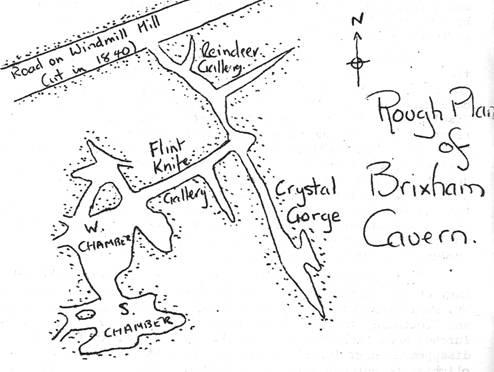
According to the guide pamphlet, one of the large
stalagmites is estimated to be over 200,000 years old, but the most important
discovery was that of the existence of man in the form of a few bones and
flints etc., in the same layers as that of bones of long extinct animals, thus
proving fairly conclusively that man was contemporary with the animals in
question.
(There are four main sections to the cave. In the Reindeer Gallery the remains of
reindeer can be seen still embedded in the stalagmite floor, along with that of
cave bear and hyena. Off this, as an
extension, runs the Crystal Gorge, where bone remains of the cave lion
and mammoth were found. The mammoth
remains are considered to have been washed in by the vast amount of water which
followed the glacial period. We next
come to Flint Knife Gallery where, in addition to flint knives, scrapers
and more remains of cave bear, hyena and cave lion were found.
In West Chamber there are several showcases of bones
and photographs, displaying the varied species of bone remains. A notice states that the minimum age of these
specimens is 20,000 years. Finally, South
Chamber contain a few formations which are small in keeping with the
general size of the cave.
That, to the best of my knowledge, is it. Not being much of a chronicler, you will have
to excuse by bad style but I hope this short write up will suffice to help fill
in another small gap for those who are interested in oddities of caving
information.
Michael Palmer.
An Echo Sounding Bird.
In the year 1800, a German Scientist, Alexander von
Humboldt, described a remarkable cave dwelling bird found in South
America. The bird is called the Guacharo
(Spanish for ‘one who cries and laments’) and Humboldt visited the great cavern
of the Guacharos near the town of Caripe in the highlands of Venezuela.
He reported the bird to be the size of a chicken with a wing
span of three and a half feet, an extremely strong beak, and blue eyes dazzled
by the daylight. The bird is covered
with extensive deposits of fat and is much prized for its oil – a transparent,
odourless butter-like food that was said to keep for a year without becoming
rancid. Once a year, the Indians went
into the cave with long poles and knocked down the nests from the high roof,
killing several thousands of nestlings. Today the bird is government protected.
One of the most remarkable attributes of the Guacharo is its
powerful voice. Humboldt wrote It is
difficult to convey any idea of the frightful noise which thousands of these
birds produce in the dark portions of the cave.” In 1953; an American team led by Prof.
Griffin from Harvard went to the cavern to investigate the possibility that the
bird used its cries in a similar manner to the bat. Firstly it was established that the birds
did, in fact, live in complete darkness during the day and fly out of the cave
at night in order to feed. The next
problem was to find out whether the birds used the squawks and shrieks for
orientation. Some of the sounds uttered
by the Guacheros were rather sharp, short, clicks but they only formed a small
part of the total noise. Accordingly a
microphone, together with an oscillograph and suitable recording devices were
set up to record the flight of the birds at twilight. To the surprise of the party, there were no
shrieks or squawks but instead a steady stream of very sharp clicks, each click
had a duration of only one or two thousandths of a second – about the same
length as the ultrasonic signal of bats.
By catching some birds and taking them to a dark room, it
was shown that they do, in fact, use the clicks as a means of object location
when flying in the dark and use ordinary vision in the light. The birds sounds have a frequency of about 7
thousand cycles per second (7 kc/s) and their wavelength (about 5 cm) compared
with that of a bat’s ultrasonic sounds (about 1 cm) indicates that the bird
could probably not detect objects as small as those which a bat would detect
with ease.
The Guachero is another case of echo sounding in
nature. I wonder how a Mendip caver
would feel if suddenly confronted by such a bird on entering a cave at
twilight?
M.Luckwill.
Caving Reports
Another reminder that B.E.C. CAVING REPORTS, which cover a
variety of subjects of interest to gentlemen whose minds are of an enquiring
nature and who are desirous of furthering their education, may be had of:-
B.M. Ellis, esq., 41 Fore Street,
North Petherton, Near Bridgwater in the County of Somerset.
Mr. Ellis has also a number of Surveys of the Netherworld,
compiled by ingenious gentlemen. Gentlemen may communicate with Mr. Ellis by means of the Royal Mail,
whose coaches now call regularly at North Petherton, but should supply a
stamped addressed envelope. Impecunious
gentlemen may discover Mr. Ellis at the Shepton Mallet Hut.
*****************************************
DONT FORGET YOUR ANNUAL SUB