
Contents
Editors Note
A Happy New Year to all members and readers. With this issue of the B.B., we enter the
twentieth year of its publication and, as hinted earlier, it is intended to
make a series of improvements (or, at any rate, changes) to mark the
event. As you will have seen, a new
cover starts with this issue. We had
intended to have it on a light grey paper and to have the number and month
printed on the cover but, owing to a misunderstanding with the printers,
neither of these things came to pass. Thus the cover is somewhat less of an improvement than we had hoped, but
at least the colours line up properly. Those few who attended the last A.G.M. had an opportunity to discuss
cover designs and to protest against this one if thought to be necessary.
A smaller change. Which will not be noticeable until next
month, is that the pages are now to be numbered in volume order for ease of
reference for those who collect B.B.s and bind them into volumes. (we know of one member who does at any
rate!). On the inside of each page will
be found the B.B. and page numbers and the month so everybody should be
satisfied.
The Editor would like to thank those who wrote or spoke to
him praising the Christmas B.B. Much as
he would like to take the credit, it must be pointed out that this mainly due
to the good standard and large amount of articles submitted and also to the
stalwarts who collated; stapled; folded; wrapped; addresses and posted them. Let us hope that we can keep as good a
standard during 1966.
Alfie
Comment
When the Belfry was first opened in 1947, it was agreed that
the basic charge would be a shilling per member per night. Since those far off days, prices have risen
until today that shilling is only worth something between fourpence and
fivepence. Even so, the basic Belfry
charge has never gone up.
The charge has been increased temporarily on two occasions
once, to pay for the Calor installation and once to pay for the installation of
main water and electricity. In both
cases, the extra charge was removed when the items were paid for.
Most of the other facilities at the Belfry were paid for out
of the Belfry profits and even today, this is just possible. It is quite a feat to be able to do this out
of the 1947 value of less than fivepence per member per night.
At the January meeting, the Committee, after some
discussion, agreed to increase the Belfry charges to 1/6 per member and 3/- per
guest. This is intended to be a
permanent increase effective from the 1st of February 1966. Even at this price, the Belfry is still cheap
compared with nearly every other caving and climbing hut in the country and,
and in purchasing power, members are still getting more for their money than
they did in 1947. The increased profit
will be used to improve the Belfry facilities still further. After the flush toilets have been completed,
showers are next on the programme and this will be followed by other
improvements being planned by the Belfry Planning Committee.
The decision to increase the Belfry rate may, of course, be
rescinded at the next A.G.M., but the Committee feel that this increase is
hardly enough to hurt members financially and it will enable the Belfry to
continue its tradition of supplying value for money in these more expensive
times.
The Gouffre de Friouato
by Alan Thomas and Mike
Luckwill
The Gouffre de Friouato (Ifri-ou-atto) is situated
approximately fifty miles east of
marked on the Michelin map of
(No 169). About eighteen miles from Taza
on the metalled road from Taza to Bab-Bou-Idir we found a steeply rising
tortuous un-metalled turning to the right. Driving up this for a long way past groups of sheep with their
shepherds, we came surprisingly to a set of six or eight concrete steps. This led up to the cave entrance.
The cave is over a mile long and a thousand feet deep. I am afraid that, in the absence of an
accurate survey, a description such as this can only be in superlatives. Norbert Casteret described it as the most
remarkable cave he ever explored. We
found the entrance was the deepest; the chambers were the highest; the
formations were the biggest etc., etc. that we had ever seen.
The entrance was quite dry and an excellent changing
room. This is just as well as the second
time we visited the cave, it was raining. Just inside began a remarkable series of stone and concrete steps which
led down the side of the pot to a depth of approximately six hundred and fifty
feet. In places, the steps gave way to
sections of sloping iron cat ladder and rickety guide rails of reinforcing
rod. Towards the bottom, we were
intrigued to see occasional steps smashed to pieces, presumably by rocks
falling from above. One missing section
of cat ladder was found at the bottom.
The pot down which we had descended dwarfed Gaping Ghyll (of
course). I should perhaps mention that
the first time, we went down very quickly and both felt quite ill at the
bottom, probably due to the rapid change in altitude.
More stone steps led through a relatively tight section for
a hundred feet or so, which then opened out into an enormous chamber (marked
A on Mikes plan) in which we descended a further hundred and fifty feet to
the bottom of the steps.
We had now gone down altogether about a thousand steps of
stone or concrete. Who had built them
and why? Surely they were not the ultimate
in fixed aids, constructed by local cavers? A winch would have been more satisfactory. The steps were too strenuous for ordinary
tourists and we found no evidence of mining. I am in touch with the Casablanca Caving Club and hope that they may be
able to provide the answer these questions and also provide us with a survey,
as numbers which we found on the rocks indicated that it might have been
surveyed fairly recently.
Unfortunately there are also many other kinds of writing on
the rocks and walls mainly French but some Arabic. It is a pity that such a fantastic cavern
should be marred by vandalism, but hardly surprising when it is impossible to
keep such inscriptions off Mendip. We
also thought that the steps were a pity, but as we only had a hundred feet of
ladder with us we would have not been able to go down had they not been there.
At the bottom of the steps, the roof must have been about
two hundred and fifty feet high. The end
of the chamber was separated from the rest of it by some boulders, round which
we climbed and the continuation was about the size of G.B. Here we turned sharp left into a long chamber
(B) with crystal pools containing water. At the end of this chamber, we crossed to top of a remarkable and
enormous natural dam and followed the sloping left bank of some large
pools. As soon as we entered the passage
where the pools were, we saw two very large stalagmites. Beyond here, the passage consisted of a dried
up crystal pool about five feet deep with which was associated strange
formations seeming to have crystal bases surmounted by stal. It was around here that the walls and rocks
glistened with myriads of minute crystals.
We then traversed to the right of a pot about forty feet
deep, in the bottom of which we could see fine mud formations. Just past here were three more gours, at the
third of which was necessary to squeeze between the rim of the gour and the
roof.
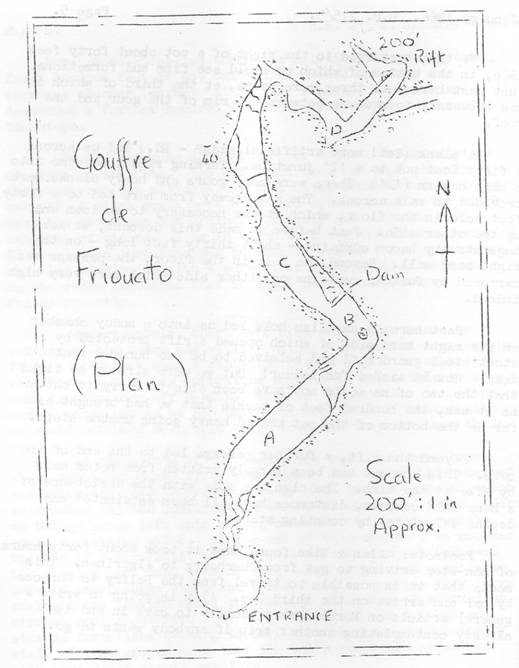
A plank (Wot! More artificial aids? Ed.) led us across a
fifty foot pot to a T junction. Turning right, we came into a high cavern (D). There were many gours and heavy planks were
provided to walk across. The passageway
from here led to a forty foot hole in the floor, which it was necessary to go
down and up the other side. Just before
we made this descent, we saw huge streaky bacon curtains about thirty feet
long on the right hand wall. Beyond
the hole in the floor, the passage was narrowed by further curtains on either
side which very high indeed.
Past here, a smallish hole led us to a muddy chamber on the
right hand aide which opened a rift protected by a stout steel guard rail and
believed to be two hundred feet deep. How we wished for ladder! But we
were already so tired that the two of us would not have been able to carry it
out. As it was, the hundred feet of
tackle that we had brought as far as the bottom of the pot proved heavy going
up the steps.
Beyond the rift, a further passage led to the end of the
cave. This account has been largely
written from notes made by Mike at the time. The plan was made with the assistance of a hand held compass, distances
have all been estimated and depths calculated by counting steps.
Footnotes: Alan
& Mike found that it took forty hours of non-stop driving to get from
Algerinas. This means that it is
possible to travel from the Belfry to
third day. Alan is going to write a
general article on
as a country to cave in and is already contemplating another trip if anybody
wants to go.
*****************************************
Have you paid you annual sub yet? Subs fall due on the 31st of January. Why not get it over once and for all? A life sub at five guineas is CHEAP. (After all, subs might go up!).
Access to
Mendip
Caves
Dave Irwin.
Many members often ask how to obtain permission to enter
controlled systems on Mendip. As a
result, Ive listed all caves that are controlled in one form or another.
Swildons Hole Call at
barn. Blockhouse being built. Permission will not be granted when cave is
known to be in a dangerous condition.
Eastwater Swallet Call at Eastwater Farm. Farmer charges 1/- per caver. No Changing facilities.
Stoke Lane Slocker Call at Cooks Farm. Farmer Stock welcomes cavers. Changing accommodation available. Farmer charges 1/- per caver. Please fill in visitors book if
requested. Cave liable to sudden
flooding after moderate rain.
Lamb Leer Cave controlled jointly by M.N.R.C., W.C.C. and U.B.S.S. Indemnity from to be signed by the leader and
all names on party to be added to it. Form to be returned at least one week prior to the date of the trip. Key will not be sent to leader until form
returned. Write to L.M. Teasdale,
Sutton, Surrey (W.C.C.) Proof of B.E.C.
membership might be required. Charge of
2/- per caver. Money to be sent to Mr.
Teasdale.
Square, Winscombe,
giving as much warning as possible. This
cave is not open to cavers on Sundays. Do not call at Farmers house.
Notices
Caving meets.
Readers will find a printed pull
out supplement with the B.B. An
additional meet is G.B. on Sunday 27th February. Meet at the cave 11am. C.C.C. permits required.
Competition.
A third reminder that there will
be a photo Essay competition at next years Dinner. Full rules will be out in next months
B.B. START PLANNING TO WIN THIS NOW as a
fair amount of work is involved.
Conference.
The 1966 conference of the
British Spelaeological Association will beheld in
exhibits, photos etc. The two obvious
subject being Cuthberts and Cave Communication. We must have enough to exhibit now that we
have promised. What about it?
Cuthberts
Work is commencing on the long
awaited detailed report on Cuthberts. To ensure that this is as complete as
possible, members are asked to submit any photographs, log books referring to
the cave and particularly to the mining and pre-1953 dig. Members may rest assured that material will
be looked after and returned to them as soon as it has been copied. Please send all materials to PHIL KINGSTON
who is also in the process of building up a reference library on the cave.