
Contents
Climbing Meets.
Sun. 20th June.
GORGE. Meet at Tennis Courts 11am.
Weekend 17.18 July.
Caving Meets.
Chelsea S.S. Triglav
Expedition. Members of this
expedition will be on Mendip on July 3rd and have kindly agreed to give a talk
and slide show on their 1964 expedition to
conditions will be similar to those the B.E.C. members will have to face on the
trip to
June Committee Meeting.
The June meeting of the committee finalised the arrangements
for the 1965 Annual Dinner. This will be
held at the Cave Man Restaurant on Saturday 2nd October following the A.G.M. as
per usual custom. For those members who
still recall with distaste the last dinner we had at the Cave Man, it should be
noted that the conditions are very different now. A slap-up meal has been organised including
soup, grilled trout, roast turkey, sweet with a cheeseboard as an alternative
and coffee. It is hoped to be able to
include a trip round Goughs after the meal.
It looks as if the arrangements at Redcliffe are in the
melting pot at present and it may be necessary to change our Thursday meeting
place in the end. Bob is negotiating at
present for an acceptable deal at the Church Hall before we consider any other
arrangements.
Other business included the construction of the new toilets
and the provision of dustbins for a regular collection by the council.
Slit-Sided Stalactites
by Jill Tuck
While looking over two lead mines on a hill near Machen, a
few miles North of Newport, we noticed a type of stalactite formation which I
do not recall seeing before, and I have therefore sketched some typical forms
for the record, in the possibility that others mat recollect seeing them
elsewhere.
Shape and Texture.
Hard cave stal. not the soft growths more usually associated
with artificial excavations. From
pottery found, it is almost certain that they have formed during the last
nineteen hundred years. Snow
formations are frequent throughout the mines on all the flows, and many of
these stalactites have snow on them, sometimes with minute stal. nodules in
small or large patches. Some stalactites
have snow built up inside and have a snow free exterior: others vice versa but,
as many others are free of snow entirely, it seems there is no significance in
this. Others again, have the interior
lined with a different colour stal. from that of the exterior.
It will be seen from the sketches that many of the
stalactites begin with a narrow neck (About the diameter of a straw) which then
widens very rapidly into a bell or boot shape, nearly always slit up one side.
An irregular line is often seen down the stalactite,
representing a previous slit which has since been closed as the stalactite
grew.
Other types of this stalactite formation begin immediately
from the roof, as in diagram 6, with a water drop that seems about twice the
diameter of the usual drip. Often,
inside the stal. deposition being built up in a roughly round shape, there is
another lump or line of stal. so that, when viewed from below, the stalactite
has the appearance of the underside of a slug.
SLIT-SIDED STALICTITES (Acutal Size)
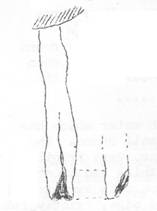 1. Irregular straw with slit end.
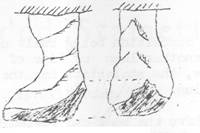 2. Boot shape, widely open at the bottom. N.B. Black areas represent inside of stal. in
all cases.
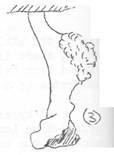 3. Boot ended helictite (the projection at the side is made
up of minute snow nodules
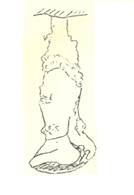 4. Complex slit stal. Positions of slits can be seen in at
four places. The top ½ is crystalline
straw
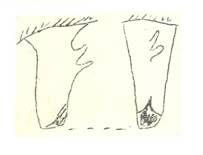 5. Helictite solid inside except for pinhole through
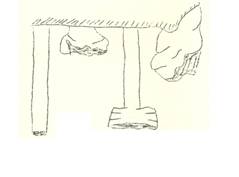 6. There other typical forms with ordinary straw for
comparison.
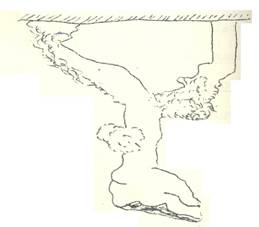 7. Twin Helicties united and ending in
All types have the heel end filled with water which has
passed down through the neck via the usual small space. The edges of the bell arte usually scalloped
and are very fragile, but some, in contrast, have edges which are thick and
smooth. A few noticed were of a more
crystallised type with symmetrical ribs leading outward to a regular
dog-toothed edge, exactly like a small scallop shell. Inside could sometimes be seen a small
needle shaped crystal almost floating inside the water drop. The usual length of the stalactites in from
one to four inches long, but others seen were longer and there seems to be no
limit to their size except that imposed by time.
Position.
The mines are lead mines in carboniferous limestone, the
entrance being on top of the hill, and the galleries from 50 to 150 feet
underground with about a thousand feet of passage. The stalactites seem to be of similar type
throughout, not dependant on possible temperature or ventilation effects to be
expected near the entrance.
General.
About 80% of the formations in these mines are of this
unusual shape and it appears that whether the stalactite begins as a straw,
helictite or anything else, it always develops this tendency to bell out. There is no correspondence between the slit
side and the air flow or general slope of the roof. Probably much depends on the actual mineral
content in solution in the water, which again may depend on the type of
limestone, and the nearness of these mines to the surface and plant acids.
It seems clear that the sloping bottom edge of the stal. and
the side slit are caused by the drip running to one side, but it seems strange
that the form is not common in other areas.
*****************************************
Club members certainly seem to be going in for studies in
caves nowadays. While Jill sits and
thinks about form of stal., the next article cites the case of a club member
who, one presumes, just sat
.
A Preliminary Psychological Experiment in St. Cuthberts Swallet
by Alan Thomas
 The aims of the experiment were twofold. To examine subjectively ones ability to
function effectively under cave conditions in total darkness, and to
demonstrate the effect of such conditions on ones ability to estimate time.
Thirty hours were spent alone in the dark. I had with me a sleeping bag, change of
clothing, food of the kind did not require cooking, and recording box. This consisted of a revolving clockwork drum
drawing a slip of paper at a constant speed past a slot. Periodically, I drew a line across the paper
and wrote an estimate of the time. Unfortunately, the device stopped some time after estimated midnight, so
the record is only of the beginning of the stay. This record, tidied up, is appended with a
true time scale.
A nice dry, gravel-floored corner of Rabbit Warren Extension
was chosen as the site of the experiment. I was portered into the cave by Andy MacGregor and Douglas Macfarlane on
Tuesday, 8th June. Before they left me
at 1.45pm, I unrolled my sleeping bag and changed into my dry clothing. As I had not done this sort of thing before,
I had a safety line tied to my left wristband to my sleeping bag, so that I could
find my way back to the camp site. I
also had a torch attached to my sleeping bag in case of emergency. In fact, the torch was not used once during
the experiment.
At no time did I have any difficulty finding anything,
despite the fact that I have a poor visual imagery.
The senses tended to become more sensitive as time
continued. For instance, I noted for the
time estimated as 5.10pm Tuesday, Stream can be heard from the end of my
string in that direction. I have been
there several times, but this is the first time I have heard it. Similarly, at 4.15 I noted Kendal Mint Cake
flashes when you break it! I had broken it twice before without seeing the
flash. Later, when I ate chocolate, I
could see the static discharges from the wrapper quite clearly.
As an ordeal, the experience was very tame. I had no difficulty spending 30 hours alone
in the dark. It is a pity the recording
machine stopped when it did because, although the record shows a progressive
underestimation of the time, my rescue party arrived about when I thought
they would.
I first got into my sleeping bag at an estimated 7pm on
Tuesday and after that seldom left it. I
should have thought that, after thirty hours rest, the trip out would have been
easy. However, despite the fact that Roy
Bennett, the Franklins and Phil Kingston carried all my gear, I found the
return journey to the surface very tiring. I was indeed grateful to Joan Bennett for providing a meal and to the
Searles for a hot bath. It was worth 30
hours alone in St. Cuthberts for the excellent service afterwards.
Letter
The editor has recently received
this, addressed to the club members. In fact,
article writing has improved very much of late and plans are afoot for a large
B.B. next month. Still, itll do no
harm.
Dear Club Member,
In a recent B.B. I saw a letter complaining about the
quality of articles published in our magazine. I dont wish to criticise the writer for putting his thoughts on paper
instead of just grumbling like the average club member, but the answer to such
criticism is Dont complain WRITE. Apathy is also a problem. A short
while ago, I wrote a series of articles taking quite arbitrary and often
extreme views and yet almost no pen was flourished in opposition or agreement
with these articles. Could this be
apathy?
The editor himself has even provided articles on how to
write an article and whilst even I at my great age cannot remember early days
in Swildons (I was only a drip then) its still a good title for an article
and, of course, Stoke is definitely different to Swildons.
Since I only decided to write this missive about 3 minutes
ago, it must be obvious that it does not take long to write things. However, I am very loath to commence another
series at the moment as my spy system is not as good as it was.
In conclusion then, remember the editor will probably
publish your article and your name can be immortalised in print. I shall recommence my series next year, all
things permitting, so look for the sign of the: –
Stalagmite (CaCO3)