
Contents
- 1 A hundred B.B.s
- 2 July Committee Meeting.
- 3 Caving Meets.
- 4 Climbing Meets.
- 5 A.G.M and Dinner.
- 6 Junior Caving Competition.
- 7 Ian Dear Memorial Fund
- 8 Obituary Noel MacSharry
- 9 Pollaraftra (Co. Fermanagh Ireland.)
- 10 A Little Peace and Solitude
- 11 Highways & Byways in St. Cuthberts
- 12 Postscript to Alan Thomas article in last months B.B.
- 13 Cleaning Cuthberts
- 14 On being a Victim
A hundred B.B.s
We hope that readers will not mind the editor doing a little
bit of private celebration on this occasion, as this issue completes his first
hundred B.B.s. The extra size of this
number is the result and, for whatever reason, is presumably welcome as such.
The B.B. has had its usual ups and downs during the time
from March 1957 when the present editor took over until now, but we hope
that the downs have perhaps not been not quite as far down as been in years
previous. The hundred B.B.s were
produce in 101 months we did not publish any B.B. at all in November
1959. The previous hundred took 123 months
to appear, so some gain in regularity can be claimed. Size has also gone up although the page
size is now smaller, so is the type and the wordage per page is very little
different, so we may say roughly that the minimum size of the B.B. is now 8
pages against 4 and the maximum size has reached 40 against 16.
On the other hand, the quality of the duplication has not
made any real strides. No issue has been
as bad as the worst B.B. ever, but no real significant improvement has been
made either. We still seek a cheap way
of producing more legible B.B.s
The quality of the articles has, in general improved over
the years, but we do seem to be a bit in danger of losing our sense of
humour. If the W++++x J+++++l; can
publish the occasional, very good, humerous article, I certainly think that the
B.B., could also.
This is part of the message youve all heard from me many
times in the past. The B.B. should
reflect all the activities of the club, and ideally should therefore include
serious (and not so serious!) caving and climbing articles, a bit of
interesting travel experiences, some humour, news of club doings (and those of
other clubs and a few general odds and ends. Various methods have been tried in the past to achieve this sort of
balance one with any real success, but the editor keeps on hoping that one
day he will find the magic formula!
I will end this note on my first hundred B.B.s with a
personal resolution. I will not gas on
about what it is hoped to do in the future! So many times, just when we thought we had something good in the bag
things have gone awry at the last moment that, in future, any improvements will
come as a pleasant surprise. I expect
that, by the end of another hundred B.B.s you will have a different editor,
but meanwhile, we must make a start on the next hundred. There is a fair amount of articles in the
pipeline at present so I hope that the next hundred will get off, at any rate,
to a good start.
Alfie
July Committee Meeting.
At the July Committee Meeting, a number of subjects were
discussed very fully. The Hut Engineer
reported very satisfactory progress on the new toilets, and this led to a
general review of the Belfry site and its amenities. Plans are in hand which may lead to the
extension of these facilities and a number of committee members are to form a
long term planning group to study the general problems of the site. The tackle situation came under review. Again, the position is good but ways were
investigated to make tackle easier to obtain without upsetting the present
system (which at least has the merit of
ensuring that we have tackle). The
Caving Secretary gave his report, as did the Hut Warden. The Climbing Secretary reported that there
was little climbing news and that members did not seem to be coming into the
climbing section in any significant numbers. Final arrangements for the Dinner were discussed, also arrangements
concerning the B.B. covers and Caving Reports. Publication of the terms of the Ian Dear Memorial Fund were also
approved. In addition to this, a large
volume of minor business was dealt with.
Caving Meets.
July
17/18th. Working Weekend on St. Cuthberts. Flood entrance pipes. Any help
would be appreciated. A good opportunity
for those who have enjoyed many trips down the cave to do something to help
maintain and improve it.
September
11/12.
Climbing Meets.
July 16/18.
Sept 17/19.
A.G.M and Dinner.
This will be as usual on the FIRST SATURDAY IN OCTOBER which
this year, falls on the 2nd. Dinner will
be at the Cave Man and will consist of Soup, Grilled Trout, Roast Turkey &
Veg., Sweet or Cheese and Biscuits and Coffee. Price of the ticket will almost certainly be 16/6. This is an advance warning!
Junior Caving Competition.
A Competition will be run by Alan Thomas which may be
entered by any cavers up to the age of 18 years old. It will NOT be confined to B.E.C. members, so
if you have any caving friends outside to club who qualify, please let them
know. There will be several useful and
valuable prizes. Further details later.
Ian Dear Memorial Fund
The bequest made to the club under Ian Dears will has now
been received and the rules, as approved at the A.G.M. governing the
administration of the fund are set out below. In the circumstances, clause 5 regarding the date of applications will
not be enforced this year.
1. The fund shall be known as the Ian Dear Memorial
Fund.
2. The bequest will be used to set up this fund to
assist junior members to visit caving or climbing areas of the continent. Further donations may be added to the fund.
3. The fund will be administered by a sub-committee
of five club members, of whom one must be the Hon. Treasurer of the club. The remainder shall be nominated annually by
the general committee. The sub-committee
shall report to the Annual General Meeting.
4. Any club member under eighteen years of age may
apply. Members over eighteen and under
twenty years of age may be considered in exceptional circumstances. The age qualification will apply on the First
day of July in the year of the proposed trips.
5. Applications must be received by the First day
of March of the year of the proposed trip. The applicant must furnish brief
details of itinerary and cost at the time of application.
6. The maximum amount to be allocated in one year
shall be limited to Fifty Pounds. The
maximum amount allocated to each individual to be limited to Ten Pounds.
7. The Fund shall be invested in National
Development Bonds or a similar scheme.
Obituary Noel MacSharry
It is with deep regret that we learn of the death of Noel
MacSharry, while serving in the R.A.F. in
had died of coronary thrombosis.
In the relatively short time that Noel was a member of the
B.E.C., his keenness for caving and climbing became evident to all who met
him. Although he knew that he was
suffering from a serious condition, he never allowed this to affect him, and
maintained his cheerful outlook until he left us to go abroad again.
We should like to add our sympathies to all his friends and
relatives.
Pollaraftra (Co. Fermanagh
Ireland
by Dave Irwin.
On Whit Sunday, during my visit to
the W.S.G., a party of six including myself entered Pollaraftra. The cave is situated, apart from being in the
middle of nowhere, in the centre of a long valley. Had we had to leave the car on a metalled
surface road, a walk of two miles would have been necessary to reach the cave. Fortunately, the car that brought us was man
enough to defy the rocks and potholes of the Irish track, this eventually
leading to a derelict farm cottage that we were thankful for the use of the
latter when we emerged from the cave.
The entrance is one of a pair of shakeholes, one of which
takes the stream. Access to the cave is
by a short climb down the dry shakehole in the form of a shallow pot. This leads to a wide passage opening out
almost immediately. In the roof of a
large chamber, a short climb of six feet gave access to a wide ledge some
thirty feet above the chamber floor. An
eyehole on the left with a handy belay point for the ladder seemed the easiest
way of tackling the pitch. In fact, it
proved to be the most awkward.
Once at the floor of the chamber, one could appreciate its
size some fifty feet high by fifty to sixty feet long with the boulder
strewn floor sloping under the high level ledge. On the opposite wall to the ladder is a very
fine stal. flow, falling in angular steps. The right hand side of this flow showed flood debris; mainly twigs that
had become stalled over producing the curious effect of a frozen forest.
The way on was scrambling under a low arch to a rift passage
in places rising to about thirty feet or so. A traverse across this section brought us to a small chamber where the
stream flowing under the boulders final sumped. The way on was not clear even though I had been given clear
instructions of the route before entering the cave by Billy Shields of the
Irish Cave Club.
After wasting the partys time, and about half hours
thrutch, we came to the end of hundred and twenty foot long drainpipe which had
to be negotiated on ones side with camera boxes as well! At last the right squeeze was found all 86
feet of it! This proved to be tighter
and more awkward than the first passage.
The party got through after a few B****y H**ls we set off
down the active stream passage once more. This led us to a fair sized chamber displaying some fine cream coloured
curtains. Following the stream again
through pools; down a ten foot waterfall, through a lake (traversable on the
side) and past some extremely fine stalactites about seven feet long, we came
to an uneven chamber the floor of which was strewn with huge blocks of
limestone. Crossing this chamber, we
rejoined the stream. We had now entered
a superb rift some four to five feet wide and sixty to seventy feet high. Here the stream bed was composed of gravel
and water worn stones. Over or through
four boulder chokes, we continued along the rift until we reached the second
(?) sump. A way on was seen above the
sump but it involved an awkward climb up a mud slope. This, we learned later, led to the canals
that are apparently quite extensive.
On our return, we went through one of the boulder chokes a
different way. This led to an upper
chamber perhaps thirty feet square containing one of the most colourful
stalactites that I have ever seen, together with a fine coloured stal. flow
displaying many shades of red, brown, yellow and shades of grey. It appears that there is and extensive upper
series in addition to the canals, that make this quite a large system having a
total length exceeding one mile.
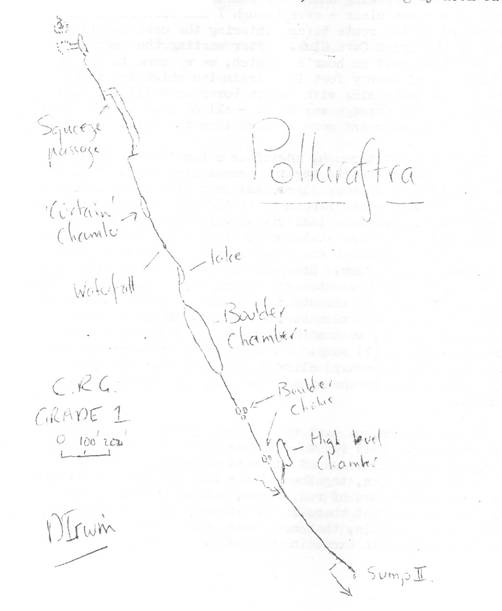
After six hours in the cave, we finally emerged in pouring
rain, making the farmhouse a welcome shelter. To date, the cave has not been
surveyed (at least, not according to the I.C.C.) so, for the record, Im
sticking my neck out by drawing a Grade I.
Having had some Club News and Notices, and a Caving article
(involving some foreign travel as well!) we continue with a climbing tale.
A Little Peace and Solitude
by M.L.
In order to find a reasonable amount of peace and quiet, one
has to travel a fair way at Easter Time. Not to the end of the world perhaps, but at least to the ends of
are all good centres for walking, but are quickly becoming a popular off season
as during the summer. It was with this
in mind that we decided, this Easter, to visit Skye and Wester Ross.
The weather before Easter had put us in high spirits, and we
drove up to
on a glorious evening. The next morning
was not so bright, but we were determined not to be put off by a few clouds and
had a very pleasant day driving up to Skye. The road to Portree is at present undergoing improvement and this means
that heavy lorries, bulldozers and other machines have turned it into a
wasteland of potholes and boulders that reduces sped to one or two miles an
hour. It was with a certain amount of
relief then, that we arrived at Glen Brittle with the car still in one piece.
The classic climbing books about Skye have given the island
an aura of which is hard to dispel. One
feels that one must enjoy ones stay even if it rains every day as it can
do. It was thus interesting to discover
what has changed and what has remained.
Sligachan is, of course, a legend and it is still possible
to obtain there a delicious Sunday tea. One must arrive early, because the supply of cakes runs out after a
short time. Delicious scones, Scottish
pancakes and fresh bread are accompanied by lots of jam, a plate of biscuits
and shortbreads. When everyone has
finished, the climbers stay behind to finish up all the leftovers. Sitting comfortably in the lounge listening
to the older residents recalling their past experiences and including no doubt,
a few tall stories, brings about a sense of security a withdrawal from the
workaday world.
Some things have changed, however. The an-Stac stone shoot which must in its
day have been a fine descent is now just a bare gully and an awkward descent,
especially in wet weather. Weather is
the perennial topic on Skye! The weather
on the island is most reliable and highly unlikely to let you down. It will rain continuously! Certainly, for our
six days there, the island lived up to its name, which is Gaelic for
The day we chose to drive back to the mainland and up to
Torridon, the weather cleared up and by this time was really excellent. There is a new road from Shieldag to
Torridon. This not only makes Torridon
of easy access to the tourist, but has cut into some of the few remaining
natural pinewoods in
Britain
our fast disappearing flora and fauna. The pine martin is not an animal one sees easily a night long vigil is
required. However, we were able to see
several Roe Deer. Two in particular were
very inquisitive presumably our own scents were masked by that of the
car. Unfortunately, it was too dark to
get a good photograph. Liathic and Benn
Eighe, which offer good walking and climbing, had an impressive covering of
snow and their round, massive forms offered a contrast to the Cuillins we had
just left.
On the way back to Mendip, we stopped at Glencoe. This glen seems to have a magnetic attraction
to those who know it well and every year one can be sure of seeing some of the
same faces and meeting old acquaintances. Here we managed to wrestle three days from the weather and, on one of
these, enjoyed an interesting traverse of Aonach Eagach Ridge. Towards the end the cloud dropped and,
although I thought I knew the area well, we completely missed the track which
descends by the side of the Clachaig Gully and instead found one which goes
down to the Youth Hostel.
We were rewarded, however, by the sight of a mountain hare
in its winter coat. The following day,
we were wandering up Stob Corrie nam Beithe when we saw, on the final snow
slope, two birds which appeared to be some kind of ducks, walking purposefully
up to the top. They were quite large
about a foot long their upper parts were black and underneath they were
white. One of them had a red crest over
its beak.
They were making excellent speed although one kept getting
ahead and turning round as if to encourage the other and it was with some
disappointment that we had to leave them without discovering their purpose.
So at last we returned to Mendip, our holiday cut short by
the weather. One blessing remained
however. With everyone either in
Mendip was the ideal place to enjoy a little peace and solitude.
Highways & Byways in St. Cuthberts
Finally, back to St. Cuthberts
for another of those interesting and informative descriptions entitled
Two: One Hundred Feet above
Boulder
In January of this year, whilst looking for a rift described
by John Cornwell to be in the floor of Long Chamber Extension, a small hole in
the roof was entered. A projecting
boulder which made the initial squeeze through this hole just a little too
interesting has now been removed and can be seen on the floor. A small chamber is entered and the way on is
straight down over the stal. bank to the right; not, however, before the
formations on the left have been observed. These include some fine mud ripple marks, curtains and flow. Do not attempt to follow the small canyons in
the north wall or negotiate the obvious route through the east wall, as this
would undoubtedly lead to the damage of the curtains and crystal pools on the
other side. Instead, follow the right
hand wall and turn left at the bottom and arrive at the top of the hundred foot
drop into Curtain Chamber. This pitch
needs a hundred foot of ladder and fifty feet of tether which may be secured
round a boulder in the west wall floor of the chamber. The bottom of the ladder should also be
secured to prevent it swinging against the curtains.
To the north is a six foot chimney enabling a traverse to be
reached, care should be taken. The
passage entered contains the stream which flows over the curtains and thus it
is essential not to stir up any mud or to deposit anything in 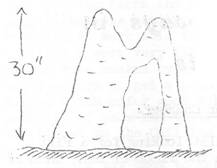 the stream. It also contains many good formations which
require careful protection. After a few
feet, drop down to stream level and walk over some rimstone pools. There are several six foot curtains on the
right and ahead and may be seen a three foot stalagmite some three inches in
diameter. A step upward brings into sight a fine stal. flow on the left
wall. Now climb well to the right to
avoid the white stal., and turn right. At this point may be seen a curious forked stalagmite as sketched in the
figure on the left. There is also an
erratic rather like some of the formations in Balch Hole and consisting of a
straw with a horizontal growth form one side some little way from the
bottom. Now climb between the curtains
on the right and the large stalagmite on the left which need not and MUST NOT
be touched. 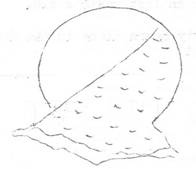 Despite the fact that there
have only been eight trips in this area, this fine stalagmite is disgustingly
filthy
and is a poor reflection on the leaders and their companions
who have been there. Unless one has a
very good reason for doing do, there is no point in going further along this
passage. Turn right, cross a series of
gorges until one comes to a large crystal pool at the bottom of a large canyon.
On no account touch anything inside the tape. Follow the gravely bedding plane down keeping well to the right to avoid
damaging some formations. At the bottom
one sees a phreatic tube some four feet in diameter, illustrated on the
left. Climbing the flow and negotiating
the squeeze brings one into an eighty foot passage, running up at an angle of
40°. About one third of the way up one comes
across some mud drip pockets. Two of
these are 3 in diameter and seven or eight inches deep.
At the top of the passage is a large chamber also sloping at
40°. The west wall has a tight bedding plane at
the bottom and a little further up it can be entered and climbed up into a
final chamber. The final passage
contains some excellent curtains which are almost transparent, giving the
appearance of lace curtains.
The series has been surveyed by Dave Irwin, the initial
parts being surveyed to Grade II and from the squeeze onwards to Grade V. The final chamber appears to be above Quarry
Corner and the whole development tends towards
On the 15th May, the aven was again visited in order to
confirm that all the bedding planes are too tight, but might well be profitable
enlarged with the aid of a chisel. The
traverse south along the east wall of Curtain Chamber is interesting and leads
to an interesting bedding plane in the east wall. From this bedding plane can be seen what
appears to be a large rift continuing in the direction of Curtain Chamber. This also requires the aid of a chisel to
permit entry. Unfortunately one of the
footholds required for this traverse detached itself and now lies on the floor
of Curtain Chamber where it isnt really much use.
Mike Luckwill
Postscript to Alan Thomas article in last months B.B.
Comment by Alan after thirty hours alone in the dark, I
havent gone mad, Im a good dog.
Cleaning Cuthberts
by the Caving
Secretary.
Recently two parties spent some time cleaning up parts of
the cave, and the following items were found. The list, I think, speaks for itself. MORE CARE IS REQUIRED ON THE PART OF THE LEADERS.
1.
2 empty carbide tins.
1 soup tin.
1 boiler suit.
1 pair of carbide lamp clips.
2. Railway Tunnel.
2 flashbulb packets.
12 or 13 flashbulbs.
1 sweet wrapper.
3. Dining Room.
Carbide dumped all around the
chamber, empty sardine tins, etc.
*****************************************
The last two items in this B.B. tell a sorry tale. It would appear that some of the Cuthberts
leaders are not taking a responsible attitude there is no other possible
interpretation. Being a leader isnt
just a question of knowing your way round the cave. It is some time since the editor burst into
rhyme but the following seems appropriate
Sing a song of preservation
Let the caving population
Do its bit of conservation
Stop this wear and tear!
Gentlemen like Balch, when caving
Found formations well worth saving
And like gentlemen behaving
Left no litter there.
Caves were then much fewer
Cleaner, whiter, newer,
Stalagmite
Shone clear and bright
And not like something floating down a sewer.
If this present trend increases
Fine formations gone to pieces
Might as well be made of faeces
For all we seem to care.
On being a Victim
by Roger Stenner
Being rescued from the bottom of Catgut Rift was an
intensively interesting experience, and very thought provoking. First, a reaction about practice
rescues. Although I realised that the
rescuers would do their best to prevent me from getting hurt, I was very happy
when the practice had ended.
I was very grateful for the visor which kept mud of my eyes,
and prevented my nose getting cut. My
conventional caving helmet was a nuisance. The rim caused the helmet to jam and it was difficult to keep the helmet
on my head. The helmet had to be removed
for much of the rift. A handkerchief
over the ears would have been very welcome. Mud or water dropping straight into the ear is very upsetting.
Twice I was parked in an uncomfortable position for a time
while nothing happened apparently because the person in charge at the time had
moved on without passing his authority to someone else. This could be most disconcerting to a real
victim.
Without a wet suit or even a boiler suit, I was warm at the
end of the rescue. I am sure I could
have spent several more hours under these conditions without being bothered at
all by the cold. I dont think it
possible to overemphasise the effects of water.
Of the psychological reactions, my strongest feeling, once
the practice got under way, was one of guilt, especially when everyone else was
working hard. When Phil Kingston was hit
by a falling rock, I was so upset that I wanted to ask Oliver Lloyd to call of
the practice. In spite of the comment
earlier, the general impression given by the team would be most reassuring to
the victim. The team worked with an air
of competence and confidence.
*****************************************
Dont forget the Annual General Meeting and Dinner will be
held on Saturday, October 2nd. Make a
note of it NOW!