

The covers have at last arrived and in addition it is hoped
to be able to make this a six page B.B. is getting back to normal.
Some time back, it was suggested that to satisfy both the
members who wanted a large but less frequent B.B. and those who wanted a
regular monthly magazine, we should from time to time publish a big bumper
edition. At present this is only done
at Christmas and the amount of material received by the editor does not warrant
doing this more than once a year. However, if all goes well this year, October should see the two
hundredth edition of the B.B. and this seems a very good excuse for large and
special B.B. It would, of course, be
followed almost at once by a large Christmas B.B., and so if we are going to do
this double ration, plans for it must be laid shortly. If any members feels that he could write a
suitable article of any type and produced it fairly soon it will enable us
to make a start in putting such a B.B. together. The article should be such that it doesnt
date between now and October and articles with an historical flavour might
be appropriate for such an edition. It
is rare for a caving journal to reach its 200th edition, so let us have a go at
putting the club motto in practice and see if we can do it to excess!
Alfie
Tackle Arrangements
The primary object of this write up is to lay out for all
club members, particularly the newer ones, the method of working of the new
tackle system, so that nobody can complain that they know nothing about it.
Criticism of this system is already flowing in, but we must
remember that the system has only been introduced because the club has been
losing tackle faster than the few stalwarts who devote much of their spare time
to making our tackle, can replace it. Apart from the unfairness of expecting these people to make tackle just
for other members to lose, it seems that a method of controlling tackle is the
only way by which the club can steadily build up a useful stock of tackle and
ensure that all members can be liberally provided with tackle for caving. The Committee are quite willing to consider
modifications to this scheme, but let us first of all give this scheme a fair
trial.
A new lock has been fitted to the tackle store and the keys
distributed (a list of names of people holding keys has already appeared in the
B.B.) It is not intended to issue any
more keys, as this would cut down the amount of control exercised and thus
defeat the whole object of the scheme.
There can be guaranteed to be at least one member with a key
on Mendip during any weekend. Anyone
planning a weekday trip will know of this in advance and can easily contact any
of the holders of keys, either directly or in writing beforehand.
All tackle has been given an identity tag. L1, L2, L3 &c for ladders; R1, R2, R3
&c for ropes and T1, T2, T3 &c for tethers.
A log book has been drawn up and is held by the Hut Warden
or Assistant Hut Warden or by anyone to whom he may delegate this job, should
he not be available. This log book
carries a list of all the tackle on the inside of the front cover, giving the
tag number and the respective lengths.
All a person has to do is to obtain the key; take the tackle
he requires; lock up the tackle store and return the key (if it is a weekend)
and enter, in the columns provided, the date and his signature. When returning the tackle, it has simply to
be signed off in the log book and replaced in the tackle store.
Remember that, until you have signed for the return of the
tackle, you will be held responsible for it all and you will have to account
for it to the Committee if it is still outstanding when the log book is checked
each month.
If at any time, tackle has to be removed for testing or
repair, it will be entered for and signed up by the Tackle Officer so that
anyone can see what tackle is available at any time, and who has the rest of
the tackle.
All this sounds very officious, but please remember that the
whole object of this scheme is to ensure that tackle is there when YOU want
it. With a little thought, it should be
perfectly possible to make this scheme work, so please co-operate.
M.A. Palmer. Asst. Caving Secretary.
Caving Log
February, although a short month, does not seem to have been
short of caving trips. Of all the trips
entered in the caving log for the month, Cuthberts proves to be the most
popular cave by far.
On the first and second of the month, digging was continued
at the back of the Dining room, by Mo Marriott and Dave Irwin. More clearing out was done, using a sledge
which made it easier to transport rubble along the constricted passages. On the same date, Brian Reynolds saw a bat on
the wall above Lower Mud Hall Pitch while doing a Pulpit Trip. Does Pete Bird know of this?
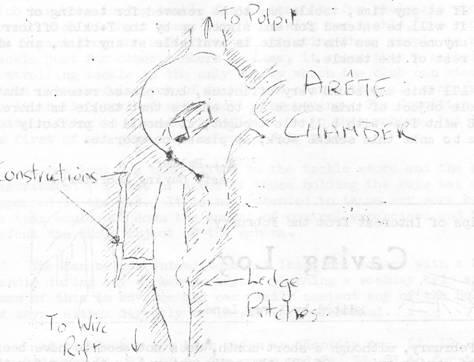 On Saturday, 8th February, Phil Kingston and Ron Drake went
into Cuthberts to look at a hole under the Arête Boulder, a fifteen foot pitch
led to a stream passage. After clearing
away small boulders and silt, a tight squeeze was passed which led to a
junction. One of the routes led to a
high rift which contained some white stal., while the other, by following the
stream, terminated in a very tight squeeze which led to the waterfall opposite
the Lower Ledge Pitch (The Showerbath.) As it was not possible for them to climb down, they had to make the
return journey. A sketch is included,
drawn by Phil, to illustrate the findings.
On this same day, Nick Harte and Dave Irwin laboured at the
top of Pulpit Pitch and provided a Rawlbolt. As a change from Cuthberts, Gordon Tilly, Barry Wilton and Kevin Abbey
went off to explore mineshafts. Innocently taking 80 of ladder, they climbed to the bottom of this
mineshaft to find that a further 40 of ladder would be required to bottom the
shaft.
Returning to Cuthberts, Roger Stenner has done some more
survey work which includes Mud Hall to Traverse Chamber and other bits and
pieces required to finish off this bit of the survey.
Another trip into Cuthberts on February 8th saw Steve
Wynn-Roberts, Nick Harte and Jim Giles taking three sections of maypole to the
Trafalgar Aven in September Series with the object of climbing it. The caving log states that a trip was made in
January in which Steve succeeded in getting about forty feet up in the aven
before he ran out of holds. On this
trip, however, with the aid of the Maypole, Steve succeeded in reaching the top
at about 85 feet. The Aven clamped down
and a very small passage led off.
More Rawlbolts have been provided on Upper Mud Hall Pitch
and in the Wire Rift by Mo Marriott and Mike Palmer and a new chain has been
provided in the Wire Rift which replaced the old, worn out, cable. The tackle on Stal. Pitch has now been
removed for renewal and the pitch cannot be used unless tackle is taken.
Digging was continued at Castle Farm on February 8th by Dave
Irwin, Dave Smith and Andy MacGregor. Dave Irwin reports that they continued clearing the choke at the bottom
of the shaft and that some fair sized boulders were removed.
During the month, many trips to Swildons and Eastwater have
been made, but all were either photographic or tourist and so deserve no
special mention.
Mathematical Puzzles
by Sett
Here is the solution to last months problem. Up to the time of writing, I have had no
correct solutions to either section, although Phil Townsend produced a solution
to the Amateurs Section which he had worked out previously, thereby promoting
himself to solving the Mathematicians Section. The answer is as follows:-
A. Divide the pennies into three groups of
four and compare two of the groups. Two
results are possible.
1. They
balance. Showing that all eight
coins on the scale are standard. Compare
three of these coins with three from the third, untried, group. Again, two results are possible. If they balance, the final untested
coin must be the odd one and it can be compared with a standard count for the
final weighing to determine whether it is lighter or heavier. If they do not balance then the
heaviness or lightness of the odd coin is determined. Which it is out of the three can be found in
the final weighing by weighing any two of the three against each other.
2. They
do not balance. Say the left hand
pan is heavier for the sake of illustration. There is either a heavy coin in the left hand pan or a light on in the
right hand pan. All the untested cons
must be standard. Remove three coins
from the left hand pan, transfer three coins from the right to the left hand
pans, add three standard coins to the right hand pan and reweigh. Three results are possible. They balance, the direction of unbalance is
the same, or the direction of unbalance is reversed. These show respectively that the odd coin is
heavy and is amongst these 3 removed from the left hand pan; the odd coin is
one of the two remaining in the same pan as in the original comparison, or the
odd coin is light and is among the three transferred from the right to the left
hand pan. In each case, the final
balancing will simply supply the required additional information.
M. The solution above completely separates
twelve counts and this is the maximum number which can be considered in 3
balancings. If it not required to
determine heaviness or lightness of the coins, then a thirteenth coin can be
added. This is not used in any of the
balancings and if they all give a balanced answer, then this is the odd
coin. Naturally, the odd coin will be
amongst those balanced twelve times out of thirteen and will then be completely
determined.
The general solution for the number of coins which can be
separated in n balancings is given by the expression.  = 1 The extra 1 is used if
knowledge is not needed of the type of discrepancy or the odd coin. The system of balancing is relatively simple
to work out, but takes an awful lot of describing.
A complete treatment is given in the Mathematical Gazette
1946 Vol. 30 p.231 by F.J. Dyson
This months problem is a practical one which I have not
seen treated before. It concerns the
number of races needed to ensure that every car in a group races every other
car at least once in a minimum number of races.
A. Sixteen cars race four times on a four
lane racing track. What is the minimum
number of races needed to ensure that every car races every other car at least
once?
M. First solve the A. Section and show that
the number of races is the minimum possible. Produce a general solution for the number of cars in a group which can
race each other, four at a time, once and once only. I have not yet found an arithmetical method
to show how these races should be arranged, but a solution for the sixteen car
problem will be given next month.
Addresses
COASE, Alan
Croft, Leicestershire.
COMPTON, Philip c/o
536932
DELL, Garth L/Cpl.
G. 23128511, O.P. Omentum,
B.F.P.O. 68.
DAVY, John
Skircoat Green, Halifax,
FRANCIS, Albert
Wells,
HALLETT, Nigel c/o
B.C.
HANNAM, Mervyn c/o
14 Vyvyan Terrace,
Cotham,
ISLES, M.H. 89
Broad Walk, Knowle,
4.
JARMAN, Roger c/o
South Chase Farm,
KNIGHT
Isleworth, Middx.
BOWDEN-LYLE, Sybil
PAGE, Pete Cpl.
P., R.M. 110 Devils Tower, R.A.F. North Point,
PALMER, D.J.
Kingswood,
REES, C.H.G. 7
Coberly, Footrshill, Hannam,
SLAPP, J. 10
Thicket Walk, Thornbury,
STEWART, P.A.E.
*****************************************
The Caving Secretary wishes to announce that CARBIDE is now
on sale at the Belfry. The cost is 10d
per pound.
Notice. Would anyone
who has access to CHAIN or CAT LADDER please get in touch with the Caving
Secretary. This is wanted for
improvements to the permanent tackle in Cuthberts.
HAVE YOU PAID YOU SUB YET?
Letters
In place of Stalagmites usual article this month, we
print two contributions. The first is a reply to one of his previous articles
and the second is an article largely inspired by his column.
From Geoff
Bull,
Speleological Group.
Dear Stalagmite
Your remarks last month on the
rescue do a serious injustice to the miners, who played a very important part
in the rescue.
Although non-cavers in general are perhaps not much use in
cave rescue operations, these men proved an outstanding exception. The comments made by some of them on the air
bore no relation to their performance underground.
The work they did in removing the squeezes and impossible
corners was not only difficult working in confined spaces but also carried
and element of danger. It was not in
fact possible to use explosive (only a few small test shots were fired) and all
the work had to be done by compressor drill and sledge.
I am convinced that work could not have been done so well
and safely by cavers, for had explosives been extensively used, as we should
probably have attempted to do, the probability was of a roof collapse. Also, only a limited number of cavers would
have been able to operate the rock drill effectively or even use a sledgehammer
properly.
The operation in fact was an example of how non-cavers can
sometimes be of use, even one of the doctors who had never caved before seemed
completely at home, despite his
work of the S.W.C.R.O. who certainly played an important part in the rescue in
initial procedure, organisation, supplies and in bringing the injured man to
the surface safely and quickly.
Musings in the Mountains
by an Exile.
The title of this article is misleading. That was why I chose it. It stems from the fact that I am surrounding
by mountains which would send the climbing members of the B.E.C. into screams
of ecstasy, providing that they have webbed feet. To reach one impressive peak only three miles
away involves a journey of three days to avoid the vast amounts of water on the
way. (The three days are on foot as
there arent any roads.)
I have just received a large number of B.B.s which have at
last caught up with me, and to provided the Hon. Ed. with some dunnage, I have
penned this tome, containing my reflections on that August journal. Regarding Stalagmites challenge in June 63
to write a song about the S.G.O.T.M.N.R.C.O.T.W.N.H.A.A., its so easy that it
isnt even making me sober up. At an
unannounced date, my humble effort will be released on Mendip.
Norman Brookss letter regarding drinking habits in the
antipodes in July B.B. for last year prompts me to remark on the drinking
habits of
a glass of beer across the room, and not being allowed to drink whilst
standing? How else can you tell whether
a person is drunk? In the August issue,
Stalagmites article wondered if any one could pronounce
Llanfairpwllgwyngwllgogerychryndrobwll llantysilliogogogoch. Did Stalagmite spell it wrongly or did a
slight typing error creep in? Being big-headed,
Ill state in print that drunk or inebriated, I can say it.
Only one thing puzzles me about the September B.B. I note
that Colin Henry George Rees went to Swildons IV. Could it be that within two months of my
leaving Mendip, vandals have so messed the cave without bang etc., that it is
possible to ride ones Matchbox and side car all the way to IV?
In October B.B., I see that the A.G.M. was a field day for
Mike Luckwill. He wants to be careful
about too much proposing, or the Family will increase yet again. Also I see that Bob B. is apparently racing
Frank Darbon for the favours of insurable companies. Insurance forms will soon contain the
question Are you, or have you ever been, a member of the B.E.C.?
Which brings me up to date considering the postal service in
the backwoods of the world. Just a
passing comment about the place of my exile. 1964 rainfall at 7th Feb is 32.04
inches.
Editors
Note: – Nigel threatens to be with us
again by the time of the Dinner, with new songs etc.
*****************************************
While leaving Stalagmite to comment on the reply from one of
the members of the W.S.G. who was on the
rescue trip, we feel that his remark about the difference between the miners
work in the cave and comments on the air is worth further comment here. One of the sad but true features of cave
rescue is the amount of distortion introduced on many occasion by both the
press and radio/TV. With this in mind,
members would like to read a factual account of the episode, sent to the B.B.
by the W.S.G. to whom we are indebted for permission to print.
Rescue at Llethryd Swallet 9/10th February, 1964
When the call out came through to the S.W.C.C. Headquarters
at Penwyllt, the position was, fortunately, that the S.W.C.C. member with the
local knowledge; the gen on S.W.C.R.O. procedure and luckily, a member with
medical knowledge, had just returned from a dig. The W.S.G. party had eaten, packed ready to
return to
and was fresh. Important too was the
fact that the entire C.R.O. gear was packed and ready for instant use. Due to all this, medical aid was on the spot
with
with 70 minutes of the call out despite the fact that Llethrydd is about 30
miles away form Penwyllt.
The conditions in the cave may perhaps be understated as
being tortuous and wet. Something like
Sidcot, only tighter and longer with more ups and downs and with a healthy
stream to complicate matters. A very
sporting cave, but impossible to bring out an injured man on a rigid stretcher
though. The stretcher in fact could not
be taken straight in places. One was not
impressed by the stability in parts.
When we reached the man, he had apparently fallen awkwardly
some 6 to 12 feet and had broken his right thigh in two places near the
knee. It was also discovered that he had
cracked ribs, chipped bones in his neck and was suffering from concussion. Even under Morphia, he was moaning
occasionally. A temporary splint was
effected, he was moved to a better spot and the splint remade.
At this time the rescue possibilities seemed to be three
fold. A shaft could be considered as
close to the antechamber where the accident happened, is Root Chamber where
tree roots can be seen in the roof and the walls. The depth of the roof below the surface at
this point was then thought to be about thirty feet. Improvements to the original route was a
second possibility. Although this was
eventually done, there was more than a slight risk that the route might be
blocked entirely if bang was used and at least half the 300 to 500 feet of
passage involved needed drastic improvement. The third possibility was to make a New Entrance by digging a subsidiary
dry swallet a little further upstream. It was expected that this would short cut the tightest parts.
The decision reached on the spot was to concentrate on the
shaft, with spare labour employed on improvement work, however the progress of
events rather changed ideas. Meanwhile
further supplies were brought in, the telephone set up, and non-essential bods
cleared from the cave. This was about 11
or 12 oclock. The depth of the cave at
Root Chamber was measured using an electronic method and was found to be a
hundred feet. This was letter checked
and verified.
Around 2am, the miners arrived with a compressor and started
work on improvements. By all reports,
the N.C.B. and the mine rescue men were surprisingly at home even in the severe
conditions encountered. There were some
delays, naturally, of the sort that are bound to arise in any such
operation. The only valid criticism of
the miners was perhaps of over caution, but this was a fault on the right
side. The comments that were heard on
the air and read in the press were mostly kept for the surface. It was noticeable that those who did the most
work underground were not the most anxious to be on T.V.
At about 3pm Monday, the work was practically finished and
the first stretcher party (consisting of cavers) went down while the finishing
touches were put to the passage. Working
in relays, with fresh bearers,
was brought, still under Morphine, in the remarkably short time of about two
hours.
During the time that
was having medical attention, his condition deteriorated up to the time that it
was decided to give a blood plasma transfusion. It is very likely that this tricky task has never been attempted under
such difficult and dirty conditions, and is a great credit to the medics. It was most unexpected to come across a caver
with his sleeves rolled up to the elbows and his arms scrubbed. When
finally reached the hospital, his condition was said to be generally good.
The credit to this operation must go to the S.W.C.R.O., to
the miners, the men of Thysons Ltd., the Police, the W.V.S., the farmer and
many others.
Editors
Note: Members
may be interested to know that
Don Coase, a B.E.C. member.