
Contents
Editorial
It doesnt seem very long ago that we were celebrating the
publication of the hundredth issue of the B.B., and yet here we are a quarter
of the way towards our second century. The rather dubious looking heading of this page is supposed to be
marking the occasion.
Readers may have noticed a gradual deterioration of the
quality of the typing of the B.B. of late. This is not due to the new duplicator, which is behaving very well, but
is because this typewriter is in need of overhaul. In particular, the tops of capital letters
are not coming out properly. We are
hoping to have this attended to before the printing of Julys B.B.
The publication last month of Caving Report No.3 has, we
hope, accomplished two things. The first
is to convince one and all that we do intend these to appear at intervals
however irregular and the second and most important is to get some of the
methods of tackle construction used on Mendip down on paper. To our knowledge, in this club alone, at
least five types of ladder have been constructed and it is doubtful whether
more than a few individuals are familiar with the methods used. We could do with a few more write-ups on this
subject for caving reports.
Alfie
Letter
Dear Mr. Collins,
I was very interested, in Belfry Bulletin No 123 (April
1958), to read the article by Ken Dobbs on ‘A cave at Newton Abbott.’ This cave
is known as
which it is situated. There is a brief
mention of it in ‘Britain Underground’ and it is also listed in ‘British
Caving’. In so far as there is a main
route through the cave, this runs downwards, and is reached by a number of
holes that drop down to the right – as mentioned by Dobbs (who must have looked
down a difficult one, as there is an easy way down just beyond!) These holes lead to a roughly horizontal
corridor, form which a variety of interesting squeezes which look as if they
ought to go on. Some do, for a short
distance, but narrow fissures or cemented boulders have prevented us from
getting very far. There are some very
colourful red flows and curtains in these lower Grottos.
I gather from Ken Dobbs’ letter that he hasn’t come across
any cavers in
some time?
Yours Sincerely
John Hooper
(Recorder & Editor, D.S.S.)
Editors Note: We
publish the above for the benefit of any members who find themselves in
if youve got some caving organized, Ken!
May Committee Meeting
The May meeting of the committee dealt mainly with routine
matters; the provisioning of the more tackle, the renovation of the club
lantern and slides, the arrangements for creosoting the Belfry during the
summer. The date of the next, and
subsequent Annual General Meeting and Dinner was fixed, as announced in last
months B.B., as the first Saturday in October. Discussion on a suitable memorial to Don Coase continued.
The following new members were elected: – G. Todd; D.
Soutar; P.C. Wilson (Junior) and A.C. Coase.
Log for May 1958
|
4th May |
Vole Hole. Digging of the 3rd shaft continues. Jill and Alfie have now reached half way |
|
|
Eastwater. Trip to Primrose Path and Rift Chambers, |
|
4th May |
Cuthberts. Maypole Series Survey. Also surveyed High Chamber and examined |
|
10th May |
Hunters Hole. Rawlbolt fitted for main pitch. The rawlbolt for the lifeline belay could |
|
|
Cuckoo Cleeves. Trip to end. Leader, Ian Dear |
|
|
Cuthberts. A four hour digging trip in the Tin Mine |
|
17th May |
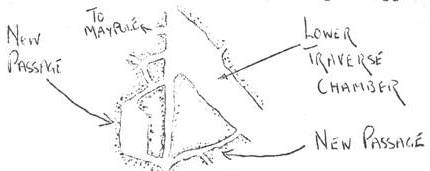
Cuthberts. A photographic trip. On this trip, a new passage on the left of
|
The two trips following are out of chronological order, we
apologise for this.
|
3rd May |
Cuthbert’s. Brian Ellis and Chris Falshaw went to Plantation |
|
4th May |
Cuthbert’s. Retrieved apparatus from Plantation Conclusion |
Further researches in
Cuthberts
Have now inconclusively shown
That water swallowed in
It not passed by the Junction alone.
Chris has promised a more scientific account later. Meanwhile, the editor, who has restrained his
poetic outbursts in the B.B. for some months now, can contain himself no longer
and inflicts the following on you:-
Experimentation
Chris F. made preparation
For an investigation
To find the destination
Of water from
This science application
Had chemical foundation.
To show, by combination,
The waters percolation.
They hoped to find relation
Of stream configuration
And rate of transportation
By Ionic Migration.
Chris had co-operation
From
did station
At lowest elevation,
Himself for the duration.
They waited with elation
And much anticipation
Then checked their installation
With great exhilaration.
But then, with lamentation,
There came the realization.
There was no correlation.
In fact, complete negation!
This caused great cogitation
And lengthy meditation
Until their cerebration
Reached absolute stagnation.
So if, when on vacation,
You try participation
With gen instrumentation
To find this deviation,
Don’t let your new vocation
Cause undue perturbation.
Just stop, and yell Damnation!
And try intoxication!
Alfie.
Cuthberts Hanging Chamber
Cavers familiar with the Maypole Series have been aware of
the presence of what seemed to be a hole high up in the left hand wall (facing
upstream) of Bridge Chamber – The entrance chamber to the Maypole Series,
containing the fixed ladder and short chain pitches.
Until recently, the nearest anyone had been to it was at the
time of the first maypole attempt on what is now the permanently laddered
pitch.
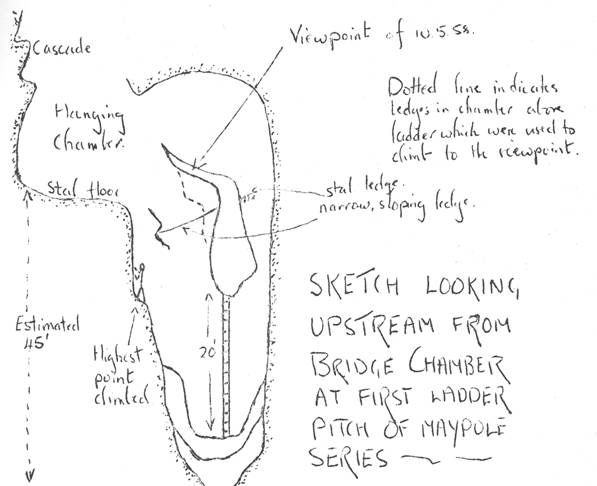
On that occasion, 16th Feb., 1957, R.S. King climbed to a
small ledge formed by the stal flow on the wall (indicated by the pin figure in
the sketch on the next page). The stal
above appeared to be too steep to climb, and the ledge too small to support a
maypole and crew. This was confirmed by
Mo Marriott, who climbed to the same spot almost a year later.
During the surveying of the maypole series early this year,
it was noticed that it might be possible to examine the hole from the chamber
at the bottom of long Chain Pitch. With
this in mind, a party took strong lights and a few weeks later climbed into the
narrow inclined rift from this chamber and found that it did indeed overlook
Bridge Chamber. By strange and hazardous
contortions, it was found possible to illuminate the hole and with satisfaction,
a fine white cascade was glimpsed. More
immediate surroundings contained a narrow, steep sloping, muddy ledge and a
small stal ledge. Both could be utilised
during the engineering which must precede access to the hole.
At Whitsun, a party carried exploration a stage further and
dropped a ladder onto the muddy ledge from the viewpoint. It was found possible to step from this ledge
to the stal ledge. From this airy
stance, it could be seen that the hole has considerable depth and height and
is, in fact, a chamber containing some important formations. Independent opinions of each of the four in
the party give the cascade an estimated height of fifty feet.
The problem is now clear, and materials and a method are
available to solve it.
Kangy
A Pyrenean Picnic or
Anglia Abroad
by Tony Johnson.
This long screed may be helpful to anyone looking for a trip
abroad which is not infected with G.B. plates and yet is not too far off the
beaten track. When planning our 1957
summer holidays, this was our main thought.
We started out from
at 6.00 on a Friday evening and by 7.30 next morning were safely on the quay at
recommenced the night B.R. service from
and is very smooth. Crossing this way is
dearer than the short routes (especially as there is longer bar time) but when
you add up the fuel bill down to
through
anything in it starting from the West Country. Added to this is the attraction of starting off in
good sleep (all berths arc comfortable and cheap).
Our first days run was to be the longest of the whole
tour. Straight south across the Seine
Ferry, on through
straight,
towards
and the Spanish frontier. It was a hot
sticky day, so we stopped short of
on the higher ground. The Boule D’Or at
Barbezieux was our first port of call, 6 pm and 410 miles from the
channel! Dinner was typical. It lasted most of the evening. One thing, was different though, the father
and mother of all thunderstorms arrived and as we ate and drank, the lights
went dim and bright by turns, finally packing up to be replaced by huge
candles. This storm lasted into the
night with lightning of every conceivable colour. We could look at the maps by the light.
Breakfast in the morning, was what was to become typical,
¬croissants and a huge bowl of coffee consumed in the bar. Then out into the sun in search of a metre of
bread, a bottle of wine (3 or 4/-) and a kilo of peaches (6d or 9d) as a basis
for lunch. Back again to settle up and
depart. The Boule D’ Or was typical of
the hotels we found in the small towns of the main tourist routes with good
food and drink – clean and cheap. A few
comments on French hotel technique may not come amiss here to those who, like
ourselves, have not had any previous experience. Firstly, and most important, get a Michelin
Guide. It is far and away the best and
most comprehensive guide I have yet found. Hotel proprietors live in fear and trembling of it and if they see you
carrying one they will not over¬charge. Next, never be afraid to say the room you are shown is too dear if you
think it is. They will usually show you
something cheaper! Unless you understand
what you are ordering (which we didn’t) stick to the fixed meal at night; odd
special dishes cost a lot more and the normal food is almost certainly very
good. Drink local wine unless you
suspect it or have a very strong desire for something special. It is usually good and very cheap. Don’t bother about garaging vehicles. They seem to be all right left lying about
the place, especially if British. Finally, don’t hesitate to add up and check the bill. It’s probably O.K. though; and don’t bother
about tips except special ones as you have probably paid for them already under
the heading “s.t.c.”
To resume then, Sunday morning fine and fresh after the
storm saw us driving the Anglia down the miles of tree lines straight towards
middle of the road. The two rear wheels
had had an argument and parted company, leaving the rest of the coach to slide
along without them. Nobody worried –
most of the passengers were picking flowers!
On past the huge Pont de Pierre into
morning. What a scrum! Rather like a cross between
all the shops going full blast! Turn
left and out again to the south and the hills, but first more petrol – trois
mille francs d’essence (super of course) just over 6 gallons for almost £3 –
This was before cheap tourist petrol. From now on, we should need to keep that tank
full, we thought, as petrol stations were likely to get further apart. 140 miles later, we arrived in Pan and lunch
was due. From here we saw our first view
of the Pyrenees, but this was rather disappointing and rather like the Lake
District from the
A few miles out of Pan and the off the road and down to a
stream for lunch. You notice off the
road. Don’t stop on the road. If you do, mobile gendarmes appear from
everywhere if you don’t pull onto the verge. Out, primus stove and water keg; on soup, coffee etc. wine in the stream
to cool and off we go.
After lunch, we first got out the sectional Michelin maps of
the
the Houtes Nationals for the yellow, white and dotted roads.
Our route now lay upwards towards the frontiers. Firstly through pine woods, past numerous
hydro electric barrages, then up through the spruce trees until we came out
into a long snaking valley above the trees. Huge boulders and cliffs all round us disappeared into low cloud. Then there was the frontier barrier, 6,400
feet up. Beyond, we could see the clouds
broken up with sunny patches on the rough dirt Spanish road. The time was 3.30 and we were on the frontier
45 hours and 720 miles from
considering we had done a lot of sightseeing and photography on the way.
However, we werent intending to cross over just yet, so
back we went down the road beneath the clouds. This was the contrast we were to
find a number of times in the next ten days – cloud and paved roads in
places) and sunshine and dirt roads in
French side of the
of the French landscape compared with the scorched appearance of the Spanish
side.
It was now 6 o’clock and time to look for an hotel. Here we made a mistake which we were careful
not to repeat. We picked out a place
which turned out to be a shocker. Instead of departing for somewhere more convivial, we persisted. It was like some vast barracks. I do believe we were the only people to stay
that summer, certainly that night. So be
warned if a place has an air of deserted grandeur about it, it is probably
deserted for a very good reason, so steer clear! French and Belgian tourists aren’t fools and
they are the main source of income in the
(To
be continued.)
H.E. Balch
It is with regret that we must record the passing of Mr.
Balch, on, we understand, Whit Monday. Mr. Balch was an Honorary Life Member of the B.E.C., and so perhaps we
may be permitted to add our own club’s tribute to his long lifetime of work on
Mendip caves.
For the last three years of his life, he was reluctantly
confined to bed, but even then he spent them being through all his caving
memoranda and tidying up all the loose ends. We received a letter from him asking several questions about the
system in
only a few months ago.
Humour has it that he did a ‘top of Swildons’ at the age of
eighty two! This was typical of the
keenness he showed.
His work at Badger Hole, his books, and his Curatorship of
the
he was never too busy to chat to cavers, giving novices and experienced cavers
the same courteous attention.
Those who never saw him have missed what every Mendip caver
considered to be part of his education – those who knew him will we are sure,
join with us in mourning the passing of a great and well-loved caver.
*****************************************
The Belfry Bulletin. Editor: S.J. Collins,
Kensington Place
Secretary: R.J. Bagshaw,
Ponsford Road