
Contents
Editorial
As a result of nearly all the members of the Editorial Board
going away on holiday at the same time, an event unprecedented in club history
will take place the B.B. will be coming out before its published date this
month, and you should be reading this in June.
It will not be possible to include all the caving log for
June, but the remainder will be published in the B.B. for August, along with
the log for July.
More than ten years have passed since we last had a page of
cartoons remember Half Pints page we have now had a firm promise, and the
first of our new series may be included in this issue.
Apologies to all, especially the author, about the announcement
of caving Report No. 3. Owing, as they
say, to pressure of work, it has not actually been published yet although the
date on the covers says May. This
matter, as they also say, will receive out early attention.
June Committee Meeting
The plans for the new, stone built, tackle store ands
changing room have been passed by the Wells R.D.C. but we still have to wait
for approval from the Ministry of Town and Country Planning. It was agreed that work should go ahead as
soon as we had permission. Arrangements
for the redecoration of the living room and kitchen and the job of the
creosoting the outside of the Belfry were discussed. The following new members were elected: –
Albert Francis, Arthur Siddaw,
Jim Leigh, Janet Boot, Richard Hartley, Stewart Always, Frank Darbon and Dave
Hoskyns.
New members are reminded that back numbers of the B.B. are
available, price 3d each, if still in stock. Please apply to the edition or any members of the board.
*****************************************
We have received the following from Claire: –
The large attendance and the spirit shown at the gathering
for distribution of Dons ashes was much appreciated by his mother and
myself. Thank you, everyone.
Clare
Bristol
Museum
The museum is short of a large number of old copies of the
B.B. and wants to make up a complete set. It is not possible to provide the following from stock of back numbers:
–
1 to 27, 90, 97, 104, 106, 107,
108.
If anyone can spare these for donation to the museum, it
would be appreciated.
The Maypole Series
The inevitable reaction to a first visit to the Maypole
Series, after climbing up what seems to be a never ending series of fixed
ladders and chains, is that surely the present end of the series must be near
the surface. Recent work has given an
indication of the depth of the series and incidentally clarified thoughts on
the structure of the upper part of the Cuthbert’s system.
The entrance to the Maypole Series (Ref. 1.) has been known
since soon after the St. Cuthbert’s Swallet was first entered. Easier exploration took priority and it was
not until the 16th Feb. 1957 (Ref. 2.) that a tentative maypole was tilted at
the hole at the top of a twenty five foot pot. The trip failed but the problem was clear and at the beginning of March,
a longer maypole enable Don Coase and Tony Rich to climb to the bottom of yet
another pot. More maypoling, under the
direction of Rich revealed the series as it is now. Later mechanization, using two chains, a
steel fixed ladder and a crude pulley has made the series readily accessible
(Ref. 3.) and it should be restated that the line at Pulley Pitch (Ref. 4.) has
been underground in St. Cuthbert’s for at least three years and has been used
extensively, and is therefore suspect. It is recommended that a tested rope be used to hold the ladder while
the ladder is climbed. The nylon line
should be used only to pull the main rope into position.
At the beginning of this year, Norman Brooks was contacted
end asked if he would be willing to use radio apparatus of his own design to
measure the depth of the final (highest) chamber. He agreed, and so a C.R.G. Grade 4 survey was
started to give an idea of where the final chamber lay in relation to the
entrance. This has been completed. The next step is to use the apparatus and it
is hoped to try this sometime in the summer.
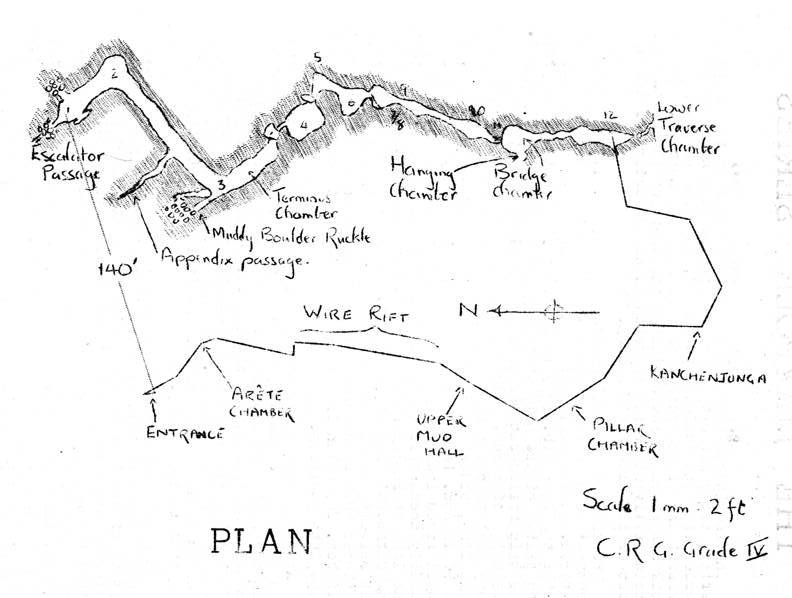
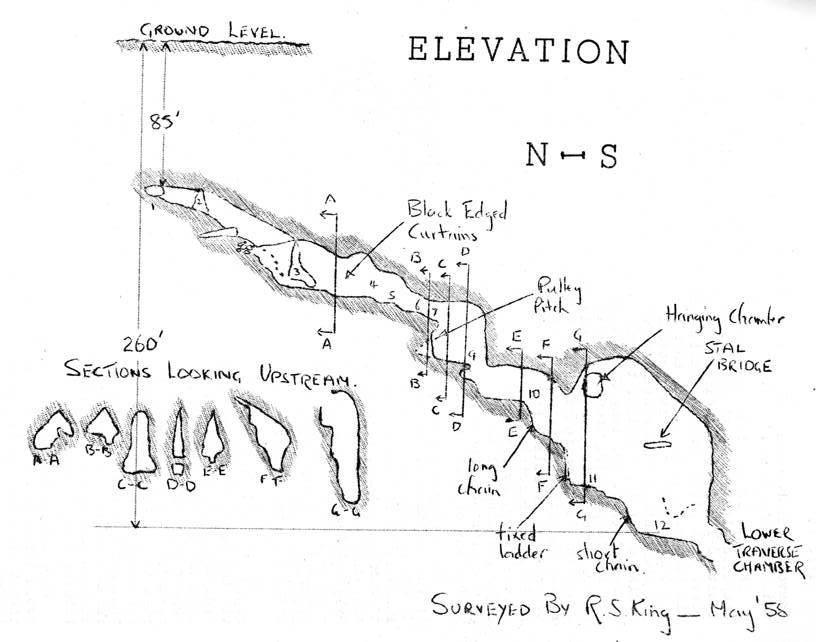
It can be seen from the survey (which will be found on pages
3 and 4 of this B.B.) that the total depth of the bottom of the Maypole Series
is 260′, the height gained in climbing the series is 175′, which gives the
depth of the final chamber as 85′ below ground level. Assuming approx. 10% margin of error to cover
both human and instrumental errors, the depth becomes 75 – 95′. This is the same level as Arête Chamber and
the top of Pulpit Pitch in the Entrance Series. It also corresponds to the estimated height of the roof of High
Chamber. The lowest point on the section
on the survey shows an arrow pointing to Lower Traverse Chamber. This passage leads to a window in the roof of
Lower Traverse Chamber and a drop of twenty to thirty feet to the main stream
passage.
The pots in the lower part of the series have been equipped
with permanent tackle. Short Chain Pitch
is about fourteen feet and is inclined at about seventy degrees. Above this pitch are two small, well shaped
pots which rise six feet between them. The entrance to the series proper is the largest pot which is vertical
and has a twenty foot permanent steel ladder standing on an interesting sill,
making a total pot height to the top of the ladder of twenty four feet (Ref.
5). Long Chain Pitch is twenty feet high
and is steep, being about vertical at the top. An awkward Chockstone Pitch, surprisingly exposed at the upper part, to
the twenty feet of Pullet Pitch, the final proper pot of the series. The remaining sixty five feet of vertical
height are gained easily over two hundred feet of passage following the major
jointing. It should be noted that a trip
can be made more comfortable for a party if the leader dams the stream at the
top of each pitch.
The survey was primarily intended to give an indication of
the position of the highest point in the Maypole Series. It can be seen from the survey that point,
Escalator Passage, is 140 feet at 610 from the entrance. In relation to surface detail, this point is
about twenty to thirty feet the other side and to the right of the dam in the
Cuthberts depression. The Muddy Boulder
Ruckle is thought to lie under a small pond filled with tussock grass. This probably has no particular significance
in that the stream from the Maypole, originating in the Muddy Boulder Ruckle,
is probably seepage water from the larger area of the depression.
In general, the most striking feature of the series is the
rapid gain in height of 110′ over the first hundred feet via the succession of
pots. An interesting feature is the
pronounced way in which the upper part follows the major jointing of the
limestone. Most possibilities of ways on
appear to have been tried but determined effort may be rewarded at (a)
ESCALATOR PASSAGE which ends in a narrow rift too tight to force but widening
beyond (b) at either of the openings to the left and right of Escalator
Passage, though the North East one is excessively loose (c) APPENDIX PASSAGE
which ends as a gravel choke or (d) In the MUDDY BOULDER RUCKLE where decaying
vegetation may be found after forcing a tight squeeze.
Care should be taken, as always during exploration, to avoid
irreparable damage to natural phenomena. It is hoped that a more descriptive account of this series will appear
in the
Cuthberts Report.
Acknowledgements are made to Messrs Fred Davies and Tom Neil
who did the majority of the survey work with me, and to some members of the
club, particularly Alfie Collins, who helped with much useful advice.
References.
1. B.E.C. Caving Report No. 2, Page 8.
2. Diaries of Don Coase and Roger Stenner.
3. B.B. No 114, July 157.
4. B.B. No 119, December 1957.
5. B.B. No 125, June 1958
Notes on the Survey.
The instruments used were a prismatic compass, a copper tape
in an aluminum case and a clinometer. Time spent on surveying was approximately
22 hours. The accuracy of the survey
will not be known until the end is fixed by radio methods and it is depressing
to realize that the circle error at the end of this long open traverse could be
of the order of fifty feet radius.
How to Write an Article for The B.B.
It is a fact most wonderful and strange to contemplate that
our club consists of some hundred and twenty members, most of whom can read and
write. It can be further be shown (as
have put it) that it requires two articles of average length to complete the
usual 8 page B.B.
We are now in the happy position of being able to draw a
conclusion. If every member wrote an
article once every four and a half years, this would be sufficient to fill the
B.B. ad. inf.
The next move in this erudite argument is one of extreme
subtlety. Each member must be persuaded
to write an article. Obviously here a
snag arises. One can imagine the reader,
aghast at this suggestion, pointing out that it is inhuman to expect each
member to produce one article every four an a half years. No man, one can imagine him saying, Could
work at such a feverish rate and retain his sanity! This is, of course, agreed. Fortunately, as the man with the flat back
tyre said, a solution is at hand. Owing
to the average stay in the club per member being of the same order as the
frequency with which he should write an article. EACH MEMBER NEED ONLY WRITE ONE ARTICLE
during his entire stay in club. It is
generally conceded that this intellectual effort, although still severe, is
possible.
At this stage, the reader has, it is hoped, been fired with
enthusiasm to take up this fearsome challenge, only to have his aspirations
dashed once more to the ground by the next obstacle. What, he asks, quite reasonably, Can I
write the article about? Agreed, this
is something of a facer. The equipment
needed at this stage by the intending author is known as an idea. An idea is not easily come by. In this respect it resembles a clue, and
people have been known to go years without either.
Don’t despair! You too can have an idea and remember, you
have four and a half years to have it in! A widely held belief asserts that the average bloke can produce an idea
in two years, and exceptional individuals, by sheer concentrated effort, have
been known to reduce even this fast time. This is, of course, without the benefit of our system. With the system, an idea is GUARANTEED to
occur. To obtain the full benefit of
this amazing system (send no Money!) you have only to peruse the following
little questionnaire. Just read the
questions and pick the group most suitable to your circumstances: –
GROUP ‘A’
Are you (l) An active
Caver/Climber/Belfry visitor?
(2) Still alive?
GROUP ‘B’
Were you (1) An active
Caver/Climbcr/Belfry visitor?
(2) Young once?
GROUP ‘C’
Are you (1) An infrequent
visitor to Mendip?
(2) A Bloke-who-has-gone-to-live-an-ellofalong
way away?
You have picked? Good. Now read on:-
GROUP ‘A’. In your active career you MUST
have been on a trip in which something unusual, interesting or amusing happened
– just one at least! Listen to the lines
shot at the Belfry, Hunters &c. YOU
probably shot one last weekend! Write it
down.
GROUP ‘B’. All the remarks of group ‘A’ apply to you, but in addition, you obviously
know that things arc not what they were (they never are!) These poor blokes who go caving/climbing/drinking/&c
now, never knew what is was really like &c &c. Tell them!
GROUP ‘C’. When you do come to Mendip, whats it like? Has it changed? Any new caves? What are you doing now anyway? Anything interesting? Whats your part of the
world like?
Of course, it is possible to have an idea without, or in
spite of, the system above. Let us
rashly assume that you have an idea of what to write about. Now you must decide in what form to write
it. The table of weights and measures
may be of use here: –
TABLE OF WEIGHTS AND
MEASURES.
|
2 Poems 2 Letters 2 Articles |
= 1 letter = 1 article = 1 screed |
Poetry requires fewer words per line than prose and also
makes you appear cleverer than you really are. This is obviously worth looking into. A letter is easily written and can always be padded out by telling the
editor what a fine magazine he runs. This automatically ensures publication. Only the advanced writer should attempt a screed.
Let us now consider the system in action. Bert Bodge, who has recently joined, is
persuaded down Swildons (on which trip some of the ladder rungs slipped while
Bodge was climbing back up the twenty) and he later goes down
again, but remains in the club and eventually moves to Kerrimuir where he is
employed by a ball manufacturer. Now let
us see what Bodge has found to write about: –
|
B.B. 128 |
(Sept. 1958) My First Caving Trip. A |
|
B.B. 131 |
(Dec. 1958) A Recent Visit to Stoke Lane Slocker (article) |
|
B.B. 136 |
(May 1959) Letter |
|
B.B. 141 |
(Oct. 1959) Letter replying to author on article on tackle about the slipping of |
|
B.B. 142 |
(Nov.1959) Poem. When youre climbing up a ladder |
|
B.B. 146 |
(Mar.1960) Letter replying to Hydrologist |
|
B.B. 148 |
(May 1960) Poem. Going through the sump |
|
B.B. 174 |
(July 1962) Some interesting fact about Kerrimuir |
|
B.B. 177 |
(Oct 1962) Letter inviting any member to drop in when passing through Kerrimuir. |
|
B.B. 181 |
(Feb 1963) Mendip revisited (article) |
|
B.B. 190 |
(Nov 163) Early Days in Swildons and Stoke Lane (article) |
It is, you will no doubt agree, surprising to see how much
can be written about practically nothing. This article has been written on the same principle just to show how
easy it really is.
Alfie
*****************************************
Caving Report Number 3 The Manufacture Of Lightweight
Caving Ladders, By Bryan Ellis, is now on sale. Make sure of your copy. Price 2/-
*****************************************
Our Congratulations to Mervyn Hannam who, we understand, is
shortly getting married. Also to Roger
Stenner for getting his degree. How did
you manage it, Roger?
Second International Congress of Speleology.
This is being held at Bard,
year from the 1st to the 8th of October. The fare will be about £24 return. Any members who are interested should get in touch with Bob Bagshaw.
Cave Research Group Meetings
Northern
General Meeting 17th May,
Southern General Meeting 12th
July,
A.G.M. 8th
November,
International Speleological Camp.
In connection with the Brussels International Fair and the
Brussels International Colloquium on Speleology (4-6 July) a camp is being
organised at Complain-au-Pont, 16 miles from
July to cavers, climbers, walkers etc. Tents will be provided but camper will have to provide their own
sleeping gear. Food will be provided and
facilities available for self cooking if preferred.
will be arranged to Belgian show caves and beauty spots as well as to wild
caves. Apply to The Secretary,
1958, Ruo Tanixho, 35 Bressoux,
*****************************************
The Belfry Bulletin. Editor: S.J. Collins,
Kensington Place
Secretary: R.J. Bagshaw,
Ponsford Road