
The
Exploration Club, The Belfry,
Road
Editor: Robin Gray
Note: Held over till the next BB. The Daves Cave. Further Radio Location.
Contents
From the Editor.
Congratulations to Quiet John and Lavinia who got married
short while ago.
It seems that the long distance plug for the working weekend
was a good idea. A good number of
workers turned up and a lot of work was done. The Belfry is now a beautiful shade of green and the bunk room looks a
lot better. However, Dany has put up a
long list of jobs that still need to be done as soon as possible. The outside window frames are scraped and
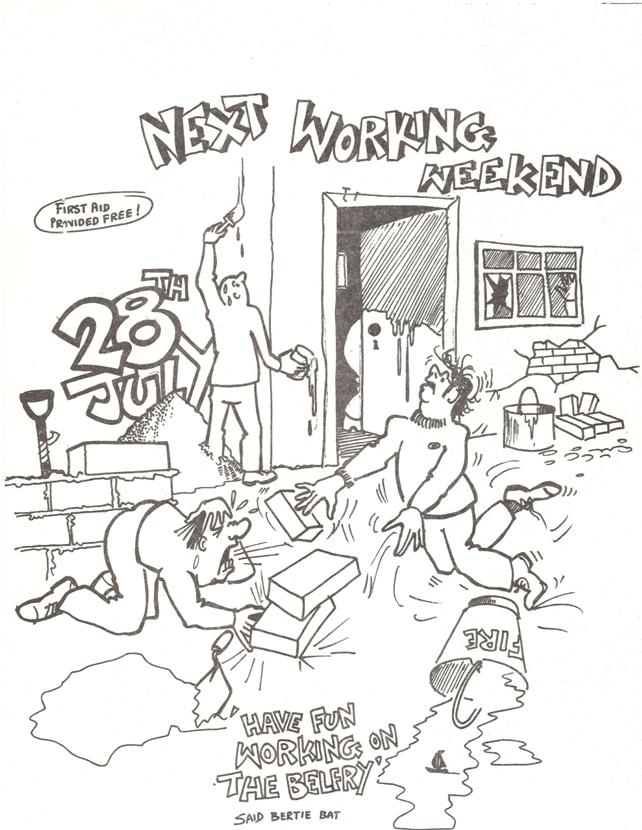
will need painting before they start to rot. We have planned another Working Weekend. Please turn to the back page for details. Many thanks to those of you who turned up and
worked so hard. Lets have even more next
time!
People have been seen taking vast quantities of plastic
bottles and inflatables down Cuthberts. It would be nice to have an article on the theory behind this strange
game, or at least taste some of the results of this secret brewing
activity. It has been suggested that
vast quantities of soup are being prepared in sump 2!
I have been asked to write a few lines about my recent trip
to
to. I’ll just show you my hands and my
new gloves and say that this is a really superb extension made even more
exciting if you are a little on the round side.
Many thanks for articles received for the BB but I still
need more! Keep them coming and good
caving.
Robin
New Find In
Scotland
Situated in
was covered one Saturday night after a quiet evening in the pub. Whilst several complicated Scottish dances were being performed, the matter
blocking the cave entrance (otherwise known as the sitting room floor) was
found to have a propensity to cave-in. Inspired by the thought of discovering caverns measureless to man,
hostile environments etc, the digging team feverishly removed the surface dirt
(otherwise known as the carpet). We
proceeded to explore the new system, which was found to be quite extensive,
stretching the length and breadth of the sitting room. The exploration continued well with little
discord among the diggers until it was discovered that two members we spending
a suspiciously long time underground and had in fact secreted the last dregs of
whisky in a side rift. Retribution was
swift–on attempting to exit the cave, the culprits were nonplussed to discover
a sofa-ruckle had blocked the entrance. The cave was fully surveyed, but unfortunately future trips will not be
possible due to access problems, the Land-owner has filled in the entrance.
Rachael Clarke
Lifeline
by Tim Large
Self- Improvement Plans
Following the A.G.M. the Committee continued to take up Andy
Lolly’s kind offer of producing a final plan in consultation with the
Structural Engineer. After a detailed on
site examination of the Belfry it has been found that more structural
reinforcement is necessary in order that the loft space can be used as living
accommodation, and also comply with building regulations. At present Andy is drawing up a revised
costing incorporating the necessary additions. The Committee will then decide whether the scheme can be accommodated
within the financial limitations as directed by the last A.G.M. Otherwise a further modification will be
necessary.
New Belfry Door Lock
This is now fitted and in the region of 40 keys have been
applied for and issued. Remember if you
still require one there is a £2 deposit. This key also opens the small tackle store key box located under the hut
fees box in the main room of the Belfry. Inside this is the tackle store key. As directed by the A.G.M. this enables members to have free access to
the tackle. It is important to complete
the tackle book noting, ladder, tether code numbers and approximate length and
number of life-lines taken. Please do
not hang on to tackle any longer than is necessary. The quantity is still small and unnecessary
delays may prevent other members from going on caving trips.
St Cuthberts
The new steel ladder for Arête Pitch has now been installed
thanks to the efforts of Glyn Bolt of the Wessex Cave Club. A valve been cemented into the dam at the
cave entrance. This makes it very easy
to cut off the water. The ‘wheel’ to
operate the valve will be padlocked to the bolt in the changing room where the
entrance rift ladder is also stored. The
padlock is the same one as the entrance one. I suggest that leaders take the wheel to the bottom of the entrance pipe
once they have either opened or closed the valve in order to prevent it being
tampered with while they are down the cave.
Dinner 1984
This has been booked at Croscombe Village Hall with good
quality outside catering. Hopefully we
can get the Hunters to provide the bar. The price will be in the region of £7-8.
Sales
At present we have the following sale items held by myself:-
BEC enamel pin Badges – £1.50.
BEC Get Everywhere Stickers –
50 for £1
BE C Sweatshirts – £6 each
A Selection of Mendip, Yorkshire
and
Surveys.
Cave Key List
Below are listed the keys held by the Club which hang on the
back of the right-hand Library Book cupboard. They are available from the duty-hut warden or any Committee member.
Longwood/August 2 of each (1 Member/1 Guest) CCC permits required.
Rhino Rift
Lamb Leer, Pinetree Pot, Cuckoo Cleeves, Brownes Folly Mine,
All members are entitled to receive a free five year
Charterhouse Caving Committee Permit. This is best done by a personal visit to the Belfry as a signature is
required.
Eastwater Western Series
This area is still being explored and surveyed. The bottom of the series is now the deepest
point in the cave at 483′. Several radio
location checks have been carried out to
verify the survey and establish where it is in relation to Mortons Pot. During the dry summer months more digging
will take place at various sites near the bottom where prospects look good for
further discoveries. Below the 70 pitch
a strong cold draught is encountered blowing into the unknown through a small
rift. This will be enlarged soon. Trips into the series are frequent so anyone
interested is welcome to contact either Tim Large or Tony Jarratt.
Change of Address
575. Dermott Statham, Westcombe,
Shepton Mallet.
890. Jerry Crick, Reaseheath, Nantwich,
815. Nigel Dibben, Holmes Chapel,
New Members
We welcome the following as probationary Members:-
1023. Matthew Tuck, Coxley, Nr.
Wellsr
1024. Miles Barrington, Cheddar.
1025. Steve Griffiths,
1026. Ian Jepson, Beecham Cliff,
1027. David ‘Wigmore’ Lightfoot, Furnace Green,
1028. Debbie Armstrong, Hitchen, Herts.
Beladon Hill,
1030. Richard Clarke, Cotham,
1031. Mike Wigglesworth, Keynsham,
1032. Barry Wharton, Yatton,
1033. Sue Riley, Chilcote, Nr. Wells.
1034. John Theed, Staple Hill,
1035. Howard Price,
1036. Nicola Slann, Flax Bourton,
1037. Dave Pike, Chippenham, Wilts
1038. Alan Downton,
Lapsed member re-joined
We welcome back to the fold: –
710/829 Colin & Angie Yooley,
Harborne,
Hut
Wa
Roster
From Jeremy Henley,Shepton
Mallet
31st May 1984
Please find attached a second hut wardens’ roster. It is hoped that a permanent hut warden will
come forward at the A.G.M. so the roster runs only until the end of October to
allow for a short settling in period after the A.G.M.
On behalf of the Committee I would like to thank all those
who have already acted as hut warden and all those who have still to do so on
the first roster. Your help has enabled
the Belfry to be open and kept in reasonable order. This time I will assume that you can do the
weekend allotted to you unless I hear from you to the contrary.
Thanks again.
Jeremy Henley
HUT WARDEN ROSTER – SECOND HALF 1984
June
23/24 Dany Bradshaw
30 Stu MacManus
July
1 Bob Cork
7/ 8 Robin Gray
14/15 Brian Prewer
21/22 Trevor Hughes
28/29 Edric Hobbs
August
4/5 Mark Brown
11/12 John Watson
18/19 Tony Jarratt
25/26 Greg Villis
September
1/2 Keith Gladman
8/9 Graham Wilton Jones
15/16 Bucket Tilbury
22/23 Chris Castle
29/30 Nigel Taylor
October
6/7 Andy Lolly
13/14 Barry Wharton
20/21 Chris Smart
27/28 Nick Holstead
Radio Location in Eastwater Cavern
by Brian E. Prewer
Recently two sites in Eastwater have been checked by radio
location with regard to their positions relative to the surface. The first site to be located was in
the newly discovered West End Series. This site was chosen partly as a survey check but more importantly as
this large passage appears to be leading back to the surface to form a possible
old inlet to the cave system.
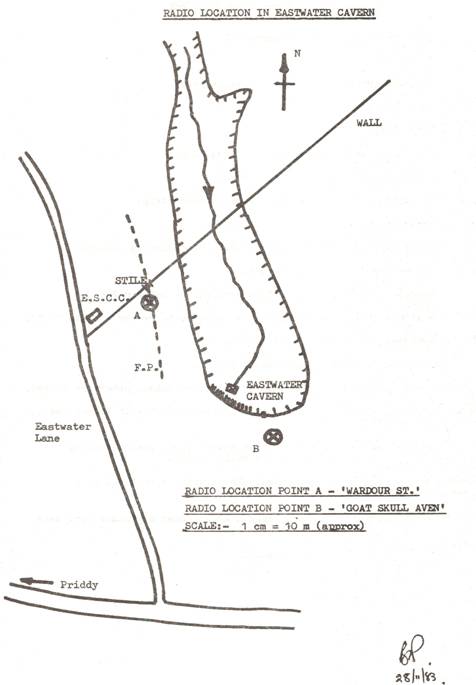
The diagram shows the position of the radio location point
(point A) relative to the surface. It is
of interest to note that projecting the known passage beyond the location point
puts the passage very close to the valley side and probably below one of the
surface quarried? depressions. The depth
of the coil below the surface was 54m (177′) which taking into account the
slope of the known passage above the transmitter coil means that the end of the
passage may only be 24m (78′) below the surface.
The second site to be radio located was ‘Goats Skull Aven’
above Bakers Chimney bypass. This aven
was chosen as a possible bypass to the Upper Traverse thus gaining access
directly to the Canyon from the surface. The located point is shown as ‘B’. This point is only 13m (43′) below the receiver coil. Taking l m as the height of the receiver coil
above the ground and 5m as being the height of the aven above the transmitter
coil we are left with 7m (23′) for the depth of rock to the top of the aven.
It cannot be far as hammering on the surface could easily be
heard in the aven! This site is very
close to the edge of the main depression, less than 9m (30). The edge of the depression at this point
appears to be mainly dumped stone waste and it may therefore be possible to
clear a trench into the side of the depression to gain access to the top of the
aven.
Bearings for Point A
130 degrees – Penn Hill TV Mast
270 degrees – Chimney on East
Somerset CC HQ.
327 degrees – Right Chimney on
Eastwater Farm
Bearings for Point B
016 degrees – Nine Barrows
Reservoir
146 degrees – White Cottage on
main road
290 degrees – Chimney on East
Somerset CC H.Q.
Note: These bearing
are taken using a simple Silva compass and therefore must only be regarded as
approximate.
Friday Night Caving Trips for 1984
22/06/1984 Goatchurch
Cavern Summer Barbeque.
29/06/1984 Manor Farm.
14/07/1984 Saturday trip.
Otter Hole. Details later.
27/07/1984 Stoke Lane.
10/08/1984 Rhino Rift
(S.R.T.)
24/08/1984 Sludge Pit and
Nine Barrows. (August Bank)
07/09/1984
21/09/1984 Swildons Hole,
Blue Pencil Passage – round trip.
05/10/1984 Cuckoo Cleeves.
21/10/1984 Saturday
trip. Dan-yr-Ogof or O.F.D. depending on
leaders.
02/11/1984
Atlas pot.
16/11/1984 Eastwater
exchange trip. Twin Verticals Dolphin
Pot .
03/12/1984 Reservoir Hole,
Limited places names to Brian Prewer Wells 73757
14/12/1984 Swildons, Old
Grotto Christmas party.
28/12/1984 Cold turkey
buffet. Goatchurch Cavern.
All trips will start at the cave entrance at 7 p.m. mess
otherwise stated.
involve an early morning start which will be decided on nearer the date
concerned.
For further information regarding any of the above trips,
please contact Ashley Hardwell (
422655 or Shepton Mallet 4789).
Where limited numbers have been indicated, places will be
reserved on a “first come first served” basis.
Together I hope we can revitalise the longest established
organised cave meet on Mendip.
Happy Caving. Ashley
Hardwell.
Caving Notes
Penyghent Pot.
Don’t forget the Club has booked this fine Yorkshire Pot for
Saturday 14th July. Anybody wishing to
go should contact me on Wells 74061.
Gouffre Berger.
As part of next years Club jubilee celebrations, it has been
decided to arrange a trip to the Berger in July 1985. Anybody wishing to come, help in organizing
(food, equipment, etc etc) should contact me or Tim Large. Further details will be printed in the next
BB.
Ian Deer Memorial Fund.
A reminder to Club members (particularly the younger ones)
that there is money available to assist in your Caving Expeditions. If you think you qualify then drop me a line
now.
St. Cuthberts Leaders.
Anybody wishing to become a leader should contact me for
details, and an application form. Since
it is now hoped that the digging at Sump 2 will recommence during the (we
hope!) dry summer your qualifying trips could be sorted quite quickly. Remember, we can’t just rely on our present
set of leaders to do all the tourist trips which we are obliged to do.
1984.
Bob Cork, Dany Bradshaw and members of the NCC are off to
the Barengassewindschact in July and if you’re interested in helping or going,
give Bob or Dany a ring.
Good Caving,
MAC
Sludge Pit Sump Where Now?
Many years go, before NHSA, two local cavers were wandering
on the slopes of North Hill in the company of their learned adviser on
geological matters. Presently they
stumbled across a deep swallet close to a site known as Nine Barrows. A name was carefully chosen for the swallet –
Sludge Pit! “This looks a likely
spot for a cave dig” they said. “No no” scoffed their adviser. For God’s sake don’t dig here, its too high up go lower down, try the
swallet near Eastwater Farm.
Thus it was that the site at North Hill was started and the
North Hill Association for Spelaeological Advancement was born. And what of Sludge Pit Swallet? That went after 7 days digging, North Hill
Swallet took a little longer ……. 7 years. The moral of course is summed up in the well known adage ‘Caves is where you find em.
 The NHASA digging team returned to North Hill after my
years away digging at Manor Farm and Windsor Hill. Sludge Pit Sump was thought an obvious site
for the team following their abandonment of the Windsor Hill Dig. Initially
before describing NHASAs involvement it would be worthwhile reflecting on the
efforts that have gone into this particular dig site in the past.
In 1967, Clive North, John Cornwell and the Bridgwater
Technical College C.C. concentrated their various activities on the Nine
Barrows area. After success at Nine Barrows,
the adjacent swallet, Sludge Pit, received their attention and was rapidly dug
open. After descending a 20 pitch, a
maze and a small streamway were entered. The streamway was explored for 500, terminating in the inevitable
sump. No obvious way on, through or past
this sump could be found.
That was in 1967. Since then, several groups of diggers have tried to extend the streamway
by attacking what appeared to be an inoffensive looking sump. The first serious attempt at digging out the
sump pool was carried out by the Axbridge C.G., starting in March 1968. Their efforts mainly involved the clearing
out of large volumes of glutinous mud. This work continued spasmodically until about 1971 when the Wessex
decided that a few weeks was all that was required to get though this
sump. Their efforts included building a
large concrete dam and retaining wall as well as pushing many pounds of
explosives on the end of long sticks into the sump pool. All these attempts were to no avail, the sump
remained inviolated.
A second
attack started in 1976 when a new high retaining wall was built on top of the
old dam. It was intended for spoil
storage, but in fact was later used for water storage by various groups baling
and pumping at the sump.
By mid-1977, the BEC had taken over the site and an attempt
was made to dig out the high level roof passage which was filled with mud. Further efforts included the hand drilling of
shot holes over the roof of the sump. All these efforts brought only frustration, lots of mud and an un-passed
sump.
About 1972, the sump was chosen by MRO as an obvious site to
test out compressed air drilling techniques using standard fire hose to convey
air to the drill at distances in excess of 300. Luke Devenish supplied the equipment and,
under the direction of the late Howard Kenny many cavers were press-ganged into
heaving heavy hoses and drills down the cave. The exercise was a great success and showed clearly that compressed air
drilling was possible at distances over 500′ from the compressor. Two shot holes were drilled some 2′ deep in a
matter of a few minutes. The fumes, dust
and noise although unpleasant, were tolerable and at the end of the day the
cave was cleared and the shot holes left to the bang gang. They succeeded in blowing 6″ of rock off
the roof into the sump!
In 1982, with the knowledge that drilling shot holes at the
sump was possible and their recently gained drilling exercise, the NHASA
digging team turned its attention to the Sludge Pit Sump. With the landowners blessing, the freshly
overhauled NSASA compressor was towed into the depression. Tests showed that drilling at the end of 500′
of standard compressor hose in place of the fire hose was feasible and that the
pressure drop along the hose was not too great.
During the course of several weeks many lengths of standard
compressor hose were placed in situ down the cave. 500′ of hose was used to be exact and in
parallel with this a telephone cable cum bang wire was installed providing a
necessary link between compressor operator and drillers mate. The hose was laid were possible to ensure
that it was kept out of the way of the scores of other cavers visiting Sludge
Pit. The next few weeks saw the drill,
the steels and various other bits and pieces carried down to the drilling
area. The first site chosen was at the
sump pool itself. The water level
appeared to be nearly constant even with fairly large variations in the amount
of water flowing into the pool. But
where to drill first? The obvious place
to anyone who knows about sumps is over the top of them, thus creating an air
space above the water level. But which
way does the sump go? No one seems to
know. Well firstly try to bail your
sump, during a period of drought – Sludge Pit stream has never heard of a
drought. Perhaps try bailing it quickly
into polybags so that it does not get a chance to refill. This results in the sump pool being lowered
by ½ in one hour and in many wet diggers
abandon bailing efforts.
Next try drilling two or three shot holes into the nearest
obvious lump of solid rock, after all thats what we took the drill down
for. Fill the holes with many sticks of
gelly. Conclusions…….holes drilled
into massive limestone rock faces make good cannons when suitably charged with
explosives, mud and stones. Forward
progress
Nil. Repeat experiment with new
shot holes 4′ deep. This confirms
previous experiment. Next try
non-parallel shot holes. This idea gives
better results as far as rock removal was concerned, but still provided a
fairly effective cannon.
After about 3′ of rock had been removed somebody suggested
draining the sump might be a good idea! Why hadnt we thought of this before? A suitable hand pump was brought into use at this stage, resulting in
the sump pool being lowered by ½ and more wet diggers! How about a water pump that operates on
compressed air. Too expensive, even for
NHASA, however a wave of a magic wand and lo and behold a pump, which after
suitable reconditioning was…..never used! And why? Somebody thought they
could see the way on, “down to the left – follow the strike. Now the hole drillers could have a field
day. Shot holes to the left, shot holes
to the right, some in the roof, some in the floor, dust and oil fumes
everywhere………The result of this activity was 3′ of passage and a large
puddle of water in the floor of the new passage. We had found another small inlet to the main
sump pool.
Where shall we go next? Back to the sump pool after all everyone else had had a dig at it. No, its time to look at the small hole on the
left above the sump pool. This small
rift had already received plenty of attention and had been abandoned as being
too tight to dig any further. With the
new found technology, shot holes were strategically placed on the left hand
wall, quite an interesting task bearing in mind the height of the drill and the
height of this hole above the sump pool. A few small sticks of roll your own gelly, just enough to knock the corner
off, produced a scene of total destruction in the terminal chamber. Over night the sump pool became a boulder
ruckle and the roof looked like a multi-bladed sword of Damocles However, after a bit of tidying up, digging
started in the big rift. After two
digging sessions the passage showed great promise, being mud filled and about
3′ square. The following session brought
a complete contrast… ..solid rock! At
this point a NHASA board meeting came to a unanimous decision to abandon the
site and retire to the Hunters for another board meeting…………..
After many diggers had tried and failed to pass the sump in
Sludge Pit, NHASA had also tried and failed despite using high technology
equipment and techniques.
What of the future for the apparently impenetrable
sump? Probably the answer lies in the
pool itself. It needs to be pumped out
and excavated, but first remove your boulder ruckle! The two side passages following the strike
are almost certainly not the way on, both close down. Perhaps we should really have stuck to the
sump pool and tried to pump it out after all. Remember the water does go down Swildons! Anyone want to borrow a good pump and
compressor?
The final act was the complete clearing of all the removable
rubbish at the sump. Cave diggers are
generally a rather untidy lot leaving a lot of rubbish behind when they abandon
their scaffolding, pipes, polybags, stirrup pump, tools etc. We have attempted to clear this mess and
return the cave to near its original state with theexception of course of the
new boulder ruckle in the sump.
Brian Prewer
March 1984
B.E.C. Publications I947 – 1984
The following list of published material was compiled by
Jonathan Roberts of the M.C.G. during cataloguing for the M.C.G. 1ibrary. With one or two additions it is here
published with his-kind permission as a guide for members who are trying to
build up their own sets of club material. It is quite possible that items have been missed out and any additions
or corrections will be appreciated. All
publications listed can be found in the Library.
NB B.B. Nos 48, 102, 341, 263-269 do not exist in
published form. (Angus take note)
Tony Jarratt.
Belfry Bulletin: (BEC)
|
Vol |
YEAR |
Jan |
Feb |
Mar |
Apr |
May |
Jun |
Jul |
Aug |
Sep |
Oct |
Nov |
Dec |
|
1 |
1947 |
1 |
– |
2 |
3 |
4 |
– |
5 |
– |
6 |
7 |
– |
8 |
|
2 |
1948 |
9 |
– |
10 |
– |
11 |
12 |
13 |
14 |
15 |
16 |
17 |
18 |
|
3 |
1949 |
19 |
20 |
21 |
22 |
23 |
24 |
25 |
26 |
27 |
28 |
29 |
30 |
|
4 |
1950 |
31 |
32 |
33 |
34 |
35 |
36 |
37 |
38 |
39 |
40 |
41 |
42 |
|
5 |
1951 |
43 |
44 |
45 |
46/47 |
* |
49/50 |
– |
– |
51 |
52 |
||
|
6 |
1952 |
53 |
54 |
55 |
56 |
57 |
58 |
59 |
60 |
61 |
62 |
63 |
64 |
|
7 |
1953 |
65 |
66 |
67 |
68 |
69 |
70 |
71 |
72 |
73 |
74 |
75 |
76 |
|
8 |
1954 |
77 |
78 |
79 |
80 |
81 |
82 |
83 |
84 |
85 |
86 |
– |
87 |
|
9 |
1955 |
88 |
89 |
90 |
91 |
92 |
93 |
94 |
95 |
96 |
97 |
98 |
99 |
|
10 |
1956 |
100 |
101 |
* |
103 |
104 |
– |
– |
– |
105 |
106 |
107 |
108 |
|
11 |
1957 |
109 |
110 |
– |
111 |
112 |
113 |
114 |
115 |
116 |
117 |
118 |
119 |
|
12 |
1958 |
120 |
121 |
122 |
123 |
124 |
125 |
126 |
127 |
128 |
129 |
130 |
131 |
|
13 |
1959 |
132 |
133 |
134 |
135 |
136 |
137 |
138 |
139 |
140 |
141 |
– |
142 |
|
14 |
1960 |
143 |
144 |
145 |
146 |
147 |
148 |
149 |
150 |
151 |
152 |
153 |
154 |
|
15 |
1961 |
155 |
156 |
157 |
158 |
159 |
160 |
161 |
162 |
163 |
164 |
165 |
166 |
|
16 |
1962 |
167 |
168 |
169 |
170 |
171 |
172 |
173 |
174 |
175 |
176 |
177 |
178 |
|
17 |
1963 |
179 |
180 |
181 |
182 |
183 |
184 |
185 |
186 |
187 |
188 |
189 |
190 |
|
18 |
1964 |
191 |
192 |
193 |
194 |
195 |
196 |
197 |
198 |
199 |
200 |
201 |
202 |
|
19 |
1965 |
203 |
204 |
205 |
206 |
207 |
208 |
209 |
210 |
211 |
212 |
213 |
214 |
|
20 |
1966 |
215 |
216 |
217 |
218 |
219 |
220 |
221 |
222 |
223 |
224 |
225 |
226 |
|
22 |
1967 |
227 |
228 |
229 |
230 |
231 |
232 |
233 |
234 |
235 |
236 |
237 |
|
|
22 |
1968 |
238 |
239 |
240 |
241 |
242 |
243 |
244 |
245 |
246 |
2147 |
248 |
249 |
|
23 |
1069 |
250 |
251 |
252 |
253 |
254 |
255 |
256 |
257 |
258 |
259 |
260 |
261 |
|
24 |
1970 |
262 |
270 |
271 |
272 |
273 |
274 |
275 |
276 |
277 |
278 |
279 |
280 |
|
25 |
1971 |
281 |
282 |
283 |
284 |
285 |
286 |
287 |
288 |
289 |
290 |
||
|
26 |
1972 |
291 |
292 |
293 |
294 |
295 |
296 |
297 |
298 |
299 |
300 |
301 |
302 |
|
27 |
1973 |
303 |
304 |
305 |
306 |
307 |
308 |
309 |
310 |
311 |
312 |
313 |
314 |
|
38 |
1974 |
315 |
316 |
317 |
318 |
319 |
320 |
321 |
322 |
323 |
324 |
325 |
326 |
|
29 |
1975 |
327 |
328 |
329 |
330 |
331 |
332 |
333 |
334 |
335 |
336 |
337 |
|
|
30 |
1976 |
338 |
339 |
340 |
* |
342 |
343 |
344 |
345 |
||||
|
31 |
1977 |
346 |
347 |
348 |
349 |
350 |
351 |
352 |
353 |
354 |
355 |
356 |
|
|
32 |
1978 |
357 |
358 |
359 |
360 |
361 |
362 |
363 |
364 |
365 |
366 |
367 |
368 |
|
33 |
1979 |
369 |
370 |
371 |
372 |
373 |
374 |
375 |
*376 |
378 |
– |
379 |
380 |
|
34 |
1980 |
381 |
382 |
383 |
384 |
385 |
386 |
387 |
388 |
389 |
390 |
391 |
392 |
|
35 |
1981 |
393-394 |
395-396 |
397 |
398-399 |
400 |
401 |
402-403 |
404& |
||||
|
36 |
1982 |
405 |
406-407 |
408-409 |
410-411 |
412-413-414-415 |
416 |
||||||
|
37 |
1983 |
417 |
418 |
419 |
420 |
421 |
|||||||
|
37 |
1984 |
422 |
|
|
|
|
|
|
|
|
|
|
|
* 48, 102 and 341 are unpublished.
376 is also numbered 377.
Caving Reports:
1. ‘Surveying in
2. A Preliminary Report on St Cuthbert’s
Swallet. R Bennett/D A Coase/C P Falshaw, J J Waddon, August 1956.
3. The
Manufacture of Lightweight Caving Ladders, B M Ellis, by 1958.
3A. The Manufacture of Lightweight Caving
Ladders, B M Ellis, October 1962.
3A. The Manufacture of Lightweight Caving
Ladders (SMCC method) B M Ellis, reprinted January 1973.
3A. The Manufacture of Lightweight Caving
Equipment, BM Ellis, October 1962. P
4. The Shoring
of
1958.
5. A Survey of
Headwear and Lighting available for Caving, BM Ellis, October 1958.
6. Some Smaller
Others, October 1961.
7. A Second
Report on St Cuthbert’s Swallet, anon, February 1962.
8. A
Preliminary Survey of St Cuthberts Swallet, anon, February 1962.
9. Some Smaller
1962.
10. The BEC Method of Caving Ladder
Construction, D A Coase & N Petty, December 1962.
11. The Long
Chamber/Coral Area of St Cuthbert’s Swallet, D J Irwin, October-1965.
12. The Presentation
of Cave Survey Data, S J Collins, September 1966.
13. St.
Cuthbert’s Swallet Report’s:-
Part A
Discovery & Exploration, D J Irwin/R D Stenner, G D Tilly, October 1968.
(Parts B,
C, D not published yet).
Part E
Rabbit Warren, DJ Irwin, June 1970.
Part F Gour
Hall Area, R Bennett/D J Irwin, April 1969.
Part G
Cerberus and Maypole Series, R Bennett/D J Irwin, October 1982.
Part H
Rabbit Warren Extension, D J Irwin/D P Turner, August 1970.
Part I September Series, R D Craig/D Irwin/R D
Stenner, October 1982.
(Parts
J,K,L,M,N not published yet)
Part O Miscellaneous Information’, B
M Ellis/D J Irwin/P A
September 1966.
14. Balague
1970, DJ Irwin (editor) 1973.
15. Roman Mine,
near
(Mon)’, J & N Tuck, July 1971.
16. Mendip’s Vanishing
Grottoes, JA Eatough/A E Mc R Pearce,?1971.
17. A Burrington
Cave Atlas, D J Irwin (editor) October 1974.
18. Cave Notes
’74, DJ Irwin (editor), October 1974.
19. 1975
Expedition to the Pierre Saint-Martin, anon, ?1976.
(20 has not been
published yet)
21. Cave Notes (1975-77)’ *, anon, May 1977.
* erroneously numbered 19 on the back.
Climbing Reports:
Some
Sandstone Climbs in the
R S King, April 1966.
Other Publications:
Belfry Bulletin Digest No.1, June
1959.
A List of reference to Work on
Mendip by the B.E.C., abstracted from the Belfry Bulletin Nos 1-160, undated.
A Variation in Temperature and
Hardness of Streams in St. Cuthberts Swallet (A Progress Report) R D Stenner,
September 1966.
A New Approach to Cave Surveys, S
J Collins, 1967.
The Spelaeodes, Alfie (S J
Collins), 1969. (2 different editions).
Irwin, September 1972