
Any views expressed by any contributor to the Belfry
Bulletin, including those of officers of the club, do not necessarily coincide
with those of the editor or the committee of the Bristol Exploration Club,
unless stated as being the view of the committee or editor.
Contents
Club Headquarters
The Belfry,
Rd.
Club Committee
Chairman: S.J.
Collins
Minutes Sec: To be appointed.
Members: B. Wilton; D.J. Irwin;
D. Stuckey; N. Jago; A.R. Thomas; R. Orr; N. Taylor; G. Wilton-Jones; M. Bishop
Officers Of The Club
Hon. Secretary: A.R.
THOMAS, Allens House,
Barrows Lane
Hon. Treasurer: B.
Caving Sec: D. STUCKEY, 34 Allington
Rd, Southville, Bristol
Climbing Sec: N. Jago, 27 Quantock Rd,
Windmill Hill, Bedminster, Bristol 3.
Hut Warden: N. TAYLOR, Whiddons,
Chilcote,
Hut Engineer: M. BISHOP, Isl;ay, 98 Winsley Hill, Limpley Stoke,
Tacklemaster: G. WILTON-JONES, 17
Monkhams Drive, Watton, Thetford,
B.B. Editor: S.J. COLLINS, Lavender
Cottage, Bishop Sutton, Nr. Bristol. Tele. CHEW MAGNA 2915.
Librarian: D.J. IRWIN, Townsend
Cottage, Priddy, Wells,
Publications: To be appointed
B.B. Post: B.
MENDIP RESCUE ORGANISATION. In case of emergency telephone WELLS 73481
Editorial
Manor Farm
The editors usual complaint about the discovery of new
caves on Mendip is the length of time which elapses before any active caver can
be persuaded to write a description for the B.B. This was even – regrettably – true in the case
of Cuthberts. It is thus more than usually
pleasant to have received not one, but two accounts of this new addition to the
major caves of Mendip, both of which are in this B.B. Our sincere congratulations to the diggers –
and the writers.
One point I feel should be made/now that we have a new cave
which contains, I understand, some fine formations; and that is to express the
hope that some method may be found to preserve them. I have personally been lucky enough to have
seen the White Way in Swildons when it was white; the helictites in G.B. when
even the First Grotto was covered in them; Princess Grotto in Stoke when its
crystal floor was still untouched by human boot; the Streaky Bacon in Rods when
it was still there; the unique (to my knowledge) unsupported flows in Hilliers
before some idiot put his boot in and many other worthwhile bits of underground
scenery which once distinguished these caves from assault courses/rubbish
tips. I hope (probably in vain) that we
can manage to leave at least something for cavers of the future to look at.
The A.G.M ..
A quiet A.G.M. will, I think, be the verdict on 1973. As Mike Palmer said, however, the stirring-up
which went on at the 1972 meeting has had, and is still having, a good effect
on the club and the quiet atmosphere of 1973 was thus not due to apathy as to
the lack of need for further innovation at this point in time.
Certainly the voting could hardly be called apathetic. A 40%
poll for the committee at a time when no controversial issues were at stake
argues a very sound and widespread degree of interest amongst the club
membership. This is a very encouraging
sign and one which augurs well for the future of our club.
The new voting system appears to have worked very well. A feature made possible by this system will
be the inclusion of a sign against members names in the annual list which is
published in November to show if his or her vote was received or not, thus
giving all members a chance to check up on this vital point. This can now be done because the members
names can now be separated from the paper showing how the votes were cast. Thus, the votes have been destroyed but the
names of the voters retained.
This also kills the myth once and for all that some people
on the committee are kept going almost exclusively by the votes of older and no
longer active members. In fact, the
combined votes of all members whose numbers are below 500 only amounted to a
quarter of the total, and those of all members whose membership number is below
600 still made up less than half the votes cast. Of course, the actual number of votes
necessary to ensure election to the committee varies widely from year to year,
but it is safe to say that members on the upper half of the list of those
elected are drawing their votes mainly from the younger members.
And Dinner
Again, an average dinner with – so far – very few complaints
to the committee. In this connection,
some members might not be aware that the committee has to choose the place for
the 1974 dinner quite soon – so if anyone has anything to say; it would be as
well to say it quickly!
The B.E.C. dinner is, by tradition, noted for two things –
its presentations (which were well to the fore this year) and its entertainment
(which was non-existent, although there are plans for reviving it next year.)
A small point which members might like to consider was the
start of a move towards throwing things. The caving clubs of Mendip between them hold a number of annual dinners,
and it would be a shame in my opinion if they all became too similar. One of these dinners traditionally includes a
missile-throwing session; so perhaps it might be as well not to pinch other
people’s ideas.
Resounding Clang
It was, of course, predictable that in a B.B. which boasted
of its 300th appearance, a clang of monumental proportions should have
appeared.
For some reason which is still difficult to explain, some
members lost pages 194 and 215 and received pages of the August B.B. in their
place. After a number of people had rung
me up to point this out – all of whom wanted the page 215 (194 was merely the
list of club officers) we have decided to REPRINT this page in this B.B. To add to the confusion, it will have a new
number but there will be some indication that it is, in fact, the missing page.
To add even further to the confusion, now that this B.B. has
been laid out, it has not been found possible to get the missing page into this
issue. Hopefully, it will now appear in
the November B.B.
Publications Department
With Dave (The Wig) Irwin finding increasing demands on his time,
it becomes necessary to find somebody willing to take on the editorship of the
club’s Caving Publications. Any
interested member should get in touch with Dave, who will give them an idea
about the job and what it entails. THIS
IS IMPORTANT so now is the chance for somebody to come forwards. More details next month.
Alfie
Manor Farm.
A short report compiled by three
B.E.C. members. Nigel Taylor; Graham Wilton-Jones and Dave Irwin.
The first of our two reports on this new Mendip cave.
On the 5th of September 1973, Mendips latest discovery was
broken into after many years of hard digging by the U.B.S.S. and the group of
diggers collectively known as N.H.A.S.A. The entrance is close by the huge shaft that opened up in 1968 in the
July floods. The cave dips steeply over
its length, broken in the middle by a series of potholes up to 20 feet
deep. The cave displays a wide variety
of passage shape and dimensions, some fine stalagmite formations and a number
of interesting inlets. At the time of
writing the cave has only been visited under fairly dry conditions. What it will be like under winter conditions
is hard to say except that the sink has been known to take a considerable
quantity of water from time to time. The
entrance shaft requires a 50 ft. ladder.
Mainly Historical
The site has been of interest to Mendip cavers since the end
of the war, and was dug by A.C.E.S. Caving Group and M.N.R.C. in the later
’40’s. Pete Stewart wrote in 1950,
..The swallet is situated at Charterhouse
in the grounds of Manor Farm and in wet weather takes a lot of water
Work commenced on June 3rd and during the
weekend, the existing timbered shaft of 5ft was extended to 12ft. The work was hard going, as the excavated
material had to be hoisted to the top of the shaft. Work continued on the following weekend, but
progress was very slow – and it was decided to abandon the dig. The total depth reached from the top of the
shaft was approximately 15ft. The rock
face began to slope under at about ten feet.
During the course of the dig, some interesting looking bones
were unearthed and our President, Mr. H.E. Balch, identified them as Bos (i.e.
cow). The shaft has not been filled
in. (British Caver No 21, 1950.)
The site was little worked and, apart from occasional visits
by cavers, fell out of interest for the next fifteen years. The U.B.S.S. team, spearheaded by Mike
Norton, next took up the challenge and continued working at the shaft. After difficult digging, a sighting was made
into a small chamber and a little more work was required actually to enter
it. The next day, a descent was made –
only to find that the roof had collapsed, blocking the way on. Before the U.B.S.S. had a chance to do any
further digging, the Great Flood of July ’68 struck, and the famous Manor Farm
Shaft opened up, further blocking the way on. Some little digging was carried out at the bottom of the shaft, but the
enormous quantities of infilling and the threat of the collapse of the shaft forced
them to abandon any further digging attempt. With sheer determination, they resolved to drive a shaft down to the
chamber by the use of explosives. Thus the site of the current entrance came
into being. The shaft was hewn out of
the solid rock and at a depth of fifty feet a small passage was encountered and
followed, with the help of more ‘bang’, to the base of the main shaft
collapse. They eventually entered the
base of the shaft on the downstream side and it was here that the U.B.S.S.
continued their dig. However, the Mike
Norton team began to break up and interest gradually waned. By 1971, work at the site had just about
ground to a halt.
The N.H.A.S.A. team (Messrs Hanwell; Thompson; Davies;
Barton etc.) after their long dig at North Hill, turned their attention to the
Velvet Bottom area of Mendip. Firstly to
Bedstead Dig and soon after to Manor Farm Swallet. After difficult negotiations with the
U.B.S.S. they were given permission to dig at the site – but at a cost. The basic agreement with the U.B.S.S. was
that, should anything be found, then the report and survey be published in the
U.B.S.S. Proceedings. This agreement
was, incidentally, made with the Wessex Cave Club and not N.H.A.S.A.
Digging by N.H.A.S.A. commenced at the bottom of the known
cave but not at the site chosen by the U.B.S.S. Slightly more to the East lay another diggable passage which, though
choked, appeared more interesting. One
by one, the basic N.H.A.S.A. team dropped by the wayside, and the brunt of the
digging continued through the winter of 1972-3 with ‘Prew’, Nigel Taylor,
Albert Francis and Pete Palfrey.
Later in ’73 the team was augmented by several other diggers
such as John Ham, Martin Bishop etc.
The dig had reached the 12′ Rift in September 1972 where a
three inch slot was found by accident. Four banging trips followed and the descent of the rift made (This is
September Rift) which led to a small passage ending in Penthouse Chamber. This passage once contained formations which
have inevitably to be destroyed by digging. Other fine formations were seen in the roof and the point reached by
Nigel Taylor, who entered a small grotto. A whirlpool sink mud formation lay in the floor. This was the subject of attack, though attention
was soon turned to the sink at the end of the chamber. A small stal cavity was noted, but
preservation decreed that it should not be touched, although several of the
diggers wanted to.
Here, at the end of Penthouse Chamber, the diggers were
working continuously from September 1972, often at week-ends and every
Wednesday night until September 5th 1973. Many tons of muck and rock were removed during this period of a year –
so much so that the floor of the chamber is now some ten feet higher than when
it was first entered and the walled-up spoil heaps are some sixteen feet above
the same level. Over 190 polythene sacks
were ‘issued’ to the dig and these filled up less than a twentieth of the total
spoil heap.
When the dig sumped with diluted ‘cowsh’ in October-November
1972 and only three or four diggers actually constituted the team, holes were
breached in the floor of the dig and 80% blasting gelignite charges were used
in pipes – with instantaneous effect – and the stream was lost again. After March 1973, more dig-shaking pipe
charges were employed to make the material more removable and less
tenacious. This technique came to be
used very frequently. Towards the end of
March and early April, it was decided to enlarge the September Rift so as to get
the railway line into Penthouse Chamber if required and also to facilitate the
passage of other, more well-developed diggers. About this time, the team was often down to three diggers – Prew, Pete P
and Nig. or Albert, Pete P and Nig or other permutations on those four.
From, July, boulders were met again and heavy plastering began
using a technique that pulled the spoil towards the digging face. In September, a large 3½ lb. plaster in five
shots with delays was applied to the working face, with the end result of
changing Manor Farm Dig into Manor Farm.
In the B.E.C. Caving Log, Nig Taylor wrote short notes on
the digs progress and what follows is a selection;
17th Jan 1973.
Administered 1½ lbs chemical in
pipe to drain sump – hopefully.
11th Feb 1973.
3 lbs fired in stream sink
choke. Satisfyingly quiet – but hope
effective – rumble.
9th Feb 1973.
Small charge and shifting debris
from previous week. Prew, Pete and
myself. 3 hours.
14th Feb 1973.
Pete Palfrey, Prew, Albert
Francis and myself. Slow progress for
hard effort.
28th Feb 1973.
Prew, Albert and yes, yet again
Pete Le Palfrey – noble squire and overseer of Manure Farm and self. Much rubbish removed. Also joined by John (Bacon) Bam of W.C.C.
23rd March 1973.
Albert Francis and self. To administer 1lb plaster charge in rift to
enable railway line to be taken down into Penthouse Chamber to facilitate spoil
removal from main dig.
(From this time on, the routine
was removal of spoil and yet more spoil.)
22nd August 1973
4½ lb. quadruple charge plaster
as boulder baiter.
(Thus, on September 5th, whilst clearing the debris from the
previous bang, the team made the initial breakthrough into the First Chamber.)
This breakthrough on September 5th led the explorers to
Alberts Eye and the week following saw the cave extended to the Gravel
Choke. Through boulders in the roof of
this rift came the discovery of N.H.A.S.A. Gallery – a 300 ft long large
passage. Fred Davies pioneered climbs to
the inlets that led to the discovery of two interesting inlet passages.
The Cave at
N.G.R. 4982 5566
Alt. 750 O.D., Length 2,000ft approx. Depth 350-400
The entrance to the system is a fifty foot deep vertical
shaft, capped with a low blockhouse. (50′ ladder, 2 belay and 100 lifeline.) This had, until 10.10.73, a fixed iron ladder
installed. There is now a suitably
placed scaffold pole which acts as a belay for electron ladder. Underneath the bottom of the ladder, a hands
and knees crawl leads through a square section passage blasted open by the
U.B.S.S. After about thirty feet, one
drops through an eyehole to the right. A
few feet further leads one to the abandoned U.B.S.S. dig on the right, but the
way on to the main cave is to the left, the side of which has been stone
walled. The debris above the wall is the
base of the now filled 1968 flood shaft. The floor at this point changes from clean gravel to cowsh-covered
gravel. Below the wall, to the right,
the passage drops away down the bedding at the bottom of which is a twelve foot
deep, narrow rift. This is September
Rift (15′ ladder and 2′ belay to wooden beam). This lands in a vadose
entrenched bedding plane going steeply (about 30O) down dip. Upwards, there is a low wide area full of
organic deposits. This is the source of
a stream which soon sinks in boulders and also the source of the famous Manor
Farm earthworms. The worms are seen at
various points deeper down, even crawling over stal. Downwards, the bedding plane development is
obliterated by excavated material and dry stone walling. Soon, there is a low crawl below some large
old broken stalactites. This is the site
of the September ’73 breakthrough.
The crawl breaks out into a large chamber dominated by a
magnificent curtain formation dropping on the left above a mass of
heavily-stalled boulders. The curtain
formation is a pale orange-tinted white and is over eight feet high. A passage leads away, up to the left above
the stal flowed boulder pile. THIS
NEED NOT, AND SHOULD NOT BE ENTERED. It is merely an awkward alternative to the main stream route. THE TAPE MUST NOT BE CROSSED FOR ANY REASON.
Just below these formations is a pitch of about twenty
feet. At present there is a steel stake
driven into the rock for a belay. The
ladder needs only to be about ten feet long, the remainder of the drop being a
straightforward free climb. The top is
awkward without a ladder. Much of the
right hand wall of the free-climb is pyrolusite and has a nasty tendency to
break away when weight is applied to it. This pitch could well be awkward under high water conditions as there is
every indication in the left hand wall (all left and right directions in this
article are looking down cave) that the stream shoots across the drop and hits
the left hand wall about ten feet from the top.
From this twenty foot pitch, the cave drops rapidly in a
series of small potholes including one of twelve feet that requires a
handline. One noticeable feature of
these potholes is that they have been heavily stalagmited over in the past and
are now being etched with fine vertical flutes – no little contribution to this
erosion being the large quantities of cowsh in the stream. On the left of the streamway are two large
stal bosses. One of these has erosion
fluting more typical of
fluting on its upstream side and thus it can be inferred that the cave has seen
a number of periods of heavy water presumably winter water levels.
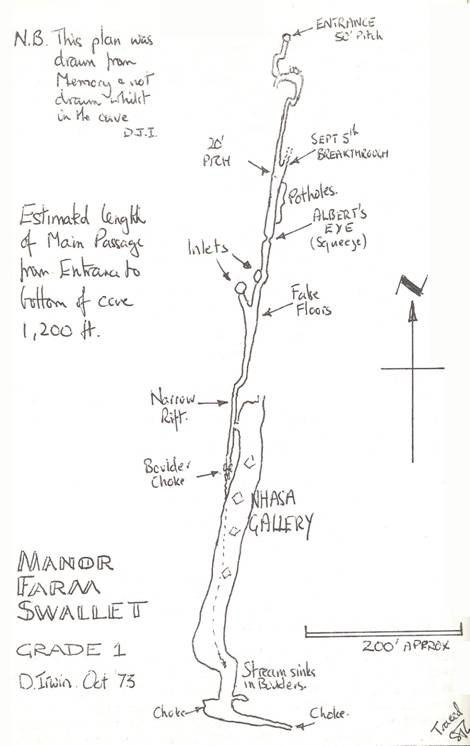
The rift below the breakthrough into the main cave goes
practically to the bottom of the known system, changing joints only
occasionally and following the same group of beds all the way. There are two basic beds that may be seen
throughout the length of the system:-
1. A group of thin beds, each about 4″ thick
with a total depth of about three feet.
2. A fossiliferous bed containing all the usual
Mendip razor-rock specimens – Spirifer; Productus; Lithostrotion Crinoid stems,
etc
Below the potholes, the rift closes down to the only squeeze
on the main route. It is neither particularly tight nor awkward and apart from
this there are very few places where it is not possible to walk.
Nearer the bottom of the rift is an area of between six and
twelve inches of false flooring. THIS
SHOULD NOT BE WALKED ON but stepped over or crawled under. The false floor area is shortly followed by a
drop to the right and an excessively muddy area and a long pool in the
narrowing rift. Continuing down the rift
leads to a gravel choke under a boulder pile jammed in the upper parts of the
rift.
Moving back upstream, one will see that the rift widens and
a prominent ledge allows one to traverse back up cave and through a hole
amongst boulders in the roof, one can gain access to N.H.A.S.A. Gallery. From there onwards, the character of the cave
changes completely. The chamber is a very
old collapsed zone, so complete that there are no signs of water action on the
walls, except where stal is to be seen flowing from the roof beds. There are, in this chamber, clear white
curtains and stalagmites and a few stalactites. The floor, apart from boulders, is of dry sand. The chamber extends down dip to meet a small
stream which emerges from a gravelly area on the right of the bedding. A short crawl on the left at the lowest point
of the chamber leads to a passage with loose boulders below which the stream
sinks. Over the boulders, a
sandy-floored chamber, reminiscent of Cwm Dwr Smithy area, is a tight 15 foot
drop to another sink (?) – some have suggested that the water wells up at this
point. This requires a ladder and a
twelve foot tether. Straight on from the
chamber, through a muddy crawl, is a phreatic sumpy area of mud and the end of
the cave so far. A too narrow rift
continues beyond this area.
There are also several inlets that are of particular
interest and, going back out of the cave, they are:-
1. The bottom of the N.H.A.S.A. Gallery. This may not the same stream as that sinking
at the gravel choke at end of the main rift.
2. On the left of the N.H.A.S.A. Gallery, a stream
can be heard in a crevice.
3. Falling into the narrow rift, just before to
N.H.A.SA Gallery, is a quite heavy drip.
4. There are two forty foot avens in a major right
halfway down the cave. There is a heavy
good stream. At the top of the furthest
aven there is least two hundred feet of inlet passage with very formations in a
grotto at the head of the aven.
5. There is a climb down below the curtain in the
chamber above the twenty foot pitch.
6. Water from Penthouse Chamber probably enters the
cave again. At the bottom of the twenty foot pitch?
It should be remembered that all this has been observed
during drought conditions. At the time
of writing there are very few streams on or under Mendip. Manor Farm will very interesting under winter
conditions – and should be spectacular in flood.
Under Autumn 173 conditions, the system would be graded as
V.D.P. and with more water underground could easily become S.P. Although still a small cave by general
standards, it is certainly a rewarding find for the diggers and a major
addition to Mendip caves.
Mendips Longest Caves:
Swildons Hole 23,500ft
St. Cuthbert’s Swallet 21,500ft
G.B. Cavern 6,400ft
Stoke Lane Slocker 6,000ft
August/Longwood 4,500ft
Eastwater Cavern 4,400ft
Goughs Cave 3,750ft
Withy Hill 2,300ft
Sandford Levvy 2,000ft
MANOR FARM SWALLET 2,000ft Approx to date
Sludge Pit 2,000ft
Read’s Cavern 1,900ft
Reservoir Hole 1,600ft
Manor Farm Swallet
Our second article on Manor Farm
follows on the next page. This is
appearing in the Wessex Journal, and other copies have been sent to U.B.S.S.,
Cerberus and the S.M.C.C. so that the information becomes widely available on
Mendip.
As we said earlier, this B.B. is
very much a Manor Farm issue, but we make no apology, as it is very pleasant to
be able to report so fully on a new Mendip discovery so soon after the actual
event.
And the last shall be
first by J .D. Hanwell.
September 1973, the promised potential of this last classic
swallet on central Mendip was finally realised. Those eventually rewarded were last in the long queue of contenders for
the honours which stretches back to 1947. The history of this saga is best told by those who made it (Harvey 1950,
Stewart 1952 and Norton 1969). Your
narrator has no such pedigree by comparison, only claiming to be among the many
lending a hand during the most recent onslaught jointly mounted by the U.B.S.S.
and Wessex C.C. inspired by N.H.A.S.A. diggers. The latter, hardened to lost causes and gentle ridicule, took on the job
on the 17th May 1972. Final success came
unexpectedly and rapidly on the 12th of September the following year after some
600 man-hours and 75 trips.
We now know that earlier Manor Farm devotees who bottomed
the ill-fated concrete shaft in 1966 were so close to entering the system; only
being cheated by blockages created by the July 1968 flood (Hanwell &
Newson, 1970) whilst hard at blasting a by-pass – the present entrance
shaft. Some of the last handfuls of
spoil removed before the final break through contained fragments of concrete
and glazed pipes originating from the dramatic 1968 collapse at the stream
sink. Chance, after all, does favour
those who leave no stone unturned.
The following record draws mainly from N.H.A.S.A. logbook
entries by no less than 17 signatories belonging to every Mendip-based
club. More than twice this number have
been involved overall. It seems fitting,
and hopefully prophetic that the last major swallet cave left in the area
should have been won through the combined efforts of so many cavers and clubs. There can be little doubt that similar
tactics are needed to find what remains undiscovered elsewhere on Mendip. Maybe Manor Farm is the first of a new
generation of local discoveries using such methods. St. Bruno’s tradition lives on after almost a
thousand years, though St. Swithin and St. Cuthbert have little to fear yet!
Most of the digging sessions during the first summer were
devoted to installing a rigid ladder on the entrance shaft and building a
concrete retaining wall down slope of the 1968 collapsed shaft. Whilst each convinced the other that both
were necessary for rapid retreats and safety, it must also be recorded that
N.H.A.S.A. had never previously dug a site so far from the Hunters. Time spent is time lost, after all! A wooden rail track was constructed to the
working face and former U.B.S.S. rolling stock pressed into service. By mid-August, the dry sandy fill blocking
the steeply descending passage was appearing less formidable and the going
easy. Early the next month a narrow rift
was uncovered in the floor and a flurry of activity ensued between the 13th and
the 20th. For Thursday the 21st
September, the log simply states ‘A look at extension below rift – see sketch’. In fact, after descending the tight rift for
some 15 feet, a short crawl gave access to a high chamber apparently developed
along the same N -S fault that controls the line of the upper Railway
Passage. Whilst a tortuous up slope
route led to a miserably tight streamway, the chamber also terminated
disappointingly beneath a vast slide of evil smelling mud. Here was the main mass of the 1968 collapse
similar to that which invaded nearby G.B. during the same event, and lubricated
with subsequent farmyard drainage for good measure! A daunting prospect but for an obvious sink
near the end.
After a short period of disorganised burrowing, a major
effort was mounted at the most Southerly point where the ‘omens’ were
considered more ‘favourable’. Retaining
walls were built, a trench started, and real forward progress was apparent by
Christmas. Labour was not so easy to
come by in the months that followed, but a committed few maintained steady
progress downhill, meeting a greater proportion of boulders lodged in a
definite passage. Several of the
boulders required banging before being removed to the ever increasing walls
flanking the chamber. Fears over the
rapidly diminishing space for further dumping were heightening as the summer
brought out more slaves and so more spoil. Then, just as the situation was appearing its bleakest, some rocks were
removed on August 15th and a stream heard beyond. One more bang did the trick and, on the last
trip that month, the music of a boulder falling stream was heard!
On Wednesday 5th September, the promised streamway was reached. The log records ‘The usual Wednesday night
team Nigel Taylor, Martin Bishop, Albert, Pete Palfrey, John Ham Prew and
several others spent an hour removing mud etc from the dig. A small hole appeared and was soon cleared to
reveal a stal barrier under which we were able to crawl. The party explored approximately 560 feet of
passage which included a large well-decorated chamber containing a fine
curtain. A 20′ climbable pitch leads
from the chamber to two 10′ waterfalls. Passage ends in a sump pool with possible route over the top. An inlet passage leading from Curtain Chamber
was also explored for about 200-300’.
The party were back again in force on the 12th and 13th,
taking hammer and chisel to the stalagmite floor above the sump. The story of the final breakthrough and
exploration continues thus in the log book: – “Martin Bishop squeezed
through, followed by Albert Francis and the rest of the party Brian Prewer,
John Ham, Pete Rose, Nigel Taylor, Nick Chipchase, Pete Palfrey, Chris Backstone
and three of Mr. Jeffriess family from Manor Farm. Large rift entered over 30′ high. Stream passage followed for many feet to
climbable 15′ pitch. Large passage with
40′ aven and stream enters from right. Left turn into large stream passage descending at 30O. Chamber entered with large boulders. Rift continues with stream. Many sections of false floor. Rift narrows and ends in boulder choke. High level route leads to bedding plane
passage 30′ wide, 15′ high and dropping at 30O. Much on boulders on floor. Stream
re-entered. More high level
passages. 20′ pitch descended. No way on. Stream could be followed in boulders. Much more work to be done. Total
length – Inestimable. Depth: Deep.”
The first tentative sketch survey was undertaken on a short
trip the following Monday and the U.B.S.S. sampled the bug population shortly
afterwards. It is reckoned that the main
passage is about 2,500 feet long and some 400 feet deep. Since the alignment of the system is closely
associated with the local fault between Manor and Warren Farms, the streamway
would appear to cross beneath and beyond Velvet Bottom. The mud halls at the lowest point reached
must be 300′ or so above sea level leaving a measly 2O gradient to the proved
rising at Cheddar. Maybe the cave has
gone deep too quickly; though some comfort can be gained from the fact that
nearby Longwood Swallet and Rhino Rift are already a little deeper. These are early days, however, and present
knowledge is too scant for further application.
On 19th September, Fred Davies and his high wire troupe
(Brian Woodward & Ray Mansfield) succeeded in climbing the main aven inlet
after two and a half hours of acrobatics. After viewing the beautiful grottoes at the top, they left a rope
hanging for the evening shift. Subsequently about another 100 feet of passage was discovered towards
the North above the aven. Nothing of
great consequence has been found since then, and it looks as if more graft will
be required for any further gains.
The definitive survey has been sub-contracted to William
Stanton and his men, and work was started on 5th October Whilst we may ponder
upon the outcome now that William knows that his compass contains alcohol, your
reporter especially looks forward to the publication of the ultimate seal of
approval: also, of course, to the promise of profound utterances on a neglected
part of Mendip which even William has notable stakes in. Manor Farm Swallet may yet play gooseberry to
Reservoir Hole and Blackmoor Swallet!
Currently, all the digging equipment is being removed and
the fixed ladder on the entrance shaft taken away. Thus visitors will need tackle to taste for
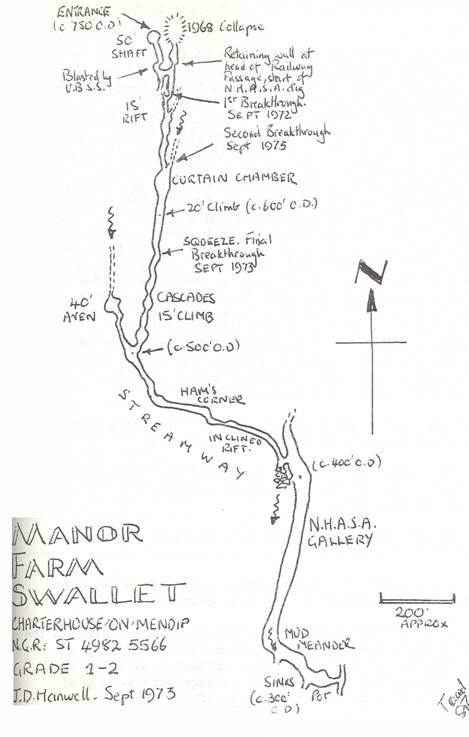
negotiating the 50 entrance pitch and the short scrambles indicated on the
provisional sketch plan accompanying this B.B. All but the entrance are climbable , though those in Cascade section
could well prove to be sporting enough in high flow conditions. The cave is now open to parties wishing to
see it. However those involved in the
hard work of digging out the system respectfully ask all visitors to confine
themselves to the main passages shown on the survey until the beginning of
1974. After this time, they have no
objections to others seeking extensions in the normal way. Find what you can AND PRESERVE WHAT HAS BEEN
FOUND.
The owner of the cave is Mr. Jefferies at Manor Farm. He has treated us more than fairly and always
enthusiastically. Please reciprocate his
generosity and respect his wishes regarding access to the system. He requires all visitors yo adhere to the
following arrangements:-
1. CARS MUST BE PARKED ON THE ROADSIDE NOT
OBSTRUCTING THE FARM ENTRANCE; THE CLIPPED GRASS VERGE OUTSIDE OR THE HIGHWAY.
2. THE CAVE KEY IS AVAILABLE FROM THE FARM AND MUST
BE RETURNED AFTER ALL TRIPS.
3. A GOODWILL SUM OF 5P PER CAVER SHOULD BE GIVEN
TO THE FARMER ON COLLECTION OF THE KEY.
4. ACCESS TO THE CAVE MUST BE VIA THE OLD
FOOTBRIDGE & PATH OUTSIDE THE FARMYARD ON THE EAST SIDE. DO NOT USE THE DIRECT ROUTE ACROSS THE LAWNS.
5. ALL VISITORS MUST BE OUT OF THE CAVE AND OFF THE
PREMISES BY 10 P.M. AT THE LATEST.
6. TAKE AWAY ALL YOUR LITTER AND RESPECT THE WISHES
OF THE OWNER AT ALL TIMES.
Very few caves, even on Mendip, can be so close to a private
residence. The caving community are
particularly fortunate in being allowed such free access and must remember that
the cave is NOT THEIRS. Those who have
spent so much time opening up the system over the past quarter of a century
appeal to their successors to maintain the happy and fruitful relationship they
have always enjoyed with the Jefferies family. They are proud of the cave – especially since three of the family were
on the original exploration trip. This
must be a unique example of co-operation between landowners and cavers.
References:
|
|
1950 |
Manor Farm Swallet. WCC Circ. (23) ½ |
|
Hanwell, J.D & Newson, M.D |
1970 |
The Great Storms and Floods of July 1968. WCC Occ. |
|
Norton, M. |
1969 |
History of the dig at Manor Farm Swallet. U.B.S.S. |
|
Stewart, P.A.E. |
1952 |
Some hitherto unrecorded expeditions and |
Round and About
…… compiled by
Wig
For older members, this is really the same as the ‘Monthly
Notes! which appeared in the B.B. from about 1967 to 1970 – a column containing
notes on new discoveries; items of interest in other clubs publications; book
reviews; library additions etc. etc. Anyone having information of any kind (including scandal!) let me have
it to include in this column.
Number 1 October 1973
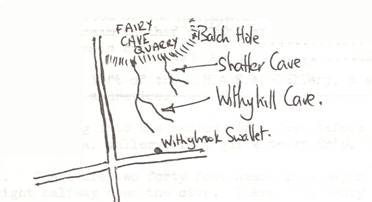
waiting for the quarry to dig for them, explored a new cave situated a few
yards to the West of Shatter Cave. Though not as finely decorated as Shatter, it contains areas of great
beauty. The length has been estimated as
between 3 and 4,000 ft. As will be seen
from the sketch below, the terminal boulder choke appears to lie under Withybrook
Slocker and at the time of writing, the Sunday Morning Digging Team are
surveying the cave to Grade 6 and hope that it will be available within the
next ten years!
BURRINGTON ATLAS
– Caving Report No 17, by Chris Howell, Dave Irwin and Doug Stuckey.
The latest in the Caving Report series is now
available. This at 40p per copy (SPECIAL
PRICE TO MEMBERS 3OP). This booklet
lists all the known sites in the Burrington area and many of the surveys of the
caves are included – such as Goatchurch; Sidcot; Foxes; Elephant; Avelines;
East Twin; Reads; Rods; Drunkards; Milliar’s Quarry Cave etc. 35pp, 5
photographs – including two historic pictures of Sidcot Swallet taken in 1925
(before digging and the First Chamber). A useful bibliography compiled by Ray Mansfield is to be found at the
end of the book.
Members wanting a copy should contact Chris Howell as soon
as possible – this is proving to be one of the fastest selling publications
ever to have been published by a club Mendip.
MENDIP’S VANISHING
GROTTOS Caving Report No 16. Of
the 500 copies printed, only 60 odd are now left. Members still wanting a copy should contact
Chris Howell straight way. Price 50p
(Members 40p) plus 10p P & P.
VELVET BOTTOM Activity here seems to be on the increase. The M.C.G. are digging at Upper Flood
Swallet and have opened up several hundred feet of new passage. Bob Whittaker and Co. are working down at Timber
Hole which is a site originally dug by B.E.C. in 1944 and the M.C.G. in the
early 1960’s. The M.C.G. are looking
hungrily again at Blackmoor Swallet and the Wednesday diggers have had
success at Manor Farm.
WOOKEY
Mendip’s professional caver, Willie Stanton, has been employed by Madame
Taussauds to survey Wookey Nine to enable them to drive a tunnel from Three and
open the passage to the public. Apparently a JCB was hired to scrape off the topsoil on the hillside to
open up Nine by digging at the point located by radio transmission. The rift that extends upwards from Nine
actually goes right to he surface – lucky for the diggers, but not so for the
JCB which, it is reported, almost fell in! Anyway, the rift is split into two – on the one side, a sheer 200ft
pitch and on the other a sloping rift making access quite easy. The passage has been surveyed and the
entrance now locked up again.
WOOKEY HOLE AGAIN!
‘Trattie’ and Chris Hawkes are digging in Four. It is thought that Four may have been used as a burial chamber. To enable the dig to be carried out here, the
manager released the water in the cave at the weir located at the
resurgence. So far, only modern animal
bones have been found.
CUTHBERTS
Fairly high levels of lead have been found on the mud in the cave. Would people ensure that they WASH their
caving clothes and not shake out the dust when dry. Further information will be available from
Roger Stenner in the near future.
ATLAS DES GRANDES
GOUFFRES DU MONDE The French
have published (July ’73) a very fine book of surveys etc. of the Wold’s most
important cave systems. Printed by the offset
process, it contains 52 pages of text which includes: Methods of exploration;
table of caves whose depth is greater than 500m; the depth record in
chronological order and historical notes of cave exploration throughout the
world. Then follow various tables. The longest; the deepest; the deeps for each
country; a chapter on the caves over 500m deep with historical notes for each
site. 56 surveys are included and each
is allotted a page, except the Holloch, which is printed on a fold-out
sheet. The book size is 9½ x 12¾. Though this appears expensive at 26F (about
£3.20) it’s a book that’s definitely for the book shelf. Copies of this book are available through
the publication department contact Nigel Taylor or Dave Irwin. Price £3.
plus 20p P. & P.
Monthly Crossword Number 39.
|
|
1 |
|
2 |
|
3 |
|
|
4 |
|
5 |
|
|
|
|
|
|
|
|
|
|
|
|
|
|
|
|
|
|
|
6 |
|
|
|
7 |
|
|
8 |
|
|
|
|
|
9 |
|
|
|
|
|
|
10 |
|
|
|
|
|
11 |
|
|
|
|
|
|
|
|
12 |
|
|
|
|
|
|
|
13 |
|
|
|
|
|
|
14 |
|
|
|
|
|
|
|
|
Across:
3. Included formations like 3
down and 10 down. (4)
5. Mendip cave contained in front half of discotheque. (6)
6. Describes well known Mendip grotto. (3)
7. Stark version of limestone territory. (5)
10. Describes a particular 10 down Cuthberts. (5)
11. G.B. Gallery. (3)
13. Slight, but otherwise necessary caving equipment. (6)
down. (4)
Down:
1. Supporting evidence of stal
formation. (6)
2. Initially top caving body. (1,1,1)
3. Thin form of 3 across (5)
4. Describes both a Burrington and a Cheddar cave (4)
8. Start a form of rock diversion. (6)
9. Not a result of a geological error! (5)
10. Floor deposit found in formations adorning our caves. (4)
11. Long time at end of passage. (3)
Solution to Last Months Crossword
|
|
S |
|
O |
F |
F |
|
D |
|
|
W |
E |
L |
L |
|
A |
V |
E |
N |
|
|
M |
|
D |
|
I |
|
M |
|
|
F |
I |
N |
G |
E |
R |
T |
I |
P |
|
E |
|
|
R |
|
Y |
|
|
I |
|
B |
L |
O |
O |
D |
C |
H |
I |
T |
|
|
O |
|
T |
|
A |
|
N |
|
|
K |
N |
O |
T |
|
V |
I |
C |
E |
|
|
G |
|
O |
R |
E |
|
H |
|