
Any views expressed by any contributor to the Belfry
Bulletin, including those of officers of the club, do not necessarily coincide
with those of the editor or the committee of the Bristol Exploration Club,
unless stated as being the view of the committee or editor.
Contents
Club Headquarters
The Belfry,
Rd.
Club Committee
Chairman: S.J.
Collins
Minutes Sec: R. Bennett
Members: R. Bagshaw; D.J. Irwin;
M.J. Palmer; N. Jago; T.E. Large; A.R. Thomas; R. Orr.
Officers Of The Club
Hon. Secretary: A.R.
THOMAS, Allens House,
Barrows Lane
Hon. Treasurer: R.J. BAGSHAW,
Knowle,
4. Tel: WHITCHURCH. 5626.
Caving Sec: T.E. LARGE,
Bishopston,
Climbing Sec: N. Jago,
Windmill Hill, Bedminster,
3.
Hut Warden: R. ORR. The Belfry, as above.
Assit H.W. N. TAYLOR, Whiddon,
Chilcote,
Hut Engineer: R.
Rose Cottage, West End, Nailsea,
Tacklemaster: M.A PALMER.
B.B. Editor: S.J. COLLINS, Lavender
Cottage, Bishop Sutton, Nr. Bristol.
Librarian: D.J. IRWIN, Townsend
Cottage, Priddy, Wells,
Pbs. (Sales) C, Howell,
Edgbaston, Birminham.
Publications: D.J. IRWIN. Address as above
B.B. Post: Mrs. K. Mansfield, Tiny
Kott, Little
MENDIP RESCUE ORGANISATION. In case of emergency telephone WELLS 73481
Editorial
Cave Politics
Every sport requires a certain amount of ‘behind the scenes’
organisation – and ours is no exception. What sticks in most peoples gullets is the thought of people revelling
in the organisational aspects of caving instead of getting down holes and
actually doing it.
Unfortunately, such people do exist – and what is more, it
is getting to the stage where caving clubs can no longer ignore what is going
on.
We therefore make no apology for running, as our main
article this month, one which deals with this subject. We are not alone in this, as the current
issue of the Wessex Journal also devotes some space to this subject. We urge readers to take the time to think
about what is amid, and to make sure that the club acts in a suitable manner to
counter any future threat to caving as we understand it.
Sit. Vac
For a variety of reasons, many of the members of the present
committee will not be standing next year. Now, as always, is a chance for younger members to come forward and help
to run the club. There is only one snag
– it means a fair amount of work!
Alfie
Swinsto Hole
An interesting article on one of
the major cave trips possible in this country, written by Derek Sanderson
Although the winch was still on at Gaping Gill, it being a
bank holiday, we (Roger Wing, Keith and Derek Sanderson) elected to attempt a
through trip in Kingsdale by abseiling down Swinsto Hole and emerging through
the valley entrance. This was quite an
undertaking for us, as we had never done any real abseiling before. Neither had we done Swinsto by ladder, though
I had done Simpsons Pot next door and Keith knew the master cave from the
valley entrance.
We arrived in Kingsdale early and found it deserted. We
entered the master cave via the valley entrance to ladder the twenty foot pitch
which would bring us out. The valley
entrance consists of an upturned oil drum leading to a long winding tunnel-like
passage of stooping height after passing a low duck. It took thirty minutes to ladder the pitch
and return to the surface.
The climb up the side of Gragareth to Swinsto was hot work
in a wet suit but didn’t take too long. We took with us three 120 foot ropes; two twenty five foot ladders, some
belays and a long string of karabiners! Well, we didn’t know what we should find in the cave! Once one has pulled the abseil rope down from
the first pitch, there can be no turning back. The karabiners were for use if we could not find suitable belays – the
ladders were for use on any pitches that looked too dangerous and the ropes
were for lifelines and spares in case the abseil rope snagged and had to be
left behind. All proved unnecessary, but
it was better to be safe than sorry.
We entered Swinsto at 11 a.m. and followed the tight short
entrance tunnel of grey smooth rock to the head of the first pitch of nineteen
feet. We passed the rope through the
ring of the eyebolt located low on the right and spent a little time getting
used to the descendeur and slings before dropping down the short pitch in only
a trickle of water. The rope came down
easily, and we were committed to going on!
There are two ways leading from the small chamber at the
bottom. Right leads to some avens,
whilst to the left is the Swinsto Long Crawl – a thousand feet of
hands-and-knees crawl in six inches of water. This, however, proved to be not as tedious as we expected and it was
soon passed. We then found ourselves at
the head of a thirteen foot climb which we went down by abseiling. There is no fixed belay here but a smooth
spur of rock to the left is adequate for the purpose.
The climb is followed, after fifty feet of pleasant stream
passage, by the second pitch of 23 feet which leads into a small chamber. There is an eyebolt in position and the
descent is in water, though this does not encumber the pleasure of abseiling
down such a smooth circular pot.
The passage turns to the right at the bottom and becomes a
narrow rift of grey rock with the stream flowing through it. After a short distance, progress is halted at
the third pitch of 22 feet. This pitch
has no eyebolt, but a large deposit of pasty calcite directly above the pitch
serves as a perfect belay point from which the abseil rope can be
retrieved. The rocks at the bottom are
browner in colour and there is a pool into which one drops about waist deep.
From here, the way on is under a pile of loose boulders into
a section of pleasant streamway where one is halted suddenly at the head of the
fourth pitch. This is more formidable,
being 46 feet deep and followed immediately by the 42 foot fifth pitch from a
sloping ledge. There is an eyebolt
here. I descended first to see if a
belay point had been installed on the ledge. There had. We passed both pitches
without any difficulty but with considerable satisfaction. The descents are invigorating, especially the
first, where the walls are smooth and one is constantly in the water.
At the base of the fifth pitch, an old abandoned pot can be
seen round to the right, whilst the way on is via a rift passage which, after
turning to the left, becomes the traverse where one can either clamber over the
water on powdery brown rocks, or follow the stream at low level. The streamway is tight but not difficult.
After the traverse, the passage remains narrow and descends
through a number of pots until the stream sinks amongst boulders and the way on
is to the right through a comfortable passage of smooth scalloped light brown
rocks. After a sharp turn to the left
and crossing some pools, we climbed down a flake of rock into a short chamber
from which the passage dropped through a 19 foot climb which we abseiled. There is no fixed belay point here, but there
is a smooth spur of rock on the right which is suitable.
From the bottom of the climb, only a few feet of passage
leads to the sixth and last pitch of 23 feet into a wide chamber with the
stream re-emerging from the opposite wall. The belay point here is a sturdy wooden stemple wedged across the
passage.
From here, a low level passage leads into the Cascades, a
high narrow passage which passes over several climbable pots in sculptured rock
until a high aven is passed on the left. This is the base of Slit Pot and is the junction of Swinsto and
Simpsons Pot. Downstream is a 12ft climb and squeeze over boulders into East
Entrance Passage – a dull, tiring, flat-out crawl about two hundred feet in
length leading to Master Junction. A map
is advisable here. To the right, a
pleasant streamway affords comfortable walking to the ladder which we had
placed for our exit. We emerged from the
valley entrance at 2.30 p.m., though the trip could have been done in a much
shorter time by cavers more familiar with the system. However, we were very satisfied with
ourselves.
Hard Rock Caving
An interesting look at ‘how the
other half lives’ and an offer of an exchange by George Honey.
or~ HOW ANOTHER CLUB ORGANISES ITS A.G.M.!
The air-conditioned coach left the centre of
the 30th of June, bound for Nordmaling – some six hundred miles to the north
for the A.G.M. of the S.S.F. (Swedish Caving Club). About twenty of the hundred or so members had
joined the coach, so there was plenty of room except for my knees. (The average Swede must be shorter than an
Englishman, for they certainly pack the seats in!). Sleeping soon became impossible, as the sun
was up at about 2 a.m. and, even with the air conditioning, it soon became very
hot. We stopped once or twice on the way
up at transport cafes – roadside Hiltons compared to the one I used to know on
the A4!
We arrived at Ava “Gastis” at 9 a.m., and drove
into a cluster of painted buildings – a ‘wandershome! which was going to be our
home for the next few days of A.G.M.
I had a quiet sleep to awake to find a lunch on. Outside it was stinking hot (the usual
Swedish summer ) and a local sports shop had on display a range of tents,
rucsacks and kayaks for us. All were of
the very best quality and extremely light and not expensive. After a super meal of salmon given by the
local council, we listened to a talk about that district of Southern Lapland
which is about the size of
At 7 a.m. next morning, we were called, breakfasted, and
were into the coach and away to the fells. A quick three caves before eating our packed lunch and then another
three afterwards. This routine went on
for three days. The pace was killing,
but it ensured that everybody who was at the A.G.M. had at least seen a cave
that year!
Now about the caves. There are three types, all in granite or diorite (another old igneous
rock). The first type is a glacial
scratch, where the glaciers have dug out a narrow cleft which may have been
roofed by a subsequent rack fall. The
second type has been formed by water during one of the ice ages. A vertical crack which had developed in the
bedrock became filled with stones and water from the overlying ice and due to
turbulence, wore out the shape shown. The ‘window’ has in some cases opened out due to subsequent frost damage
.
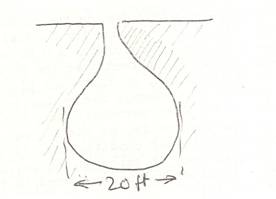 The third type is a pure fault. A vertical crack. I went down a hundred feet of one of these on
ladders made out of fir trees. Note the
use of fixed tackle. From the bottom, we
went back up another fault which was a giant boulder ruckle about ten feet wide
and a hundred and fifty feet high.
Of course, I forgot to say that to get to any cave in this
area requires an hour of two walking through pine forest or up a
mountainside. Caves could be described
as easy but access difficult. The
pressmen got there however, since caving is a rather unusual affair in
mention in the local paper.
As I said, it was an impressively organised weekend with
lectures on geology, speleology and with film and slide shows from all over
itself was like any other club’s A.G.M. and I was asked to look into the
possibility of arranging an exchange meeting with the B.E.C.
There are medium sized limestone systems, as Roger Stenner
can verify (I have an article of Roger’s which has been mislaid for some time,
but which will appear in the next B.B. – Editor.) Most of these caves are of the Goatchurch
style. One thing that is impressive is
the immense size of the country making even a simple cave into a big trip. What the S.S.F. would like would be a week on
Mendip with tourist trips down Cuthberts, G.B. and Swildons and the like so
any ideas, please?
Editors
Note. One hopes that the club will
manage to find the time to act as hosts to the S.S.F. and even perhaps be able
to organise a return match. I must say
that I like the idea of the local council laying on meals for the caving
club. Imagine up going down to Cheddar
for our A.G.M. only to find that the local council have turned up in force and
laid on a free lunch complete with local cheese and cider.
Changes of members Addresses
423. L. DAWES. The Lodge,
Derbyshire.
594. P.A. WILKINS,
Avenue
731. R.BIDMEAD,
Fishponds,
707. R. BROWN, 26
Beds.
808. J.A. HUNT,
Filton,
K. JAMES,
*****************************************
Mike Palmer, our Tacklemaster, would be very interested to
hear any members who would be prepared to help make tackle. His address is at the front of this B. B,
The Future Of Caving Clubs
In this article, a word of warning is sounded about the
possible dangers to caving clubs, and a guide to their avoidance.
by S.J. Collins.
Reader ‘s views are welcome on the above subject
The Club System
A caving club designed to suit its particular needs seems to
rank highly among the requirements of the average caver. One has only to glance at the lists of clubs
which are published from time to time to realise just how many clubs are
operating on Mendip today. It is certain
that there are more clubs at present than there were cavers when I personally
started to cave.
Now it is considerably easier for a small group of young
cavers to join an existing club than it is for them to start a new one. Apart
from all the obvious snags like getting hold of tackle, their club is bound to
lack many of the less tangible advantages built up over the years by the larger
and more well established clubs.
In spite of this, quite a proportion of cavers have
preferred to take the hard way, and this process has been going on here on
Mendip almost as long as has caving. The
case appears to be well made that some cavers have been, and still are,
prepared to go to considerable lengths to construct clubs to suit their
particular requirements rather than to join ready-made clubs.
There are, of course very many new cavers who prefer to join
existing clubs – and have quite a large choice. For this choice – or indeed, that of founding their own club, to be
effective – clubs must, like individuals, have distinct personalities and
differ from each other by all the usual attributes such as age; experience;
character; wealth; influence and the like.
Thus, whatever the outlook of any individual caver might be,
the fact that he can exercise considerable choice in the type of organisation
he joins or creates represents a freedom well worth preserving.
Unfortunately, there are factors which – if one takes a
pessimistic view – could well lead to the destruction of the club system and
if, as I have contended, cavers value the existence of the club system; it will
be instructive (to say the least of it) to examine what is happening and what
may well happen in the near future, so that clubs can act in a manner which
will preserve them. This applies equally
to their dealing with each other as to their approach to bodies external to
them.
Forces Acting Against The Club System
These can be reduced to three main forces, all of which can
be made to reinforce each other, which fact should be borne in mind constantly
when considering them individually.
- Access. The main difference
between caving and climbing is that caving is extremely vulnerable to
control by access. It is difficult,
if not impossible, to put a ring of barbed wire right round a whole
mountainous area; but ridiculously easy to control the specific and narrow
entrance points to caves. Thus, any
body which gained significant control of cave entrances in a caving area
would be in a position to dictate terms to caving clubs and, if it wished,
to control them completely. - Finance. For many older
clubs, the days of operating on a shoestring are now part of their
history. Such clubs have heavy
outgoings such as rates; insurance; maintenance etc., and must operate on
a reasonable scale merely to keep afloat. This makes them financially sensitive and any real curtailment of
their operations could quickly result in a financial crisis from which an
interested external body might agree to rescue them – at a price. This is the same technique as pushing a
man into a river and then offering to pull him out in return for certain
concessions. This could well be
used as another lever by which control could be exercised against the
wishes of a caving club. - Centralisation. A situation
could well arise in which the loyalties of club members were gradually weakened
by the activities of central bodies. This is likely to take the form of a gradual erosion of club
functions and – like all insidious processes – it will be tempting to
ignore it until it becomes too late. If this actually happened, and clubs were thus persuaded to destroy
themselves, it could be argued that they had merely exercised their own
free choice in the matter. Against
this line of argument, most of the older clubs owe a considerable debt to
past (but still interested) members who have worked hard to build up that
club and who would hardly be expected to welcome its destruction by its
present members.
The
Present
State
Already, the three factors discussed have begun to affect
caving clubs. Taking access first,
considerable progress has been made in the north towards replacing individual
arrangements between land owners and cavers by a form of centralised access
control. Much more rapidly than I would
have believed possible, we have seen the start of the abuse of power, as demonstrated
by the Northern Council. Far from
learning any lesson from this on Mendip, we are in the process of taking the
first steps towards a similar situation.
To those who argue that the Caving Councils are not external
bodies but are merely the clubs of a region acting in concert, I would say that
this may be true NOW but there is little guarantee that it will continue to be
so in the future. There are a number of
organisations which have interests in caving and are not based on the club
system. The current Wessex Journal,
which I would urge members to read, deals with one such group – that of the
education system – to which we might well add scouting; various other youth
organisations and the like. Bodies such
as the police (concerned with rescue organisations) and even local and national
government departments would all find it easier to be represented on a single,
central body through which they can exercise the greater degree of control that
they might well start to consider desirable. The time could well arrive when the clubs, who formed the councils in
the first place, found themselves in a minority on them. Frankenstein, I seem to remember, found
himself in a similar predicament.
On the financial front, no club is as yet anywhere near
dependant on external funding – although several have had building grants,
which may have started a taste for free handouts. In this connection, it is of interest to see
how the N.C.A. – a club controlled body, remember! – has so far used its
money. The bulk of this has gone to the
scheme for Caving Instruction, which will result in the creation of a group of
people who feel that they owe their authority to a central body rather than to
any club. The thin end, perhaps, of a
very large wedge.
The very existence of a central authority tends to weaken
local enterprise, even if it has no real teeth. Look for example, at the curious reluctance of Mendip surveyors to run
counter to the C.R.G. in spite of the fact that nearly all of them are in some
way dissatisfied with its policy.
Possible Future Developments
The way by which these factors may gain momentum until the
club system is finally broken is best illustrated by a look into an imaginary
future. The only assumptions necessary
are that the N.C.A. exercises effective control of cave access and contains
sufficient people who desire the end of club caving. Neither of these assumptions is, in my
opinion, a severe extrapolation.
We thus have a position whereby clubs can be threatened by
sanctions if they fail to implement central policies. One can see clubs being ‘recommended’ to use
‘qualified’ cave instructors as a first move. Gradually, certificates of competence would become the norm – finishing
up with an almost exact parallel to the Driving Test and M.O.T.
Having saturated the market for Instructors, the general
appeal to safety – always a good emotional bet – might be next centred on
tackle with the creation of ‘recommended’ standards of tackle and a central
inspectorate to ensure its enforcement. This will require some full-time staff who will, to start with, have
spare time on their hands which they will want to use to their best
advantage. The creation of a number of
departments and committees of this central body would be one of the obvious
outcomes of this state of affairs. Thus,
a club, for example, wishing to dig at a certain spot might well have to
satisfy the Research and Exploration Committee, the Local Authorities Land
Utilisation Co-ordinating Committee and the Cave Preservation and Environmental
Control Committee for a start. Needless
to say, unauthorised caving of any sort would result in an enquiry with the
possibility of individual suspension of licences or even the suspension of a
club, if group culpability were proved.
Centralised cave
and hut bookings for ‘away’ trips might well help some permanent official to
fill up his day and increase his importance. No doubt, a national journal would be started
at about this stage.
The substitution of donations from clubs by a levy based on
membership would provide yet another weapon to be used against such clubs who
still showed an unacceptable degree of independence. In this connection, Treasurers would be
required to submit a standardised balance sheet and would thus find themselves,
along with tackle officers, caving secretaries and hut wardens, effectively
working for the central body.
Soon, clubs would be asked to adopt a model constitution, so
that anomalies could be removed between clubs. By this time, the final blow would go almost unnoticed. It would be called ‘Rationalisation of
Regional Assets’ and would result in the creation of single regional
headquarters having a full-time warden. The club system would be over.
Possible Counter-Moves
A heavy responsibility rests on all who control caving clubs
if they wish to prevent something like that just described from actually taking
place in the future. Detailed action
will of course, depend on the circumstances and the nature of the particular
threat involved at anyone time. It is,
however, possible to imagine some general guidelines, which are listed below:-
- Keep informed: It should be the duty of all who are
concerned with the running of clubs to make themselves aware of all the
moves which are being made or projected even if they have no apparent
bearing on the situation. In
particular, those who represent clubs on the councils must understand
fully the mechanism by which those councils work. One of the main weapons of the
organisational man is his ability to use procedural points to reduce the
opposition. - Look ahead: A good chess player tries to work out
the long term effects of his move, because he knows that short term
advantages may prove detrimental in the long run. The same type of thinking should guide
clubs. For example, if a club
cannot do caves in the North as it used to because of access restrictions
imposed by the Northern Council; should it join the Northern Council, or
accept some immediate disadvantages? Arguments in favour of joining may be that the influx of other
clubs will alter majority decisions in that council. Arguments against may be that if all
clubs joined all councils, the way would be open for their abolition on
the grounds that they were now all the same and that a single body could
now replace them. Careful thought
on these sorts of lines is necessary for EVERY decision. - Respect other Clubs: While a certain competitive element is a
natural part of the club way of life, it must be recognised that working
away at removing another club’s advantages which your club does not
possess can eventually rebound on your own club. The process of levelling down does most
clubs nothing but harm eventually. You joined your club by exercising your choice. Make sure that a choice of the sort you
enjoyed is not taken away from cavers of the future by this type of
action. - Take, and keep, the initiative: Where you cannot prevent things
occurring which are to the detriment of the club system, the only counter
measure is to set up equivalent ones BASE ON THE CLUBS. Thus, if some sort of competence
document looks as if it cannot be avoided; it is better for clubs to take
it upon themselves to organise a scheme than to have one forced down their
throats. Keeping one jump ahead
without panicking is difficult but not impossible. - Cultivate personal contacts. If representatives of clubs can only
meet under official circumstances, a degree of stiffness is introduced
which does not allow people to exchange ideas as freely as does informal
between friends. If all club
officials were on a beer buying basis with each other, many suspicions and
misunderstandings would be removed and cooperation could occur without
letting in the beaurocrats. - Remember who you represent: If you are convinced that nothing you
can do will save, or affect, the situation; you owe it to the members who
elected you to look after their interests to tell them that you see no
point in trying to stave off the inevitable. This at least gives them the opportunity
to decide whether they still want you to represent them. If you really believe that it is already
too late to save you club, then it is dishonest not to say so.
The Burrington Surface Survey
One of the major tasks which had to be carried out for the
Burrington Atlas was the surveying of entrance heights of the caves. In this
article, Dave Irwin and Doug. Stuckey describe the work which was done.
In 1968, work commenced on producing a handbook of the caves
of Burrington. This involved the surveying of all the caves that had not at the
time surveys readily available to the caver and also entailed the checking of
all the altitudes of cave entrances. Discrepancies were noted between editions of Caves of Mendip by
altitude of East Twin. So a surface
survey was started to enable the altitudes and also the position of the various
groups of caves to be positioned on the 25″ O.S. map of the area.
The aim was to produce closed traverses that were linked to
O.S. bench marks. During a weekend in
August 1968, Bill Smart used a telescopic levelling device and produced a set
of results between the bench mark at Ellick House and the entrance to Aveline’s
Hole. Spur lines were connected to
several cave entrances en route. The
work lay dormant until September 1972 when Doug. Stuckey and Dave Irwin
continued the work with the surveying unit. The finished traverse lines (see table 1 for details) and the spur lines
amount in length to over three miles. In
certain cases, the readings were with both the compass and clinometer where the
entrances needed to be located on the surface and others, where the entrances
were marked on the 25″ O.S. map, the clinometer only was used.
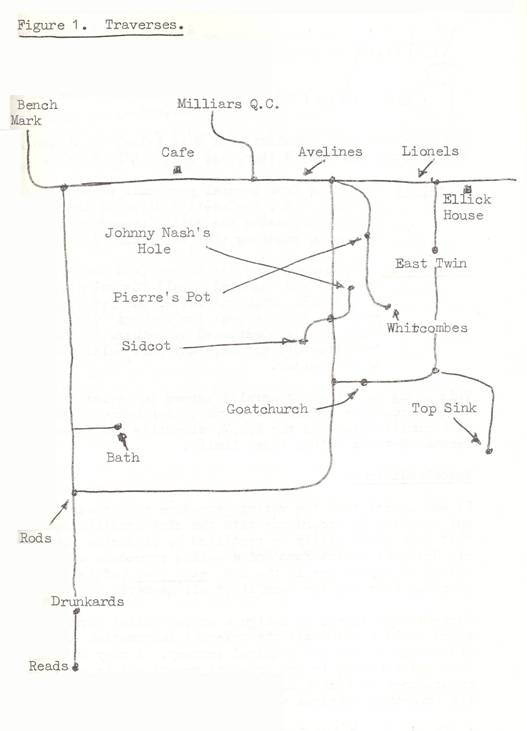
Figure 1 shows the traverse lines. Locations of the caves have been marked, so
giving the route of each of the lines. The survey lines were produced using fibron tapes and the survey
unit. Closed traverses were corrected by
distributing the mis-closure equally between each station. Where the compass was in use for cave
location, this was calibrated using the centreline of the main road through the
Coombe. The readings were to the
requirements of a Grade 6 survey. The
clinometer readings were read to the nearest ten feet on level stretches. Leg lengths were up to a hundred feet.
From the table 2 it will be noted that there are a number of
levels that disagree quite markedly from those quoted in ‘
of Mendip’. The first East Twin Swallet
is quoted as being 471 in CCM, taken from the values quoted on the B.B.
(1). The new surface survey located an
error in a back bearing of the 1968 survey and so East Twin entrance altitude
is 493 feet.
Rod’s Pot created a problem for the authors. The value quoted in CCM was based on a survey
of the surface in the Reads – Rods area by Crickmay (2). Three surveys were made by the authors
between Drunkards Hole and Rod’s Pot. The vertical differences between Rod’s and Drunkards entrances were
11ft, 12ft and 16ft. The difference
quoted in CCM is 28 ft. Having
eliminated our third value of 16ft due to a poor clinometer reading we looked
at the results of the traverse taken from
road line. The vertical mis-closure was
exceptionally good – in a traverse length of about 5,500 ft, the mis-closure
was 3.23 ft, and the fact that the road traverse closed exceptionally well
between the two bench marks leads us to assume that there is a serious error in
CCM value.
Closing the traverses was carried out in the following
manner. The bench marks were located and
the line closed on to them (traverse 1). Next, the line from the
via Rod’s and back down the track to the cafe – thus re-joining traverse
1. This was traverse 2. Traverse 3 linked the West Twin (at Sidcot
Swallet) Goatchurch and East Twin and re-joined the West Twin valley at the
same point as the start of traverse 2. Levels of other caves were found by constructing spur lines from the
closed traverses, and linking a number of caves along the line.
The assistance of the following members made this survey
possible and our thanks is gratefully recorded. (Many people thought that the authors had given up actually going
underground):- Chris Williams; Roger Stenner; John Hunt; Nigel Taylor; Mike
Taylor and John Rees.
References:
1. Belfry Bulletin No 247 (October 1968).
2. U.B.S.S. Proceedings. Vol 6 No 1 p37 (1946-1948).
3. Complete Caves of Mendip. 1972 Edition.
4. O.S. 25 survey
TABLE 1
|
Traverse |
Length |
|
Mis-closure |
|
Percentage |
|
1 |
|
351.74 |
– |
352.86 |
|
|
2 |
5,470 |
|
– |
|
0.06 |
|
3 |
5,555 |
|
– |
|
0.05 |
(all measurements in
feet)
Table 2
|
Cave |
Altitude |
Altitude CCM 1972 |
Altitude B.B. 247 |
|
Pipsqueak Elephant Hole Elephant Rift Lizard Hole Frog Hole Toad Hole Road Arch Foxes Hole 1921 Dig
Spar Pot East Twin Swallet Top Sink Dreadnought Holes West East Upper East Lower Lionels Hole Goons Hole Bruces Hole Barren Hole Tween Twins Pseudo Nashs (A) Jonny Nashs
Quidlers Arch
Whitcombes Hole Goatchurch Cavern Sidcot Swallet Flange Swallet Yew Tree Swallet 200 Yard Dig
Supra Avelines Nameless Cave Avelines Hole
Café Rift Plumleys Hole
East Rods Pot Drunkards hole Drunkards Dig Bos Swallet Reads Cavern Fox Holes |
572.04 598.05 622.30 613.71 631.61 545.93 569.25 560.00 566.00 476.70 493.28 596.34 560.79 556.75 554.79 463.11 446.98 467.25 537.82 440.06 425.59 447.41 416.93 481.26 521.27 547.66 540.05 469.56 444.17 470.00 365.14 385.99 399.18 506.14 324.62 331.20 303.34 325.64 568.96 564.16 569.76 581.58 585.54 586.84 525.40 525.00 approx. |
650 572 – – 605 625 – 565 – 560 455 471 – – – – 441 414 470 540 450 – 425 424 485 517 546 530 470 440 465 360 – 390 495 325 370 – 328 – 550 547 575 – 585 527 525 |
572.04 – – – – – – – – – 470.61 – – – – – – – – – – – – – – – – – – – – – – – 324.82 – – – – – – – – – – – |
Notes: CCM = Complete
Caves of Mendip
(A) Pseudo
Nashs Hole is listed as Johnny Nashs Hole in CCM.
Voting Procedures
At the last A.G.M., the Committee was asked to look at
voting procedures. Here is the report of
the Sub-Committee on the subject
The Sub-Committee, consisting of Mike Palmer (Chairman) Alan
Thomas and Barry Wilton, met on the 4th of Feb.
Objective
Resulting from several proposals
presented at the A.G.M., the meeting directed that the Committee examine the
voting procedure with a view to ensuring that the ballot is secret.
Information
A sub-committee was formed from
members of the club who answered a call for volunteers in the B.B. Only one
letter was received in response to an appeal for members views. Other people questioned by members of the sub
Committee did not have any particular views on the matter.
This being so, it was generally agreed to review the voting
procedure within the terms of reference of the club constitution and the A.G.M.
directive and to keep recommendations within those limits.
Recommendations
It was agreed that the voting procedure is not carried out
strictly in accordance with the club constitution that this could easily be
rectified by producing a properly designed Ballot Form and a voting procedure
which should be reproduced in the B.B. each year before the election time for
the benefit of all members.
Barry Wilton agreed to design a proper Ballot Form which would
contain all the relevant information and by its design ensure the required
secrecy. A copy of this form was
attached to the original report and is not reproduced in this B.B. because it
is self-explanatory. Its important features are;-
- The
Words ‘BALLOT FORM’ - A
place for name and membership number. - A
tear-off strip ensuring secrecy of ballot.
The following was agreed:-
(a) Ballot forms will only be sent out to fully
paid-up members at the latest date for posting stipulated by the constitution.
(b) Forms can be returned by post or handed in at
the A.G.M.
(c) No further forms will be available at the A.G.M.
(d) The Tellers can still check the names against a
list of paid-up members at the A.G.M. if necessary.
(e) The tear-off strip shall be removed by the
tellers before opening the ballot forms to count the vote.
(f) Regarding (c) a notice is to be placed in the
B.B. saying that if no ballot form has been received by two weeks before the
A.G.M., the Secretary is to be contacted requesting a form.
(g) The Chairman of the A.G.M. should direct the
tellers to destroy the Ballot Forms and strips with the approval of the
meeting.
(h) At the start of any A.G.M., the Chairman should
ask any non-members or non paid-up members to identify themselves so that they
can be excluded from any voting.
Note that the foregoing does not require any alteration to
the Club Constitution if adopted in toto or in part. In the main, it is only an amplification of
the procedure already formulated in the Constitution.
(Signed) Michael A. Palmer.
The General Committee of the B.E.C. have adopted this
report, which therefore becomes the club’s official procedure.
(Signed) S.J. Collins.
Monthly Crossword Number 34.
|
|
1 |
|
2 |
|
3 |
4 |
|
5 |
|
6 |
|
|
|
|
|
|
|
|
|
|
|
|
|
|
7 |
|
|
|
|
8 |
|
9 |
|
10 |
|
|
|
|
|
11 |
|
|
|
|
|
12 |
|
|
|
|
|
|
|
13 |
14 |
|
|
|
|
15 |
|
|
|
|
|
|
16 |
|
|
|
|
|
|
17 |
|
|
|
|
|
18 |
|
|
|
|
|
|
|
|
Across:
3. Otherwise glassy substance
without little
6. Associated for many years with Oakhill. (5)
7. Defines mud chamber in Cuthberts. (4)
9. Opposed to flow? (3)
11. Climbing aid. (3)
12. Long time. (3)
13. Make this nor a mistake. (3)
15. Stumble over cave visit? (4)
17. Removed from cave dig. (5)
18. Can be said of cave or of caver! (4)
Down:
1. Estimated time out initially.
(1,1,1)
2. Flashy adjunct to caving? (4)
4. He goes first like the dealer. (6)
5. Angle a form of ore. (6)
8. A jerk on a rope? (6)
9. Climbing ladder. (6)
10. Its home is between Plantation Junction and the Great Gour. (3)
14. Pore over this line? (4)
16. Edge of pot. (3)
Solution to Last Months Crossword
|
N |
I |
F |
E |
|
S |
T |
A |
L |
|
O |
|
I |
|
O |
|
|
L |
|
|
S |
|
T |
A |
C |
K |
L |
E |
D |
|
T |
|
|
|
T |
|
E |
|
A |
|
R |
O |
W |
|
O |
|
A |
I |
M |
|
A |
|
E |
|
P |
|
|
|
M |
|
W |
E |
T |
S |
U |
I |
T |
|
I |
|
|
N |
|
|
S |
|
A |
|
N |
|
A |
D |
I |
T |
|
T |
R |
O |
G |