
Hon. Sec: A.R. Thomas. Allens House, Priddy, Wells,
Hon. Editor: – S.J. Collins, Homeleigh, Bishop Sutton,
Contents
Editorial
Once more, we approach the time of the year when the Annual
General Meeting takes place and the B.B. becomes full of minutes of meetings,
reports from the various club officers and all the other paraphernalia of the
A.G.M. This makes the B.B. bigger but duller.
However, we make no apology for the amount of space taken up
at this time of the year with affairs connected with the running of the
club. The B.E.C. takes some pride in the
fact that every single member is given the fullest opportunity to take some
part in deciding the way in which his club should be run and the only way to
ensure that every member is in a position to do this, is to keep each member as
fully informed as possible on all that has been done.
The Committee this year has been faced with the task of
getting the new Belfry built and fitted out, and this has naturally taken a lot
if its time. During the next year, it
faces the equally difficult job of finding the best way to run the new Belfry
for the benefit of all club members. We
hope that some members will feel that they could lend an active hand to this
process by standing for the committee. If this is not possible, then a member can still help to run the club by
turning up at the A.G.M. with his ideas, suggestions or criticisms or by letter
the committee know what his feelings about any aspect of the way the club is run, are.
Notices
Has anyone got any spare GLOSS PAINT? Small amounts are wanted for the doors inside
the Belfry. Any reasonable colour will
be considered. Have a look through your
junk cupboard and see if you can help. Please give pint sorry, PAINT to John Riley.
SINGLE BED MATTRESSES are also wanted for the Belfry. If you have one thats going spare, bring it up
to the Belfry. If no suitable transport,
let PETE
know about it, and he will arrange for it to be taken up to Mendip.
The ANNUAL GENERAL MEETING and DINNER of the B.E.C. will be
held on Saturday, October 3rd this year. Make a note to keep this day free. All details will be found in next months B.B. Dont forget the date.
If you have any points to raise from last years minutes or
from any of the Club Officers reports, KEEP THIS AND THE NEXT B.B. for
reference.
Minutes of the 1969 A.G.M.
Editors
Note: The
minutes of Annual general Meetings are fairly lengthy affairs. In past years, some fair amount of valuable
time has been taken up with the chairman of the meeting reading the minutes and
even then, the average members will be lucky if he can remember just what they
said. For the last two years, the
minutes have been taken as read by one member volunteering to read them and
finding out if there was anything in them which members would like to be
reminded of. Now that we print as many
of the officers reports as we can get hold of before the A.G.M., so that all
members cab see them and be able to raise questions if necessary; it seems
sensible to do the same for the actual minutes, so that the chairman of this
years meeting can, if he so wishes, assume that all members have read the
minutes.
The 1969 Annual General meeting of the Bristol Exploration
Club was held at The Old Duke on Saturday, 4th October and opened at 10.30am
with the Secretary calling for the election of a chairman. It was proposed by Alfie and seconded by
Sybil that Sett be elected chairman. This was carried without dissent.
The Chairman then called for ballot papers and for members
resolutions. He then asked for names for
the three tellers. Joan Bennett, Tony
Meadon and Maureen were suggested by the meeting. Joan said that she would rather not act as
teller as she wished to attend the whole meeting. Garth volunteered in her place and this was
accepted by the Chairman.
The Chairman said that all the club officers reports had
appeared in the B.B. with the exception of the Hut Wardens report. He suggested that the Hut Warden give his
report and that this be followed by questions if necessary. Kangy asked the Chairman whether this was
the first report to be dealt with. Normally reports are given starting with the Hon. Sec., the Hon.
Treasurer, and the Caving and Climbing Secretaries before the Hut Wardens
report. The Chairman said this was true,
but there was nothing to prevent him starting with the Hut Warden.
The Hut Warden, Phil Townsend, said that he had no actual
report prepared but that he was prepared to answer questions from the floor of
the meeting. Alfie said that tales about
the way the Belfry had lately been run had caused him mush concern. As an ex Hut Warden, he was appalled by the
fact that there appeared to be no proper records being kept, and instanced the
fact that Sybil owed the Belfry six schillings but there was no record of her
having stayed there. Sybil agreed that
she could have easily kept quiet about her stay and wondered how many people
had, in fact, and just done this. She
gave the sum owing to the Hon. Treasurer. Peter Franklin said that he had taken it upon himself to make up a
Belfry book as there were no books at the Belfry into which to enter
debts. This book had been in action for
the two weeks preceding the fire and as far as he knew, it was the only source
of recording. John Ifold said that one
always had a system of taking names at the Belfry and it was essential to have
such a system. The Chairman said that
this was true. Alfie said that it was
symptomatic that no figures of bed-nights had been published for the last two
years. How could one know whether the
Belfry was full or not if there were no records? Later on in this meeting, we would have to
decide what to do about getting ourselves a new Belfry, but we were going to
have to work in the dark if we couldnt even say how much the present building
was being used or how much the receipts from it ought to be in a year. Pete Franklin agreed and that he had stayed
up for a whole week and nobody appeared interested whether he paid or not. Alan Thomas said that in the absence of a Hut
Warden, the senior member present should be responsible for the Belfry and that
Pete should therefore have acted as his own Hut Warden for his stay. The Chairman said that when he was Hut
Warden, he was present for about fifty weeks in each the year and he made very
definite arrangements for the other two. Dave Irwin said that this discussion was a bad reflection on the Belfry
regulars, who should have been sufficiently responsible to have kept the
records going. He said that we could do
well without members who stay at the Belfry and then attempt to get out without
paying their dues. The chairman said he
thought many members would not volunteer their dues, but they will pay quite
easily if someone makes the effort to collect the money. Alan said that, in fairness to the Hut
Warden, he had the job wished upon him and had stated at the time that he would
not be able to get to Mendip regularly.
Sybil asked whether the Committee had realised what was
happening. The Committee Chairman, Dave
Irwin, said that it had been agreed to drop the regular monthly reports of club
officers at committee meetings, and it was not until May or June that the state
of affairs was realised in committee. He
said that members must communicate with the committee if they thought that
anything was going wrong. Alan said that
the Committee had tried various solutions. A Belfry regular was co-opted, but he then moved away from Mendip. The Chairman asked if anyone thought that we
were short of a significant sum of money as a result of there being no
record. The Hut Warden said that there
was no need for a record. This raised a
general shout of protest to which the Hut Warden replied that if members were
not prepared to do the job themselves, they should shut up. Dave Irwin said that a committee member
should be prepared to whatever is necessary. The Chairman replied that he did not go as far as this but would rule
that if any committee member takes on a job, then he must do it properly. Dave Irwin said that if a member was not
prepared to do whatever the job the Committee asked him to do; he should not
stand for the Committee. The Chairman
said he could not agree with this as it was generally recognised that many
people stand for the Committee with a particular job in mind. For example, we all know that Bob is no
longer prepared to be Hon. Sec. If
members elect him, knowing this, it would be high unreasonable for the
Committee to expect him to do the job. Alan Thomas agreed with this and said that not all committee members
were qualified to do any job on the Committee. Mike Luckwill said that we have had some excellent Hut Wardens in the
past but we cannot expect that any Hut Warden will necessary act as they did.
A general discussion followed on methods of Hut Wardening,
but eventually Kangy proposed that we should continue the system that we have
used in the past. This was generally
agreed to by the meeting without a formal vote. Bob Bagshaw suggested that the meeting adopt a Hut Wardens Report with
a rider that the Committee shall ensure an effective Hut Warden bearing in mind
the comments of this meeting. This was
seconded by Pete Franklin who said that he thought that we had lost much money
in lost hut fees which we needed badly. He said that any Hut Warden must have an effective paperwork
system. The proposal to adopt the report
with the rider was then put to the meeting. About three quarters of those present were in favour.
The Chairman then proceeded to the B.B. Editors Report as
the only other club officers report which had not been previously
published. Dave Irwin then gave his
report (attached). Bob Bagshaw asked why
the report had not been published. Dave
said that the B.B. Editor is not officially an officer of the club. The adoption of the report was proposed by
Kangy. It was accepted unanimously. Alfie then proposed a vote of thanks to the
retiring Editor, this was seconded by Dave Turner and carried unanimously with
cheers.
Dave Searle then read his report at Hon. Librarian
(attached). The report was adopted nem.
com. after having been proposed by John Ransom and seconded by Alfie. Dave Irwin then read the report on behalf of
the Caving Publications, since Gordon was not present. Dave Turner asked what the typewriter was for
which the club had bought for caving publications and where was it? Dave said that Gordon had it and that it was
used for typing the caving reports.
The Chairman then asked if all other reports could be taken
as read. This was agreed. He then called for questions arising from
these reports, which had all appeared in the B.B. Results of this were as follows: –
Hon. Secs Report. Adoption without questions proposed by Alfie
and seconded by Phil Townsend. Carried
nem.com.
Caving Secretarys
Report. Kangy asked whether the
Caving Secretary anticipated the Ian Dear Memorial Fund being used during the
coming year. Dave said that no one would
know the answer to this until next March. Adoption proposed by Dave Smith and seconded by Mike Luckwill. Carried nem.com.
Hut Engineers Report. John said that his report was wrongly dated
in the B.B. It was written on the
18.8.69 not 18.9.69 as stated. Joan
Bennett said that the club should thank John for all the work he has put
in. This was seconded by Dave Irwin and
carried unanimously. John said that,
after the fire, he had concentrated on making the tackle store watertight and
that this had now been done. The old
shower had been removed and three bunks installed. Water had been connected and electricity
would soon be in again. The report was
adopted nem. com. After being proposed
by Dave Irwin and seconded by Alan Kennett.
Tacklemasters Report. Dave Irwin proposed that the report be
adopted. This was seconded by Garth and
carried nem.com.
The Chairman asked why there was no report from the Climbing
Secretary. Dave said that at present
there was no Climbing Secretary.
Hon. Treasurers
Report. Dave Irwin asked why the
National Development Bonds and the Ian Dear Memorial Fund were in the
accounts. Bob replied that it was the
easiest way in which the accounts could be presented. This was the first time that the Ian Dear
Memorial Fund had been used and there was no real need to have them
separate. Dave asked whether we were
going to re-invest the I.D.M.F. but Bob replied that the time was not
appropriate to change this investment. Bob pointed out that he gave total the club monies, but that the Ian
Dear Memorial Fund should not be regarded as money but an asset. On a question about income tax, Bob agreed
that the whole question wanted looking into, to which Joan Bennett replied Hear,
Hear! Dave Irwin said that he had
spoken to Tim Reynolds who was prepared to advise Bob. The Chairman asked whether the new Belfry
fund was an asset. Bob replied that the
total monies do not include assets but do include the new Belfry fund. Joan Bennett said that there were two points
that were misleading. Caving
Publications appeared to have made a loss of £38, but the publications report
said that they were doing very well. Dave Irwin explained that the discrepancy between these two points was
due to the accounts closing on 31.7.69. Since then, Bob has received more money and the loss to date is actually
£8 which includes all publications including the B.B. and its postage.
The Chairman commented that the B.B. could well make a loss
which could be offset against subscriptions, and the fact that it is now
virtually self supporting is extremely good. Alan Thomas said that he thought it was an excellent achievement and
supposed that this would be reflected in next years accounts. Joan Bennett then raised the problem of the
Belfry account. This shows a profit of
£3.19.0 on the Belfry, but £36 has been transferred so the Belfry has made a
loss of over £30. There is no breakdown
of the figures, so members do not know how this loss was built up. Joan said that it would be difficult to work
out the finance of a new Belfry if we do not know how we are running the
present one. Sett, replying to this,
said that in his time as Hut Warden, the details were always accounted for, but
not separated out in the financial account. Dave Irwin said that the Belfry, in fact, had made a considerable loss
during the year and the accounts should reflect this in an obvious manner. Bob said this was difficulty to know how much
detail to show in the accounts. Since
they were closed he had received £60 in Belfry income and bills for about £30
expenditure, the bills, the loss is therefore not a great as it would
appear. The main items of expenditure
were Coke (£24); Solicitors costs (£8.10.0); Fire Insurance (£11); and Gas
(£10). There was also about £10 for
repairs. John had been in the middle of
redecorating when the fire broke out. Mike Luckwill proposed that the report be adopted buts asks the Hon.
Treasurer to do his best to present the accounts in a manner more suited to the
higher financial status of the club. This was seconded by Phil Townsend and carried nem.com.
The Chairman the read out the results of the ballot for the
1969 1970 Committee. Voting was, R.J.
Bagshaw (56); Dave Irwin (56); Norman Petty (55); Alan Thomas (53); Alfie (52);
John Riley (43); Jok Orr (40); Mike Luckwill (37) and Pete Franklin (23). He declared the above to the new
committee. The remainder of the voting
was Mike Palmer (19); Gordon Tilly (19); Fred Atwell (19) and Phil Townsend
(15).
The Chairman then took members resolutions. The first, proposed by Dave Irwin was that
The St. Cuthberts leader system be opened to every club having adequate
insurance cover. Dave explained that
while this resolution would open the leader system to include the whole
country, rather than the six Mendip clubs as at present, leaders would still
have to go through the usual procedure before being admitted as leaders. Tony Johnson asked how adequate insurance was
to be decided. The Chairman said that he
imagined that the leaders meeting and the general committee would investigate
any prospective leaders. Mike Palmer
said that he felt insurance should be adequately defined. On the other hand, all guests of the club
were covered by the clubs insurance. After some discussion, the Chairman said that the Committee must decide
on what is adequate. Alfie agreed with
this, but suggested that the Committee should obtain professional advice. This was generally agreed. Tony Johnson wondered whether all cavers
really counted as guests of the club for insurance purposes. Dave Irwin then resolved that the Committee
look into the problems of insurance and the extension fro the Cuthberts system
next year. This was seconded by Jill,
and carried. The original proposal was
not voted on as it had not been seconded.
The second proposal was from the retiring committee. That the new constitution be adopted with
the exception of article 85 which should be replaced by a new article 85 as
drafted by Digger Harris. Alfie proposed
an amendment that his or hers should be removed since the preamble of the
constitution already covers this point. This amendment was seconded and passed nem.com. The vote on the amended proposal was carried
with one dissenter.
Another Committee resolution proposed that the words that
the accounts must be audited before presentation be added to Article 78. Dave Smith asked how much this would
cost. Joan Bennett said she thought
about £20. The Chairman asked if we were
willing to risk having to pay this sum annually. Pete Franklin said that in his rugby club,
two members were elected every year to audit the accounts. If a similar system were adopted in the
B.E.C., the audit would not cost anything. Tony Johnson then proposed that the resolution read that the accounts
must be audited by two members of the club not being members of the
Committee. This was seconded b y Pete
Franklin and carried with one against.
Roy Bennett and Kangy proposed that Article 58 be amended to
include the B.B. Editor. Mike Luckwill
said that the Committee could always co-opt the Editor if desired and thus the
resolution was unnecessary.
Editor must be on the Committee by right and Kangy said that the B.B. Editor
was third in importance amongst the officers of the club and thus should be on
the Committee. Dave Smith said that at
any rate, the Editor should be at all Committee meetings. Tony Johnson said that if the Editor was not
a member of the Committee, then he should be co-opted as a non-voting
member. Roger Stenner said the subject
was best left loose and Alfie agreed on the basis that the club should not
build up a set of rules round the Editor of the B.B. Mike Luckwill reminded the meeting that any
member of the club can attend a Committee meeting, and this would apply to an Editor
who was not on the club committee. Alan
Thomas said that the Committee already had powers to deal with situations like
this as it thought best and specific proposal was therefore not necessary. There was some further discussion in which
Kangy made the point that the position of the B.B. Editor was anomalous; Alfie
said that this was deliberately so and a good thing; Tim Hodgson said that the
Editor should always be impartial. Finally, Tony Johnson proposed that the Editor of the B.B., if not a
full member of the Committee, be automatically co-opted as a non-voting
member. This was seconded by Roger
Stenner and carried 26 to 13. A ruling
from the chair was given that there was now no point in voting for the original
proposal.
There being no other points, the Chairman then asked for a
vote on the acceptance of the constitution. Phil Townsend said that the new constitution was unnecessary and the
club should not allow it to go through. The Chairman ruled the point out of order, since the proposal to be
voted on was already whether to accept or reject the constitution. Mike Luckwill said that he sympathised with
Phils feelings, but assured that a constitution of this type really was
necessary at this stage of the clubs progress. Garth asked if he could go on record as stating that the new
constitution is too large a subject to be debated upon now. Alan said that every member had had an
opportunity to read it. The Chairman
said that this was so. He had allowed
some debate to go on because he realised that this was an important subject,
but he would have been within his rights to have asked for straight vote without debate, subject of
course, to proper amendments. Roy
Bennett said that we could always amend the new constitution if necessary and
proposed that a vote of thanks to Alfie for the work he had put in drafting the
document. This was seconded by Sybil and
carried unanimously. A vote on the
acceptance of the constitution was then carried 32-2.
The next resolution was by Mike Luckwill, seconded by Andy
Macgregor, That this club deplores the proliferation of national and Regional
bodies concerned with caving. It was
carried 40-4.
The Chairman then declared a break for lunch.
The afternoon session was devoted to the problem of replacing
the Belfry. Members present at the
meeting had been circulated with a broadsheet prepared by Alfie (as Long Term
Planning officer) called After the Fire? (attached). The Chairman invited Alfie to give a fuller
description of the great situation. He
said that it seemed that our grant was not going to materialise. The Chairman said that this was a good
background, but that we had better forget the grant or any possibility of it.
Two proposals were before the meeting, prepared by the 1969
Committee, reinforced by other members of the club. Those were
.
Provided that the Committee is satisfied that the club has
received a sufficient sum from the insurance and from further donations to a
minimum of £600; it proceeds forthwith with the erection of the building as
agreed at the 1967 Annual General Meeting.
Alternatively, a special Committee shall be set up with the
following terms of reference:
To examine the situation resulting from the fire and to
produce a proposal for the future accommodation of the B.E.C. bearing in mind
the best interests of the club in both the short and long term. This Committee is instructed to publish its
findings in writing to all club members by a date no later than the
of
.1970
and to arrange their proposal to lie within the financial limits as determined
at the time by the 1970 committee.
A long discussion followed and subsequently by Tony Johnson
proposed that the above be taken as two separate proposals. This was seconded by Pete Franklin and
carried nem.com.
The first of these proposals was then discussed, voted upon
and carried nem.com.
The second proposal, with the date of the first of April
inserted, was voted upon and carried 28-2.
The meeting then went on to discuss money, and a proposal by
Tim Hodgson seconded by Alan Kennett to use the Ian Dear Memorial Fund as a
temporary measure was carried 19-18. In
view of the heated arguments for and against, and the closeness of the vote, the
chairman called for a re-count. This
time the voting was 20-20. The Chairman
then used his casting vote in favour of using the fund provided that interest
was paid on borrowing it and that all other provisions of the fund were paid.
The meeting closed by Mike Luckwill reporting to the
Chairman that he had been though the minutes of last years meeting and that
there was nothing to be brought up. The
Chairman declared that meeting closed after the minutes had been adopted, at
3pm.
S.J. Collins
Minutes Secretary
August Committee Meeting
At the July meeting of the Committee, some of the later
stages of the Belfry fitting out were still on the agenda. A few items are still needed as gifts from
members.
The treasurer reported that matters were now sufficiently in
hand for the financing of the Belfry, that he was stopping his monthly report
to the Committee. The arrangements for
the dinner were put in hand, and a scheme for the car park was suggested. Methods of producing the new constitution
were being looked into and other matters dealt with included the provision of
space at the Belfry for M.R.O. gear and the progress of the B.E.C., exhibition
at the
Tackle Masters Report
During the past year, we have lost or mislaid four
ladders. Two of these are twenty feet
standard type ladders; one is a ten feet standard ladder and the fourth is one
of the ultra weight ladders.
The total tackle at present is as follows: –
16 standard twenty foot ladders.
6 lightweight twenty foot ladders.
1 standard ten foot ladder.
11 ultra weight twenty foot ladders.
4 lightweight fifty foot ladders.
7 karabiners.
1600 feet of lifelines.
20 tethers of assorted lengths.
The Gouffre of Coume Ferrat
by R.S. (Kangy) King
(Our man in
Many fine descriptions of cave exploration abroad have to
remain unread until a suitable translation appears. Since this is the time of the year when
B.E.C. members get their annual chance to visit foreign caves, it seems
appropriate to publish this translation by one of our members. It is a summary of an historical account by
Georges Jauzion, taken from the XIV and XV volumes of the Societie Meridional
de Speleologie et de Prehistoire.
Between the valley of the Ley and the
are the limestone massifs of Gars-Carir; Palournere; Montreich, Lestelas and
Castesegui. The last two are in the
community of Balagueres near St. Giroins, which contains the Coume Ferrat the
fourth or fifth deepest pitch in the world.
In 1957, two Balague men told the Societe Meriodional de
Speleologie et de Prehistorie of the existence of a hole, and on the 26th
August of that year, a team went to investigate. Dropped stones, which whirred as they reached
terminal velocity, revealed an impressive pitch which was confirmed by a cord
of 180 metres (590 feet) not touching the bottom.
The first attempt was made on the 29th June, 1958 when G.
Hengl descended to a ledge at 128 metres (420 feet). Though physically fit and naturally strong,
the ascent made practically without the aid of a rope which had become
wrapped round the ladder shattered him. It was a completely free pitch, and he reported that the shaft
continued.
This nerve racking experience led them to decide that a
better winch, using wire to reduce friction, should be made for the sake of
safety. It was not until the spring of
1965 that the new ladders and the winch became available and the second attempt
was made. This occurred on the 4th of
July, 1965.
The entrance passage is rectangular in section, about 30
metres (98 feet) long and sloping so that the end is about 15 metres (49 feet)
below the entrance level. Just before
the big pitch is a little chamber with roughly parallel walls. After this is a narrow passage dropping down
into the hole, while above this passage is a higher ledge which now has
cemented are four rawlbolts for securing the winch. A rotting tree trunk CAN STILL BE SEEN. This was used to hold the pulley and
telephone wire for the initial attempts.
R. Vennet went down first and got to the 128 metres (420ft)
ledge in twenty minutes. He was followed
by Georges Jauzion, who describes his experience as follows
.I was in an
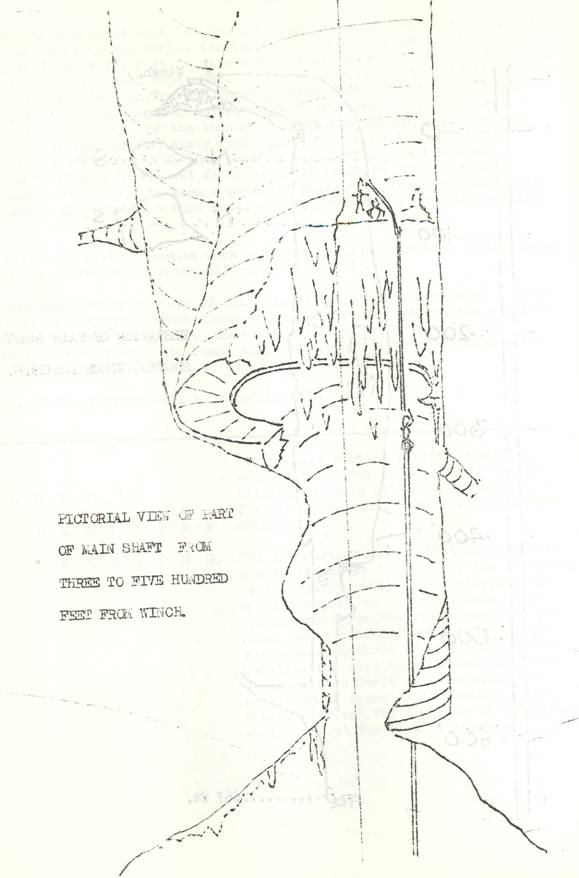
immense cylinder of some hundred feet diameter with walls covered in old stal
eroded by falling water. From time to
time, a stalagmite loomed out of the dark. For a hundred and eighty feet, the ladder hangs near the rock but below
that, it hangs well clear and there is a tremendous feeling of exposure. Looking up, I could see the top far away lit
by light from the winch ledge. Looking
down it was more impressive with Venets light reflected on the wet walls like
a little star. The ladders disappeared
in the darkness below my feet. With the
tension of the cable which supported my weight, I could have believed I was
floating in space.
He arrived at last on the ledge, touching the walls for the
last thirty feet. The lower ledge was
made entirely of stalagmite which had been later eroded by the action of the
waterfall. A fall of six feet in
thickness forms the edge of the second shaft. Twenty feet lower is a ledge with ample room. This staging point is, in effect, a
horizontal stalagmite floor of about thirty feet diameter with its central part
eroded by the falling water leaving a collar attached to the shaft. Half of this collar is too narrow to
traverse, the rest forms the ledge.
The trip finished by sounding the lower part of the pitch
and establishing that is was greater than a hundred and fifty feet and also
planning the placements of the ladders. The new winch almost eliminated the fatigue of climbing 420 feet to the
surface, which was accomplished in about quarter of an hour.
The third attempt was made on the 18th of July. In order to conserve effort and materials it
was decided to use the first ladder for the second pitch as well. This was done by lowering the ladder on the
end of the winch wire. When the ladder
had been fixed, a three hundred foot rope was attached to the winch wire and
then pulled up to the ledge by the winch. Jauzion then attached himself to the lower end of this rope and started
to descend the second pitch. A telephone
proved essential to co-ordinate all these movements.
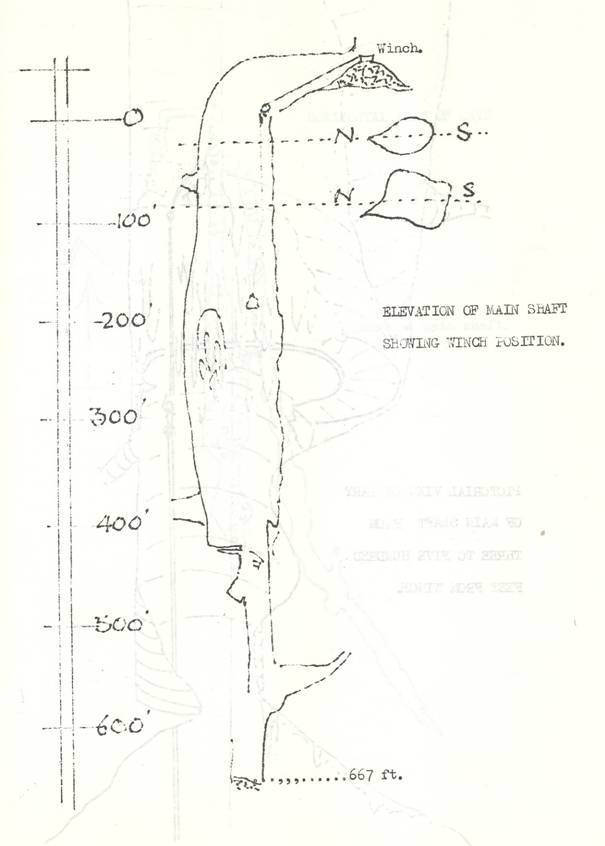
At about a hundred and ten feet below the edge, Jauzion
stopped to look at the view. While
straining to see the bottom, he noticed that one of the C links on a ladder
had come adrift below him. Common sense
compelled him to give the signal to ascend. Once back on the ledge, it was found that the ladder was hooked up on a
rough section of wall and could not be pulled up. The solution was to hang the top end of the
ladder on the winch wire and let it swing free into the centre of the shaft. This confirmed that the whole of the shaft
could be a free pitch.
Having confirmed that the Coume Ferrat was something like
the fourth deepest vertical in the world, tactics were changed somewhat. An extra four hundred and fifty feet of wire
was provisioned and three men descended to the ledge on the 26th September. Bolts were inserted to hold the ladder and to
safeguard Jauzion. For the first hundred
feet until, the slack was taken up in the four hundred and fifty feet of wire,
a rope was used. This was tied to the
rung of a ladder to await the return. A
ledge was reached at six hundred and sixty eight feet and the bottom at seven
hundred and sixteen feet. A long passage
led northward and a further downwards to finish in a level floor of small
boulders and a vertical wall, above which could be seen a possible
widening. Near the ladder was seen a
steep slope under a huge rock. This
proved too difficult to climb solo.
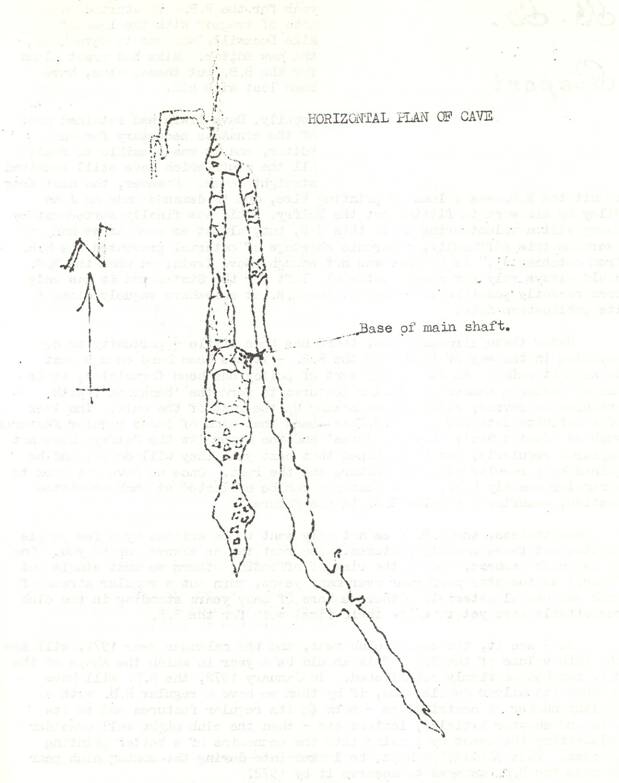
Fifth and sixth descents were made which sorted out most of
the known cave and paved the way for the big expedition of 1966.
The spectacular feature of this expedition was the success
of a large and efficient motorised winch which enable cavers to descend the
complete shaft in about twenty minutes. In spite of the big effort made, no important continuations were found
apart from a shaft of sixty feet with a small stream at the bottom.
B. B. Editor’s Report
This has been an extremely difficult year for the B.B. It started on a note of tragedy with the loss
of Mike Luckwill, who was to have been the new Editor. Mike had great plans for the B.B. but these,
alas, have been lost with him.
Luckily, Dave Irwin had retained most of the contacts
necessary for an Editor, and it was possible to route all the stuff which Dave still received straight to me. However, the next snag to hit the B.B. was
a lack of printing time, due to the demands made on John Riley by his work in
fitting out the Belfry. This was finally
sorted out by Barry
volunteered to do this job, but, almost as soon as we had overcome this
difficulty, a chronic shortage of material prevented the B.B. from catching
up. As if this was not enough, Dave
Irwin, on whom the B.B. could always rely for caving material, left for the
States and it has only been recently possible to bring out the B.B. at somewhere
vaguely close to its publication date.
Under these circumstances, there has been little opportunity
to do anything in the way of improving the B.B. it has been hard enough just
to keep it going. As far as any sort of
policy has been formulated, it is one of having a number of regular features to
form the backbone, with articles on caving, climbing etc. making up the rest
of the bulk. The lack of a definite date
for each B.B. has meant that some of these regular features such as Just a
Sec; Monthly Notes and the newer At the Belfry have not appeared
regularly, but it is hoped that next year they will do so, and be joined by a
regular climbing feature and the rest. Once we have got back to a regular monthly B.B., these features can be
calculated at each committee meeting, ensuring a regular B.B. in the future.
Nevertheless, the B.B. does not only want to be written by a
few people turning out these monthly features. The rest is, as always, up to you. One or two club members, and at the risk of offending others we must
single out Kangy as the star performer over many years, turns out a regular
stream of good and useful material. Other club members of many years standing in the club regrettably have
yet to write their first word for the B.B.
As I see it, the coming club year, and the calendar 1971,
will see the 25th volume of the B.B. of the B.B. This should be a year in which the shape of
the B.B. can become firmly established. In January 1972, the B.B. will have reached its Silver Jubilee and, if
by then we have a regular B,B, with a healthy number of contributors n- both to
its regular features and to its main and shorter articles, letters, etc. then
the club might well consider celebrating the event by looking into the
economics of a better printing process. This should, perhaps, be looked into during the coming club year in case
the B.B. manages to deserve it by 1972!
S.J. Collins, Hon.
Editor.
Hon Secs Report
The replacement of the Belfry must loom largely in any
report this year. Once the mandate was
given by the 1969 A.G.M. to go ahead with the new building, and the committee
was satisfied that sufficient funds would be forthcoming; it was not long
before work commenced. The club now has
a headquarters of which it can be justly proud built entirely from its own
resources.
Our relations with other clubs have been good throughout the
year. The
whilst we had no Belfry (as indeed we had done for them many years ago when
they lost their Beechbarrow H.Q.) and so did the Shepton. In return, we have informed them that their
members may stay at the new Belfry at members rates. The barn which we owned on the other side of
the depression has been sold to the S.M.C.C. who plan to turn it into their
headquarters. We wish them every
success.
Regarding ownership of property in the immediate vicinity of
the Belfry, there is one item which is sub judice but which I hope to be able
to report at the A.G.M.
The strength of the committee was tragically reduced by the
death of Mike Luckwill. Arrangements had
been made for him to take over the editorship of the B.B. During the year, we also found that Jok Orr
had to resign owing to his moving away from the district and Dave Irwin also
went to the States. Dick Wickens was
co-opted as Caving Secretary and Graham Attwell as Climbing Secretary.
I have answered many enquiries for membership during the
year, a large proportion of them than usual for climbers. There has been a tendency for the caver
applications to come from mature cavers and not novices.
On the closure of the Waggon and Horses, the Thursday
meeting place has been successfully transferred to the Seven Stars in
As I began with the Belfry, may I conclude by thanking
everyone who has contributed effort or money in the past year to make it
possible for the B.E.C. to have what it has always had the finest club
headquarters on Mendip.
Alan Thomas, Hon.
Secretary, B.E.C.
Monthly Crossword Number 3.
|
1 |
|
|
2 |
|
3 |
|
|
4 |
|
|
|
|
|
|
|
|
|
|
|
|
|
|
5 |
|
|
|
|
|
|
6 |
|
7 |
|
|
8 |
9 |
|
|
|
|
|
|
|
|
|
|
|
|
|
10 |
|
|
11 |
|
12 |
|
|
13 |
|
|
|
|
14 |
|
|
|
|
|
|
|
|
|
|
|
|
|
|
|
|
15 |
|
|
|
|
16 |
|
|
|
ACROSS:
1. Proceed to an ancient city for
this cave formation (4)
3 and 8. Cows have a profitable hole (4,4)
5. The last half that goes on your back (3)
6. City Mendip Swallet (4)
10. Hopefully not delicate underground (4)
12. Old Mendip void (4)
14. Stoke and Swildons this are old, Cuthberts new (3)
15. Found in cave digs too late (4)
16. Traditional landing material (4)
DOWN:
1. Describes wet suits; goon
suits, etc. (4)
2. This up this from Farrington to Chewton (4)
3. Associated with T (1,1,1,1)
4 and 13. Write Fir in Cuthberts (4,4)
7. Hall in Hilliers (3)
9. Cave route without mountain route (3)
10. Working sounds like a colloquial write-off (4)
11. 1 across is a form of this (4)
12. Wood, Chamber and Hole (4)
Solution To Number 2
|
P |
A |
S |
S |
|
A |
W |
I |
G |
|
O |
|
U |
|
D |
|
E |
|
O |
|
O |
U |
B |
L |
I |
E |
T |
E |
E |
|
L |
|
M |
|
G |
|
S |
|
S |
|
|
B |
E |
N |
|
G |
U |
T |
|
|
S |
|
N |
|
P |
|
N |
|
E |
|
L |
A |
D |
D |
E |
R |
D |
I |
G |
|
O |
|
I |
|
N |
|
A |
|
O |
|
T |
A |
P |
E |
|
S |
Y |
O |
N |
Stencils completed 21st August 1970