
Notices
Annual Dinner IMPORTANT NOTICE
Let Bob Bagshaw know your choice of meal before 21st
September
Bobs address: – 699 Wells Rd. Knowle,
*****************************************
SAVE MONEY!! Discounts may be had at Bryants camping centre of 5% for personal
gear. Show your membership card. A 10% discount may be had for Sub-Aqua
Products (Eastleigh) Ltd.,
Twyford Road
Hants. Send your order for wet suit
material on Club notepaper.
Alfies Spaeleodes
Work is progressing well. Alfie has made arrangements for the printing and Jock Orr is well
underway with the cartoons Ive only seen a few but from what I have seen
they are superb! Publication details
later.
*****************************************
The long awaited Caving Report No. 5 is back in print.
Headgear and Lighting
The only publication of its kind that covers all forms
headgear and the many forms of lighting available. Completely revised by Geoff Bull 72 pages
PRICE only 5/-.
These are obtainable from Bryan Ellis, Knockauns, Comwich,
Nr, Bridgwtaer, Som. or Gordon Tilly at
the Belfry.
Dont forget 1/- p & p.
*****************************************
LATE NEWS: – Eddy Welch is retiring from the Committee.
*****************************************
Guardian reports (19/8/68)..
Seriously injured caver in Berger. Appeal to all potholers in
parties. Injuries are spinal.
Hon. Sec: – A.R. Thomas,
Somerset
Editor: – D.J. Irwin,
Road
1QA
Club Headquarters: – The Belfry,
Road
Ahnenschacht 1968
While still in
following report of the BEC Expedition there has just been received from Alan
Thomas
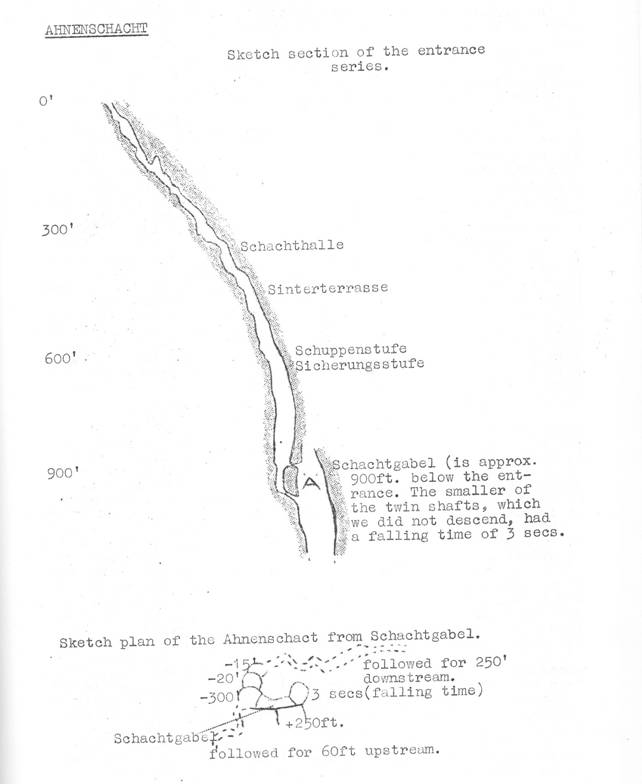
A brief description of the Ahnenschacht and its situation
appeared in my previous article (1) and I shall be describing it in greater
detail later on. This was written whilst
still in
is intended only to describe our activities and this years discoveries.
 This years party consisted of Mike Luckwill, Dick Wickens
and myself who had been there last year with the addition of Alan Thomas
(junior), Martin Webster and Ian Daniels. We were accompanied to the Hochogelhutte by Val and Sally Luckwill.
Wise from our experience of last year we decided that it was
largely unnecessary to sleep underground, as nothing saps ones moral fibre more
efficiently, nor was it necessary to have an enormous carry which equally saps
ones physical strength.
On 23 July, Dick, Martin and I carried up to the hole (1½
hours of fairly hard going with heavy packs) sufficient gear to ladder it to Schachthalle
which is about 375 feet down. We spent
an hour gardening the entrance pitch and the equally dangerous one beneath
it. We then went ahead laddering six
pitches in all which took us about five hours. We found that these upper pitches were very much wetter than last year,
probably because there was snow two days before we started and then rain. It took us about half an hour to get out from
the farthest point reached.
The next day all six of us carried to the hole and all
except Mike went down. We were able with
some difficulty and very wet (we all had waterproofs on) to ladder as far as
the Schuppenstufe (650 ft. down). This
is only about 30ft. above the farthest point we reached last year and we got
150ft. more ladder down to this point. This was a seven hour trip but, as yesterday, it did not take very long
to get out. When we surfaced it was
pouring with rain and very misty. We
removed our boiler suits and made our way back to the hut in a record 35
minutes.
We had a tent pitched near the hole which was handy both for
the storage of gear and for emergency, had the weather ever been too bad to
return to the hut.
The 25th July was a rest day. Mike, Alan, Martin and I carried the
remaining 880ft. of ladder and 1,000ft. of rope up to the hole. Dick and Ian went down to Ebensee for
supplies. The altitude of the hut, by
the way, is greater than
hole is situated at 6,100ft.
The next day was extremely wet and it was with great
difficulty that we got some of the gear part the way down from Sintertemasse to
Schuppenstufe, 170ft. below.
The 26th July was Saturday. Helmuth Planer, his wife and sister in law, Wolfgang Heumer and his
fiancé (they were to be married next Saturday) arrived. It was a very wet day. We could not go caving but in the afternoon
we all walked over to the Ischler Hut to see Frau Kratke. We were somewhat encouraged to be told that
better weather was on its way from
Sunday mornings weather was about the same but Dick,
Helmuth and I went down the hole early as Helmuth had to be out by mid-day and
the others joined us later. Between us
we succeed in getting the five bags of gear down to Schuppenstufe.
The next day was occupied in getting gear from Schuppenstufe
to Sickerungsstufe (only about 30ft.) and laddering the next pitch which was
about 250ft. We rigged a telephone from
Sinterterrasse to Sicherungsstufe and used radios from Sicherungsstufe to the
bottom of the 250ft.pitch which is known as Schachtgabel. The next day I went down to that point and
saw the so-called big shaft for the first time and threw a few stones
down. We got 700ft. of tackle down to
here.
The first of August was the day we bottomed what the
Austrians describe as the Big shaft. We
gave it the name Joseph Shaft after Joseph Kogler our host at the hut. It will be appreciated that we were an
extremely small team to be attempting such a hole about three times deep as
Gaping Gill, otherwise very similar to a Yorkshire Pot. It was, therefore, very necessary to spend
all these preliminary days getting gear into the cave in preparation for the
descent. The upper pitches were 70o
slopes and the bags kept snagging. For
the first week the weather was very much against us; it improved for the second
and the hole became drier but the lower reaches were never very dry.
We entered the cave at 10am and having nothing to carry we
quickly reached Sinterrasse where we left Ian to lifeline us back up the 170ft.
pitch. As things turned out he had to
stay there on his own for ten hours. Mike stayed at Sicherungsstufe for nine hours whilst the rest of us
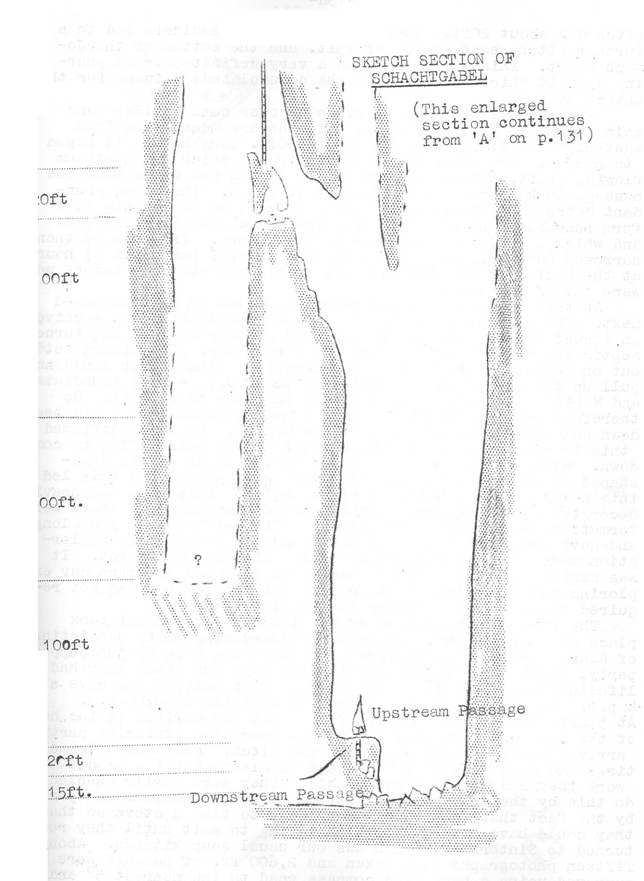
proceeded to Schachtgabel. It was not
easy to ladder the big shaft; its a loose scree slope, though there is solid
rock at the lower end round which we are able to tether the ladder. A short way down the pitch a doorway gave
access to a chamber beneath the scree slope. The first fifty feet was a series of steps, after which the ladder was
against the rock for another fifty feet and tended to snag every few feet. Even when it was clear of rock our troubles
were not over because I had hardly gone down 150ft. before I came to a great
tangle of ladder all depending from one rung. It was easy enough to kick free but the sensation it caused as it
hurtled down and the ultimate boing,
rather like a guitar, as it reached the destination and the rest of the ladder
took the shock was remarkable. This
happened twice. It proved to be about
300ft. down to a circular ledge about 20ft. across. Going off to the west and then meandering
partly south of west was an upstream passage which I followed for about sixty
feet before it became too tight. The
floor was a distinct vadose trench.
The shaft continued on the east side of the ledge which
needed extensive gardening before continuing (as it was one of the ladders was
damaged by falling rocks). The next
pitch was about 20ft., then a scramble over boulders led to a further pitch,
east again, of 15ft. and the bottom of the Joseph Shaft. This last pitch had a very definitive stream
pouring down it which I took to be the accumulative drainage for the entire
hole.
From here I was able to climb up over some boulders and gain
access to a high passable rift passage meandering in an easterly direction
which was about 250ft. long before it began to narrow. The floor was a vadose trench which had a
stream flowing in it. There was mud on
the ledges and signs that the passage took a great deal of water at times. There was abundant botryoidal stal. on the
sides as well as an erratic in a form resembling bract fungi of which there
were many examples and which I could not remember seeing before. The passage then narrowed but I did not
follow it further as I had spent 2½ hours at the bottom of the Joseph Shaft and
it was midnight before we were out of the cave.
At this point some explanation is needed of what happened
next. The day before descending Joseph
Shaft I had received an insect bite on the wrist which had greatly swollen and
turned septic by the day after which was a rest day. The others set out on August 3rd to begin
de-tackling. The ladder would not pull
up Joseph Shaft (Shades of G.G.! Ed.) immediately and Martin descended a
hundred feet in order to free it. He
therefore saw the doorway which I had observed when I had been down and
decided to have a look through it. He
soon confirmed this to connect with the other shaft and he called Mike to come
down. Mike entered a tiny passage on the
right of the dome-shaped chamber to which the doorwaygave access and this led
into a large rift running at right angles. The rift was heavily decorated more so than anything we have on Mendip
there were formations coated with formations! This rift was 50yds. Long and gave access to a large passage and further
hours of exploration made it abundantly clear that a big system existed. It was decided that it would be necessary to
spend an extra day exploring and surveying and therefore the tackle that was
not required for this was taken up the 250ft. pitch.
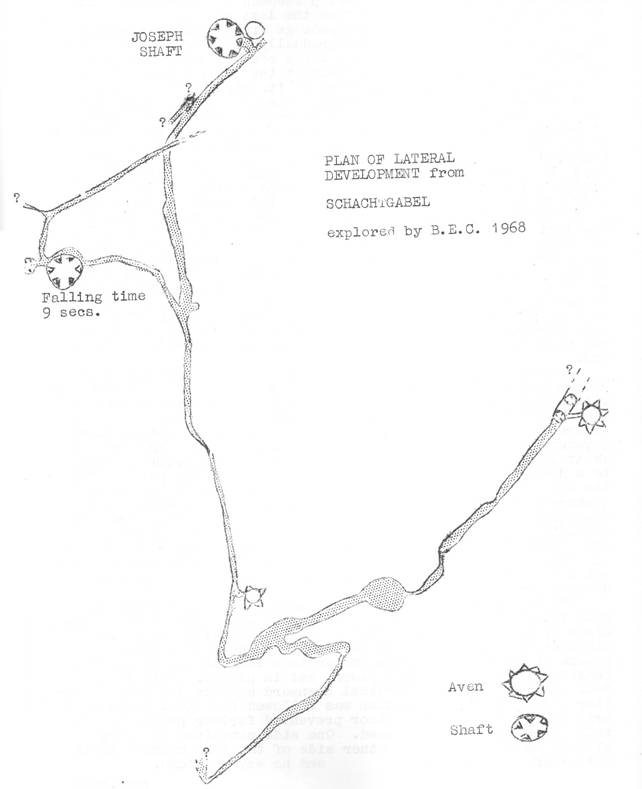
The further exploration of the lateral development took
place on Sunday night. An
exploring/surveying party consisting of Alan, Martin and Dick were taken down
the cave by the support party, consisting of Mike and Ian who came out after
they had life lined them down the 250ft. pitch. They entered the cave at 4pm. The
support party was out of the cave by 8.00pm. At 5am the support party left the hut and arrived ay the head of the
250ft. pitch only 15 minutes before the exploring party arrived to be life
lined back up the pitch. All were
extremely tired and much of Monday was spent in sleep, but the amount of work
they had done was formidable. They were partly enabled to do this by the
extremely dry nature of the extensions and partly by the fact that took the
trouble to wait until they returned to Sinterrasse which was our usual soup
kitchen.
About 15 photographs were taken and 2,600ft. of passage were
surveyed using a hand held compass read to the nearest 50 and distances to the
nearest yard. Some three large new
shafts were discovered, and several smaller ones, of course, not
descended. All the large ones took at
least 5 seconds for the stones to fall; the deepest took 9 seconds before the
last bounce.
The heavily decorated rift passage first entered continued
for about 150ft. and gave way gradually to an undecorated wider ascending
passage emerging in a large boulder chamber also ascending The passage continued at the top (after a few
awkward climbs over boulders) about 25ft. high by 10ft. wide for about 60ft.
when it dropped into a stream passage. This was about 40ft. high. It was
followed upstream, a ten foot waterfall was climbed and the passage followed
for a further 50ft. to a fork. The right
hand passage at the fork was followed up a 20ft. mud slope into a passage 15ft.
high by 20ft. wide with a mud floor. The
passage dimension slowly diminished until it emerged into a large chamber the
roof of which could not be seen. A mud
slope led down to a 30ft. diameter shaft with a falling time of 5 secs. clear
or 9 secs. to the last bounce. The shaft
was skirted through large boulders on a mud slope and on the other side a climb
a 20ft. climb up a mud slope led into another large shaft with a falling time
of 5 secs. At the bottom of the mud
slope a descending passage 10ft. x 15ft. was followed to a fork after
200ft. It was a rift passage 20ft. high
b y 6ft. wide with several potholes in the floor with passages leading
off. None of these were followed. The main rift was well decorated with dying
stal. but was not followed to its end.
Returning to the fork inn the stream passage the left hand
branch was then followed. It was an
ascending passage 400ft. long with several potholes in then generally boulder
strewn floor. A stream entered from the
left at the bottom of a large shaft and apparently flowed back down the passage
but could not be heard anywhere in the passage. Here the explorers had a brew up. At about 400ft. the passage changed after a short phreatic section to a
descending passage. The general shape of
the passage was low and wide 6ft. high by 30ft. wide. It continued for about a hundred feet to
another fork with the left side continuing downwards and the smaller right hand
passage ascending. From the ascending
passage a strong draught issued. This
was followed for about 400ft. until it emerged in a small chamber and continued
at the bottom of a rift too difficult to ascend without tackle and about 25ft.
deep. Throughout the passage the draught
was pronounced.
The larger descending passage, left hand at the fork was followed
for about 500ft. It was tunnel like
15ft. in diameter. After about 250ft. a
large chamber about 40ft. high and 40ft. in diameter was entered at the far end
of which a steeply descending squeeze about 109ft long gave access to a low
steeply descending bedding plane with a sandy floor, wet in places. This closed down after 100ft. and a vertical
squeeze led into a similar descending passage which was followed for 150ft.
until several shallow pots in the floor prevented further progress. At this stage the passage forked. One side contained the pots already mentioned
and the other side of the fork emerged in the bottom of a large shaft and no
way on found. (The explorers had no maypole about 600ft. would be desirable). It say much for the stamina of the party that
when their relief arrived they de-tackled the top of Joseph Shaft and sent
three bags of gear up the 250ft. pitch.
The next day (Tuesday) a party consisting of Dick, Alan
(Jnr.), Martin and Ian de-tackled the cave as far back as Schachthalle. This took them about 10 hours. The following day it took Mike, Dick and Ian
about 7 hours to get all the gear from the cave. On Thursday (about 2am) Mike, cunningly
persuaded a member of cheerful Austrians to accompany them on that days
carrying. The result of this was that in
fact the carrying was completed in one trip.
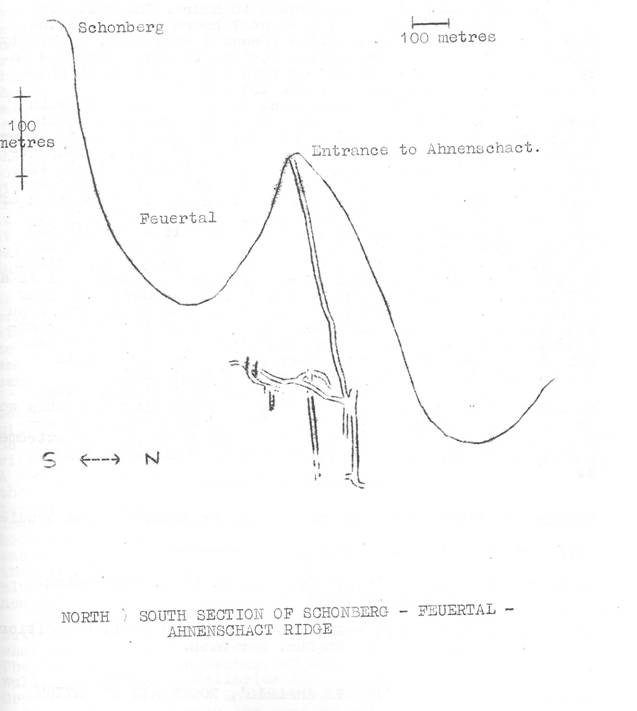
The entrance of the Ahnenschact is at 1890m. The main horizontal development has therefore
been found at approximately 1590m and although we did not realise it until
afterwards this is exactly what we should have expected. The entrance of the Raucher is only 3km away
and the altitude of its entrance is 1570m. It is more than likely that the geological conditions which appertained
to cause the formation of one would have applied to the other. It is possible that they are connected. The Raucher entrance lies roughly SSW of the
Ahnenschacht and each cave has ¼km of passage in the direction of each other. Another interesting feature is that the
lateral development from Schachtgabel leads off in the direction of the
Feuertal where we have seen many possible shafts, some plugged with snow. The discovery of an easy entrance in the
valley would be a boon to the further exploration of the cave. The possibility of such and entrance existing
is supported by the fact that a bat was seen in the horizontal passages leading
from Schachtgabel.
Once again having safely got everybody and everything not
only out of the cave but back to the hut without mishap we are already
labouring under the delusion that we had an enjoyable holiday. I was perhaps lucky in developing an
extremely painful carbuncle at the critical point of the expedition.
References: –
The Ahnenschacht A. Thomas
B.B. No. 237 (Dec. 67)
The Ahnenschacht R. Stenner
B.B. No. 239 (Feb. 68)
Osterreichs langste und tierfste
Hohlen H. Trimmel, Wien 1966 (pp. 46-47)
Die Tiefenvorstosse 1958 in den
Ahnenschacht (Totes Gebirge) Die Hohle 10, 1, Wien 1959. (pp. 5-8)
Ed. apologies. The
correct name for the Joseph Shaft is JOSEF SHAFT
Outdoors
With Hedera
For me the Great Interaction proved to be the most
stimulating recent event. Even Sell
dropped everything to join the pilgrimage to see the effect of Outdoors on
Swildons. Quite a privilege to be there
really. There before your very eyes
Instant Cave Development!
Outdoors got a little confused with Indoors and kept
tripping over Wig rushing Outdoors all over Mendip on his two flat feet
pausing only to light another gasper and with
Shining eyes and waving arms to elucidate the latest
marvel. Well it was marvellous. From the obvious ones like the Forty, and the
vertigo inducing shaft at Manor Farm, to the ones which had to be deduced like
the depth of flash rivers in the valleys it was marvellous. A walk done which was of absorbing interest
was from the top of Velvet Bottom to Cheddar. Interesting to see how the water sank and re-appeared a few hundred yards
later and to consider that the mass flow of water which burst from the narrowed
Velvet Bottom were it joins the Cheddar Road was probably less than higher up
Velvet Bottom. It seems to me that most
of the water from the upper catchment area sunk in the broader parts before it
reached the Longwood intersection and that the water emerging at
from the
catchment. And Ill show you where the
lot sunk! (and resurged? Ed).
Another outstanding consequence of the Awash was ones
ability to walk up and down Cheddar Gorge in pleasant quiet traffic free
conditions and to climb there with feeling antisocial. Lets start by demanding that at least the
Upper Gorge be closed to self defeating traffic. Common sense must prevail in the end. Cheddar Gorge cannot be seen from the motor
car the presence of which is destructive to appreciation.
Just after the Mendip Awash two Outdoor Men took a two
seater canoe down the Brecon and
passing through what must be the most beautiful countryside in the world and
giving unique views of the Brecon beacons, the Black Mountains and
Llangattock. A car was left by the
canal; a mile or so outside of Gilwern and then the other was driven to the
viaduct near Brecon and the towing canoe put in the water a discrete distance
from the lock keepers cottage. Possibly
the biggest laugh was the Talybont Tunnel which was entered to ecclesiastical
tunes, there was a pause for a ceremonial
beer drinking ceremony halfway and then the rest of the tunnel was treated to
secular singing. The blushes came when a
male member of a family party picnicking near the exit remarked dryly, we
enjoyed your singing!
Meanwhile in the vertical plane bob Sell, Roy Marshall, Pete
Sutton with a couple of characters called Bob and Rory have had what must have
been a pretty satisfying holiday in
Sabre Cut, Grim Wall, The Brothers, Mallories Rib, Skylon, The Wrinkle, Yellow
Groove and Main Wall. Interesting to
hear that the Main Wall in spite of its relatively low grading was thought
good. Bob Sell also joined Terry Taylor
on Red Wall, an HVS, on the way up to Cryn Las. Now thats something that I like to hear about in more detail because a
more horrifying cliff I have yet to see.
Three hundred feet of impeding slime, perpetually wet and
apparently smooth. I just cant imagine
climbing it. Ah well, pervertion is what
the other fellow does.
Our ranks have been increased. Eddy Welch has recruited a walker, Ruth, by
marrying her. The end justifies the
means. Thank you Eddy.
University Of
Bristol
extra-mural studies.
Autumn Courses of interest to cavers: ——-
Geology 30 weekly meetings
(Tuesdays). 8pm. Commencing on 1st
October 1968.
Limestone geomorphology Sat.
Nov. 23rd and Filed expedition on Sun. Nov. 24th.
Other courses include Pollen
Analysis, Rocks and Quarrying, Fundamental of Soil Mechanics.
Sutherland 68
by Mike Palmer
In the blur of early morning on Saturday 7th August a party
of BEC members comprising Tony Meaden, Phil Coles, Mike Palmer and Colin
Priddle set out to explore the caving area of Sutherland in N.W. Scotland.
A pre-arranged stop was made in
of Manch and the local pub.
The G.S.G. party were to have travelled from
this refused to function satisfactorily and on Sunday morning when the BEC
party set out for Sutherland they were still trying to mesmerize the engine
into life. Apart from stops to purchase
provisions and to take the odd photograph, the journey was uneventful and the
GSG hut was reached by early evening. After moving in operations were completed and cooking a meal had been
vetoed, an expedition began to find the nearest public house (which happen to
be called hotels).
The hut is situated about 14 miles from Ullapool on the A835
just inside Sutherland border and on the outskirts of the
which is more generally known as the Knockan area. From the hut, though the village of Elphin,
the road can be followed to a tee junction with the A837 at Ledmore. The nearest hotel from there is to the right
and only a short distance down the road, but it proved to be hopeless since it
didnt stock drought beer; however a few bottles were consumed since closing
time was near.
Early Monday morning John Manchip arrived in a Reliant Car
with a young lad from GSG named Andrew. This arrival interrupted Tony Meadens attempt to frighten Phil Coles
with tales of ghosts and how they particularly haunt old crofters cottages
occupied by cavers!
From the hut a very fine view of the surrounding mountains
(hills?) is obtained, one in particular being very prominent, Cul
2,786ft. the shape of which appealed to the erotic instinct of the of the party
and during the safety of breakfast we decided it would be a worthwhile walk.
Three hours later, four of us had reached the highest summit
of the two peaks, while the other two, Phil and Colin had taken the other route
to the slightly lower peak.
Needless to say Tony had only flexed his muscles a trifle,
while the rest of us were absolutely shattered; the view however was
magnificent and a fit reward for our efforts.
The evening found everyone very much in need of suitable
refreshment and joined by another member of the G.S.G., Robin (desperate)
Duncan, who hitched up from Edinburgh, we turned left at the tee junction and
ended up at the other hotel at a place called Inchnadaugh. No doubt by now some of the exploits of our
party was common knowledge at the hotel, so suffice to say that the beer and
barmaids were excellent and the hotel is highly recommended.
Because of the very fine weather a lot of the time was spent
locating beaches where we could laze in the sun. One of the best we found and spent most of
our time was the
approached by following the B869 that branches off the A837 north of Lochinver.
Sad to say on Wednesday we all decided to end the misery of
idling our time away on the beach and went caving! The cave that we chose to explore is situated
in the
a tracked marked on the O.S. map from behind the Inchadamph Hotel. By careful driving it is possible to navigate
a car to a point close to a cottage near the end of the track, which proved to
be useful changing place. Following the
general direction of the track, which is well worn, the Cnoc-nan-Uamh System is
soon reached (NG. 276206) the distance being about a mile. The entrance is easily recognisable since it
is a large open bedding plane with a sizeable stream running from the left
across the visible bottom and disappearing to the right.
Laden with diving gear the party followed the stream to the
right, down a spectacular bedding plane, until a short crawl at the bottom
ended abruptly in a sump. Quite
impressed by the size of the sump and the amount of water being consumed, Colin
was soon prepared for a short exploratory dive.
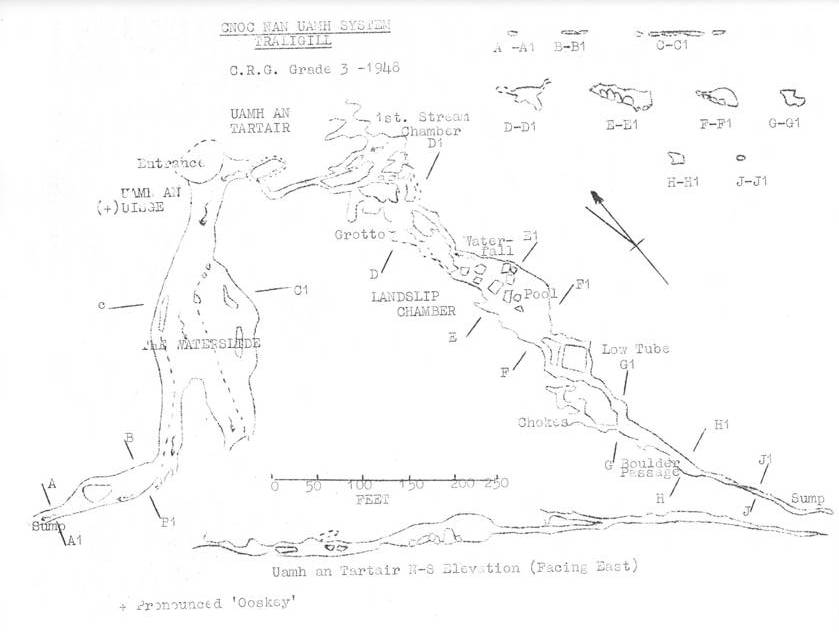
After 20ft. he returned to explain that the sump followed
the line of the cave and was quite large the water was very clear. A second dive resulted in a penetration of
approximately 50ft., at which Colin decided it was unwise to continue without
diving support. On this occasion he
reported that he was nearly able to provide us with a supper of trout, which he
saw swimming near the sump.
Next, the upstream passages of the system were
explores. The party was soon halted by a
loud sucking noise, which at first was rather alarming until it was discovered
that it was caused by a small whirlpool of water where the stream sank in the
bed and reappeared in a small pot below.
Several ducks had to be negotiated, which entailed immersion
up to the neck, but they were very sporting and good experience. This brought us to Landslip Chamber and a
large pool approximately 20ft. x 20ft. which appeared to be quite deep. The stream clearly flowed from this pool and
it thought that the pool hides a large sump; because of the size of the pool
Colin decided that it would be dangerous to dive by himself. Also the diving gear was too far away.
Traversing round the pool, a large passage was easily
followed after a short crawl. This
appeared to be of phreatic nature and towards its end it began to dip towards
another sump which looked black and evil. It could be that the passage (like P.R. in Swildons) might rejoin the
stream way at a higher level beyond the sump, which showed clear evidence of
resurging in times of flood or even normal wet weather.
After Mike has wallowed around in the sump for a short time
and only proved that it went deeper and could not be passed at this time, the
party returned top the entrance and sunshine.
On Friday we went caving again (apart from JM who stayed in
bed) and almost wished we hadnt bothered. Apart from the cave, called Elphin Hole (NG. 20870956) being
uninteresting, we were nearly massacred by the Scottish midges en-route to the
cave entrance they are really ferocious and draw blood.
That just about wrapped up our active holiday band we were
forced to go back to the beach and laze in the sun. To end on a serious note, the potential for
caving is good and for those who enjoy walking there is plenty of it and we are
sure that the BEC will be welcome to stay at the GSG hut.
Letter To The Editor
Wellingborough,
Northants.
22 Aug. 1968
I would like to take this opportunity to thank all those who
were involved in my extraction from Nine Barrows Swallet on 12 May 68.
My injuries consist of a broken leg and ankle which I am
glad to say are progressing satisfactory. I expect to have the plaster removed on September 11th which means that
it will probably be mid-October before I can treat you to a pint in the
Hunters.
Yours,
John Benham.
Ed. Note: – Details of this rescue appeared in B.B. 143
p.88.
Address Changes: –
Viv. Brown,
Keith Franklin,
Road
Phil Coles,
Cotham,
6.
*****************************************
Time for carbide Empty coffee tins, marvel tins etc, are
required by the club to enable the carbide, held on the Belfry site, to be
broken down into suitable weights for sale.
*****************************************
NEXT MONTH IN THE B.B. articles include BEC climbing meet
in the Otztaler Alpen and the Bernina, Address list of club members and a look
back to Mendip caving in 1947 in an article entitled So What by Senex.
From Other Clubs
By Gordon Tilly
Development of an Inexpensive Flowmeter by B. Dobson, Field Telephone
Systems by S.J. Thompson, and there is also a record of the SUSS visit to
Ireland in 1967. Contents also include
descriptions of Bossen Hole, Middleton Dale, Derbyshire and October Aven in Giants
Hole complete with surveys.
MENDIP CAVER VOL.
4 No.4 contains results of Phase 3 Water Tracing
results by Dave Drew (see June B.B.) and notes from
and various cave digs. Vol.4 No.5
includes a report on the flood damage on Mendip and strangely enough it bears
the title Mendip Awash which sounds familiar!
WSG Bulletin Vol. 5
No. 10. This issue deals mainly with
club caving log but also has an article on Charging of Nife Cells and the
Preparation of Electrolyte by Dave Everett.
Monthy Notes No. 17
by Wig
News in brief: –
French cavers reported to have challenged Pearce (of the
Berger) by stating that he only went down 3,696ft. and they have reached
3,749ft. Pearce replied to Guardian
reporter, You dont leave footprints on rock.
St. Cuthberts Sump
July
flood blocked sump. Divers and cavers
now digging to left of the sump itself. By digging here it is hoped to bypass the constriction that was met by
the divers last year.
G.B. Since the flood reports have been coming in
stating that there are several unstable areas in the cave. It is known that the Ladder Dig Extension
ruckle moved during the flood and is now in a more dicey state than it was
before. Also the entrance passage,
scoured out by the flood water, is still unstable and beyond the Devils Elbow
is also another point to watch out for. It has been suggested that the cave is no longer suitable for novices
perhaps it will be best to go and have a look for yourselves in that respect.
CHRISTMAS BB. All material should be in the hands of the
Editor Dave Irwin (Wig) by early November.
Surveys. A new series of cave surveys is being
prepared by club members. The first will
appear in December or January 1968 B.B. All will be to CRG. 6c-d and also maintaining the requirements of the
MSC.