
Club News
Foot And Mouth
The recent outbreak of Foot and Mouth (known as Hoof and Gob
to some) did not reach the Mendip area, although there was a scare, when cattle
at a farm just north of Bristol was suspected of having the decease, on
Christmas Eve.
It appears that your Committee made the right decision by
keeping the Belfry open to members living outside the restricted areas. Other clubs made similar arrangements though
some closed their huts to members.
Caving Again!
Certain caves are open again following the Foot and Mouth
outbreak. At the time of writing
(7-2-68) the following caves are open: –
1. a). Burrington
area.
2. b). Charterhouse
area.
3. c). St.
Cuthberts, Hunters Hole and Cuckoo Cleeves in the Priddy area. Swildons Hole is NOT yet open.
Members wishing to visit any other cave should first contact
the farmer before crossing fields. Remember to use foot baths if they are provided at the farm entrances.
Practice Rescue – St. Cuthberts.
The Wire Rift practice (Jan.21st.) organised by Keith
Franklin was a complete success. It had
been thought the rift would have produced problems that could have been
overcome by special equipment. Prew
and Mike Palmer laid a telephone wire from the Belfry so that a complete log of
events could be made. Pete Franklin
played the victim so well that he is applying for a job as an instructor at
the R.A.D.A.
The Club Needs Your Dollar
For the small sum of 5/- a week (two pints of beer) for
three years YOU could help rebuild a new permanent Belfry why not sign a
Bankers order right away. More details
from Bob Bagshaw.
Annual Dinner & AGM October 5th. 1968.
Make a note in your diary now.
January Committee Meeting
Main points discussed were a) Long Term Planning. b) Foot and Mouth it was decided to await
the C.C.C. action. c) B.B. changes of
format and cover design. Cuthberts
Guest Leader system several clubs had replied and a meeting to be held in the
near future.
Useful Addresses
Hon. Sec: – A.R. Thomas,
Somerset
Editor: – D.J. Irwin,
Road
TACKLE MASTER N. Petty,
Bankside Road
PUBLICATIONS B. Ellis, Knockauns, Combwich, Bridgwater, Som
Subscription
January 21st. does that ring a bell? Its well known that its the last day of
January but did you know it is also the time that the BEC SUBSCRIPTION is
due? Come on cough up. Remember 25/- (under 18s 15/-) and when you send
it to Bob also enclose your membership card for endorsement. To please Bob even more send a S.A.E. so he
can return the membership card immediately.
Thanks From the Thanks Department
Many thanks to Juliet Parker for typing the January B.B. and
to Barry Wilton for arranging the printing of the B.B. covers so quickly.
Late News
Members having a note of importance can get it into the B.B.
providing that it is no longer than 150 words and in the hands of the Editor by
the Saturday evening prior to the 1st. Sunday of the month.
All other material should be received by the Editor at least
two weeks before printing.
Easy Recognition
In the past it has been difficult to locate any particular
B.B. quickly. It has meant searching
through a pile of B.B.s and looking inside the front cover to find the issue
number. To make things easier the B.B.
number and month of issue is now typed in the top left hand corner of the first
page. Members wanting to use this as a
quick reference need only fold over the back corner of the cover.
Christmas Puzzle
Only one answer was received from Tony Meaden. He has not found the most efficient method
(which only needs a single question asked three times) but he will be bought a
pint by Alfie when the occasion arises.
Address Changes: –
R. Broomhead, 14 Cedar Park, Stoke Bishop,
I.M. Daniels, Handsworth,
T.H. Hodgson, 19 Alfred House, Kingsdown,
D.J. Irwin,
Bedminster,
W.J. Smart, c/o Richard Costain (CE) Ltd., N.E. Aprons Contract, Central
Complex,
O.F.D.
Since the opening of the Severn
Bridge South Wales caving areas have acted as a magnet to Mendip Clubs. Cavers from the
in about an hour and the Penwyllt area in something under two hours.
Our next article, written for the
B.B., comes from Paddy OReilly (SWCC), one of the leading lights in the
exploration of Ogof Ffynnon Ddu now the longest and deepest cave in the
Swildons v. Penyghent argument is quietly put to bed!
The road to Penwyllt winds steeply up over the grey
limestone slopes and clings to the edge of the hill till it peters out in an
ugly soar of spoil heaps and quarry debris. The view for the casual visitor changes as he climbs the hill. The green slopes of Craig-y-Nos on the valley
floor disappear from view as he climbs past the deserted quarry workings. There is a wide gaping hole by the roadside
that someone has thrown an old mattress into. A cave, he mutters, as he
continues, unaware that the small cave segment is part of an enormous system of
underground passages that stretch for miles under his feet and somewhere far
over there on the moors, near Pwll Byfre.
The Byfre is a cliff face, which swallows a sizeable
stream. The stream is not seen again
until it emerges several miles away at Ffynnon Ddu. The resurgence at Ffynnonn Ddu attracted many
cavers, but it was not until the newly formed Cave Diving Group attempted to
force a way into it in 1946 that it seriously received attention.
Peter Harvey dug in a small fern shrouded hollow nearby for
some time before being able to negotiate a narrow crawl. It led into a still pool, over six feet deep
in places, with several passages on. A
week or so later he returned with a rigid wooden ladder to climb into the
passages, but the excitement of the discovery led to disappointment when all
the ways on appeared to peter out. The
cave, Pant Canol, was abandoned, and it was not until years later that it was proved
to connect with the main cave.
persisted nearby however, and some time later broke into a large passage that
ended in a sump at one end. In the other
direction it went on and got bigger till at last the roar of water could be
heard there was tremendous excitement and an archaeological digging party at
Ogof-yr-Esgryn joined in the exploration; the stream way was followed until it
was found to emerge from a small side passage which sumped. On ahead the way went into a big
boulder-strewn river chamber that was blocked by a huge boulder collapse,
Boulder Chamber.
There was a certain amount of disappointment after the
initial burst of enthusiasm there was hardly a quarter of a mile of stream
way, and the Byfre was more than two miles away. Within a few months John Parkes(?) had climbed
a waterfall and discovered an extensive network of high level passages that led
off from the main stream passage that gave hopes of providing the bypass to the
sump. The series did not go however.
Don Coase attempted to dive the sump, but was forced to give
after a couple of hundred feet nor so when the passage narrowed and turned a
right angle.
Another high level route was discovered, the Rawl Series, on
the other side of the Main Stream and with it came hopes of a route beyond the
sump. A survey showed Starlight Chamber,
a large collapsed chamber, was vertically above Boulder Chamber. It seemed as if the only way to progress was
by digging inside the cave.
Everything that happened in 1953 was overshadowed by the
incident in which Bill Little and Lewis Railton were trapped in the Rawl Series
by flood waters. Foresight meant that
they had dry clothes with them but their three day enforced encampment was a
nerve-wracking experience for both. The
Byfre had to be diverted away from the sink in order to allow rescue workers to
get to their shelter.
Despite this setback, diggers got to work and several
successes were made Pant Canol was connected into the main cave, posing the
problem had Ogof Ffynnon Ddu been extended by several hundred feet or had Pant
Canol been extended by three miles?
What appears to have been the first determined attempt on
the boulders in Boulder Chamber was made by Dai Hunt and some others about
1953. A small tube to the left gave
access to a muddy pool which was baled but only led further into the
boulders. Digging in the floor led to a
small chamber with a sump on the right which was called Hush Sump. It was later found, that in cases of extreme
flood the level of Hush Sump gradually rises till it overflows out to join the
main stream.
O.C. Wells dived in Hush Sump and returned with tales of a
magnificent diving site rivalling Wookey, but it was several years until it
was revisited. There were two major digs
going on at that time, the one in Boulder Chamber and one in Coronation Aven
near Starlight Chamber named partly because of the year in which it was
discovered in, and partly because of what almost happened to many of the
diggers. That was a miserable dig wet,
cold and draughty and interest in it was spasmodic.
As the years dragged by there seem to be little progress in
location O.F.D. II. Many digs were
started on the moors the most likely of spots between Penwyllt and Pwl Byfre
were examined again and again. The Pros
and Cons of digging where or there were thrashed out over pints of Vale of
Neath in the Glyn. Peter Harvey believed
that if O.F.D. II were discovered it would be relatively underdeveloped.
Nonetheless Cwmdwr Quarry attracted attention because a cave
that was known to exist there; but had been filled in. A systematic dig began and for many months
Clive Jones and his fellow workers dug in narrow, constricted droughty rat
holes to emerge into a large dry passage, Cwndwr Jama. It ended in both directions in boulder
chokes, but in the lower choke a small stream disappeared. It was traced to O.F.D.
It was 1960 before divers returned. Meanwhile the Boulder Chamber dig had
produced some interesting results. A way
through had been found and a large circular passage followed down dip to end
disappointingly in another sump Dip Sump. A connection was proved between Hush Sump and Dip Sump, but it was on
the latter that a big push was made. Charles George and Brian de Graaf did a splendid series of dives through
the sump which was 200ft. long, to an airspace, from which appeared to be
several ways on. The Shrimp Series, as
it became known, was explored except for one or two high inlets. The main stream entry, Oxygen Pot, was dived,
but only a bedding plane, so the way on was not through there.
Attention turned away from sumps and digs. The Hot Air Mine was found one snowy day, and
a few efforts led to a chamber about 70ft. down, but again there seemed no easy
way on into O.F.D. II. Alan Coase
discovered an aven in the Waterfall Series, Tiger Aven, that led through an
interesting series of squeezes to a big pitch it proved only to be a circuit
and the pitch was back into Crystal Chamber. Bill Little discovered the Fault Series right by the entrance a
network of small interconnecting passages that lay undiscovered for so long,
close to the entrance.
The summer of 1966 saw renewed activity in Dip Sump. Charles George returned back to the Shrimp
Series and climbed into one of the inlets left unexplored. It appeared to go on into a small network of
interconnecting passages. Subsequent
dives were backed up by John Osbourne and Terry Moon and a big pitch was found
that led into a big black space. It
was obvious that O.F.D. II had been entered.
The big black space led to an intersection
Piccadilly. To the left the passages
grew in number and size until a big chamber The Smithy was entered. Here the confusion really began. A stream (later proved to be the Cwmdwr
steam) could be heard below the Smithy and when followed it emerged as small
inlets from a network of minute passages. Downstream, a canyon type passage meandered in till it widened out and
joined near a low arch by a much bigger stream. On the day it was discovered it was in flood, nevertheless it was
followed upstream for a considerable distance. The two elated divers returned through Dip Sump to announce that O.F.D.
II had been found.
The effect on outside activity was fantastic. Renewed efforts were made in Coronation Aven
and a way through to the new cave was made, but after one person has been
through, the whole thing collapsed, leaving the diggers scuttling for safety in
the confined space. The dig was
abandoned after rescuing the trapped caver.
The bottom boulder choke in Cwmdwr was re-examined but no
way through could be found. Prospecting
was carried out on the moor and a site for a shaft was decided on, near the old
Engine House.
The returning divers pushed upstream. The magnificent stream way continued on and
on, past a series of potholes, round a great oxbow and on at last to a great
waterfall 20ft. high, taking all the stream. Maypoles were carried through Dip Sump, and the waterfall scaled. Disappointment was acute when the character
of the stream altered almost immediately, and the lofty stream passage after
two miles, degenerated into a miserable bedding plane sump. On that particular trip the diving party had
a narrow escape when returning towards Dip Sump. The route involves crossing a chamber with an
unstable floor. The whole thing collapsed
and trapped one of the party. For a few
moments it seemed as if he was lost completely but then it moved again and the
boulder shifted so that he was thrown clear. The party came back safely through Dip Sump.

For a while the new cave was left alone until one day a
party of divers went to search for a connection with Cwmdwr. While eating sandwiches in the Smithy they
were disturbed by a loud explosion. Smoke billowed out of a nearby boulder pile. The divers split up. John Osbourne followed one route and after
some distance and extremely intricate squeezes emerged in a well water worn
boulder collapse. Half an hour
previously Clive Jones had been digging there but had gone away disappointed. John raced towards the entrance and followed
the others to the SWCC headquarters where he had quite a job convincing those
present that at long last there was a dry way into O.F.D. II.
Then the masses invaded the place. The delicate floor formations rapidly
disappeared under the eager visitors vibram boots and the numerous side
passages were pushed to their limits. In
the stream way at the Marble Showers, an area of beautifully flecked rock, an
extensive series was entered and led to the head of a very large waterfall near
the bottom of the stream. Further
upstream there was very little progress and the Top Waterfall was only visited
and admired.
Convinced that there must be a way around the final
waterfall and sump, Paddy OReilly and Colin Fairbairn maypoled one of the
inlets about three quarters of the way upstream, to gain access to a network of
interconnection rifts. In several places
there were passages floored with a peculiar white mud, like mochmilk, and
thought at one time to be a clay mineral. It has never been seen anywhere else in the country and its origin is
still unknown.
The Clay Series was visited on several occasions and its
distance from the entrance meant that trips of fifteen hours or more were
needed before any serious exploration could be done. One particular trip Paddy OReilly and Susan
Bradshaw camped near one of the best formations in the cave, The Trident, a
15ft. long stalactite, and with several others managed to follow a very large
passage, the Chasm, to its ultimate end a boulder choke. There seemed every possibility that this
passage might lead to the stream way beyond the Top Waterfall. On the second day of the camp a network of
large dry passages that criss-crossed again and again was found. In one of them there was an aven below which
was a pile of pebbly debris, with land-snail shells and bat droppings,
indicating that is was close to the surface. The radio detection device was used and the spot located as being
vertically below a scree slope on the surface. There was no indication of any cave underneath, but when digging began,
with a party inside, a way through was cleared within three hours and the
farthest reaches of O.F.D. II were again thrown open to the masses.
Again visitors came in droves and again much of the shine
was removed from the virgin cave passages; so much duplication of effort was
done on those first few weeks after the new entrance was opened that several
passages were rediscovered again and again. The most important one was left untouched however for the original party
to push it. A traverse of about 200ft.
over a deep rift led over the choke that had previously blocked passages and a
way down into a large stream passage was found. Downstream it ended in a bedding plane sump and upstream a twelve foot
waterfall barred progress. The following
week, a maypole defeated the waterfall, but the flood waters prevented the
party from following the river all the way. By traversing at a higher level in places another half mile of stream
way was explored; it ended in a sump. The sump was eventually bypassed but within a short distance a large
river chamber was found. It ended in a
very final boulder collapse.
So the exploration has ended. Perhaps only for a while, for there are
undoubtedly many for thousands of feet to be added here and there. A preliminary survey of the major passages
has been started and the total passage length of O.F.D. is likely to be in the
region of 15 miles. The final chamber
now reached is no more than several hundred feet from Pwll Byfre although it is
still south of it. The character of
O.F.D. III is very much different from O.F.D. I or O.F.D. II; the usual;
cascading stream is only met occasionally, and for most of the part the passage
is wide, meandering and nearly horizontal. In its length, O.F.D. III hardly drops 100ft, while O.F.D. II drops
nearly 600ft. From the new entrance to
the level of the water in Gothic Passage, the vertical distance is almost
850ft. making the system the deepest in
and certainly deeper than any in
The development of the cave is difficult to trace. The Clay Series contains some very large
passageways that seem to follow on from O.F.D. III and appear to be cut off; it
has been suggested that an original cave system existed with passages extending
from the Clay Series, downwards towards Cwmdwr Jama and the Smithy thence to
the Rawl Series. It will however be many
years before any theories can be properly formulated at any rate not before the
system is properly surveyed.
Paddy OReilly,
Penwyllt.
Letter To The Editor
Dear Sir
I would like to thank all those concerned with the
presentation which was very much appreciated. This gave me an excuse for non-caving, as I can now claim that the
carbide chamber of my lamp has two holes drilled in it and I couldnt take it
down a cave as this would spoil the plating.
The remainder of the ceremony was not so enjoyable, but I
would like to say how much I appreciate the thought behind the presentation
which will always remind me of my time as B.B. Editor.
ALFIE
Outdoors with Hedera
The risk of catching a cold on a nasty wet rock or foot and
mouth from a wall eyed mountain sheep begins to diminish and our scene begins
to swing.
As does D. Targett Esq; Derek, reporting little recent
activity apart from Avon Main Walling has two limestone areas in mind for a
swinging 68. Last year a speculative
poke at a newish face at Swanage yielded an as yet un-named A2 route and
promises more while at Wintours Leap he tied up with a party to put up Flight
a new route on Fly Buttress.
Ed Ward-Drummunds proposed code giving a detailed
description of a climb is said to prove a) useful b) useless. My impression is that if a climb is hard then
any description is useful (including where it is S so I can avoid it). Ed. W-D has departed for
the Red Cliff to the Padare Lake Hotel.
Two new routes to try out on the 24th March on the Frome
Valley Sandstone. Derek Targetts
introduction to the area resulted in Direct H.V.S. (in technique) on Bridge
Buttress. This takes the line directly
above the Cave. Start on the right wall
of the Cave and take the wide crack in the roof of the Cave. Pull over two overhangs to the thin wall to
the left of The Ramp and then indulge in a spectacular finish over the final
big overhang. The other route completes
(I think) Cave Quarry with Middle Slip. Extreme in technique. Climb
Dusty Ledge to the impossible bulging wall with the diagonal scratch and
climb it. Obviously.
B.E.C. joined Insman in Corwall in mid January at the O.C.
Hut, Bosigran. BEEOOTEEFUL weather smirked
Peter Sutton, Bob Sell and Fred Atwell. Back in the Old Days Cornwall attracted HUGE meets basking in balmy
Easter sunshine with mighty man Sandall playing throwing Kangy or Bennett (or
anyone to hand). I once even saw Norman
Petty with his coat off! This year we go
to on 18/19 May, sez Eddy. TIP Mark
James has regained his Big Van
.
Nice to see Terry Taylor at the Waggon though unfortunately
his
probably be in the Lakes instead of
if, as it seems likely, the current restrictions remain.
Hedera
*****************************************
The following books are in print or will be ready soon
available from WEST COL PRODUCTIONS, 1 Meadow Close, Goring-on-Thames,
the
Vol.2 from
du Geant to the Fenetre dArpette same authors. Price Vol.1 35/- Vol.2 28/-.
Vol.1 (35/-). Saas Fee and
(28/-) by Collomb. olomites by P. Crew
(25/-).
Rangham (28/-).
ALPS
and Crew (16/-). GRAIANS WEST
Tarantaise and Maurienne by Collomb (25/-).
Wallhorn and Scheidegg Wetterhorn by J.O. Talbot (21/-).
Ahnenschacht
by Roger Stenner
A REPORT OF SCIENTIFIC WORK CARRIED OUT DURING THE 1967 EXPEDITION
I was invited to join the expedition to organise a programme
of scientific work that could be carried out during the exploration of the
cave. This work would not be such as to
hinder the purpose of the trip, the descent of the shaft. In
surface base camp with telephonic communication with the parties in the cave.
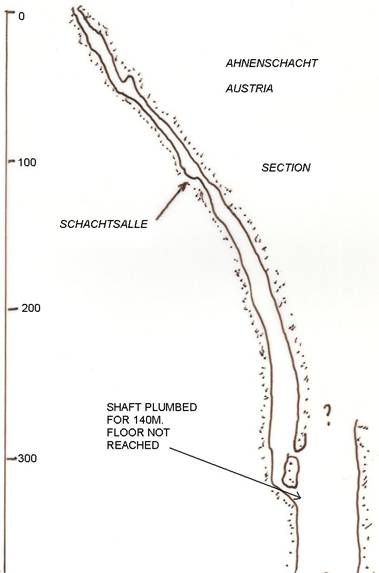
Scale is Depth in Metres
SURVEYED BY V.L.H.O. 1961
The provisional plan was to analyse water samples collected
from the surface and from the cave for carbonate, calcium, magnesium and
aggressiveness towards calcium carbonate (these analyses to be made at the base
camp using transportable laboratory) to collect water samples for a
comprehensive analysis in England; to check progress in the cave using an
altimeter with a second altimeter at base camp to give the necessary
corrections; to study water and air temperatures in the cave; to collect rock
samples for analysis in England. The
provisional plan relied on members of the exploration and tackling teams being
able to collect samples, measure temperature and altitudes and during the
making of the plan, this did not sound unreasonable.
This was the plan, however, in practice there was no surface
water to study, and because of the difficulties met within the cave only two
sets of water samples were collected, and one water and air temperature
measured in the cave. Springtails were
seen but none collected. After returning
to the valley a resurgence was examined but it is not known whether a water
connection exists between this and the Ahnenschacht.
The altimeter work was more successful. The measurements at the base camp were
started in clear hot weather. A
thunderstorm swept the mountain that night. The following day was dry and windy, but the night brought another
thunderstorm, and the ten hours of heavy rain put an end to the assault on the
shaft. The surface altimeter changed
178ft. in this time. Three sets of
readings were duplicated at different times, giving a check on the method of
correcting the results. (See footnote
1).
were taken at the foot of the tenth pitch illustrate the method of correcting
readings. The values off the corrections
were obtained from a graph by plotting readings made at the base camp with the
second altimeter.
FOOTNOTE 1. For further reference B.B. Nos 148, 161, and
to the section on the use of a barometer in the book on Cave Surveying now
being prepared by members of the Mendip Survey Colloquium.
FOOTNOTE 2. The method of measuring the aggressiveness of
water towards Calcium Carbonate devised by the author is explained in a paper
in the course of preparation.
|
STATION |
ENTRANCE |
FOOT OF 10th PITCH |
||
|
DATE |
23-8-67 |
23-8-67 |
24-8-67 |
25-8-67 |
|
TIME (HRS) |
18.15 |
23.45 |
09.40 |
02.50 |
|
ALTITUDE (FT) |
4942 |
4590 |
4640 |
4695 |
|
CORRECTION (FT) |
0 |
-45 |
-115 |
-16 |
|
CORR. ALT. (FT) |
4942 |
4545 |
4525 |
4530 |
|
DEPTH (FT) |
0 |
450 |
470 |
465 |
The altitudes quoted are relative to an arbitrary value of
5,000ft. for the base camp. The
altimeters are graduated to 20ft., and the readings were estimated to 2ft.
RESULTS:-
1. Pool at Schachthalle: Water 3.5oC., Air 4.6oC.
2. Drip feed above pool at ⅓rd. pints/min.
3. Resurgence: Water temperature 6.8oC.
|
|
SITE |
||
|
|
1 (POOL) |
2 (DRIP) |
3 (RESURGENCE)
|
|
Calcium
|
70 |
68 |
79 |
|
Magnesium
… |
22 |
19 |
29 |
|
Bicarbonate
.. |
83 |
84 |
101 |
|
Permanent |
9 |
4 |
7 |
|
Chloride
|
0 |
0 |
0 |
|
Aggressiveness
. |
0 |
+6 |
+1.5 |
|
pH
. |
8.0 |
7.6 |
7.1 |
|
Saturated |
8.0 |
7.8 |
7.4 |
All values expressed as 105 conen (M). (105 x Molar Concentration).
The following cautious observations can be made: –
1. Water temperatures are lower than those met in
British caves.
2. Calcium to magnesium ratios are unlike those met
within the major caving area of
3. Absence of chloride, if this is a regular
feature, may have unexpected biological consequences.
Analysis of rock and water samples brought back to
yet complete.
GENERAL OBSERVATIONS
If it at all possible a separate party should be available
with the sole purpose of being responsible for the collection of samples and
data. It is not fair to exploration
teams to ask them to undertake this extra work.
The author has information on the choice and package of
chemicals and apparatus for expeditions, and has first hand knowledge of the
special problems of carrying out chemical analysis in primitive working
conditions. I will be very happy to
share this knowledge, either by direct correspondence, or if the Editor wishes
this, by means of a B.B. article.
Cuthberts Practice Rescue
The first of a series of practice rescues in St. Cuthberts
planned for this coming year took place on 21st. January
One of the problems associated with cave rescue in St.
Cuthberts is what to do in the event of an accident occurring in or near the
Wire Rift. It is feasible to take the
victim on up the Old Route or it would be necessary to go back to the New Route
with the added complications of rigging Upper and Lower Traverse (these would
be omitted if an accident occurred near Lower Mud Hall and the victim taken
down the bedding plane top the top of the Water Shute), Gour Passage and Pulpit
Pitches. The question was partly
answered on January 21st. when a practice rescue was held from Mud Hall to the
bottom of the Arête Pitch. The victim
was P. Franklin with a carrying party of R. Bennett, P. Coles, B. Ellis, K.
Franklin, P. Kingston, Dr. O. C. Lloyd, C. Priddle, D. Roberts and S.
Tuck. A telephone party of B. Prewer and
M. Palmer used the practice rescue as an exercise in line laying techniques and
communication with D. Irwin and R. King as surface link in the Belfry.
The accident site was in Mud Hall and there the victim was
tied into the carrying sheet. The rescue
route decided was a two stage pull up from Mud Hall to a high level carry
across to the end of the Wire Rift. Then
on above the Chockstone via the false floors followed by a drop down to just
above the ladder guarding Waterfall pitch. From here a stream level carry was thought best to the beginning of the
rift; again a two stage pull up Ledge Pitches to the bottom of Arête
Pitch. The time taken was 1½ hours but
this could probably be cut by half an hour so giving a comparable time to that
taken in the
There were several points arising from the practice. The hauling party for Mud Hall Pitch should
be right up in the high level passage and the pitch split into two parts, first
using the steel ladder as a guide up to the ledge then on up with two people
below the victim and one above for manoeuvring purposes. The drop down to Waterfall Pitch ladder
proved a bit difficult in that the victim had to go down feet first so he had
to be brought out above the pitch across two people braced over the drop and
then guided back down. The stream carry
was most easily effected by a hauling party providing the forward movement
helped by one person directly above the victim giving a small upward lift. This person should give the instructions to
the hauling party as to when to pull. Odd bods should be stationed in the various pots up the rift to provide
a smooth path as possible. Again at the
Ledge Pitches the hauling party should be right at the top of the pitches and
the ladders used as a guide.
This practice rescue showed the feasibility of the
the injury sustained is not too serious (a fair bit of manhandling is involved)
and that the carrying party are ALL experienced and competent cavers.
K. Franklin
From Other Clubs
by Gordon Tilly
U.B.S.S. Proceedings. 1966 67. No.2 Vol. 11. This edition contains two archaeological
reports. The Bridge Circles, Mendip,
Somerset. Henge Monuments by Prof. E.K.
Tratman and Excavations at Gatcombe, Somerset, in 1965 and 1966 by Barry
Cunliffe. There is also a paper by T.A.
Atkinson: The Geomorphology of Longwood
Swallet, Charterhouse-on-Mendip which is well worth reading, and finally a
report on The Little Neath River Cave,
by M.G. Norton, D. Savage and F.A. Standing. This report includes some photographs and a CRG Grade V survey.
SPEPEO. Vol. 6. No.1 Autumn 1967. Newsletter of the S.W.E.T.C. Caving Club
dealing maily with reports of club meets. The most interesting being their visit to
newsletter gives general information on the activities of the society. There were no articles of any particular
interest.
Swildons Not Yet Open
Many people have been enquiring of Farmer Maine when he
intends to re-open Swildons Hole. As far
as I can gather the cave will be open when the National restrictions are lifted
as a precaution against the spread of Foot and Mouth. It has been reported that he is not opening
the cave until the main door of the blockhouse has been fixed into
position. Rumours are rife at the
moment; the worst being that the cave may not be re-opened. All, it seems, that we can do at the moment
is to wait and see what happens.
*****************************************
ADVERT from a
local newspaper: INDUSTRIAL SCRUBBER
for sale; offers invited. Contact
secretary Garalydan Social Club. Ebbw
Vale. Should the B.E.C. make an offer
for the Belfry? Must be cheap at 3/- a
night!
*****************************************
Members requiring a copy of Caves of Wales and the
Dalesman publications (Mendip, Derbyshire and P.U.) and should contact Dave
Irwin by the end of March. Dalesman
offer generous discounts to clubs making bulk purchases the profit will
enable the Librarian to purchase more books for the library.
New
Balch
Cave
Discovered by quarrying in Fairy Cave Quarry. NGR. ST65764763. Located in S.E.
corner of the quarry. Gated by Cerberus
S.S. on instructions of the quarry management. Members wanting a trip should contact PREW Prewer. The new passage lies under Crystal Chamber
that was part of the now destroyed
published, with a survey and photographs in the B.B. later this year. Photographers should note that the formations
are superb and if they want a trip they are advised to get a trip in as soon as
possible the best formations are particularly vulnerable to damage.
Cavers Bookshelf No. 2
by B.M. Ellis.
Mendip Karst
Hydrology Research Project: Phases 1
& 2. by T. Atkison, D. Drew and C.
High.
Club, Occasional Publications, Series 2, Number 1. Price 10/-.
The only two criticisms of this work are its title and the
numbering of the series. A simple title
on the lines of The tracing of Swallet Waters on Eastern and
Mendip
much better idea of the contents. Similarly, numbering of this Series 2, Number 1 immediately gives rise
to the question, what was series 1? The
answer is that it has yet to be written and published. The report is in fact very interesting and
informative on some very important Mendip field work. For years the resurgent sites of many Mendip
swallets have been the cause of much discussion and argument. Now the streams disappearing into a number of
swallets on Eastern and
been traced to their resurgences using the latest technique of lycopodium
spores. The work covers the major cave
systems of Swildons, Eastwater, St. Cuthberts, Longwood and
of the smaller slocker streams. The
report is well written, giving full details of the new technique, the results
and the preliminary conclusions. It is
likely to become a classic in its field.
The price is not particularly high as it is extremely well
produced and contains 19 pages of closely printed text, 25 tables, maps and
diagrams and eight photographs. Each
full page contains about 900 words which is equivalent to nearly double that on
the pages of most other reports, and production is by good quality offset
lithography.
*****************************************
M.R.O. Would all
members prepared to help in cave rescue fill out the form attached so that the
club records can be brought up to date. Please send the form back to either Keith Franklin or Dave Irwin.