
Climbing News
Now that the days are lengthening,
climbing has restarted on Thursday evenings. Meet from about 5.30pm onwards by the tennis courts.
Mendip:
There has been a renewal of
weekend climbs run from the Belfry. Arrangements for these are usually made on the previous Thursday
evening.
Weekends:
Trips have been arrange for
weekends away from the Bristol/Mendip area as follows: –
May 21/23.
June 4/7. Whitsun at the Dewarstone,
July 16/18.
Wales
Caving News
Changing Room:
The committee have requested that
all leaders of parties should ensure that the Changing Room is left clean and
tidy. All articles of clothing are to be
removed and, if useless for further trips, should be placed in the well known
pit near the Belfry.
Cuthberts Leaders:
The current list is as follows
(Names underlined are active or live on Mendip.) K. Abbey, R. Bennett, M. Calvert, J. Cornwell, J. Eatough, M. Baker, B. Ellis, C. Flashaw, K.
Franklin, P. Franklin, P.M. Giles, N. Hart, J. Hill, D. Irwin, Miss P. Irwin, R. King, P. Kingston, B. Lane, Dr. O.C. Lloyd, A. MacGregor, A. Meadon, M. Palmer, N. Petty,
B. Prewer, B. Reynolds, R. Roberts, A. Sandall, R. Stenner, M. Thompson, S. Tuck, P. Townsend, R. West, M. Wheadon, D, Palmer. Prospective leaders: A., Coase, J. Dryden, C.
Harvey, R. White.
Bats
We continue our Bat and Ball
epic. Sorry our article on Bats,
written by R.E. Ball. Part two follows:
–
Continued from last
months B.B.
The Verspertilionide family contains all other British
bats. These range from the fast flying
Noctule, slightly larger than the Greater Horseshoe, down to the familiar
Pipistrelle, slightly smaller than the Lesser Horseshoe. The Noctule may be seen before dark flying
high with a very powerful action. It
sometimes flies in company with swifts and swallows and lacks nothing of these
birds skills. The Pipistrelle is
probably the most commonly seen small bat and it is a familiar sight on summer
evenings, as it flies about with jerky movements up and down a regular
beat. It must not be assumed that
every small bat seen is a Pipistrelle, as identification of species in flight
is very difficult, especially in poor light. All bats of this family have a simple nose and are characterised by a
lobe of skin called the tragus which projects upwards from the base of the
ear. The shape and size of the tragus is
one of the means of identifying these bats.
The only members of this family encountered in local caves
are three of the genus Mystis, these being the Whiskered Bat, Natterers Bat
and Daubertons Bat. There is also a
single member of the genus Plecotus the Long Eared Bat. All of these use caves for hibernation and
are to be found in the Mendip area. They
are difficult to find, as they creep into small cervices and a diligent search
is required to discover them. However,
they can occur almost anywhere and we found a Long Eared in the entrance to
Goatchurch two years ago, so its worth a search. This bat is unmistakable. It is a little larger than the Lesser
Horseshoe and has enormous ears about one and a half inches long!
The Myotis bats are difficult to identify into actual species
as it is necessary to weigh and measure the bat before identification is
certain. All these are a little bigger
than the Lesser Horseshoe, but smaller than the Long Eared.
Order Vespertilionidae bats hibernate in hollow trees and
buildings, so they are not likely to be met by cavers. The remaining species of this family are
Serotine, Becksteins, Leislers and Barvastelle, none of which are known to be
of common occurrence locally. In fact,
the distribution in
of many of our bats is largely unknown. There are very few people actively engaged in bat study and the numbers
of authentic records of distribution of the various species are not very
high. In an effort to improve our
knowledge, the Mammal Society has just launched a scheme for reporting bat
sightings. It is hoped from this to
produce a more accurate picture of the status of the various bats throughout
One widely used method for obtaining information about the
movements of bats is that of ringing or banding as it is known on
several countries and much valuable information has been obtained. The ring used is an open C shaped aluminium
clip which is gently closed around the forearm near the wrist. It is free to move up and down and, if
properly applied, causes no injury to the wing. The bats seem to accept the presence of the ring without annoyance and;
although one or two chew the ring, bats have lived for fifteen years with no
damage to the ring or injury to the wing. The ring is stamped with a code number and letters for subsequent
identification. Each time a ringed bat
is recovered, it is weighed and a note taken of its ringed number and date and
place of finding. Unlike birds, the bats
form an almost static population and a very high recovery rate is obtained of
ringed bats. Whereas a bird ringer
almost never catches the bird he has ringed, we can expect to find the same bat
many times in its lifetime. Hence we can follow one bat throughout its life and
if is done for enough bats, we can hope that we shall begin to understand
something about the life of our local bat population. A good average of all Mendip caves and mine
workings is in operation at the moment, and the local ringers co-operate by
working on agreed dates, thus ensuring that on each bat weekend, all the
locations are investigated. Throughout
the hibernation period these ringing weekends occur about once a month and it
is felt that more frequent visits, while giving more information, would cause
undue disturbance and upset the validity of the findings. The areas covered are Burrington, Cheddar,
Wookey, Banwell, Harptree and several other small caves and mines. All findings are circulated so that each
ringer has access to the records for the whole area. It is thought that we now have an almost
complete coverage of the Greater Horseshoe bats and it is rare to find one that
has not been ringed by the end of the winter.
To end with, I would like to repeat the pleas with which I
ended the first part of this article to take great care in all matters
regarding out bats. While there is no
legal protection for wild animals other than birds their future lies in our
hands. Man has the power to destroy wild
life and unfortunately, this power coupled with ignorance has led in the
past to the disappearance of many species of birds and animals. Lets us act in a more enlightened manner and
realise that the protection of wild life is our responsibility. As cavers, we should take care to protect the
life in our caves with the same respect that we show for our stal.
formations. Towards this end I hope that
this article has done something generate an interest and understanding towards
our furry caving brethren.
R.E. Ball.
Editors
Note: Elsewhere
in this B.B., readers will find a letter lamenting the poor standard of
informative articles in the B.B. This article, and the recent one by Derek Ford
on the formation of Cuthberts should, we feel, be excepted from such
criticism. We try to provide something for all club members form time to time
and, although we usually have to split a long article such as this one, such
material is always most welcome. What
about other specialists having a go at educating, informing and entertaining
us?
P.S. Although the
point about the care of bats and formations is well put and taken, we are
afraid that if bats are treated the way some formations are, parties would have
to go down at regular intervals to clean them!
A New Discovery in
South Wales
by Jill Tuck.
A hill in the neighbourhood of
chiefly during the mid-nineteenth century, and many pits and shafts can still
be seen there. One of the mines consists
of about a thousand feet of passage and is known to local cavers, so Norman and
I accompanied by Laurie Williams and Tony Davies of B.N.S. Caving Club, set out
for a few weeks ago and have a look at it.
While searching for the entrance, however, we came across
another small hole; stones dropped in fell a guesstimated distance of fifty
feet plus and a strong draught was felt, so our original intention was
abandoned in favour of the unknown.
After some gardening, it was possible to drop a ladder and,
after feeding in about eighty feet, we climbed in cautiously to find ourselves
on a steep earthen slope, sliding down the side of a rift chamber. From all appearances then and later, it was
obvious that the site had not been entered since it was abandoned. Beautiful white, cream, coffee coloured and
red stal. was abundant. Straws, thicker
stalactites, stal. flows helictites, miniature gours, pool coral and curtains
at an early stage of development could be seen throughout the cave. Many were coated with snow type of
deposition once common in
the appearance of most of the passages compared favourably with any of the
pretty caves on Mendip, except perhaps Balchs Hole. I did not see any stalagmites longer than about four inches. In one place the rock wall resembled the
Beehive in Lamb Leer, being streaked with stal. and mineral deposits. There were also frequent examples of a type
of stal. quite new to me and a separate description will follow if the editor
can stand more screed (yes please Jill Ed.) In general, the mine consisted of three or four parallel rifts, mostly
over fifty feet high and ten feet wide, lying at an angle of about 70o. Piles of loose boulders hade been dumped in
many places by the miners and digging would reveal more workings. The rifts were connected by short cross
passages, while there were many other ways leading off the main rifts. As a rough estimate, there is well over a
thousand feet of passage so far and the total depth exceeds a hundred and fifty
feet.
We examined the mine closely with a view to deciding its
probable age and origin, and came to the conclusion that much of it could be
natural cave and that a hole through which we entered was probably not the
original entrance, but a later subsidence of part of the roof. We could not find any shot holes, there was
only one beam of wood (lying loose against the wall) and the presence of
charcoal scattered about the floor suggested that the mine might have been
worked by the old method of heating the rock by fire to shatter it. On the other hand, this charcoal may turn
out to be decomposed wood.
 As we tramped through the first rift, we came across a few
bones and an almost complete animal skull, but is was not until some four hours
later that we made a major discovery. At
the end of one passage blocked by a pile of miners infill, Laurie spotted a
large piece of pottery and, searching amongst the rocks, we found pieces of
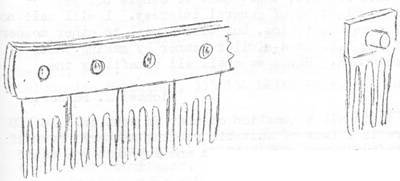
comb carved out of bone. The comb was of
unusual construction, the teeth being carved in sets of from four to six teeth, which were then set
between two other pieces of bone which formed the handle. Each set of teeth had a plug protruding out from each side. This plug was carved integrally with the set
of teeth and was not an insertion, and these plugs fitted into a row of matching
holes in each handle piece. A rough
sketch, drawn from memory and not to scale is shown on the right.
Bones were abundant here, and I collected several of
them. These bones, with the comb were
sent for expert identification and Bristol Museum Authorities have now dated
them as being of the last half of the First Century A.D. There is a possibility that our discovery is
a genuine Roman lead mine.
inspect the mine and, because of the possible importance of the find, I am
sorry that it is not possible to publish the location of the mine until it has
been expertly examined.
Editors
Note: Jill has promised us more
information about this find as soon as it becomes available, and we are sure
that the club members would like to know more, and if possible, visit the place
later when all is clear from the archaeological point of view. Jill, being an
Hole type, has clearly been putting into practice the old motto The B.E.C. get
everywhere! Only one thing puzzles
me. What did the Roman miners carry
combs down the pit with them for?
Letters
111a,
Paignton,
S. Devon.
23rd April, 1965.
Dear Editor,
Once upon a B.E.C. time, there used to appear in the B.B.
some very good articles of general interest on archaeology, local Mendip
History and a lot more details of peoples own caving exploits.
But now, with all due respect to the authors, we dont seem
to advance beyond cave photography occasionally and surveying fairly
frequently.
One particular whim of mine at the moment is to learn
something about the geological history of the Mendips, with some particular
regard to the formation of its caves. Could it not be possible for some one (Dr. Ford excepted) to produce a
series of articles on this matter? I am
sure that some of the young members might appreciate some understanding of the
caves they explore.
Besides this subject, there must be others not yet touched
upon that might be of general interest. I will make no suggestions of possible topics, but will appeal to other
members to make use of the B.B. in a similar manner by making their own
suggestions known. Maybe we shall all
benefit by the results.
Michael A. Palmer.
As Mike says, it is all a question of what is sent in. Do YOU feel there is a lack of suitable
reading matter? Even if you cant
contribute, you can write in and say what you want!
Personal
Congratulations to Sett and Jan on the birth of their
son. If my spy system is working, he was
born on April 7th, weighed six and a half pounds and is to be called Julian
Guy.