
Nominations
The time is once more upon us we must begin to think of such
things as A.G.M.s and Dinners, starting of course with nominations. Following the custom started last year, we
shall not be printing forms for nomination, since only a few are used and two
hundred used to be printed. Instead, if
you have a particular person or persons in mind you would like to see stand for
the 1965 committee, ascertain if they are willing to stand if elected and then
write as follows: –
To R.J. Bagshaw, Hon. Sec.,
B.B.C.
Knowle,
4.
I wish to nominate
for the
1965 committee. I have ascertained that
he/she/they are willing to serve on the committee if elected.
..(Name).
..(Membership No.)
and send it or give it to Bob Bagshaw. In accordance with the club constitution,
members or the retiring committee who are willing to continue if elected are
automatically nominated. This year,
apart from Mo Marriott, who does not wish to stand again, all the members of
the present committee are prepared to continue. There is thus no need to nominate any of the following: –
R.J. Bagshaw, S.J. Collins, N.
Petty, R. Bennett, J. Ransom, G. Tilly, K. Abbey, M. Palmer.
Nominations should reach Bob as soon as possible. Voting forms will NOT be sent with the September
B.B. but will be sent by post to every single member of the club. In case of joint members, a separate envelope
will be sent to each. A short, factual
write up on all candidates will appear in the September issue of the B.B.
Practice Rescue
by Mike Palmer
(Assistant Caving Sec.)
Whereas I agree with most of what Mo says in his article,
his last one paragraph prompts me into making a few suggestions that might
overcome the soaking experienced by the victim, especially if it means
avoiding the wire rift.
I feel, having watched the operation at Traverse Chamber
Pitch and helped in the operation at the other two pitches, that with only with
a little bit of thought and engineering, the handling of the victims at these
three pitches could be made a lot easier.
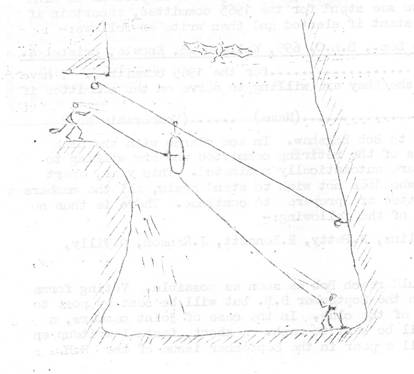 To outline the basic idea, a small sketch might be
explanatory being most adaptable, in the main, to Traverse Chamber Pitch, shown
on the next page.
No doubt the angle of the cross line would nothing like as
severe as sketched, but it shows the idea. All this can be rigged up by the laddering party and the rawl bolts can
be put in at any convenient date. The
idea of the rope secured at the bottom of the carrying sheet is to steady the
victim on the descent and if anything were to happen to the cross line, the
body would be held reasonably safely by the two ropes, one from the top and one
from the bottom.
On the other two pitches, similar plans could be adopted,
this time employing stemples (of Eastwater fame) or two rawlbolts with a chain
slung between them. The idea this time
is to raise the hauling point above and in front of the haulers. On Gour Passage Pitch especially, this could
be of some help, because on the rescue, great difficulty was encountered due to
the victim being pulled into the side of the pitch instead of up it. Also of course, the inevitable tangle with
the ladder and lifeline was experienced.
Roughly the same procedure could be applied on Pulpit Pitch,
but possible first of all the amount of gear should be considered. On the rescue much more rope and greater
lengths were found to be necessary and this caused a rather long delay. The tying of a rope to the base of the
carrying sheet as shown in the sketch was used and found to be very useful in
keeping the victim away from the water.
The poor victim suffered quite a lot of battering on the
last two pitches, besides getting soaked, so I would think that any method that
could be evolved to overcome this would be welcomed, especially by the
unfortunate.
One last point I would like to add is that several other
leaders considered the method practicable and possible labour saving, so I
should be very interested to hear of any comments.
Odd and Ends
Solution to last
months anagrams. 1. G.B. Cavern; 2.
Lamb Leer Cavern; 3. Arête Pitch; 4. Maypole Series; 5. Saint Cuthberts
Swallet; 6. Forty Foot Pot; 7. Badger Hole; 8. Eastwater Cavern. 9. Primrose
Pot.
Overheard in the
Hunters A caver is a member of a
caving club who is not renovating an old cottage.
Comment by Alan
Thomas on returning from Swildons IV. Swildons 4, Alan Thomas 0!
Letter
Many members of club contributed recently towards a wedding
present for Roger Dors and Jacky. We
have received the following letter from Roger
.
Redland,
14th August
Dear Friends,
Thorough the medium of your magazine, my wife and I would
like to express a very big thank you for the generous cheque which you gave us
as a wedding present.
Wishing you all continued and safe prosperity on
Mendip. Thank you again,
Yours
Faithfully,
Roger Dors
Tourist Routes
by Dave Irwin
Due to the increasing dumping of carbide, handling of
formations, breaking of formations in the cave etc., it has been suggested by
another leader that it would be a good idea to fix standard tourist routes
through the cave which would be graded to suit the party.
Before suggesting routes that I think would be suitable to
get the ball rolling perhaps I might highlight some of the spots that have
been spoiled
1. Base of
Cascade
Could not parties be taken into
Harem Passage and approach the Cascade from the Railway Tunnel and leave via
the Tunnel? Ban the climb by the
Curtain.
2. Curtain
Chamber.
Isolated curtains have been
broken. The remedy is to omit Curtain
Chamber completely from Tourist Trips.
3.
Carbide dumping goes on
throughout Boulder Chamber, mostly at the foot of the climb to Annexe Chamber,
alongside Quarry Corner, at the turn off to the Cascade, at Vantage Point
etc. Mostly within fifty or sixty feet
of the Kanchenjunga Carbide Dump. Has
this been dumped by official parties or has it been dumped by leaderless
parties entering the cave during the week by the old entrance which is not
locked?
There routes are suggested. A normal route, a severe route and an intermediate route of V.Diff.
standard. They are as follows: –
Arête, Wire Rift, Quarry Corner,
Harem Passage, Rabbit Warren, Rat Run, Cerberus, Stalagmite Pitch, Duck and out
via Rabbit Warren Extension.
Arête, Wire Rift, Quarry Corner,
Harem Passage, Rabbit Warren, Duck, Stalagmite Pitch, Dining Room, Cerberus,
Rat Run, Everest, Out.
Arête, Wire Rift, Quarry Corner,
Harem Passage, Rabbit Warren, Rat Run, Cerberus, Stalagmite Pitch, Duck, Rabbit
Warren Extension, Catgut, High Chamber, Pillar Chamber, Wire Rift, Out.
Severe Route
Arête, Pulpit or Wire Rift,
Quarry Corner, Harem Passage, Rabbit Warren, Rat Run, Cerberus, Stalagmite
Pitch, Duck, Rabbit Warren Extension, Catgut, High Chamber, Harem Passage,
Fingers Traverse, Everest Passage, Stream passage via Bypass Passage, Water
Chute etc, Out.
These routes have deliberately left out September, Coral,
Curtains etc. to preserve formations and keep parties out of the potentially
dangerous Coral/Long Chamber area. What
do other members feel or suggest about this subject?
Book Review.
Potholing: Under the
Anyone who enjoyed the
exploration cum guidebook of underground adventure will have to add this volume
to his caving library. The author, as
well as having a sound knowledge of British caves, has led expeditions to
Gouffre Martel and La Grotte de la Cigalene. He describes normal caving trips to several of the more severe systems
with sufficient detail to be a guidebook. Caves covered in this way include Penyghent, Lost Johns, Grange Rigg,
Providence Pot to
Simpsons.
Dave Irwin
Caving Log
Edited by
June 1964
On the 13th of June, Andy MacGregor and Dave Smith explored
a hole near the top of Upper Traverse Pitch in St. Cuthberts and found it to
be a much quicker route to lower Traverse Chamber than via Sentry and Bypass
Passage. In Swildons on the 14th, Roger
Stenner met with some trouble on the Forty, when a girl damaged an arm muscle
and somehow got her boots caught up in the ladder about halfway up. A
up the ladder behind her, and managed to remove her boots. The girl then came out of the cave without
much fuss and without needing further assistance.
Castle Farm was dug on the 20th and 21st by Roy Bennett, the
Franklins, Barry Wilton and Dave Irwin. Daves report states that the floor was lowered and digging was
continued at the side rift at the bottom of the shaft.
On the 25th of June, Dave Irwin took a party into St.
Cuthberts and noticed that one of the small curtains in Curtain Chamber is
broken!! This may be due to carelessness
when walking to the main part of the chamber. Alan Thomas and Geoff Bull dug in Hunters Hole on the 27th. From their report, a recent collapse on the
right hand side of end of the dig reveals a solutional tube going up for about
thirty feet, containing straws. The work
on Hunters Hole has recently been revived by Alan, who is showing a very great
interest in it.
To give members some idea of the numbers of trips made in
the month of June, the log shows Swildons 3 trips, Hunters, – 2 trips, Castle
Farm dig 1 trip and Cuthberts 14 trips. The most popular cave may easily be spotted, but not all trips are
entered up in the Caving Log, so a few more can be probably added to this
number. Perhaps these trips are not
entered because people think they would be of no interest in the log, but every
trip is of some interest (besides being required by Club rules! Ed.) Another reason may be that non-Belfryites do
not use the Caving Log, and I think it would be a good idea if a secondary log
was kept for this purpose at Redcliffe.
July 1964
On the fourth of July, Jim Giles and party took 22 feet of
maypole to
aven above it. The lake was found to be
full. Lengths of maypole were erected
below the large aven and a climb was made to the stal. ledge which forms a
false roof to the lake. A ladder was
then made fast to the next ledge and with the aid of a skilful lasso throw,
this was climbed. A further climb was
then made to the top of the aven, which unfortunately closed after a short
horizontal passage was followed for about ten feet.
The other aven was then tackled from the second ledge, again
using lasso techniques, but this also closed. Yet another aven, much shorter than the others, was tackled, but this
followed suit. The resulting score was
thus. Cuthberts 3, Jim Giles nil.
Hunters Hole was dug on every weekend in July, and even
twice on some weekends. Alan Thomas, who
is the main force behind the dig, was helped quite a lot by members of the
Westminster Speleo-Group, who between them put in quite a lot of useful work on
the dig.
On the 5th of July, Ray Mansfield plus party maypoled the
hole in the roof of Coral Chamber and found that it led to a tight solutional
passage. Phil Kingston and Ron drake
maypoled the hole in the roof of Pillar Chamber on the 18th, and discovered
that the passage led to a high rift which was climbed for thirty five feet, a
bedding plane, six feet wide, then extended for four feet, when the whole thing
closed down suddenly.
A bit of Straightening out was done in Rocky Boulder and
Coral series on the 17th by several Cuthberts leaders. Rocky Boulder Series was apparently conquered
and everything explored to the bottom of the final chamber. Other passages above this final chamber were
examined and the confusion over which is Annexe Chamber? was ironed out.
Tony Meadon and Mike Luckwill had a look at some passages
behind
and unusual calcite formation, plus a beautifully stal. encrusted area
containing many crystal pools. Tony
states that this must not be used as a route to High Chamber!
Mo Marriott has
repaired the winch at Castle Farm and reports that it will now lift a weight of
one hundredweight.
Climbing News
North Wales , 25th, 26th and 27th July.
To the climbers encamped in the
Saturday was not encouraging with intermittent rain and low cloud over the
mountains. However, toward the East one
was dazzled by a slight lessening of the gloom and it was decided that a valley
walk in this direction would be in order. We set off therefore across the slopes North of the A5 and following an
aqueduct, arrived at the upper end of Llyn Cowlyd. This lake is in a very pleasing setting but
is rather spoilt by a dam and other oddments at the outfall end. The largest oddment was a control tower
shaped rather like a Martian space ship, to which the B.E.C. gained
access. The sluice controls were all
carefully locked however, and visions of cutting of
water supply faded rapidly.
After some lunch, the col to Llyn Bigau was traversed and
Cwm Bigau ascended under the faultless navigation of en ex local bloke called
Dermot (see B.B. Number 18!!). At the
head of the Cwm, the impressive cliffs of Craig-yr-Isfa rose into the mist,
while the walkers did likewise over rocks and scree to the left. At the col a split developed, and some
descended to the campsite via Pen-yr-Helgi-Du while others took a lower route
by Ffynnon Llugwy. This is a very
pleasant walk and much to be recommended on an off day.
Sundays weather was just as un-encouraging as on Saturday
and certain (un-named) persons went touring by motor car. Other more intrepid spirits approached Moal
Siabod from the South with the object of ascending it, but gave up in the face
of incredible odds (general lassitude etc.) To salve consciences, King, Reynolds and Bennett did an evening climb on
the right hand end of Gault-yr-Ogof. The
climb did not appear to be in the guidebook, and the description of a different
climb was used, leading to some confusion en route.
Sun appeared on Monday, and the residue of the party (King
and Bennett) partook of an enjoyable amble up the Gashed Crag of Tryfon thus
bringing the weekend to a close.
Roy Bennett.
****************************
Next Climbing Meet.
Obituary. Lionel Williams.
It is with regret that we report the death of Lionel
Williams while climbing in Skye. Although not widely known to caving members, Lionel was an active and
popular member of the climbing section and will be greatly missed.
We wish to convey our sincere condolences to his family.
Alan Thomas Weekend
I have just spent a very pleasant weekend with my brother
and his wife introducing their children and my dog to the joys of caving. On the whole, Buster complained the least.
We started very suitably with Dennys Hole which, for the
sake of the children, we descended with a hand line. Buster seemed quite happy at the end of the
cave, but soon became bored so I brought him out. It was then that I met a party of three
intrepid explorers about to descend by our rope. Two of them wore shorts but the third
obviously a man of greater experience than his fellows wore trousers. He was the leader of the party as you can
tell (quite apart front his being in front) by the fact that he wore as helmet
and carried a copy of Balchs book open at the page in his hand.
When Tommy brought the children out and began to coil up the
rope, cries from below implied that we were leaving the intrepid explorers to
die in true melodramatic fashion. I then
climbed down Fox Hole mainly to show off and was surprised to find the
amount of passage at the bottom. In the
afternoon, we went to
and Brownes Hole, now sadly damaged by Blasting.
The next morning we rose early (G.M.T.). You have to when
you are living in a caravan with two children and three dogs and headed for
Burrington before the Whitsun rush. After looking at Avelines etc., we entered Goatchurch and descended as
far as the Drainpipe. You may judge how
long it is since I have been in Goatchurch from the fact that I didnt know
that there was a squeeze just before the Drainpipe. We left then cave as it began to fill up
(with people).
The same morning early (Belfry time) we collected John
Cornwell and Tim Atkinson from Hillgrove and prepared to descend St.
Cuthberts. Quote, I dont doubt that
its a very nice cave but I cant see what useful purpose would be served by my
going down it. Guess who. I have
never been so impressed by anything in my life. St. Cuthberts is fab. With one
exception, which modesty forbids me to mention (Alfies Hole? Ed.) it is the
finest cave on Mendip and its state of preservation say much for all concerned.
In the afternoon we looked at Sandpits and then joined up
with Molly and the two children who had been to Wookey Hole. Next day Tommy and Molly and eleven year old
Pamela went down Swildons with Bob Lawder while I looked after seven year old
Scott and cooked the dinner. Scott
dropped 2cwt of cast iron on his foot, but the dinner was alright.
Altogether it was a very rewarding weekend. The general solicitude for my well being is
gratifying. I was at a loss to explain
why I had never been down St. Cuthberts before. I dont mind being asked how old I am. There has been a lot of this sort of joke
lately largely the Editors doing, I suspect. Some years ago, when Pop Harvey offered me his chair at the Hunters it
was very funny. It was only this weekend
that I realised that one or two youngsters were doing it as a matter of course.
Mathematical Puzzles
by Sett
Junes problem was intended to be much easier for the
amateur than for the mathematician. It
is solved, for all practical purposes, by making a scale drawing of the wall
and the stalagmite bank and fiddling a ruler about until the length of fifteen
feet rests on the floor and the wall and just touches the bank. The correct answer is 13 11.
Tony Meadon sent in the only solution, a correct one, and
has been paid his pint. His solution was
slightly different from mine but achieved the same result. If we try to set up this problem in
mathematical terms, we find that we are involved in solving a quartic
equation. This can be avoided by first
finding the area of the triangle formed by the floor, wall, and ladder and the
substituting.
Let the height up the wall be H, the length from the base of
the wall be L and the perpendicular from the corner of the floor and wall to
the ladder be A. Then the area of the
big triangle is HL/2 or 15A/2 or 4(H 4)/2 + 42. Therefore HL = 15A and H + L = 15A/4,
therefore (H + L)2 = (15A/4)2 and H2 + 2HL + L2
= (15A/4)2. But H2
+ L2 = 152 and 2HL = 30A.
Substituting and solving for A, we get: –
A + 5.207 or -3.073.
HL = 78.1
Therefore H = 13.90 or 5.61.
This Months Problem.
When the U.B.S.S. were doing an archaeological survey on
Reads cavern they laid out the floor in a grid to help them in their final
report. The grid started at the centre and proceeded outward as in the
sketch. They soon noticed that a large
number of patterns appeared amongst the numbers. If you draw a large grid, you will see these
patterns. Amateurs, a pint prize for the
longest list of patterns. Mathematicians, a further pint prize for the longest list of patterns
with an explanation as to why these patterns should appear.
|
16 |
15 |
14 |
13 |
|
5 |
4 |
3 |
12 |
|
6 |
1 |
2 |
11 |
|
7 |
8 |
9 |
10 |
Sett