
Once again, in typical B.E.C. fashion, we seem to have got
out of the difficulties we were under last month; although this has happened at
the last moment. We have got sufficient
articles now not only to be able to publish a big Christmas edition as usual,
but to have a go at the record number of pages for a B.B. and to have one long
article – of the sort we asked for last month – to start the collection for a
large Spring Number next year. Thanks
very much, blokes!
During last year – the one that has nearly ended, that is –
there was a suggestion to publish some sort of joint issue of the journals of
various caving clubs. Later on in the
year, this got to’ be a suggestion to publish a joint edition of the Wessex
Journal, The Shepton Mallet Caving Club Journal, and the B.B. for Christmas. This would have been sent to members of all
these clubs and, in the case of the BE.C, would have come out instead of the
Christmas edition.
There were many snags of a technical nature which became
apparent and which finally led to the cancellation of the idea for this
year. One of these is the fact that
enough good articles were not available in time. If members want a similar venture next year
to succeed, we must have articles for use as a ‘pool’ on which we can draw.
Normally, the Christmas B.B. concentrates on the lighter
side of club activities, but you will find that this one has a large proportion
of caving news and articles. We hope you
will approve, and take this opportunity to wish all members and all cavers
everywhere
A Very Merry
Christmas
Alfie
Contents
- 1 Library
- 2 December Committee Meeting.
- 3
- 4 Cuthbert’s Leader’s Meeting
- 5
- 6 Caving Reports
- 7 Climbing
- 8 LUD’S CHURCH or the Cavern of Ludchurch.
- 9
- 10 Pot Bottomer’s Delight
- 11
- 12 Bottlehead Slocker
- 13
- 14 My Search For Bushman Paintings
- 15
- 16 Balch’s Hole
- 17
- 18 Plantation Stream
- 19
- 20 Annual List of Club Members Names and Addresses
- 21
- 22 CROSSWORD
- 23 P.S.
Library
The committee wish to record a vote of thanks to John Ifold
on his retirement from the position of Hon. Librarian. John has been the clubs Librarian for many
years and at one stage gave the library a home at his house. The new Hon. Librarian is Sybil Bowden Lyle,
as announced in last month’s B.B.
A complete list of all books, publications &c held at
present in the club library has now been compiled. Owing to the size of this list (which
contains a detailed breakdown of the contents of all books and periodicals) it
will not be possible, to give each member a copy. A limited number of copies are being made
and, if you are engaged in some work which entails the use of such a list,
please get in touch with the librarian, Miss Sybil Bowden-Lyle at
Southville,
at the Belfry for reference.
The list of back numbers of the B.B. held in the library is
incomplete. Some member’s have
volunteered to supply back numbers of their own to the library if none can be
found, but first we would like to ask whether anyone has any copies, which have
been borrowed from the library in the past. Please hunt among your books and return any B.B.’s you may find to the
librarian.
December Committee Meeting.
At the December meeting, Gordon Tilley and R.A. Philpot were
elected as club members. Other business
dealt with included an agreement for Keith Gardner to form an Archaeological
sub-committee; final arrangements for the new drainage scheme; distribution of
B.B’s and Caving Reports to other clubs and the ordering of a further batch of
club ties. .
Cuthbert’s Leader’s Meeting
The first Cuthbert’s Leader’s Meeting was held at the Belfry
late in November. The meeting was
chaired by R.A. Setterington. The
following topics represented the main subjects of the meeting:-
Second Report on Cuthbert’s.
Bryan Ellis stated that he intended to publish this in
January of next year. He said that he
intended to print 75 -100 copies, as this seemed about the right amount,
judging from past experience. This was
agreed by the meeting and A. Collins suggested the inclusion of some prints of
September Series which he had received for the B.B. from Brian Prewer, but
which would not be sufficient for the B.B. This was accepted, and the prints will be included in the report. After some discussion on the history of the
depression prior to the opening of Cuthberts, the Chairman suggested a long
opening paragraph, giving a short account of this history.
Survey.
After the present state of the art had been explained by B.
Ellis, it was agreed by the meeting to publish what had been surveyed to date
in the report, even if this meant that some parts of the survey would have to
be of a low grading. R. Roberts promised
to provide a survey of September Series; R. Bennett promised to provide one of
the Rocky Boulders and Coral Series and J. Eatough one of the Cerberus Series. All this data must be received by Bryan Ellis
by the first of January.
A discussion on names of passages followed. R. Bennett suggested fewer names and said
that only important routes, junctions, etc, should be named. He particularly objected to Surprise
Passage. He suggested that all names be
revised, but it was pointed out by P.M. Giles and others that this would throw
all past references into confusion. The
meeting agreed that, in general, naming in Cuthberts was good and in some
cases – such as Oubliette Pitch – excellent and imaginative naming had
occurred.
A further suggestion that all names should indicate the part
of the cave system in which they were to be found was not considered
practicable.
The meeting finally agreed to keep an eye on further naming
and warned leaders that this must be done before such names reach the Caving
Log and hence the B.B. It was agreed
that the part of the cave sometimes called Cascade Passage should official be
known as the Railway Tunnel, and that the passage in September Series is
Victory Passage, not Victoria Passage.
Entrances.
A. Collins said that, unless we acted quickly, all the work
done in opening the new entrance would be wasted. The meeting agreed to take urgent
action. M. Baker agreed to contact a
source of suitable concrete pipe and B. Prewer agreed to contact Ben Dors as
soon as some pipe had been found. A.
Collins said he would prepare the foundations and lay the pipes, but it was not
worth starting until the pipes had been delivered. He would need some assistance with the
digging and the Chairman promised to round up some suitable labour when the time came. It was decided to fit a chequer plate cover
which would be padlocked with the same lock as at present and to install a
permanent steel ladder. After some
discussion, it was agreed that, when the new shaft has been satisfactory for
some time, the present shaft will be destroyed.
Rescue Arrangements.
P.M. Giles outlined a scheme for a full scale rescue
operation in the cave, which should simulate real conditions as far as
possible. The meeting thought this idea
was good, but that a first attempt should concentrate in getting a fairly big
man, in an unconscious condition, up the entrance pitch. A. Collins was accordingly chosen and P.M.
Giles agreed to make a suitable rescue harness for this operation.
Leaders.
The responsibilities of leaders were discussed at some
length. C.A Marriott announced that his
first newsletter was nearly ready and it was agreed that these newsletters
should keep all leaders abreast of developments and current problems. After much discussion on the advisability of
removing the names of inactive leaders from the list, it was agreed that the
Caving Secretary prepare a rota of all leaders for call on tourist trips. If a particular leader failed to respond or
to give the Caving Secretary a sound reason, this would be brought up to the
committee, who would then consider his removal from the list.
Formations
It was agreed to purchase plastic tape for taping
routes. M. Baker also agreed to organise
a scrubbing party.
Exploration.
The meeting agreed that not enough was being done. It was felt that the better distribution of
information via the leader’s News Letters and the publication of a survey in
the near future should help here, by highlighting the areas where exploration
would be most profitable.
Date of next meeting.
Unless special circumstances intervened, it was proposed to
hold Cuthbert’s Leaders Meetings annually, on the Saturday nearest to the
Twenty eighth day of November, for easy remembering.
Caving Reports
Caving Report No 6 has now been published, entitled
“Some Smaller Mendip Caves.” It’s contents are Tankard Hole by R.D. Stenner. Alfie’s Hole by S.J. Collins. Hunter’s Hole by B.M. Ellis. Fairman’s Folly by R.D. Stenner. Vee Swallet by
Stenner.
Copies are available from B.M. Ellis,
Copies are also available of Report No 4 “Shoring of
Swallet Cave entrances” and Report No 5″ A Survey of Helmets and
Lighting Available for Caving.” Both these are at 2/6 each.
When ordering by post please include 3d postage (l/- for 2).
Climbing
The London Mountaineering Club have reserved 12 places for
us on the weekend beginning 19th January at “Fronwydyr” – their hut in Nant Peris. Although one cannot tell what the weather
will be like, we have had some excellent snow climbing in January this
year. Any member who fancies some winter
climbing should contact Tony Dunn as soon as possible as 8 places have already
been taken. Transport will be provided
and we aim to leave
not later than 6.30 pm on the 19th.
LUD’S CHURCH or the Cavern of Ludchurch.
In the October 1961 issue of ‘Country Life’ was an article
on Lud’s Church situated 4½ miles on the eastern side of Axe Edge,
Swythanley Park and running parallel to a stream 250 yards away.
The entrance is through a natural rock porch, down man made
rough steps into the ‘cave’ – a narrow defile seldom wider than two feet, and
sixty feet deep. At either end are
caves. At the North end, the cave appears
to descend almost vertically for “a considerable distance” but, as
the article states; there is no record of it ever having been explored. It recommends that only an experienced
potholer equipped with tackle should attempt the venture. There is a reference to the cave in Vol. 20
of the British Caver.
Sybil.
Pot Bottomer’s Delight
by Chris Falshaw.
Having spent two years in Nottingham learning that Bass can
be either mild or bitter and that the river
contains some of the smallest fish in
time I did some caving, Derbyshire being on our doorstep as it were.
Accordingly I have made contact with the Four Days Club here
in
trips with them. Last week we did
Giants Hole together with five B.S.A. chaps from
after a short trudge along the Stream Passage we were forced onto hands and
knees, then stomach, into nine inches of water. Two hundred feet from the entrance we came to the first sump, but a
short climb up the left hand wall led to the most obnoxious crawl I have met
for a long time. Pillar Crawl is not
very tight and not too wet, but there is a series of gours containing the
blackest and foulest water imaginable, similar to coal dust soup with a dash of
sump oil. A descending passage then
leads to a short crawl – with water – to the infamous “Bypass Passage
Sump”. This sump was then
transferred by a complex baling operation to a series of three dams leading
back up the passage we had just descended and in the process creating a sump in
our rear (dont you mean at our rear? Ed). The baling apparatus consisted in hurling water about in junior oil
drums and wetting as many people as possible. After an hour’s baling, we were able to pass through a crawl into a fair
sized chamber, which contained some fine stal flow of a whiter then whiteness
colour. From the lower edge of the
chamber we descended a fifty foot permanent steel ladder –
Dunlop and Frankenstein as the main stream was with us once more. The base of the pitch led into a small
chamber where the party stopped for fags.
And this is where the fun really starts. The Giant’s Crab Walk. ‘The crabs down here jump six feet high
mainly because they can’t jump sideways, I suppose. This passage consists of three thousand feet
of Random Hole Distribution” and this is the main trouble – the constant
change of direction. It is something
like an insane eel crossed with a whales intestine. The passage itself is not uncomfortably
tight, but it is narrow enough to have to go sideways for the main part. The walls through the passage show fine scallop
marks about two to three inches across and occasionally on the vertical descents
there are some fine groovings.
At the end of the Crab Walk we came to a tight bit, the Vice
– which, of course, we passed with consummate ease and which was shortly
followed by the second sump, which we bypassed via a series of Rabbit Warren
type passages (hence this part becomes a little hazy). Eventually we reached a sixty foot drop –
Geology Pot – which, in contrast to the rest of the cave so far, was dry. This pot was followed by a twenty five foot
drop with the stream. The ladder hung in the stream and a right
bashing by the water was unavoidable. So
were unable to proceed much further than this, as the rest of the system was
flooded. This meant that there was about
eighty feet of flood water in the cave.
He retraced our steps to the Bypass Passage Sump and then climbed up into the roof to
have a look at some formations and a high level sump that the B.S.A. are working
on. We eventually reached open air at 3
am to a high wind and the sound of snapping guy lines from out tents.
Bottlehead Slocker
by Jill Rollason
Another cave was recently added to the Mendip total when
Mite Thompson, Dave Causer and party broke into a new system at Dowhhead, two
miles from
against a rift in a small cliff, and visitors walk into the front entrance of
the shed, and straight out again through the back, where an old oil drum can be
seen lying on its side with much other rubbish. This oil drum is the entrance.
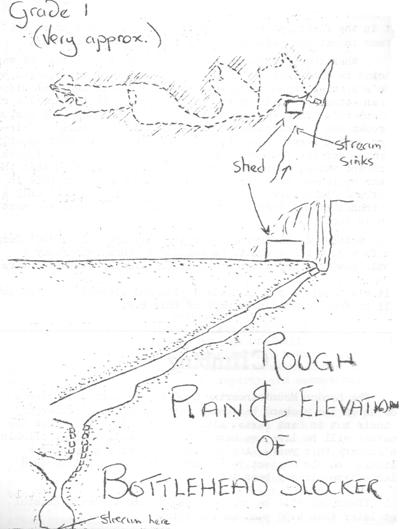 The rift lies at one side of a shallow valley which takes a
good stream, now diminished by a waterworks reservoir at the head of the
valley. The stream sinks about ten feet,
from the rift and is only encountered again at the lowest point of the system
known so far.
The cave has been named Bottlehead from the locality and not
from the quantity of bottles and tins blocking the entrance – apt though this
might be. It was open (but not explored)
until about sixty years ago, but was gradually blocked by rubbish tipped into
it. The local farmer is very keen to
have it opened and is very obliging since he is sure that he has a lucrative
show cave of the future on his property and cannot be convinced otherwise!
The system consists chiefly of a wide bedding plane at an
angle, of approximately forty degrees, and after sliding through the oil drum,
progress is made downward through miscellaneous boulders and china for about
twenty feet until the bottom, of the rubbish scree is reached. After this, the bed carries on down in a
series of small steps, the height of the roof varying from about ten feet to
eighteen inches, and the width of the bedding plane being perhaps thirty feet
across, but half blocked by boulders. After gradually working over to the left of the bedding plane, a drop of
about six feet leads into a solutional rift chamber with a fine false floor now
at waist level and some stalagmitic flow. About twenty feet further along this chamber is a deep pot in the floor,
at the bottom of which is a rift where the stream is met approximately forty
feet below the chamber.
When the cave was first entered, the top of the pot was
blocked by a boulder the size of a piano, which was removed by Mike’s special
brand of magic. When the debris had been
disposed of, an attack was made on the boulder pile beneath, until a rift was
entered. This was nearly closed at the
bottom by a mixture of rocks and a particularly glutinous mud, but there was
air¬space to the stream beneath, which could be heard very clearly. Digging over the following three weekends enabled
the diggers to reach the water, where they were disappointed to find that the
stream welled up into the passage through a six inch hole in the floor and
disappeared after about ten feet into a slot only a few inches high. Work has stopped temporarily until the next
move is decided.
Bottlehead Slocker is approximately 250′ long, 100′ deep and
is well worth a visit, especially by those who fancy a gentle cave the day
after an enjoyable evening at the Hunters.
My Search For Bushman Paintings
by Sybil Bowden-Lyle.
When touring this summer in the Kruger National Park, South.
Bushman painting. To Grits and Kowie
+Wium, my companions, it was disappointing: a wee reddish daub in a gloomy rock
shelter behind an iron grating, put there to prevent tourists from, touching
it: but I was very thrilled and pleased. Poking my camera through the grating as far as I could, I aimed at the
‘daub’ and hoped for the best. It was
fairly successful.
Later we stayed with Kowie’s brother in Uniondale, a small
township in
lived in large numbers. Nobody in the
district seemed interested in the possibility of paintings but, with typical
South African hospitality, Sonny Wium made enquiries. As the local doctor, his duties took him over
a very extensive area and he knew all the farmers. One of them twenty miles away, believed that one
of his native boys had seen one somewhere on the farm. We set out, five adults, four children and
one native boy. Fortunately, the rock
shelter was easily accessible, although off the beaten track, just up the steep
slope of a cactus covered kopie. This
time everybody was pleased for there were twenty five human figures all in the
reddish paint, each one different, some; carrying bows, others shields and all
nude, about five to six inches high and showing the two noted characteristics
of a Bushman – enlarged pear shaped buttocks and a semi-erect penis. In some places, superimposed at times, were
various dots showing the finger prints of the Bushman artist of many years
ago. I tried to puzzle out their design
but in the hour that I stayed there alone, making drawings and counting the figures
and the 167 dots, I failed to find a reason for the dots being where they were,
they did not follow the contours of the rock, and neither did they form any
picture, just a maze of large and small finger and thumb prints, mostly black
but some in red. I took several
photographs but in the car on the return Journey, the camera slipped to the
floor, unnoticed, and lay above the exhaust pipe. The whole film was completely ruined.
Before I left I returned to the farm, to thank the farmer
for his help and for the loan of the native guide. It was then that he told me that several
years ago, an ‘archaeologist’ had asked to see these paintings. Permission was given and the man visited the
rock shelter. Hours later he returned
carrying a large chunk of rock upon which were the best paintings. Naturally the farmer had been furious at the
theft and the vandalism. These paintings
are now in the homestead and since then no-one has been granted permission to
search his land. I was extremely lucky,
for Sonny is one of the most well loved and respected people in the whole area,
and, without his introduction, I should never have been allowed to see these
works of art.
The next painting was much more difficult to find, but, by
this time, though Kowie and Grita had returned to working
with a now highly interested doctor and his just as interested family, plus
another intrigued farmer. We set out in
a truck into the bush, startling wild zebra and springbok on the way. After five miles of bumping and jolting over soil
eroded stream beds and an axle-destroying track, we left the truck and entered
the kloof, a kind of ravine. Pushing our
way between thorn bushes, prickly pear, various cacti, over boulders and in and
out of the stream, we searched every rock shelter up on the side of the
cliffs. Neither the farmer or his
friend, who carried the rifle as a protection against the many leopards which
live in the region, knew where to find the painting – they had only heard
rumours in their boyhood days.
Gradually the party became separated. Sonn’, Juna and-the
kids decided to return to the truck as the way became too difficult for the
children, and Sonny intended to come again. While we had a brief consultation, the two farmers, thinking that we
were all following, disappeared round a bend in the kloof. For the next half hour I was alone in country
where the two leopards had been shot the previous week. As they attack on sight and not only when
hungry, I moved on as quickly as possible to reach the protection of the men
and the gun, but my feet refused to go past any rock shelter until my eyes had
scanned the walls for tiny bushman paintings. Leopards or no leopards, I was determined to search the cliffs but every
time I rounded a bend I expected to see a prowling beast. I didn’t know whether to make as much din as
possible with my feet and scare off any would be diner or to move as silently
as possible. That scared me most, as
then my ears strained to hear possible animal movements; the whereabouts of
distant farmers; the sudden far off bark of the dogs or the echo of a gun
shot. All I did hear was the pounding of
my own heart. At last I caught up with
the men and their dogs and we continued down waterfalls and up cliffs.
After a mile and a half we forsook the dogs as we found the
shelter. There were fewer figures but
some animal paintings deer of some type. While recovering our breath, as the shelter was about fifty feet up a
steep climber’s type climb with a traverse of thirty feet over a drop, I
started to scratch around in the floor roughly where a possible fire would have
been lit by the bushman inhabitants. There, about eighteen inches down, was a charred stone; a largish piece
of charred tortoiseshell and a bone. These I brought hack with me. We
just managed to return to the truck before the sun sank in the most unusual
sunset I have ever seen. That has proved
successful as a colour print.
The fourth painting was the most difficult to reach,
although the rock shelter was plainly visible from the track. Sonny was by now even more eager to see
paintings than I was. While Juna and the
children had a picnic by the car, we tried to cross the river channels of black
water of unknown depth, hidden by twelve foot high pampas grass and tangled
plants. Half a mile downstream, I saw
willow trees by an outcrop of rock and these I reached fairly easily. After ten minutes of pushing, shoving and
muttering, I managed to make a pathway through the excessive growth near the
river. Eventually I crossed the channels
with the aid of the willows and remained dry. Sonny, who was determined to see the paintings before I did, got soaked,
but the paintings were worth the effort.
Above several deer were figures forming an ellipse. They were evidently dancing and were joined
together by bows and bow-like instruments similar to those of present day Zulus
whom I saw. Well pleased, we returned
via cactus and thorn bushes to the willow trees and home. Sonny, his interest really roused, has
contacted more farmers; heard tell of several more paintings and his telegram
delivered at the airport of departure in Jo’burg told me “Have found more paintings. Come again.”
Unfortunately I had promised to return to school in just
over 24 hours – but next time I go to
Balch’s Hole
by Jill Rollason.
A cave was discovered on Mendip on the 3rd of November 1961,
by a workman inspecting the rock face of a quarry, and the hole was first
entered by members of the Cerberus Club who made arrangements for some-members
of the B.E.C. to see and photograph this very beautiful system the following
week.
The party made one abortive visit to the cave entrance on
the 12th November, working for four hours to get the entrance sufficiently
stable without success. ‘Gardening’, in
this case meant touching rocks of many hundredweight with a twelve foot crowbar
which then fell out of the roof and crashed terrifyingly to the floor about
fifty feet below. The quarry owners
kindly blasted away some of the worst rock for us during the week, and a further
three hours gardening on the 19th of November enabled us to face the roof
hopefully if not optimistically. Morale
was not improved by the comments of the quarry foreman who said very definitely
that we were crazy to risk it; that fifty tons of rock at least had fallen in
the day before, and finally went off muttering “Tha’s bad rock, mister’ –
tha’s baaaaaaaad rock”.
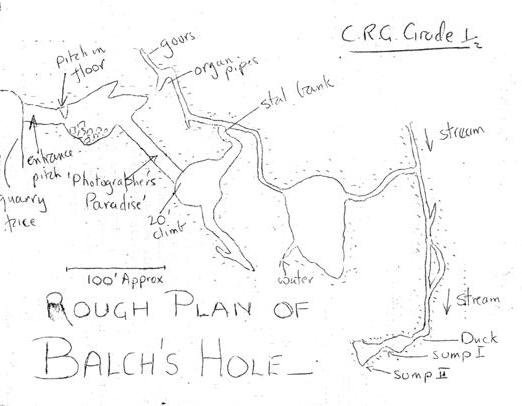 The party, consisting of Gordon Selby, Brian Prewer, Jim
Giles, Mike Thompson, Alfie Collins and myself, decided to risk it. Entry is made by an awkward rope climb up to
the entrance, which opens immediately to the Main Chamber which is of almost
G.B. proportions except for length and can hardly be more than ten feet below
ground level in places. A fifty foot
ladder climb down a steep slope, exposed all the way to any falling rocks,
leads to the bottom which is piled up with large newly detached boulders. A traverse round a pitch in the floor and a
scramble over boulders leads into stable cave beginning with a wide, level
passage; wonderfully decorated with pure white and transparent
stalactites. Straws, fantastic
helictites and fine pillars are abundant and the floor is crystalline with some
rimstone pools. At this point Messrs
Giles and Collins decided simultaneously that this was it, and began to set up
photographic gear.
The passage ends abruptly in a twenty-foot ladder climb into
a small chamber with two exits, one disappearing in a pool of water after about
twenty five feet, and the other leading into the further reaches of the cave. A short scramble up a stalagmite bank brings
you to a T-junction and an old stream passage which contains dead water at most
times. The water was motionless and knee
deep on this occasion, but must have risen over eighteen inches over the last
fortnight, as Brian Prewer said that the Cerberus party he had been on had
originally found the passage dry at this point.
The stream passage to the left leads through a series of
decorated rifts, mainly of sparkling flowstone, but there is a fine grotto
fillet with pure white stalactites and pillars and a magnificent set of organ
pipes – also white – about ten feet wide and fifteen feet high. The main rift in this passage may lead up
into another passage but it was not possible to explore without spoiling the formations. Voice connection was made between the next
rift and the photographer’s paradise above the twenty foot pitch. There is at least one bypass and the route
ends where the roof meets a stalagmite floor, where a good set of gours can be
seen. A particular feature of the whole
cave is the crystal on walls, roof and floor which sparkles in every beam of
light.
The stream passage to the right is often only eighteen
inches high, but is again a series of rifts richly decorated with, curtains and
flowstone, very white. After a while a
large, chamber is entered, about four times as large as the Old Grotto in
Swildons – very attractive – with two passages leading off. One is nearly filled with water and the other
is the route down via a mud slide to the true stream passage and the sump.
Mike Thompson made the trip especially to dive the sump and
passed it successfully. Unfortunately,
he then encountered a second sump about ten feet beyond which has temporarily
halted progress, but this second sump does not appear to be a difficult one and
may well be dived in the near future.
Anyone wishing to visit the cave should get in touch with
our Cerberus representative, Brian Prewer. Unauthorised visitors to the cave – which is named in honour of
“Herby” Balch – will antagonise the quarry owners, who have been more
than obliging, and also expose themselves to some danger from loose rocks.
Editors
Note: It has been pointed out to me
that Balch’s Hole is very similar to Stoke Lane Slocker in some respects. If the entrance to Stoke was at the other end
of the cave, and one went through the large chambers to the stream passage and
thence to the sump, you would have a state of affairs very much like that in
Balch’s Hole.
Plantation Stream
(Is it a misnomer?)
by Bryan Ellis.
Throughout this article the following names are used for
streams. Main Stream – the stream
flowing through St. Cuthbert’s Swallet from the choke to the duck via Sewer
Passage. Plantation Stream – the
tributary joining the Main Stream at Plantation Junction in the cave. St. Cuthbert’s Stream – the surface stream
sinking in the large depression by the cave entrance. Plantation Swallet Stream – the surface
stream sinking in Plantation Swallet.
During the original exploration of St. Cuthbert’s Swallet, a
large tributary was found to join the Main Stream at the Eastern end of Sewer
Passage; a tributary producing more water than the Main Stream in fact. The only swallet known in the area of
sufficient size was Plantation Swallet and therefore the tributary in the cave
was called plantation Stream, but not without a certain amount of
misgiving. Because of the possibility of
pollution, and the later agreement between the club and the owners of the cave,
the water could not be contaminated by chemicals in sufficient quantity to
prove the connection. Don Coase was
against any attempted proof for this reason and considered the point to be in
any case only of academic interest.
In October 1957,
petty took a series of water temperature readings at various places in the cave
and reported the results in the Belfry Bulletin” No 118. Those of interest to this article are as
follows:-
|
Plantation Plantation Main Pool |
51.0oF. 50.5oF. 48.5oF. 48.5oF |
In recording these readings, Norman boldly assumes that
Plantation Swallet Stream and Plantation Stream are the same, flowing via
Continuation Chamber, but Coase – in commenting on these readings – thought
that as the temperature drop was so small, the water could not be the same.
In the following B.B. (No 119 for December 1957) Don again
comments on the water temperature readings and mentions that in November 1955,
a few readings taken by Roy Bennett again showed the temperature of Plantation
Stream to be different from that of the Main Stream. On this occasion, Plantation Stream was 2.2o
colder, presumably because of the air temperature on the surface being lower
than the assumed ambient cave temperature of 8.5oF. His conclusion was still the same, that
Plantation Swallet Stream and Plantation Stream were not connected.
At Coase’s suggestion, Norman petty and Paul Burt took a
further and more comprehensive series of. readings of water temperatures in December 1957 and the readings were given
in the B.B. for January 1958 No
120. On this occasion, the relevant
temperatures were:-
|
Plantation Plantation St. Cuthbert’s Main Stream in |
45.0oF 47.5oF 46.5oF 48.5oF |
A theory was put forward by Petty and Burt as follows. The surface air temperature was known to have
risen considerably shortly before the surface stream temperatures were taken
and therefore they proposed that the slower moving St. Cuthbert’s Stream had
approached nearer to the new air temperature than had the swiftly flowing water
of plantation Swallet Stream. The Main
Stream in the cave had risen still further to reach the ambient cave
temperature but Plantation Stream – although it had risen – had not reached the
cave temperature. Now, if the source of
Plantation Stream was not Plantation Swallet Stream, then it must be seepage water because there is nothing else
on the surface and any seepage water would be at least at the temperature of
the St, Cuthbert’s Stream, because it
would be even slower moving. As St.
Cuthbert’s Stream had reached cave temperature by the time it had become Main
Stream at Plantation Junction, seepage water would also have done so. But Plantation Stream is colder. Therefore Plantation Stream must be the
continuation of the stream entering plantation Swallet. Q.E.D.!
This theory seemed plausible, even reasonable, but there was
still no proof of the connection. Norman
and Paul also took samples of the water from Plantation Swallet Stream and from
St. Cuthberts Stream and chemical analysis showed the former to contain a
considerably concentration of chloride ions than the latter. Their intention was to analyse samples of the
water from Main Stream and Plantation Stream in the hope that a similar difference would be found,
thus adding further weight to their
theory. Unfortunately, it is not known
whether these further samples were ever collected and tested because no further
reference to them is found in the B.B.
The possible use of accumulative detectors was then
realised. These would ‘add together’
the results of several very small introductions of
chemicals, and each of these introductions on their own could thus be kept well below the minimum level which could
cause contamination of the water. The
next episode in the story – as far as is known – was when in May 1958, the
present author assisted Chris Falshaw in an attempt to prove the connection
that had been hypothesized by Paul Burt and Norman Petty. In the Caving Log for May 1958 (published in
B.B. No 125) will be found a brief account of the setting up of ‘instruments’
in Plantation Stream and a negative result is implied. In a later B.B. (No. 128, September 1958)
Chris writes a little more about the experiment and explains that it consisted
of adding paper maker’s Alum to the water at Plantation Swallet and attempting
to collect it on an ion exchange column placed in Plantation Stream. He states that for a variety of (un-named)
reasons, the results are suspect. He
mentions also that further water temperature readings had been taken, but gives
no figures.
That, then, was the story as obtained from the “Belfry
Bulletin” when the author carried out a further experiment during July
1961. In Volume 3, Number 3 of the
“Bulletin of the Bradford Pothole Club Terry Marston describes a new
method of water tracing that has been developed by members of the B.P.C. Its application to the Plantation Stream
problem was immediately seen. Very
briefly, the method consists of adding a very small quantity of dye to the
water and collecting it at the other end of the test on specially treated hanks
of cotton placed in the water. The
advantages of this method of water tracing over the more usual methods of using
fluorescein are numerous. The dye used
is non-injurious to all known fresh water organisms (even the C.R.G. bug,
hunters have approved its use) the small quantities required decrease cost and
the danger of contamination at the resurgence; the effect is accumulative; and,
most important of all, all the possible places for the re-appearance of the dye
do not have to be watched continuously for an unknown length of time – one just
collects the hanks of cotton at a later date!
The survey showed that Plantation Swallet lay to the East of
most of the known cave and therefore the intention was to place cotton
detectors in the following streams: Maypole Series; September Series;
Continuation Chamber; Tin Mine and Plantation Stream. However, when the detectors were being placed
in position on the 15th July, the party was not capable of this round trip and
as a preliminary experiment it was necessary to make do with these sites: Wire
Rift; Maypole Stream; Main Stream at the bottom of Everest Passage and also in
Sewer Passage; Plantation Stream and the Duck. After leaving the cave, twenty five grams (less than one, ounce) of the
dye was added to Plantation Swallet Stream.
The following weekend, the six cotton hanks were removed
from the cave and treated to remove the impurities that also stain them, and
sometimes mask the dye coloration. The
results were as follows: Maypole Stream; Wire Rift; Main Stream near Everest
Passage and Sewer Passage – all negative. Plantation Stream and Duck – both positive. Therefore it is now possible to state
definitely that Plantation Stream does flow from Plantation Swallet and does
not have to be classed with the so-called Priddy Green Stream’ in Swildons
Hole – as a misnomer. One must be
extremely careful in interpreting negative results in water tracing, but as the
result was positive at the Duck as well as Plantation Stream (but nowhere else)
it seems safe to say that none of the water from Plantation Swallet reaches the
Main Stream before Plantation Junction.
Annual List of Club Members Names and Addresses
This list, which is published every year, is that which is
possessed by the B.B. Postal Department and is the list of members to whom the
B.B.s are currently sent. If your name
is not on this lists or your address is wrong, please get in touch at once with
the Postal Department.
|
418 |
S.F. Alway |
|
|
306 |
T Andrews |
|
|
236 |
T. Attwood |
|
|
486 |
P.J. Badcock |
|
|
20 |
R.J. Bagshaw |
|
|
392 |
M.J. Baker |
Morello, |
|
358 |
D.J. Balcombe |
|
|
290 |
R. Bater |
|
|
214 |
R. Bennett |
3 Russets Cottages, Backwell Common, Somerset. |
|
390 |
J. Bennett |
3 Russets Cottages, Backwell Common, Somerset |
|
451 |
D. |
|
|
370 |
W.L. Beynon |
Bulimba Hostel, |
|
417 |
P. Bird |
|
|
364 |
P.M. Blogg |
1 Ridgeway Park, Ridgeway, |
|
460 |
P.J. Borchard |
|
|
145 |
Miss S. Bowden-Lyle |
|
|
320 |
N Brooks |
Pine Lodge, Park Avenue, Camberley, |
|
209 |
P. Burt |
3 Manor House, Rothamsted, Harpendon, Herts |
|
190 |
Mrs P. Burt |
3 Manor House, Rothamsted, Harpendon, Herts |
|
488 |
M. Calvert |
2 |
|
429 |
R Casling |
|
|
366 |
B.R. Chamberlain |
|
|
471 |
D. Causer |
19 Kenmore crescent, |
|
211 |
Mrs C. Coase |
Address to follow |
|
89 |
S.J. Collins |
33 |
|
377 |
D. Cooke-Yarborough. |
The Beeches, |
|
494 |
J. Cornwell |
|
|
71 |
A.J. Crawford |
3 |
|
405 |
F.G. Darbon |
43 Arthur Henderson House, |
|
464 |
J. Davey |
|
|
350 |
Mrs A. Davies |
|
|
472 |
R. Davies |
|
|
226 |
I Dear |
B.T.V. Staedy, c/o C.D. Office, |
|
449 |
G. Dell |
|
|
164 |
K.C. Dobbs |
|
|
457 |
J. Downie |
Dimlands, Llantwit Major, Glamorgan |
|
325 |
A.J. Dunn |
|
|
331 |
J.A. Etough |
|
|
322 |
B.M. Ellis |
|
|
263 |
D. |
|
|
232 |
C. Falshaw |
2 Home Croft, Bramcote, |
|
394 |
Mrs C. Falshaw |
2 Home Croft, Bramcote, |
|
496 |
P.G. Faulkner |
|
|
371 |
A. Fincham |
|
|
269 |
T. Fletcher |
The Old Mill House, Parnack, Nr. Stamford, Lincs |
|
453 |
D.C. Ford |
Department of Geography, |
|
|
|
|
|
278 |
G.A. Fowler |
|
|
469 |
K. Franklin |
|
|
468 |
P. Franklin |
|
|
404 |
A. Francis |
Keedwell Cottage, |
|
251 |
K.S. Gardner |
Keedwell Cottage, |
|
410 |
Mrs K. Gardner |
92 The Grampains, Shepherds |
|
476 |
M.C. Garton |
P.O.s Mess, R.N.A.S. Yeovilton, Yeovil, |
|
470 |
P.M. Giles |
|
|
434 |
D. |
|
|
346 |
G.H. Griffiths |
|
|
478 |
S.H. Grime |
The Spinney, Rickman Hill, Coulsdon, |
|
491 |
M.H. Grimes |
34 Gatehouse Close, Withywood, |
|
239 |
D. Gwinnel |
23673215, H.Q. Eastern Command, AMM. INSP., Mill Hill, |
|
432 |
N.P. Hallett |
Myndeep, |
|
104 |
M. Hannam |
|
|
304 |
C.W. Harris |
Hill House, Moorlynch, Bridgwater, |
|
4 |
D. Hassell |
|
|
480 |
C.J. Hawkes |
|
|
448 |
R.C. Hawkins |
|
|
372 |
M.J. Healey |
|
|
436 |
J.W. Hill |
|
|
373 |
S.M. Hobbs |
Field View, Shepton Mallet, |
|
440 |
M. Holland |
The Hive, c/o Mr. Giddings, Boat House, Hemingford Grey, Huntingdon |
|
387 |
G. Honey |
Leigh House, Nempnett, Chew Stoke, |
|
97 |
J. Ifold |
Sunnyside, |
|
150 |
P. Ifold |
|
|
444 |
B.J. Isles |
89 Broadwalk, Knowle, |
|
363 |
M. Isles |
|
|
438 |
Miss P. Irwin |
|
|
486 |
R. Jones |
|
|
285 |
U. Jones |
1a |
|
439 |
W.F. Jones |
|
|
513 |
G.M. Joyner |
|
|
316 |
R.S. King |
|
|
413 |
R. Kitchen |
|
|
462 |
Miss L. Knight |
|
|
456 |
T. Knight |
|
|
260 |
J. Lamb |
|
|
475 |
|
14 |
|
463 |
|
7 Staff Cottages, |
|
483 |
A.G. Lee |
|
|
495 |
M. Luckwill |
|
|
466 |
B. Lynn |
|
|
487 |
P. Mack |
|
|
275 |
|
|
|
416 |
T.K. Marston |
|
|
106 |
E.J. Mason |
|
|
383 |
P.J. Miller |
|
|
334 |
D.W. Mitchell |
|
|
339 |
G. Mossman |
5 |
|
308 |
K. Murray |
17 |
|
386 |
A. Nash |
23714348 Pte A.G. (Int) Kahawa Camp, B.F.P.O. 10 |
|
329 |
T.W. Neil |
Bradley Cross, Cheddar, |
|
330 |
Mrs T.W. Neil |
Bradley Cross, Cheddar, |
|
|
T.OFlaherty |
|
|
396 |
M.A. Palmer |
Cathedral Coffee Tavern, |
|
496 |
Miss S.E. Paul |
|
|
22 |
L. Peters |
|
|
160 |
N. Petty |
|
|
499 |
A. Philpot |
|
|
146 |
T. Pink |
|
|
56 |
G. Platten |
Rutherfield, |
|
337 |
B. Prewer |
Greenfields Farm, Upper Coxley, Wells, |
|
342 |
R.J. Price |
2 Weeks Road, Bishop Sutton, |
|
458 |
L. Pritchard |
|
|
484 |
J.M. Pullman |
Badgers Wood, Brockley, |
|
358 |
D. Radmore |
|
|
452 |
J. Ransom |
15 South View, Lenthay, Sherborne, |
|
258 |
C.H.G. Rees |
|
|
452 |
Mrs Rees |
|
|
241 |
A.L.C. Rice |
|
|
343 |
A. Rich |
c/o Pox 126, Basham, Alberta, Canada |
|
391 |
P.A. Richards |
|
|
361 |
Mrs P.A. Richards |
|
|
443 |
R.J. Roberts |
|
|
489 |
Mrs Robinson |
|
|
490 |
G. Robinson |
|
|
157 |
Miss J.P. Rollason |
|
|
240 |
A. Sandall |
|
|
359 |
Mrs. A. Sandall |
|
|
237 |
B.M. Scott |
23 Gunter Grove, |
|
482 |
G. Selby |
|
|
78 |
R. Setterington |
|
|
213 |
R. Setterington |
|
|
425 |
J. Simonds |
|
|
414 |
C. Smith |
|
|
473 |
D. Smith |
|
|
276 |
J. Stafford |
Wern Isaf, Pethel, Cearns |
|
38 |
Mrs. I. Stanbury |
74, |
|
1 |
T.H. Stanbury |
|
|
365 |
R. Stenner |
|
|
381 |
Mrs. Stenner |
|
|
60 |
P.A.E. Stewart |
|
|
|
D.M. Thomas |
|
|
497 |
M. Thompson |
Ashen Hill Cottage, Priddy, |
|
479 |
J. Tierney |
Flat 3, 37 Hawley Sq., |
|
409 |
G.E. Todd |
Sundayshill Cottage, Falfield, Glos |
|
74 |
J. Tompsett |
Mallins, |
|
80 |
Mrs. D. Tompsett |
Mallins, |
|
326 |
E. Towler |
|
|
382 |
S. Tuck |
38 Westbury Hill, Westbury-on-Trym, |
|
79 |
R.M. Wallis |
Swildons, |
|
441 |
G.O. Weston |
|
|
442 |
Mrs. G. Weston |
|
|
175 |
J. Waddon |
|
|
|
C.F.W. Wheadon |
237600799 Infantry Workshop R.E.M.E. Rhine Camp, Dhekelia, B.F.P.O. 53 |
|
420 |
R. Winch |
1 |
|
341 |
R.A. Woodford |
|
|
418 |
E.A. Woodwell |
|
|
477 |
R.F. Wyncoll |
9 St. Christians Croft, Cheylesmore, |
CROSSWORD
|
1 |
|
2 |
|
3 |
|
|
4 |
|
5 |
|
|
6 |
|
7 |
|
8 |
|
|
|
|
|
|
|
9 |
|
|
|
|
|
|
|
|
|
|
|
10 |
|
|
|
|
|
|
|
|
|
|
11 |
|
|
|
|
|
|
|
|
|
|
|
|
12 |
|
|
|
|
|
|
|
|
|
|
|
13 |
|
|
|
|
14 |
|
|
|
|
|
15 |
|
16 |
|
|
|
|
|
|
|
|
17 |
|
|
|
|
18 |
|
|
|
|
|
|
|
|
|
19 |
|
20 |
|
|
|
|
|
|
|
|
|
21 |
|
22 |
|
|
23 |
|
|
|
|
|
|
|
|
|
|
|
|
|
|
|
|
|
|
|
|
|
|
|
|
|
|
|
|
|
|
|
|
|
|
|
24 |
|
|
|
|
25 |
|
|
|
|
|
26 |
|
|
|
|
17 |
|
|
|
|
|
|
|
|
|
|
|
|
|
|
|
|
|
|
|
|
|
28 |
|
29 |
|
|
|
|
30 |
|
|
|
|
31 |
|
|
|
32 |
|
|
|
|
|
|
|
|
|
|
|
|
33 |
|
|
|
|
|
|
|
|
34 |
|
35 |
|
|
|
|
|
36 |
|
|
|
|
|
37 |
|
|
|
|
|
|
|
|
|
|
38 |
|
|
|
|
|
|
|
|
|
|
|
|
39 |
|
|
|
|
|
|
|
|
|
|
|
40 |
|
|
|
|
|
|
|
|
41 |
|
|
|
|
|
|
|
1 Across: Trail pew to track down
your quarry (8)
5 Across: More appropriate across than down (8)
9 Across: The Shepton
(5)
10 Across: 373560 (6)
11 Across: Seen in French caves & until recently near the Belfry (3,3)
12 Across: I do it, being stupid (5)
13 Across: Water may in ground or you in water (4)
16 Across: There is a singular version of 41 across having this 30 across in
G.B. (4)
17 Across: Found in static layer (4)
18 Across: Not normally found in 5 down (4)
23 Across: A contribution to a pillar eventually (11,6)
24 Across: Let tool shed back’er (describes its situation nicely!) (10,7)
29 Across: Dears is curtailed here. (4)
30 Across: 1 and 10 across are examples of this (4)
32 Across: Common to Chamber, Wood or Hole on Mendip. (4)
33 Across: Do this and you may make a 25 down (or find trouble) (4)
35 Across: a 34 down in Cuthberts. (5)
37 Across: Tis sex and with us now. (6)
38 Across: A 29 across. (6)
39 Across: Runs on twacks. (5)
40 Across: Morton’s Pot has them and Swildons has the middle Part. (8)
41 Across: See 14 down (8)
1 Down: Three cubed from
(5,3)
2 Down: Poisons (6)
3 Down: 36 down may not have it, but 18 across does (4)
4 Down: Wine drips on dry bar – One over the eight, presumably! (6,4,7)
5 Down: 18 across is not-normally encountered here(3,2,8,4)
6 Down: This hole has recently been reported. (4)
7 Down: Not possessed by 12 across. (6)
8 Down: Dig in. (8)
14 Down: You could wear this caving or
17 across could this a 41 across (4)
15 Down: Only mugs are this, presumably
(4)
19 Down: Bend to put nothing in 34 or 36
down. (5)
20 Down: You might have beer on this,
but don’t put beer on it. (5)
21 Down: A form of 26 down. (5)
22 Down: Inclined. (5)
24 Down: They are painted in many
colours in song. (8)
25 Down: Water movement in Red Dye. (4)
26 Down: The 21 down type of this may
use a part of this beheaded (4)
27 Down: Concerning photographs (or
second hand articles) (8)
28 Down: Describes the start of no
caving trip (2,4)
31 Down: 4 or 6 are heard in the
Hunter’s (6)
34 Down: 35 across means this (4)
36 Down: See 3 down or 19 down. (4)
P.S.
by the Editor
That’s all for this issue – a new record number pf pages for
the B-B. We must apologise to those who
sent in articles which did not get printed. Especially to Jim Giles, who has sent in an excellent review of the
year’s digging activities which will be printed very shortly. Observant readers will also note that, in
addition to all the usual typing errors, two new forms of typewriter pox have
struck. One is sticking of letters due
to the damp and is being remedied by taking all the keys out and washing them
in “omo” and “the other is carriage sticking – causing printing
like the ‘and’ being squashed. If any
member knows the cure for this, we shall be mosy obliged.
*****************************************
The Belfry Bulletin. Secretary. R.J. Bagshaw, 699,
Editor, S.J. Collins, 33,
8.
Postal Dept.
718,
Eastville,