
From now until the Annual Dinner, which will be held this
year at the
Saturday October 7th, many reminders will be going out to members on various
subjects connected with the Dinner and the Annual General Meeting. The first of these – the nomination form –
will be found in this copy of the B.B. As well as the usual space for the nomination of candidates for the 1962
committee, there is also a place on the form for member’s resolutions. These do not have to be sent in with the nominations,
but, if you have some point which you would like to have brought up at the
A.G.M., the form is a convenient place to write it down so that it won’t get
lost.
This year there is also the photographic competition and the
song competition. We want lots of
entries for both, so get organised while there is still plenty of time!
We have just obtained a new typewriter for the B.B. We hope that it will help to make the print
more readable. We could still do with
contributions of PAPER which should be of foolscap size and duplicator type.
Alfie
*****************************************
There will be a trip to AGGY AGGY on the 9th of
September. This trip is being organised
by Alan Sandall, who should be contacted for further details.
*****************************************
Jim Giles (hereinafter referred to as ‘the organiser) has
told us that the judges for the photographic competition will be JONAH, JOHNNY
EATOUGH and “PONGO” WALLIS. In
the event of any one of these three judges not being able to turn up for the
A.G.M. and dinner, “SAGO” has offered to act as a judge. Don’t forget that the closing date for
this competition is the 15th of September. Rules for the Song competition, also arranged
by the organiser, will be found in this issue of the B.B.
Contents
Letters to the Editor of the B.B.
Dear Sir,
May we add to the recent remarks and correspondence
concerning the St. Cuthberts leader system?
Since the cave was opened, there has been a steady
deterioration in the condition of the cave (i.e. muddy hand prints on
formations, broken formations, chocolate papers left about and spent carbide
left in places other than those recommended. This deterioration has increased rapidly during the last two years in
spite of the leader system. We suggest
that the rules be tightened up and that a limit be put on the number of cavers
that one leader should take. A list of
all the leaders should be published.
We were recently amused, on reading the caving log, to see
that it seems fashionable for some leaders to rediscover parts of the system
already described in the caving log and the B.B. This will soon lead to various parts of the
cave having two names and this may have already happened. The up-to-date St. Cuthberts Report is
urgently needed, as is a meeting of leaders etc to allocate research
projects. There is much to be done without
duplicating previous people’s work.
Yours Sincerely,
John Eatough; R.S. King; Johnny
Attwood; Roy Bennett; Mo Marriott.
Comment.
St. Cuthbert’s is one of the
finest, and certainly the most complex, cave system on Mendip to date. This makes it the sort of cave which is, and
should be even more in the future, an object for serious research. The present leader system, in my personal view,
is an attempt to compromise between giving the ordinary caver a decent chance
to go round the cave, and preserving it as intact as possible, for present and
future research work. It is worth noting
that Derek Ford, who has recently been doing scientific work in the cave, was
quite impressed with the general state of the cave and congratulates the club
on the way in which it has been so far preserved. This is all the more reason why we should not
let it slip at this stage. The club is
placing considerable trust in the Cuthberts leaders and it is surely up to
those leaders to recognise this and to keep an eagle eye on their parties at
all tines.
As for duplication of
discoveries, it is surely one of the first things that any potential discoverer
of anything does to check that no previous record of that discovery
exists. All Cuthberts discoveries are
pretty well written up nowadays and there is very little excuse for anyone
falling into error here’. Editor.
*****************************************
To the Editor, Belfry Bulletin,
Dear Sir,
I was astounded to read in your May bulletin that an
18″ stalactite had been broken off in St. Cuthbert’s Swallet. It was not the act itself that astounded me,
but the revelation – by the publication of what was termed a ‘Caving Log’ –
that your club are still going into caves. I must ask you to reconsider the entire question of entering caves in
the light of modern speleological thought.
The fact is that, although people are rightly concerned
about the visible effects of their visits to caves, they fail to take into
account the chaos they have caused in the unseen physical world. The passage of a person through a cave may
appear to, leave it intact, but in fact he has probably upset the chemical
balance; arrested crystalline growth and left the ecology in smoking ruins.
The balance of nature in caves is very finely adjusted,
simple self-reproducing fungi forms and viable bacteria are in the soil, air
and water and lend support to worms, tiny beetles and Crustacea. A caver lifts samples of these from one part
of the cave on his clothing and sets them down elsewhere, causing the
multiplication of certain forms of life in parts of the cave at the expense of
others. Numerous alien bacteria are
often introduced. If we could examine a
caver under a high powered microscope – especially your members – we should see
that they are surrounded by clouds of their own germs, playing old Harry with
the local breeds. The caver leaves a
trail of exhaled breath throughout his journey and may temporarily raise the CO2
content of the air by as much as 0.1%. Surely, as a preliminary measure, it is not asking too much that you
should take in your own supply of air and take out your exhaled breath.
The use of flashbulbs causes photosynthesis affecting the
pigmentation of certain life and crystal forms. I have found isopods quite blinded after having lights carelessly shone
upon them.
being subjected to the pressure of nailed boots and one could go on finding
similar examples indefinitely.
Surely the time has come for the B.E.C. to join with other
leading caving clubs of this country and use their resources to prevent people
from entering caves rather than encouraging them. The wanton exploration of unknown caves must
cease. Perhaps in ten years time we
shall be able to relax, having gated or blocked all the entrances, and rest
content in the knowledge that beneath us the caves are secure in their natural
state, unspoilt by the presence of man, developing as nature intended in their
pristine splendour.
Yours faithfully,
Harry Pearman.
Note. Mr. Pearman, of the C.S.S., has graced these
pages before, when he gave us another insight to his vast fund of
knowledge. Unfortunately, this must of
necessity be an infrequent occurrence as the passage of germs and other
micro-organisms from one part of the country to another caused by his sending
these communications obviously constitutes a grave threat to the ecology of the
country as a whole. It is suspected that
the well known Lamp Pox was originally brought to Mendip in this manner, as,
previous to visits by the C.S.S., it was unknown in this part of the
country. Editor.
Archaeological News
Axbridge
Museum
Saturday 22nd July saw the official opening of the new
Axbridge museum by Prof. L.S. Palmer. The museum of the Axbridge Caving Group and Archaeological Society,
until recently housed in a large wooden construction just off the town square,
has been fortunate in finding a home in the Town Hall. The new surroundings are more fitting for its
excellent collection of archaeological and speleological exhibits. The members of the society in general, and
Jack Weare, their curator, in particular are to be congratulated on the results
of their work. A visit to the Town Hall
is thoroughly recommended.
One of the most interesting cases, from an archaeological
point off view, is that housing the Haywood Cave Burials. These were discovered when the society began
to force an entry into Haywood rock shelter. A cairn of stones which blocked the entrance was found to contain ten
human skulls mixed with ochre and implements of Mesolithic date – the first
burial of this type and date to be found in this country,
Lundy.
Recent excavations on the site of a Dark Age/Medieval
cemetery on Lundy, carried out by members of the B.E.C. and Lundy Field
Society, revealed foundations of buildings, tumbled walls etc, associated with
14th century pottery. A hitherto unknown
tombstone was discovered, orientated N-S, with the inscription L L L C O H I,
which as yet we have been unable to decipher.
Caves on Lundy will be examined at a future date in detail
but can be classified as follows:-
(a) Artificial “caves” in the upper
Devonian shales.
(b) Sea caves in granite at present sea level.
(c) Sea caves in granite above present sea level.
(d) Artificial holes in granite
Group (a) includes such “stores” as Benson’s Cave
beneath the 13th Century Marisco Castle and Group (b) the caves of Seal Hole,
Virgins Spring (a freshwater spring in a sea cave) etc.
An unrecorded hole high up in a granite fissure was pointed
out by a man who entered it some fifty years ago and it seems to have been
either a mine or some secret store place.
Archaeologically, the most interesting are the high level
caves of the Double Decker and Queen Mab’s Grotto which compare with the raised
beaches of the
cave sites on Gower to the north. Mesolithic flints and Bronze Age remains have been found on the island
and it is hoped that these caves may produce further evidence of prehistoric
occupation.
K.S. Gardner.
M.R.O.
The second conference of Cave Rescue Organisations will be
held during the weekend Sept 30th/Oct 1st 1961 in
members having any suggestions or topics for discussion would let me know as
soon as possible. Amongst those already
tabled are:-
Sumping apparatus; Problem of bad air; Design of stretchers;
Relations with police; Moving boulders; Special apparatus; Training of cavers
in C.R. techniques; C.R.O. in Ireland.
K.S. Gardner.
CAVING LOG for 1961
28th
May. St. Cuthbert’s. Norman, Keith,
Chamber.
23rd
May. August Hole. Ray
and Pete. Upstream passage.
3rd
June. St. Cuthbert’s. Jim Giles, Alfie and Sett. Checking possible places for new entrance. The top passage was lengthened by six feet and
a survey made.
3rd
June. St. Cuthbert’s. N. Petty and R. Stenner. Continued to fix the Coase Memorial Plaque.
3rd
June. St. Cuthbert’s. Keith, Pete Franklyn and
digging upstream of Dining Room. Air
space found and strong draught noted. More digging required.
3rd
June. Raiders Rift and Hawks Hole. Ray
Winch.
4th
June. Swildons. Mike Calvert and Ron Wynkell. To sump to find specimen tubes left by Bruce
Lynn. No catch. Water very low.
4th June.
St. Cuthbert’s. D. Ford, P.M. Giles (“Beau” Giles).
D. Ford continued his geological survey.
Gour Hall to Everest Passage. Jim took photos in the same area.
10th
June. St. Cuthbert’ s. To Cerberus Chamber with R. Winch and Mike Johnson.
The Don Coase plaque is now fixed. N. Petty.
10th
June. St. Cuthbert’s. P. Millar,
S. Tuck, K. & P. Franklyn,
eventually abandoned and stream diverted down hole.
10th
June. Swildons IV. Party
Phil Davies (W.C.C.) John and Garth. This
trip was to transfer equipment into IV for the attempt on VI on the 17th. We were a tired party by the end of the trip.
19th
June. August Hole. Ray
Bushy plus one other.
11th
June. Swildons. Fred Davies, Derek Ford, Nigel and three others. Took kit down to IV. Nigel was clapped out at the end of it all.
17th
June. G.B. Keith, Pete, Paul Mack,
four others, R. Stenner plus two schoolgirls from Lockleaze on a photographic
trip all taken with side lighting.
19th
June. Swildons. P.M. Giles, W. Foster, K. Thompson, B. Dibben. Tourist trip to Barnes Loop.
18th
June. Hilliers. Ray,
Bushy and some others. We managed this because
we found the only Cerberus caver left.
24th
June. Swildons. George
and Dave. Paddy, Nigel and Ron Wink ole. Quick trip down to sump I where Dave and Ron
rested. George, Paddy and Nigel went
down to Sump II. Water was b
..y cold.
25th June. Swildons IV. P.M. Giles, K. Dawe (S.M.C.C.) Removal
of diving and other equipment from IV and collection of dye samples from the
wet way, sump I and Series IV.
25th
June. Stoke Lane Slocker. Ray, Bushy etc. The most distant parts of the cave are
obviously not often visited and the glitter etc of the formations is something
quite different from anything else I have seen on Mendip. It was absolutely superb. The best trip I have been on for years. On the way back, of course, Bushy’s trousers
burst.
1st
July. Dallimore’s. Ray
and Bushy. Not exactly a super cave but
can be entered when you cannot get down Cuthberts. There are a couple of passages which would go
after a bit of digging. I don’t think there
is much future here though.
1st
July. Swildons. J. Hill,
P. Mack, M. Luckwell. Trip down to Sump I.
Very dry indeed. Despite that, two thirds of the party arrived at
the bottom of the forty with no lights. The
Beach at Sump I was in a quite disgusting condition. Air smelt strongly of C2H2
and there were empty carbide tins, discarded clothing and spent carbide which made the whole place look
like a rubbish tip.
2nd
July. St. Cuthbert’s. D. Ford.
P.M. Giles. Derek continued his geological
survey. Cerberus Series from Dining Room
to Everest Passage and Curtain Chamber. The
lake is now dry.
2nd July. St. Cuthbert’s. Leader J. Hill. Tourist trip to
Dining Room.
4th
July. Swildons. Keith Gladman & Tony Lowes.
6th
July. St. Cuthbert’s. R. Roberts.
R. Boakes, B. Lynn. A 56 hour trip. Most of the kit had been taken down on the
previous weekend. We camped in Cerberus
Hall, which needed levelling. This is an
excellent site. Our main occupations
were sleeping and eating. We did
however, find time to undertake a complete exploration of Cerberus Series,
which is far more complex than most people realise. The lake in
is completely dry and there is quite a lot of passage at the far end, ending in
a 15 rock face which might be worth investigating. We left the cave on Saturday night and
hurried to the hostelry for suitable refreshment.
9th
July. Swildons. Keith
Gladman, Mike Calvert, Mike Lunner. Round
top of the cave on a trip which included going through Don’s Delight.
8th
July. Raiders Rift and Hawks Hole. Ray
and Bushy.
9th
July. Rod’s Pot. R. Stenner
plus two girls and one boy.
10th
July. Longwood. Keith Gladman, Tony Lowes. Stream
bed dry. First sign of running water in
the main chamber. Final passage now
blocked with several large boulders. Found large BULL in barn on return.
11th
July. Back of Gough’s. Derek
Ford, Keith Gladman, Tony Lowes, Peter Barker. Good cave with many interesting and tight
passages. Had some difficulty finding
the chimney that goes up to boulder chamber (very muddy). Comical to listen to comments that weegees
made as we were going through. Had a
look at Coppers Hole dig and found that the dig has been flooded. Also shoring very unsafe.
11th
July. St. Cuthberts. Prew, Keith Gladman, Gordon. To Dining Room.
15th
July. St. Cuthbert’s. D.
Ford, Jim Giles, R. Pyke, C. Hawkes. D. Ford
continued his survey.
15th
July. St. Cuthbert’s. Jim
Hill, Mike Calvert. Failed to find Bypass Passage.
16th
July. Stoke Lane Slocker. F. Davies, R. Dunster, ?, M. Giles. Trip to first sump which F. Davies passed but Giles baulked.
18th
July. St. Cuthbert’s. Bennett,
Eatough, Attwood, Kangy. Stepping
lightly around the huge piles of corruption left by exhausted parties after
previous intrepid expeditions, we arrived in Boulder Chamber. We ventured into a more complex series than you
might realise” known collectively as Coral and Rocky Boulders Series. “No, No!” we cried as he pulled and
pushed yet one more boulder upon us until at last we reached virgin cave, passing Bennetts previous best. A very nice trip. Kangy.
16th July. Brownes Hole. Alfie, Nigel and Jill. Two slim chaps went surveying with an
astrocompass. The Lamp Pox became
evident after a while.
21st
July. Swildons. Garth, Rosemary, Gordon, John R.
23rd
July. St. Cuthbert’s. B.
Ellis, D. Ford, M. Grimmer, C. Goffin, P.M. Giles. Geological survey plus collection of dye
samples. Dye was put into Plantation Swallet
the previous week. It appears that
Plantation Junction is correctly named.
28th
July. St. Cuthbert’s. P.M. Giles, N. Clarke plus 4 schoolboys.
29th
July. Swildons IV. K. Dawe,
Eric, Nigel Clarke, Roger Boakes, Richard. Sherpa trip to kitchen.
30th
July. Swildons. R. Stenner
+ 2 boys. Top series.
30th
July. Swildons. D.
Ford, O.C. Lloyd, H. Kenny, M. Hooper, P.M. Giles. Another abortive attempt on the sump by P.M.
Giles who, with M. Hooper returned to surface, while the others went on into
series II.
30th
July. St. Cuthbert’s. A. Sandall,
N. Ballet, N. Clarke, I. Dear, P.M. Giles, C. Sandall, R. Wyncoll, M. Palmer. Lots of mud and Alfie Collins took part in
the digging of the new shaft. Contact
was established with the passage mentioned in the trip of 3.6.61. Some persuading of the intervening rock is
now necessary.
30th
July. Hollowfield Swallet. R. Wink
‘Ole, Mike, Gerry, Mike L.
30th
July. Rod’s & Drunkard’s. Ray
Winch and some
boys.
31st
July. St. Cuthbert’s. P.M.
Giles, R. Pyke, N. Clarke. Maypole
Series.
31st
July. Swildons. Ray
and Bushy to Shatter Pot. Bushy’ s
trousers split again.
1st August. Cuthbert’s. D. Ford and R. Wynkoll. Maypole
Series.
1st
August. Nine Barrows Swallet. P.M.
Giles, B. Prewer, N. Clarke, Ron Wynkoll. Entrance tidied up and several large boulders
hauled out.
1st
August. St. Cuthbert’s. P.M.
Giles, N. Clarke.
2nd
August. Cuthberts. Two
trips led by Jim Giles and Mike Palmer with two members of the Craven Pothole
Club. This was the first exchange trip
into the cave for some time and the tackle used was more than the club possess. The total length of ladder used was 170 and
the ropes in use added up to 240. The
extra ladder was supplied by N. Petty, and the C.P.C. bods allowed us to try a
120′ length of COURLANE rope on the Pulpit Pitch. This rope is nearly half the price of nylon
and keeps an almost constant breaking strain over a longer period. It is available from; HALLS-BARTON ROPERY,
using it. A comment on Cuthbert’s from
the C.P.C. “There’s nowt like it in
Caving Log.
Owing to the amount of entries now being put into the club
caving log, it is proving not possible to print it all in the B.B. It is thus proposed to merely mention most
trips and to print only trips involving work or new discovery. Trips of general interest which are fully
written up in the log will be printed as articles. If anyone has any other suggestions, we shall
be pleased to hear of them, and will arrange the printing of the log to suit the
majority of readers.
Editor.
*****************************************
WHY BE DIFFERENT. Everybody else will be wearing a CLUB TIE this year at the Dinner. Get yours from Bob Bagshaw. Price 1/6 only. The tie chosen by gentlemen cavers with
caving gentlemen in mind.
Song Competition
The following rules have now been received from Jim Giles:-
1. The song must be suitable for singing in mixed
company at the Dinner.
2. Entries must be original and must be limited to
the fields of caving and climbing and associated subjects.
3. Winning entries will be judged by a general vote
at the dinner from the audience.
4. Closing date is the night of the dinner.
5. The competition is open to members and visitors.
6. Prizes to the value of 10/- will be awarded for
the best two songs.
N.B. Only the words
need be original – any tune may be used.
PRIZES FOR THE PHOTOGRAPHIC COMPETITION. 1st prize in each class; 30/- Book Token.
Runner Up in each class; 10/- Book Token.
Knots. No. 1 The Bowline
by John Ransome.
It is a known fact that tying knots does not come easily to
everyone, but all who go caving should at least be able to tie a bowline. Your life, and that of others may well-depend
on your ability to tie a bowline. It is
easy to tie and untie, and it is a good thing to practice tying it in the dark,
or without looking at it, so that it becomes easy to tie it underground.
The most useful purpose for this knot (or hitch) is in life
lining on ladders, pitches etc.
If possible, it should always be tied by the person about to
use it. A person is inclined to place
more trust in his own work and, if tied by someone else, it may become too
tight and affect the confidence of the person concerned. In the case of accidents or with novices, the
circumstances are of course different.
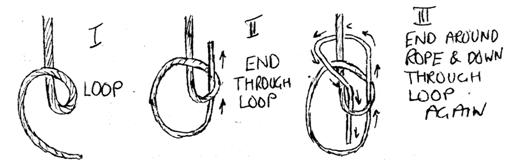
Take the rope in the left hand, and the end in the
right. Make a small loop in the rope,
take the end and push up through the loop, take the end round the back of the
rope, then down through the loop and pull tight. With Nylon rope, it is best to put one or two
half-hitches on after the bowline, as this type of rope is more likely to slip.
More knots in this series will follow at intervals. Ed
*****************************************
The Belfry Bulletin Editor, S.J. Collins, 33,
Secretary. R. J. Bagshaw,
4.
Postal Department.