
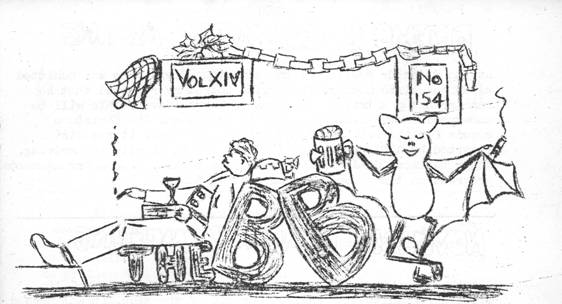
This Christmas number of the B.B. not only marks the first
such number to be produced in the new smaller format, but also celebrates the
Christmas number of the Clubs Silver Jubilee year and the tenth anniversary of
the first Christmas number of the B.B. The heading on this page is taken from the front of that number No. 41
for Christmas 1950.
We have therefore tried, not only to produce a bigger B.B.,
but also, we hope, a more neatly printed and better laid out and printed number
to mark the occasion. If we actually
succeed in this you, we hope, will be pleased and we shall be amazed.
In any cases, we hope that this B.B. will serve to while
away the odd moment before opening time and, as we usually say about this time
of the year.
We wish all Club
Members, other Readers, and all Cavers everywhere, A Very Merry Christmas.
Contents
- 1 December Committee Meeting
- 2 November Committee Meeting
- 3 Do You Want?
- 4
- 5 Caving Articles; Log and News
- 6 Some Scottish Caves
- 7 Letter
- 8
- 9 Fernhill A New Mendip Cave
- 10
- 11 Caving Log
- 12
- 13 Mendip Notes
- 14 Emborough
- 15
- 16 Odds and Ends, Miscellaneous Articles etc.
- 17
- 18 The East Indies Part 1
- 19 L.S.M.S. Newsletter
- 20 A Guide to Caving Terms
- 21
- 22 Climbing, Hill Walking, Travel & Similar Articles
- 23 A Month in the Cumbrian Mountains.
- 24 A Rope Ladder for Crevasse Rescue
- 25 Weekend in North Wales
- 26
- 27 Annual List of Club Members Names and Addresses
December Committee Meeting
At the December meeting of the committee, David Drew was
admitted as an associate member. The
Caving Secretary reported that he was arranging a trip to the back of Goughs
cave. This will be announced in the B.B.
when details are known. The Christmas
covers for the B.B. are being printed by Garth. It was also reported by Alfie that the club ties should shortly be
arriving. Other business dealt with
included new tackle, M.R.O. arrangements, progress on the new hut and other
details.
November Committee Meeting
At the November meeting of the committee, Dave Causer and
Jim Giles were admitted to full membership of the club. It was agreed to reduce the rate for hiring
the club tent. Other items dealt with
included the authorising of a further 5,000 B.B. covers, to the three colour
design used at present, the arrangements for the club tie and the inclusion of
a final reminder to members whose subs were still outstanding.
Do You Want?
A club car badge? A club
tie? Back numbers of the B.B.? Caving Reports? B.B. Digest No.1? Some books to read? Caving Lamp Spares?
All those things are available through the club. See Bob Bagshaw for Ties and Car Badges,
Alfie for B.B. spares &c and Mo, Sett or Alfie for lamp spares. See John Ifold for Library books ROUND AT
REDCLIFFE HALL on the first Thursday of the month or the assistant
librarian. Books may be borrowed from
John Ifold by Post.
*****************************************
You May Now Hire The Club Tent For 1/- Per Person Per Night!!
Caving Articles; Log and News
Although we normally publish only original articles on
caving, we have been sent by Mr. G. Platten Editor of The British Caver
some information about Scottish caves which he has kindly allowed us to
publish, since he will be unable to produce Vol. 33 of the British Caver this
year.
Some
Scottish
Caves
west base of Whitten Head, roughly six miles north-north-east of Heilem
Ferry. The name is derived from Hugo,
son of Freskyn de Moravia. The entrance
is anything from 20 to 50 feet wide and between 50 and 80 feet high. The tunnel runs for about half a mile into
the bowels of the earth. The walls are
variegated with a thousand colours. The
interior of the cave on both sides is lined with kedges or slabs of
rock. There are a further series of
caves on the east
pronounced by Dr. Maculloch to be tch most extensive and extraordinary in
any part of the Scottish coast. This is
a truly conservative statement in view of page 80 of The Scottish Clans &
Tartans published by W.A.K. Johnson Ltd., Edinburgh. Extracts from this book read: – We drifted
up the deep channel under the gigantic arch
.as we peered through the darkness
we could see dimly, at the far end, the place where the roof and the water met
at the termination of this long and lofty chamber. On each side were huge ledges of shelving
rock running parallel down each side of the cave, at an angle downwards towards
the water, behind these, inky blackness
.we could see clearly perceive the
bottom through the greenish blue water. The rock walls, on which were occasional patches of colourful
conglomerate, were brilliant planes of yellow, green, red and blue stains.
As we made our way up the long channel, the cavern seemed
gradually to contract in height and width towards the extreme end
..to us, the
length of the cave seemed endless. On
approaching almost to the uttermost part
of it, we perceived that it shelved down and narrowed to the extreme end, on
the right hand side, to join a gravely beach which met the massive rock roof,
where it dipped threateningly at an awkward angle. To our left, the arches dipped more abruptly
amid a number of scattered stones and boulders, behind which was faintly
visible in the din light, the dark outline of a small crevice.
The above extracts were taken from Angling in Wildest
Scotland by R. Macdonald Robertson and supplied to the British Caver by J.
Salvera. Also supplied by J. Salvera and
J. Jonkinson are the following descriptions of Scottish caves.
Pipers
Cave
Located on the north slope of Bein Ghuilean, the entrance is
situated immediately under a small rockface on a shoulder of the hill. This can easily be seen from the road at the
cemetery. This is a gull type cave
formed in mica schists. The overall
depth is roughly 60 and the length of lateral chambers 250-300. The cave is damp and middy with little to
recommend it except one or two short climbs and an interesting straddle
traverse which is an optional method of reaching one of the largest chambers
near the main entrance.
As for the piper, it is by no means strange that he did not
return, although one wonders at these miraculous pipers who had such an
affinity for the most difficult caves in
an octopus. Two for the pipes, one for
the torch and two for climbing. The
pipers dog, as usual, was more fortunate, and managed to reach the light of
day at the sea caves at Southend. There
are three of these on a raised beach at Kiel Point. The most westerly has a high climbable aven. The centre one is the largest, two hundred
feet high, fifteen feet wide and 81 foot long. The easterly cave has a small entrance but goes tunnel like for ninety
feet.
The Pipers cave.
Sandyhills
Bay
The cave is situated on the beach roughly forty yards east
of the Needles Eye. This latter being a
cave driven through the narrow headland at approximately right angles to the
strike of the tide. The entrance is
comparatively narrow and high with a pleasant sea washed sandy floor. Progress is easily made along this section of
the first eighty feet or so. Here it is
necessary to climb a few feet (quite tricky) to gain the extension of the cave
which has obviously been tunnelled by man. Some yard along this tunnel and let into the right hand wall is a deep
well roughly six feet square and over ten feet deep. A few yards further on, the floor of the
passage is covered in water up to a depth of nine inches. Eighty two feet from where this pool
commences, the mine finished abruptly, the mineral vein having apparently
petered out at this point. The overall
length is about 250 feet.
There are a few other sea caves in this area, but nothing
particularly worthy of note. We spent a
couple of hours searching for a cave shown on the 1 O.S. as being on Clawbelly
Hill, but without success.
In the Lothians, there are caves under
by Ian Findlay. Of
caves he says: – The caves are directly under the castle and go far into the
rock. They are on two levels and there
are many chambers. There are fireplaces,
seats and cupboard accommodation and a window or two giving on the chasm. There is also a deep well shaft which would
keep the castle and caves supplied with water for any length of time. The caves at
are associated with the black arts of Sir Hugo and are reached by a worn stair
reaching steeply downwards.
Of lofty roof and ample size
Beneath the castle deep it lies
To hew the living rock profound
The floor to pave, the arch to round
There are never toiled a mortal arm
Letter
To members of the B.E.C. and all who go underground to dream
about places like the Hunters.
Here, such places close a 6 pm. All shops are closed for Saturday as well as
Sunday.
outdoor sporting type. If you are brave
enough, you can even go pig sticking. Most people here hunt with guns, and this can be dangerous.
I am living with some university students who also belong to
the U.C.G., Aukland. We have a flat and
it is used as a meeting place for cavers. King Country is where most of the caving is done from Aukland. It is about a hundred miles from Aukland in
the centre of the
possible to do a new cave on each trip. They were very amused when I told them that we spent weeks just trying
to get into a hole, which even then does not usually go into a decent cave
system. The caves here are very much
like those of
There is plenty of bush, rivers, mountains and miles of
beaches. I have spent one or two Sundays
tramping and this is nowhere as tame as it may sound. The bush is so thick that one has to keep to
streams and tracks. I spent one Sunday
travelling from A to b and the water went from my shoes to my waist and one
chap was so short that he had to swim.
Hope you get through Priddy Green soon.
Colin
Knight.

Fernhill A New
Mendip
Cave
During the course of geological field work on Mendip over
Whitsun this year, I noticed in Fairy Cave Quarry, near Oakhill, a prominent
enlarged bedding plane feature in the northwest corner of the working
face. The bedding plane dipped steeply
in a northerly direction and was completely filled with an eight inch thickness
of banded stalactite. Towards the floor
of the quarry, the bedding plane widened, until there was a gap some five
inches above the stalagmite flow. A
strong draught blew outwards from this gap. The bedding plane continued downwards for some distance and appeared to
widen with depth. I was not sure whether
this was a new cave, or a portion of either
or Hilliers Hole, about to be exposed by quarrying. On my next visit to Mendip on 17th June, I
again visited the place this time accompanied by Phil Davies. After we had made a rough survey of the
surface and plotted the position of the bedding plane on the Fairy
Cave/Hilliers Hole survey, we came to the conclusion that it was not a known
portion of either cave.
Some time was spent in removing enough rock to make a tight,
but passable entrance, and a considerable amount of loose and shattered rock
had to be made safe. I then squeezed
into the hole and chimney down the bedding plane, which was sufficiently steep
to present the appearance of a rift, until I reached a boulder floor 43 feet
below. A quick look round confirmed that
this was a brand new cave and I made the return climb to the surface, deciding
as I did so, that a knobbly dog would be useful at this point. Next day we both descended into the cave and
made an exploration. A short distance
along from the bottom of the entrance pitch, we came to the Main Chamber
which is about forty feet wide by sixty feet long, having a sloping roof ten to
twelve feet high and a sloping boulder ruckle floor. The chamber had once been a pretty place;
there were several large stalactites and stalagmites, a pillar and even a few
straws although those near the entrance had been severely damaged by rocks
which had dropped down the bedding plane after from being dislodged from higher
up by blasting from the quarry outside. A chamber which we named Curtain Chamber adjoined the Main
Chamber. This was long and varied in
width from twelve feet to seven feet. It
contained several fine banded curtain stalactites, one of which was about five
feet square. The floor and walls were
covered in flowstone. A small crawl from
the end of this chamber led to a boulder choke from which a slight draught
blew. This probably connects with
or the Upper Grotto of Hilliers Hole, both of which are within a hundred feet
of this point. A further small passage
at the foot of the entrance pitch led us to a somewhat shattered region which
we calculated to lie only a few feet below the quarry floor. The remainder of the trip was spent in
photographing every important feature of the cave, as it was obvious that many
of the fine formations were in great danger of being destroyed by the effects
of quarrying operations, even if they were spared by vandals once the news of
the cave got round!
The name Fernhill Cave was decided on, as the name of the
quarry could not be used imagine Fairy Cave Quarry Cave, The 1 O.S. map shows Fernhill as the name of
the area to the northeast and as we did not wish to add another meaningless
named cave to the list that already exists, Fernhill was chosen. Other urgent business prevented me from
taking part in the survey of the cave, which was carried out a few weeks later
in case quarrying should close the cave. During the surveying operations, voice communication was established between
a hole in the boulder floor of the Main Chamber and nearby Ducks Hole.
The exploration and survey could not have been carried out
without the co-operation of Mr. A. Garlick, the quarry manager, to whom my
thanks are due.
Jack Waddon.
Editors
Note: Although this cave was not a
B.E.C. discovery in the usual sense of the word, we can at least say that it
was first entered by a B.E.C. member. In
fact, we have had to omit the last paragraph of Jacks article, as events have
already made it obsolete. In case Jack
does not know, his trip on the 17th June was followed by a photographic trip
two weeks later by Alfie, Jill and Garth. On 26th July, a voice connection was established by Pam Russell, Fred
Davies, and Phil Davies between Fernhill and
and towards the end of August, Alfie contacted the museum about the possibility
of rescuing some of the formations before blasting finally shattered the
cave. A trip was run on 28th August and
the actual rescue trip took place on the 22nd September. This was a Thursday evening, and four members
of the club assisted Peter Bird to obtain some formations, as the cave was due
to be closed the next day. It is now
closed until further notice. It is hoped
that the curtains and other formations in Curtain Chamber will survive this
phase of quarrying, but in any case, the B.E.C. may fairly claim to have taken
a hand in preserving some of them, which will be on view suitably treated to
preserve their lustre in the
Caving Log
For August, September, October and November.
7th August. St. Cuthberts. Party, A. Sandall, T. Blake, T. Chamberlain. Down to Cascades and through Rabbit Warren to
Dining Room. Back by way of Rat Run and
out.
10th August.. Goatchurch. Leader, Jonah. Party, Malcolm and Linda. Pleasant trip to Drainpipe. As it was my first trip down, I went through
first, then Jonah and Linda. On the way
back, Jonah tried to persuade himself that he was thin and wore his Nife. This was unsuccessful. Went out through the Tradesmans
Entrance. I was quite impressed by the
Drainpipe. So was Jonah, in a rather
different way.
10th August. Sidcot. Party, Malcolm and Linda. We got lost.
7th August. St. Cuthberts. Party, Mo Marriott and Keith Franklin. Trip to Pyrolusite Series to have a look at small holes at end. Obvious signs of previous days thunderstorm.
13th August. Swildons. Party, Mo Marriott, Keith
Franklin and 17 boy scouts. Top of
Swildons, all 3 main routes covered.
13th August. Priddy Green Swallet. Alfie, Willy Stanton, John, Nigel and Alan. Digging to pass squeeze at bottom of bedding
plane. Willy passed squeeze and reached
chamber. A sudden rise in water was
noted and a quick about turn was made. Water was flowing from everywhere including all around the concrete
entrance shaft. It was noted that Willy
wasnt with us and contact with him was impossible due to the amount of
water. Willy, however, came up later
when the water subsided none the worse for his experience.
14th August. Vee Swallet. Digging trip. Mo Marriott and
Keith Franklin.
14th August. Swildons. Nigel, Garth, Alan and 7
scoutes. Tourist trip to top of
Twenty. Too many people to go any
further. Scouts not exactly dressed for
the job. White shirts, Blazers and
Plimsolls.
20th August. Stoke Lane. Tony OFlagherty, Roger Luttmer
and Mike Holland plus Garth. Wet but
uneventful trip through to first choke after sump.
20th August. St. Cuthberts. John Attwood, Kangy and John Eatough on a photographic trip to the
Maypole Series. The photography was
preceded by an exploratory couple of hours during which Purgatory Passage and
Echo Chamber were discovered. Photographs were taken of some small but interesting formations.
21st August. Hunters Hole. Llew Pritchard. Nobody interested
in caving this week, so I decided to clear out the Letter Box in Hunters
Hole. In keeping with the wishes of Ian
Dear, I would have not liked to go further even with a party. After two hours of removing mud, rocks, live
frogs and dead mice, I reached bedrock. The entrance shaft is now four foot deeper and the letter box between
30 and 2. Obviously, the next party
down here will clear off the first ladder pitch and the ledge.
21st August. St. Cuthberts. Party. Keith Franklin, Laurie Maynard, Geoff Tudgay, three scouts and
Tunnel. Returned via Cerberus Series and
24th August. Swildons. Garth, Owen and Michael
Calvert. Upper Series. Much water in rift above the Forty.
24th August. Swildons. Alan Nash, Sip,
Nosser. Very wet photographic trip to
Sump 1 or thereabouts.
25th August. Swildons. Intended trip to Sump 1 but
only two people were available, so did a short trip tom the forty. Gareth Owen and Michael Calvert.
28th August. Fernhill. Alfie, Jill and Peter Bird on
short photographic trip cum museum type tour of inspection to see if any
curtains were removable and/or suitable for exhibition. Party made safe exit unaided by any form of
rescue party!
2nd September. Swildons. Party, Alan Lynn, Gareth Owen
and Michael Calvert. Down Short Dry way
up Long Dry Way, down Kennys Passage into Wet Way and out. Quite wet.
2nd September. Goatchurch. P. Miller and Miss M.
McDonnell.
4th September. St. Cuthberts. Attwood, Margelts and Eatough on a tourist trip to Cascade, Curtain and
Rabbit Warren Extension. Very wet in
entrance.
7th September. Swildons. Pete Miller, R.J. Brook and
Miss M. McDonnell. Down Long Dry way and
up
11th September. Reads & Goatchurch. Garth, Llew, John, Dick & Eddie. Quick Goatchurch & Reads with Z Alley and Formation Chamber.
12th September. Swildons. Intended trip to Sump 1 but one
of the younger members of the party complained of feeling very cold after the
Forty and Twenty, and as this did not improve even when the party got on the
move, we turned round just after Barnes Loop. There was a lot of water at the entrance. All this meant a short trip but it was most
satisfactory. P. Eyles.
13th September. Swildons. Short trip to fetch the twenty
feet ladder some fool let fall at the Forty yesterday. All right for him he was back in
14th September. Longwood. P. Miller and Miss M. McDonnell. Cave was surprisingly dry after all the rain
lately. No water down the entrance and
stream quite low.
17th September. Swildons. D. Causer, Rowena, Garth, Peter
Lewis, S. Causer plus three theological students. Long Dry way, Barnes Loop to Sump 1, back via
Trats
Swildons to break in Rowena after holidays.
20th September. Swildons. J. Davey and G. Shaw
(B.P.C.) A steady trip down to Sump I
via the
to follow them through to Sump II. A
quick exit via the Short Dry. A very
enjoyable trip.
22nd September. Fernhill. B. Bagshaw, Garth, Jim Hill, P.
Bird + one unknown. Formation rescue op.
23rd September. Goatchurch. J. Davey and G. Shaw
(B.P.C.) Full exploration of the
cave. Party wondered if the cave
inscriptions were pre-historic, and why every tight squeeze is labelled
Drainpipe (surely one of them is labelled Bloody Tight? Ed.) On the way back we had a quick look at Sidcot
and
24th September. Swildons. Leader, M. Boone. Party J. Davey and G. Shaw. Working trip to P.R., Inserted rawlbolt at head of Shatter Pot.
24th September. Goatchurch and Sidcot. Party, Jim Borchard, Tim Giles and Pat Irwin. Two very enjoyable and speedy trips. Two members both got top to bottom of
Purgatory. Giless first caving trip.
25th September. Cuthberts Culvert. Alfie, Jill, Roger, Jim Hill, George Tomkins and Birch. Spoil heap divided into two by-products. Clay for dams and stone for Belfry
Construction. 3 hours digging.
25th September. Sidcot and Rods Pot. Garth and Llew. Full trips
through both systems. Helictites still
to be found in 80 rift at bottom of Rods. Strenuous works in all chimneys of Rods.
9th October. Reads. Llew, Garth, George Honey,
Richard Roberts, Jim Borchard and Jim Giles. No positive leader we all took turns. Had one Weegee with us i.e. Garth who forgot his helmet and went with
light in hand. From the Main Chamber we
started to go to the 18 by a devious route, but became hopelessly bogged down
in the Stream Passage. The amount of
water coming in made it a sporting trip.
9th October. Reads. Richard, Jim Borchard, Jim
Giles. Short trip down to Gravel Pit and
back. Fair amount of water in Pit. Met a party of nine year olds from
and no helmets.
15th October. Goatchurch and Sidcot. Sago
plus six T.A. bods. Beginners trip
through the Drainpipe in Goatchurch and
in Sidcot.
16th October. Swildons. Sago plus three T.A. bods. Trip to Sump I. Out via Wet way. Very wet.
16th October. St. Cuthberts. Norman, Peter Miller, Nigel C and Dick. Tourist trip to sump via the Water Chute.
16th October. Swildons. Garth, Llew and Jim Giles trip
to Swildons Four. Trip basically to
bring Sheptons digging gear out of Four, into the Breakfast Chamber. Goon suit trip though Jim didnt have one and
suffered for it. A lot of water going
down. After bringing the gear up Blue
Pencil we were all nadgered and getting out was a job, especially as we spent
45 minutes waiting below the Forty. In
and out via the
22nd October. Goatchurch and Rods Pot. Tom
Sage and Aldermaston Mountaineering Club. We played around in Goatchurch trying out the tightest squeezes
possible. Rods Pot was very damp. Tried to descend the Fifty Foot Aven without
any tackle. Only got halfway down.
23rd October. Longwood. Tome Sage and four members of
Aldermaston Mountaineering Club. Arrived
at 1 pm at entrance to Longwood and descended entrance shaft. On arriving at the bottom, I was told to call
out the M.R.O. as there had been an accident on the 33 into the Main
Chamber. This was done immediately. Aftre this, I returned to the cave and
discovered the nature of the persons injuries, which were not severe. He was mainly shocked and with the aid of the
rest of his party, was able to reach the surface. The M.R.O. arrived, together with an
ambulance, about an hour after the call was made.
Report on the above by B.E.C. M.R.O.
representative. The Police phoned Howard
Kenny, who directed Tom Sage and raised the alarm in Wells. Luke Devenish raised a party from the
Hunters, Priddy Green and the Belfry and all available members proceeded to
Longwood. The injured person was poorly
equipped, apparently wearing a beret instead of a helmet. Which accounted for
the minor head and facial injuries.
23rd October. Swildons. Garth Dell, Jim Borchard, Lady C. Tour round Upper Series. Water about normal. Nothing exceptional except that it was Lady
Cs second two hour trip.
30th October. Swildons. Mike Baker, Llew, Garth and
Jim. Down the
pictures of the Old Grotto and Stream Passage and out the same way. Stream about normal for winter.
6th November. Emborough. Inspection trip to Emborough
Swallet by Alfie and Jill. Torrent of
water has removed old rock blockage and stream is again running into old
entrance instead on new one as planned. Dam replaced and water re-directed. Noticed that new sink hole has opened up in field outside swallet
area. An area of about 5 x 7 has
dropped about five feet. Farmer has
commenced filling in.
6th November. Back of Goughs. A
genuine Weegee trip. After leaving the
show cave, the going became rather muddy, with a few dicey traverses and climbs
IF you wanted to do them. The trip was
arranged by courtesy of the W.S.G. Some
photographs were taken. It was the first
time I have even seen mushroom beds (at least I think thats what they were) in
a cave. Party from B.E.C. consisted of
Mike Baker, Jim Giles, Pat Irwin and Garth. We just about managed to make it in time for a quick un at the
5th November. Swildons. Leader, Tom Sage. Party David Stoke, David Worley, Peter
Burnham. Very wet with much water going
over the Forty.
5th November. Rods Pot. Party; Pat Irwin, Jim Borchard,
Jim Giles and Ginger Owen. A very
interesting and active trip, involving a climb down the first aven and Gravel
Pit. Both Jims and Ginger performed by
falling down at various points and all had lamp pox. The journey out was a case of the blind leading
the blind. This was a first Rods for
both Pat and Ginger.
7th November. Goatchurch and Sidcot. Bob
Grace and 15 Q.E.H. First caving trip
for most.
8th November. Rods Pot. Same part as before. Laddered down the sixty foot aven and climbed
up the other aven. Then down to the end
of the cave. Enjoyable trip with some
photographs taken.
13th November. Cuthberts. Party, Mike Baker, Pat, Garth
and Jim Giles. Photographic trip as far
as the Dining Room.
19th November. Swildons Four. Party, Garth, Pat and Jim Giles. 40 and 20 kindly laddered by W.C.C. It was at the Double Pots that Sods Law first struck. Garth, having packed his cigarettes into a
waterproof bag, discovered that it was not. At Shatter Pot, we found that man
making an anchor for his sherpas. After
passing a few indolent type minutes at this point, we carried on to do a quick
up and down trip of four. It was on
our return through the Blue Pencil that Sods Law struck again. Garth entered Blue Pencil as far as the first
bend with Pat making the chain climb when he espied a pair of bots followed by
Mike Boon and Oppo with the obvious result. With the second attempt, we made our way to the Forty, picking up a
couple of diggers from Shatter Pot on the way, who left us at Barnes Loop. At
the 40 we noticed a marked increase in the water rate. Due to lamp pox we came out via the Short
Dry. In an attempted carbide change in
the Old Grotto, Jim lost his ring. On
the whole, it was a good, appetising trip and the first four for Pat.
20th November. Great Oones Hole. Party, Llew, Lady C and Peter Scott. The delightful indolence struck again, due to Peters barrel. Hence there was no support for a decent cave
today. We went to Cheddar as a change
from Burrington. A quick trip with easy
going. Peter seemed to like his first
cave.
Mendip Notes
Wednesday night, 26th October to
Thursday, 27th October, 1960.
Thirty six hours of
continuous rain over the two days above produced the heaviest flooding seen on
Mendip for many years. Our local lads
on the spot, reported abnormal conditions in nearly all the major Mendip caves,
the most notable being: –
SWILDONS. A
river seen here, flowing onto the fish pond was up to ten feet wide. The grating as completely covered to a depth
of twelve to eighteen inches. An
exceptionally large stream disappeared under the tree. Peak volume was early on Thursday morning as
the rain ceased. By 11.30 pm, the flow
had reduced to normal winter level. The
cave was enterable by approximately 5 pm.
ST.
CUTHBERTS. The water at St. Cuthberts was the highest
ever seen. The water at midday on
Thursday was running from the lake down the entrance shaft in a considerable
stream. This condition was also observed
at again midnight. On Friday the water
had only dropped by a few feet and the entrance rift would have been quite
impassable. These conditions persisted
well into the weekend. Plantation
Swallet was only taking a normal volume of water, which suggested that, in
these conditions, it cannot be persuaded to take more. The main difference between the conditions at
Cuthberts and Swildons must surely be the mineries reservoir. Cuthberts remained impassable until Sunday,
which, we think, justifies our calling out the fire brigade and emphasises the
need for further waterworks in the Cuthberts depression.
EASTWATER. Water here was seen pouring into the main
entrance shaft and entry was quite impassable. A moderate sized pond had built up behind the stone wall beneath the
Eastwater Hut.
Cheddar Gorge was seen on Thursday morning and although the
Gorge itself was completely clear, the area round the show caves was quite
amazing. The entrance tunnel to Goughs
was a gigantic sump and water was issuing form the mouth of the cave in a large
river. The river flowed down the main
road, through the Cliff hotel and back in the stream. The drinking members of the club will be glad
to know that the local fire brigade saved the cellars.
No flooding was observed on Rodney Stoke Moor until Friday,
showing the usual delay for water to reach the resurgences of 24 to 26 hours,
when the area from Wedmore top the foot of the Mendips surpassed that of the
lakes on the northern side of the hills.
Mike Baker &
Prew.
Emborough
Digging out this cave will be quite feat of engineering, unless we get more of
the normal run of luck. It was hoped
that the Priddy Green dig would be finished by now and a joint gang of navvies
from the S.M.C.C. and the B.E.C. were going to descend on this swallet and have
a concerted bash. We have had to start a
new scheme owing to the applications of Sods Law to P.G. Swallet. A team of diggers, including Mo, Ian Dear,
Alfie, Jill etc. have arranged to keep the last Sunday in every month during
1961 free for this project. We could do
with all the help we could get, so if you have no trip on for any of those
days, we can offer an interesting dig. Everyone will be welcome!
Odds and Ends, Miscellaneous Articles etc.
WHO?
Who gets his breakfast brought in
bed?
Whos got a thumbprint on his beard?
Who wants to buy a minicar,
And is not often at the bar?
Whos taken off his fungus (face)
And gets put firmly in his place?
Who soon will have to buy a ring?
(For finger, not the other thing.)
Whos at least three inches off his waist
Considering his ladys taste?
Who waits his orders from above
And rushes off with thought of love?
It wont take long to work this out.
Its rather sharp end and round about.
U.N.X.
Pergated.
The Belfry Bulletin Christmas Advert Page
|
Following recent suggestions at the last A.G.M. that the |
||
|
DONT STAY A
LIFE!!!!
Join Missionary
Subscriptions (Example
Details
A.
|
HAVE YOU TRIED
SQUEEZAID?
The
Do |
KEEP GOING ON
G U T T O
The
Do
Obtainable
1/11
REDISTRIBUTED
– HOGSNORTON- |
|
F
Keep
|
NO
Vertimeter
This
PLUMBLINES
|
|
|
For
All Folow |
Fillacan
FORTIFIES
Now
(C2H5CH)
|
|
Is you address correctly printed in the list of members
names and addresses at the back of the B.B.? If not, get in touch with Bob Bagshaw or Mo Marriott. This could be the reason why your B.B. is
sometimes late or not delivered
*****************************************
This Odds & End section of the B.B. on the next page
was intended to be taken up with articles of a humorous nature. The club appears a bit short on humour this
year, so we hope the author will understand if we include a travel type
article. Editor.
The
East Indies Part 1
Preface by the Author. In response to a cry from the wilderness,
i.e. Alfie, you are about to be inflicted with a series of articles by
myself. The main purpose of these is to
fill up space, but I hope you enjoy them all the same. If not, no doubt you will be able to put these
pages of the B.B. to some worthwhile use. – Llew Pritcherd.
As some of you know, Ive just finished nine year holiday at
the taxpayers expense Spikes view of the affair. Actually, the Royal Navy can be a very hard
taskmaster at times, but I must admit that I enjoyed being in the service.
In January 1956 I joined my first ship, after serving my
apprenticeship in the lab. This was a 6
cruiser, the Superb. Incidentally, she
was the same order initially as our new ships Tiger and Blake. My purpose in life was to see in practice,
for one year, all the theory I had been taught during the past four years. The ship had almost finished within the yard
and by February we were ready for trials. The
inhospitable that winter and I remember, above anything else, the bitter cold
which penetrated every part of the ship. It had fallen on me to work the light AA guns, which were exposed to
everything the weather produced. Surprisingly, I wasnt sea sick, and soon the comparatively welcome
sight of Sheerness hove into view again. To a landsman, it must seem pretty desolate, especially in winter. To me, over the years, it came to mean
and all that I loved in life. We
anchored off Sheerness for a couple of days before going to Chatham and during
this time I saw an unforgettable sight even more do because the hero of this
scene later died in the Madagascar Straits, thousand of miles from his home
land. As usual, a very heavy swell was
running and the boats crews had great difficulty in getting off the boom into
their boats. The Marines were manning
the Master Pinnace, a big and cumbersome thing. As the last man came down the Jacobs ladder, the swell dropped the boat
away and he finished up swinging from a boat rope by his arms, being
continually submerged by the swell. Of
course he was in full winter issue of waterproof clothing, but this only
becomes a dead weight when actually submerged. He was in imminent danger of drowning when
flashed along the boom, down the ladder and pulled him out. Not an easy task when about two hundredweight
of wet marine is concerned.
After leave, we set sail for
travel in circles. However, Ushant and
Finisterre dropped astern in time and we were soon running through the straits,
after a week in the
straight to
so we watched forlornly as Gib slipped by. For those of us who were on their first voyage, it was a great
disappointment, for we had learned wondrous yarns of the rock.
Here days slipped by as we steamed east in a transformed
world. We had left the cold Atlantic
behind and were now in a civilised, warm sea the friendly
have dirty ships in
we steamed into
morning. My first impression, and its a
lasting one, was of the huge walls of Valetta rising sheer out of the
water. Soon, we were surrounded by
Maltese boats. All of us, especially the
married men, were itching to get ashore. The married men always are first ashore. There must be a moral somewhere. But it was not to be. Suddenly a
very black cloud descended. Apparently
the Arabs on the Persian Gulf
rioting. We were the flagship of the
East Indies Squadron, so the call was sent out for us. The
is still one of those places where the presence of one of Her Majestys ships
settles all local problems in no time. After a six hour turn round, we left
like a Grand Prix car getting off the grid. In no time at all,
starboard bow, and we went straight through the canal like a dose of salts
one of the last before
(To be continued in next months B.B.)
L.S.M.S. Newsletter
(London-Somerset
Missionary Society)
Our Ref: LSMS/NL/1
Some years ago, it was brought to the notice of certain
members of Civilisation that there were, in a foreign country known as
varlets. (NOTE Civilisation being that
area east of
and South of St. Albans.)
A pioneer missionary who visited this obscure but
interesting land brought back an encouraging report. Apparently, it was possible, after much
concentrated effort, to convert the ignorant populace of the rough
country. To this end, the L.S.M.S. was
formed by a group of very charitable people of Civilisation.
The early missionaries had to fight all kinds of hardship
ranging from travel sickness caused by travelling on rough roads, and Doghair
Poisoning, to the ignominy of working with the U.E.C.F. in such strongholds as
the B.E.C. and the W.C2.
One of the main drawbacks which have had to be overcome is
the illusion held by the Uneducated Country Folk that they are already civilised. Just where this idea originates from at
present defies all research. It can only
be put down to ignorance.
There is still one illness which we missionaries have not
yet been able to cure; the disease known as the Dreaded Indolence. The U.E.C.F. have strongly resisted all
attempts to cure them of this strange disease and many original ideas have been
thought up by members of the L.S.M.S. One of the latest ideas, due to a female member of the Society, is to
form a romantic attachment with a male member of the illiteracy. To date, this is having heartening results
(at weekends, anyway). Another method
being used by several missionaries is to try to be more indolent than the
sufferers from this complaint, thus shaming them out of this disease.
However, all the work of the Society has not been in vain,
for several successes have been recorded. One very notable success has been the conversion of a certain money
lender to Whitechapel tenets. Alas! Even this victory was marred recently when
the poor fellow was heard to say, We ought to spend some money! A brainstorm was recorded. Another success was spoilt when a certain
converts went abroad and came back de-converted. Happily, though, the groundwork put in by the
Society was not lost and the poor fellow is becoming quite sett in his ways
again
All peoples of
(and other uncivilised communities) may obtain details of the L.S.M.S. and its
good work from A. MOTRALS via the Editor. (Thus preventing A. MOTRALS from being filled in). Correspondence will be very welcome.
(Signed) A. Motrals President L.S.M.S.
A Guide to Caving Terms
By Jim Giles and Jim
Borchard.
Easier than it looks A
flagrant lie.
Harder than it looks True.
Hard to get started Im off
form.
Safe A
relative term.
Interesting With
intense concentration it is just possible to avoid getting lost.
done by middle aged.
Active Caver Beginner.
Expert A
picture of indolence.
Slightly damp Submerged.
Entrance Squeeze Turnstile
at Goughs.
Climbing, Hill Walking, Travel & Similar Articles
The recent appeal for more climbing articles has met with a
good degree of success. It has been
possible to pick out some of this type of article which is hoped will be of
interest to all members.
A Month in the
Cumbrian Mountains .
By Nigel Hallett
Earlier this year, I was fortunate enough to spend a month
in the
course. I say earlier this year, but
in actual fact, the snow was falling orrid, so you can guess it was much
earlier.
The course consisted of climbing; mountain rescue; fell
walking; physical training; map work and forest aid, so we were kept pretty
busy to do all this in four weeks.
The first week was spent in map reading, and a three day
fell walking scheme. The scheme was
designed to break us into the rigours of walking in the
District
set off from Eskdale after lunch and after about three hours we arrived at
Wasdale Head, only about six miles away. Even after this distance, there were several of the party suffering from
blisters. There we pitched our bivouac
sheets (no luxuries such as tents allowed) had an evening meal cooked on a very
temperamental primus stove and settled down for the night. For several who had led a sheltered life, it
was their first night camping out. The
next day we set off at 0900 hours with the intention of going to Scafell. After about three hours we reached Sty Head
and the weather was beginning to look a bit grim and by the time we reached
Sprinkling Tarn a strong wind was blowing. We pitched our bivouacs and then set
off for Scafell. When we reached Esk
Hause, a blizzard had started and we turned back. On the way back to our camp, we came across a
nice ice slope and were introduced to the pleasures of glissading. Oh! Was that ice cold! Then back to
camp; an evening meal and so to sleep.
The next morning we awoke to find ourselves snowed under and
due to the uncertain amount of chaos this caused, some items of kit were
lost. Going past this place a week
later, I collected fourteen skewers, two mittens, part of a primus and an
unopened tin of baked beans.
We had in front of us the thought that what had taken us a
day and a half now had to be done in less than a day. So we set off down to Sty Head, down the pass
and eventually arrived at the Wasdale Head Hotel where our spirits were revived
with spirits and setting off with renewed vigour, we were soon back at Eskdale.
The second week was spent in climbing some crags near
Eskdale, also learning how to take a stretcher and bed down a sixty foot
pitch. The general opinion of this was
that it was all right being a guide, but no joke being the bod in the
stretcher. A feeling of absolute
helplessness as you hang fifty foot up, all trussed up like a chicken, is
rather nauseating. Whilst we were
climbing, we had to fall off once and also hold someone falling off. On the end of my lifeline I had a sixteen
stone copper. The belay nearly cut me in
half as I had allowed him about four feet of slack in the line nylon at that,
too!
A solo scheme of two days helped pass the second week
away. The scheme was in the low land
country between Eskdale and the sea. It
was made more interesting by low cloud on a ridge along which we had to
go. Once again, the compass was put to
good use. The third week held the most
interest for me, as we went on a five day scheme with a day spent
climbing. The first day was pent in
getting there. The walk up the side of
Great Gable with a forty pound pack was murder. We stayed the four nights at the hut of the Keswick Climbing Club, who
have, by the way, a very smoky fire. The
afternoon of the first day, we went to see a small cave about two miles from
Borrowdale. The entrance is extremely
tight about the same as the entrance rift in St. Cuthberts but with an inch
loss in width. It is only a short cave
but quite interesting.
The second day, we split into three parties, one going
climbing, one going fell walking and the other going on a 13 mile stroll
through Keswick just to prove that there were more than houses every thirteen
miles, I think. The egg and chips we had
there tasted lovely after pom and beans.
On the third day, my friend and I, together with an
instructor, went climbing up Shepherds Crag. It was originally intended to do Great Gable, but low cloud ruled this
out. We started off at 0830 hrs and
reached the Borrowdale Hotel at opening time, which was fair judgement. The first climb was on Brown Slabs Arête and
after this and a meal, we started to climb Jackdaws. Only going halfway up this, we did a nice
hand traverse to do the top half of Donkeys Ears. This is a V. diff. climb, but has one severe
move on it. My friend became nicely
stuck here and, because it was his first experience of climbing, almost required
a new pair of trousers. After we had
finished climbing, we set off back but only got as far as Borrowdale when the
hop-call was heard.
is much easier after five or six pints!
On the fourth day, we went fell walking while others went climbing
and on the last day, we slogged it back to Eskdale in snow, sleet and rain
according to the altitude.
In the last week of the course came the climax of the month
with a three day scheme. The idea of
this scheme was to go via various check points, including as many peaks as
possible in our route. Our first day
took us from Eskdale, over Yewbarrow, Dore Head, Red Pike, Steeple, Wind Gap,
Pillar and bivouac down by the Ennerdale Youth hostel. The second days route was from the Youth
Hostel to Hay Stacks, High Crag, High Stile, Chapel Crags, Red Pike (another
one) Buttermere, High Snockrigg, Robinson, Dale Head and down to
1815 hrs. It was still at it the next
morning at 0800 hrs when we set off on the last day. Going via Grey Notts, Brandreth, Gillercombe
Head and Green Gable, we decided that the weather was too bad to attempt Great
Gable, so we dropped down to Sty Hotel. From
distance of four miles took us five and quarter hours. I never realised until that day what weather
we could have in
Hause and we went down
to the Wasdale Head Hotel where the refreshments were more than welcome. Then on again for the last seven miles to
Eskdale to arrive in at 1730 hrs, very tired and soaked to the skin. Never was bed so welcome.
When we left Eskdale to return to our various parts of the
country, it was mixed feeling. On one
hand, we were leaving behind a region where there are too many hills and on the
other hand, we had all enjoyed ourselves enormously. We were all much fitter than when we arrived
and I dont think anyone regretted the month away from it all. We had walked about 200 miles in that month
and climbed over 37,000 feet in all kinds of weather. I look forward to the next time I visit the
A Rope Ladder for Crevasse Rescue
By R.S. King
There are plenty of ingenious scheme for crevasse rescue,
full details of which may be found described in climbing books with any calm to
be instructive. Starting with a single
climbing rope worn in the usual manner and used for straight pull out, they
evolve until eventually one can read articles fervently recommending
complicated techniques needing several ropes and dozens of snap links.
Briefly, the methods are as follow. Each method assumes, to start with, that
Charles has slipped into a crevasse and that his fall has been checked by the
climbing rope, which, ideally is belayed to an ice axe. He may be rescued by: –
1. A straight pull out.
2. A second rope or part of the main rope with
a loop, is lowered to Charles. Then by
putting his weight alternately on the second rope and the main rope, which are
each raised as they go slack, Charles can get himself out.
3. By means of Prussic Loops (friction hitches)
which are attached to the rope and pushed higher by Charles as he uses them as
stirrups to get himself out. Note. A mechanical Prussic Hitch may be purchased
at great expense which eliminates the knot.
4. By using snap links and the climbing rope to
make a pulley arrangement to give a mechanical advantage when pulling.
These are the most common methods in order of simplicity and
have all been used successfully. Unfortunately, no two crevasse accidents are the same and none of these
methods is suitable for every emergency. My faith in them has been reduced by at least three incidents.
I was with a party of three climbing on a very wet day in
Snowdonia. We were trying a short climb
containing a place where it is necessary to lasso a spike and swing across a
gap into a steep corner. This was done
at last, and our beloved leader swung mightily across and thudded against the
opposite wall. The move is deplorably
irreversible and though he struggled, pulled and yelled, a combination of thin
rope, cold fingers, slimy rock and a persistent dribble of water down his neck
defeated his attempts to climb on. We
quickly roped off the route and made a traverse above him. With much effort we pulled him up the
rope. He had been dangling for three
quarters of an hour and he stated that he could not have held on much longer. The painful cutting of the rope and the wet
had rapidly exhausted him. This and
other cases show that endurance is short when hanging from rope, even when
provided with a foot loop.
In
traversing a glacier, one of the party I was in, dropped into a crevasse. Charles jammed in the crevasse about twenty
feet down with his rucksack pinning his arms, making it impossible for him to
help himself. Pulling from above proved
conclusively to us that he could be hauled up, but the rucksack and arms would
have to stay. Fortunately, it was
possible to climb down and free him. We
pulled and he was dragged out in poor shape after about twenty minutes or
so. He was badly bruised and very
cold. So there are situations where it
is vital to climb into a crevasse where a fall and the effects of cold make it
difficult or impossible for Charles to help himself.
Then a hard case friend of mine decided it would be
necessary on one occasion to climb down and collect some equipment. He cane back on Prussic Hitches. It took a long tome and tired him. So much for Prussic loops. A highly theoretical method to be used only
as a last resort.
A basic requirement of crevasse rescue is that is should be
simple and quick. Frank Smythe used to
carry a rope ladder. Thus seemed a good all round answer with the merit if
simplicity and triggered off a design for a very light crevasse rescue
ladder. Made from the lightest
commercially available materials dural rungs and nylon line the twenty foot
ladder weighs ONE POUND. Deliberately,
for lightness, the rungs are calculated to be just strong enough to take the
weight of a medium weight Charles and no more. They are amply strong enough for one rescue, during which some rungs may
bend. These may be easily replaced. Rung spacing is enough to take a boot with a
crampon. The ladder is intended to be
carried around in a rucksack ready for use. Though the nylon line has a large safety factor, it may fray and should
be checked. No fraying is apparent on
the prototype ladder, which has been on two holidays in the
of a party so that there will also be one on the surface. The ladder may be used according to the
circumstances. Departures from the
standard method of clipping the top lops of the ladder round a belaying axe and
then lowering the ladder down the crevasse may be readily made. An obvious one is that the ladder may be
given a greater effective length by lowering it on a rope. It then can be climbed to the top and when
the weight is being taken by the climbing rope, the ladder is pulled up ready
for a further ascent. It will facilitate
climbing into a crevasse. Its shape,
besides being ideal for gripping, is similar to a caterpillar track and will
help top pre]vent it cutting into the lip of a crevasse. It will also speed rescue and reduce the
effect of exposure.
The editor regrets that he lost the specification of this
interesting form of ladder. Failing his
either finding it, or persuading the author to give him another copy for the
January B.B., it is suggested that those interested in making up a length of ladder
to this specification should either get in touch with the Climbing Secretary or
with Kangy direct.
Kangy also writes on this subject
Etiers, used in
artificial climbing, could be, and probably are, used for the further purpose
of crevasse rescue. It is worth
remembering however, that the special ladder at one pound weights the same as
four small snap links considerable less than an etier.
Weekend in
North Wales
By Tony Dunn
The party consisted of Joan and Roy Bennett, Ivy and Alan
Bonner, Geoff Mossman, Sam Tarling, Pat Irwin and myself. The trip was result of a request by the
London Mountaineering Club for the use of the Belfry to enable to climb in
Cheddar and an invitation to use their hut in
in return. Geoff, who was then Climbing
Secretary, accepted this offer with clarity.
We left
at about 6.30 pm, three cars being used and Jean and
about
it had stopped. We were very fortunate
in having a fine weekend. The hut
Fronwydyr (Grid Ref. 606587) is reached by taking the turning to the right
about ten yards beyond the Nant Boris post office (when going towards
Llanberis) and the gate leading to the hut is just beyond the third lay-by and
on the left hand side of the broad. The
hut is very well equipped with accommodation for about 18 people; calor gas
cooking and running hot water by electric immersion heater. There is also coal available, and on Saturday
evening we lit a fire in the front room and it proved so comfortable that we
went down to the local pub, bought some bottled beer and took it back to the
hut instead of stopping in the pub.
Saturday morning Geoff, Pat and Alan did Flying Buttress on
Dinas Cromloch while Joan, Roy and Sam went round the Snowdon Horseshoe. Roy and I then set off accompanied by a
friend of Geoffs and mine from Swinton, Lancs called Peter Roberts. When we arrived at the floor of Main Wall
there were three parties ahead of us, so that although we were roped up by
about 11 am it was one oclock before we had climbed the first two
pitches. However, once we were past the
Gangway Pitch, there were no more delays and we finished the climb at about 3.30.
On Sunday Geoff, Sam, Ivy, Pat and Joan went up Cricht and
having two cars at their disposal were able to park one at the far end of the
ridge so that is was not necessary to return to the starting point on
foot. Roy, Peter, Alan and myself made
for Clogwyn-y-Ddisgl and we did the Gambit Climb. A very fine climb of V. diff standard and too
serious a proposition as the hard pitches were fairly low down. In fact, a very pleasant relaxation after the
very exposed and slippery Main Wall of the day before.
Annual List of Club Members Names and Addresses
Apart from the list of members addresses, which follows,
thats yer lot for Christmas 1960. We
could point out that this B.B. is by quite a long way the biggest we have ever
tackled; thank our contributors for enabling this to be so, and apologise for
the usual amount of errors which, in spite of our rash promise on page 1, have
still crept in. Ed.
This list which follows is that used by our Postal
Department and includes all the paid up members to whom this magazine is
sent. If your name is not on this list,
or your address is incorrect, please contact C.A. Marriot.
|
418 |
S.F. Alway |
|
|
306 |
T Andrews |
|
|
236 |
T. Attwood |
|
|
20 |
R.J. Bagshaw |
|
|
392 |
M.J. Baker |
Morello, |
|
290 |
R. Bater |
|
|
214 |
R. Bennett |
3 Russells Cottages, Backwell Common, Somerset. |
|
390 |
J. Bennett |
3 Russells Cottages, Backwell Common, Somerset |
|
451 |
D. |
|
|
370 |
W.L. Beynon |
Bulimba Hostel, |
|
417 |
P. Bird |
|
|
|
J. Binden |
|
|
454 |
C.H. Blonkthorne |
Hill Farm, Bishop Norton, Glos |
|
364 |
P.M. Blogg |
No address |
|
460 |
P.J. Borchard |
|
|
145 |
Miss S. Bowden-Lyle |
|
|
320 |
N Brooks |
|
|
209 |
P. Burt |
3 Manor House, Rothamsted, Harpendon, Herts |
|
190 |
Mrs P. Burt |
3 Manor House, Rothamsted, Harpendon, Herts |
|
429 |
R Casling |
|
|
366 |
B.R. Chamberlain |
|
|
447 |
B.G. Clark |
Ferrybridge Cottage, Wyke Regis, |
|
211 |
Mrs C. Coase |
|
|
89 |
S.J. Collins |
33 |
|
377 |
D. Cooke-Yarborough. |
The Beeches, |
|
494 |
J. Cornwell |
|
|
71 |
A.J. Crawford |
3 |
|
405 |
F.G. Darbon |
43 Arthur Henderson House, |
|
464 |
J. Davey |
|
|
350 |
Mrs A. Davies |
|
|
226 |
I. Dear |
B.T.V. Staedy, c/o C.D. Office, |
|
449 |
G. Dell |
|
|
164 |
K.C. Dobbs |
|
|
457 |
J. Downie |
Wardroom, R.N.A.S. Yeovilton, |
|
325 |
A.J. Dunn |
70 The Crescent, Henleze, |
|
331 |
J.A. Etough |
|
|
322 |
B.M. Ellis |
Oakmead, Cher, Minehaed, |
|
263 |
D. |
|
|
446 |
M.H. Evans |
|
|
426 |
P. Eyles |
|
|
232 |
C. Falshaw |
2 Home Croft, Bramcote, |
|
394 |
Mrs C. Falshaw |
2 Home Croft, Bramcote, |
|
496 |
P.G. Faulkner |
|
|
371 |
A. Fincham |
|
|
453 |
D.C. Ford |
4 Kensington View, Upper East Hayes, |
|
278 |
G.A. Fowler |
|
|
469 |
K. Franklin |
|
|
468 |
P. Franklin |
|
|
385 |
R. Francis |
|
|
404 |
A. Francis |
|
|
251 |
K.S. Gardner |
10a |
|
410 |
Mrs K. Gardner |
10a |
|
470 |
P.M. Giles |
P.O.s Mess, R.N.A.S. Yeovilton, Yeovil, |
|
459 |
K. Gladman |
95 Broad Walk, Kidbrooke, |
|
388 |
J. Goodwin |
11 Glanarm Walk, Brislington, |
|
455 |
R.Grace |
c/o Q.E.H., |
|
434 |
D.A. Greenwood |
|
|
104 |
M. Hannam |
Myndeep, |
|
304 |
C.W. Harris |
|
|
4 |
D. Hassell |
Hill House, Moorlynch, Bridgwater, |
|
448 |
R.C. Hawkins |
|
|
372 |
M.J. Healey |
|
|
436 |
J.W. Hill |
|
|
373 |
S.M. Hobbs |
|
|
440 |
M. Holland |
c/o C. & J. Clark, Street, |
|
387 |
G. Honey |
c/o Mrs. Giddings, Boathouse, Hemingfordgrey, Huntingdon |
|
445 |
J.A. Hook |
|
|
97 |
J. Ifold |
Leigh House, Nempnett, Chew Stoke, |
|
150 |
P. Ifold |
Sunnyside, |
|
444 |
B.J. Isles |
|
|
363 |
M. Isles |
33 Greenleaze, |
|
438 |
Miss P. Irwin |
|
|
279 |
J. Jenkins |
|
|
360 |
R.L. Jenkins |
|
|
51 |
A. Johnson |
Warren Cottage, |
|
225 |
M. Jones |
|
|
267 |
Mrs M. Jones |
|
|
285 |
U. Jones |
|
|
439 |
W.F. Jones |
1a |
|
433 |
J.F. Kembury |
|
|
316 |
R.S. King |
|
|
413 |
R. Kitchen |
|
|
462 |
Miss L. Knight |
|
|
456 |
T. Knight |
|
|
463 |
|
41 |
|
465 |
M.J. Langford |
15 |
|
466 |
B. Lynn |
|
|
467 |
L. Margetts |
|
|
275 |
|
|
|
414 |
T. Marston |
|
|
106 |
E.J. Mason |
|
|
383 |
P.J. Miller |
|
|
334 |
D.W. Mitchell |
|
|
437 |
L. Mortimer |
Burley, |
|
339 |
G. Mossman |
5 |
|
308 |
K. Murray |
17 |
|
386 |
A. Nash |
|
|
329 |
T.W. Neil |
Orenda, Bradley Cross, Cheddar, |
|
330 |
Mrs T.W. Neil |
Orenda, Bradley Cross, Cheddar, |
|
362 |
P. Nicholson |
|
|
327 |
J. Pegram |
335 5th S.E., |
|
22 |
L. Peters |
|
|
160 |
N. Petty |
|
|
146 |
T. Pink |
|
|
56 |
G. Platten |
Rutherfield, |
|
337 |
B. Prewer |
|
|
458 |
L. Pritchard |
91a |
|
461 |
D. Quested |
Boundary Hall, Tadley, |
|
291 |
D. Radmore |
|
|
241 |
A.L.C. Rice |
|
|
343 |
A. Rich |
Pox 126, |
|
443 |
R.J. Roberts |
|
|
258 |
C.H.G. Rees |
|
|
157 |
Miss J.P. Rollason |
|
|
240 |
A. Sandall |
|
|
359 |
Mrs. A. Sandall |
|
|
237 |
B.M. Scott |
|
|
78 |
R. Setterington |
|
|
425 |
J. Simonds |
|
|
414 |
C. Smith |
|
|
276 |
J. Stafford |
|
|
38 |
Mrs. I. Stanbury |
74, |
|
1 |
T.H. Stanbury |
|
|
365 |
R. Stenner |
|
|
381 |
Mrs. Stenner |
|
|
60 |
P.A.E. Stewart |
|
|
409 |
G.E. Todd |
|
|
78 |
J. Tompsett |
Mallins, |
|
80 |
Mrs. D. Tompsett |
Mallins, |
|
382 |
S. Tuck |
38 Westbury Hill, Westbury-on-Trym, |
|
79 |
R.M. Wallis |
Swildons, |
|
441 |
G.O. Weston |
|
|
442 |
Mrs. G. Weston |
|
|
175 |
J. Waddon |
|
|
420 |
R. Winch |
1 |
|
418 |
E.A. Woodwell |
|
*****************************************
Secretary, R.J. Bagshaw,
Editor, S.J. Collins, 33
8.
Postal Dept.
Marriott,
Eastville,