


Contents
- 1 Editorial
- 2
- 3 Caving Log
- 4
- 5 Letters to the Editor
- 6 Pyrenees 1960 – Summer School.
- 7 Mendip Rescue Organization.
- 8 New Addresses.
- 9
- 10 Belfry Binder
- 11
- 12 Lady Chatterbox Cover
- 13 Puzzle
- 14
- 15 A Note on Continuous Flash Powder Igniters
- 16 Proposed Combined Clubs Foreign Caving Expedition.
- 17
- 18 Crossword
- 19
- 20 Annual List of Club Members Names and Addresses
- 21
- 22 The Use of a Barometer in Cave Surveying
- 23 Conclusion
Editorial
No, you werent missed off the list for the November B.B.
There wasnt one.
This is the first time since we took over the running of the
B.B. that we missed an issue just as we were in sight of beating the record
for the regularity of the publication, too! The thing that finally had us baffled was a series of accidents to the
duplicator. After four hours work;
nearly a ream of scrap paper, and not one decently printed page to show for it,
we finally gave up.
However, good has come of all this. This B.B. and, we hope, ALL FUTURE B.B.s
will be printed on a modern, all electric, dreaded automatic machine. The pages of this one that were already
printed were done at the rate of one page every four minutes. This compares with at least two men working
quarter of an hour on the old machine for the same result. All those long suffering members which have
had the bad luck to handle the club duplicator will know what a wonderful
feeling it was to stand beside the machine and watch identical printed copies
coming out like machine gun bullets!
Novembers B.B. was to have been the last one to have the
now familiar blue cover. This
distinction is now taken by the October issue. This copy is the last one to be printed on the old size quarto- and we
hope, in honour of the occasion, to make this the biggest B.B. ever to be
published so far. You will consider that
this is written before it is all printed, you realise that we are sticking our
necks out at this stage. However, we
hope it turns out all right, and it only remains for us, on behalf of all
members of the B.B. Editorial board to wish all our readers a very Happy
Christmas.
Caving Log
For September, October and November 1959.
|
5th Sep. |
Swildons. Photographic trip round Upper Series. Party, N. Brooks, Ron Woodford, R. Hancock, |
|
6th Sep. |
Swildons II. Tourist trip. Party, N. Brooks, and as for |
|
12th Sep. |
Agen Allwedd. Party, N. Petty and George Honey. Photographic trip to Main Chamber |
|
13th Sep. |
Swildons. Party, D. |
|
16th Sep. |
Swildons. Party, D. |
|
17th Sep. |
Swildons. Party as above. Upper Series. Down via the |
|
19th Sep. |
Swildons. Party, R. Lewis, A. Knight and three |
|
20th Sep. |
St. Cuthberts. Party, Alan Coase, Colin Knight and Norman |
|
21st Sep. |
Swildons. Party, J. Davey and D.A. Greenwood. Down to Sump I. A little water still going down the |
|
23rd Sep. |
St. Cuthberts. B. Prewer, John Davey and D.A. |
|
27th Sep. |
Swildons. Tourist trip to Mud Sump in dry |
|
10th. Oct. |
Swildons. Party, Nigel Hallett, Colin Knight and two |
|
7th Nov. |
Swildons. Ian Dear and some Rover Scouts frtom |
|
21st Nov. |
St. Cuthberts. Norman Petty and Roger Stenner went down to |
Note on the above. A
wave of MODESTY appears to have broken out amongst our active cares. Why not hand YOUR name down to posterity by
recording your trip in the log book? Apart from the fact that the club rules require you to, of course!
Letters to the Editor
Beufort Street
Dear Sir,
Regarding your comments in the August B.B. about the origin
of the word ouijee. This particular
spelling has been used by the Chelsea Speleological Society and London
Speleological Group from time immoral and it has on occasioned some research to
find its history.
In the classic case of Jones v Claire, the judge at one
stage asked, What is a ouijee? and learned council opined that it might be
the corruption of the word ouija, a board to obtain spirit messages, but did
not suggest what the connection might be.
Greaves Famous Oaths quotes the case, and adds the
information the ouija is derived form the French and German words for yes.
Recent researches at
have now produced the correct connotation. Dr. Caoutchouc, as famous for his revolting personal habits as for his
epigean exploits, explains the matter in a manuscript Caves and Orgies. If Martel is the father of Speleology, then
Caoutchouc must have been the grandfather, for he formed the Exploration
Societe Speleologique dOrleans or ESSO in 1850, with Martel as a junior
member. He recalls that a member, whose
name has been lost in iniquity, once achieved a degree of notoriety by
continually saying, I know that! when anything was explained to him. Thereafter, he was always referred to as I
know that! or Oui, jy
newcomers and was shortened to Oui jy.
It is not known who first brought it to
doubt it was amongst the more repeatable phrases that floated up to the early
lifeliners at Gaping Ghyll. English has
no sound to match jy and it has become altered in consequence to jee. Similarly the goon in goon suit is a
corruption of the French Goudron, meaning pitch and trog is an abbreviation
of the French trougge meaning of a ruddy countenance, i.e. bloody cheek.
I am available to answer any similar entomological problems.
Yours etc.
Harry Pearman,
Editor, C.S.S./L.S.G. Journal
Editors
Note. The name Pearman is, of course,
a corruption of the name Pairman, meaning a man who makes a hobby of pairing
unlikely words together.
*****************************************
West
Sir,
Perhaps you would be good enough to print this letter in our
esteemed bull. B.E.C. members are
welcome at the above address with b. & b. GRATIS WELL, NOT QUITE. Lets say 40/- single, 92/6 double. Comfortable beds on coal in cellar. Homely smell of gas in cellar supplied at
nine pence extra. Food, miscellaneous
and various. Drink 1953 Hock; 1952
Barsac; 19?? Chianti; 1958 Mendip Elderflower (Petty/Stenner/Falshaw). Regret no screech, only a mock
bottles available. Free parking (no
lights) in front of genuine corrugated iron
rains. Cigarettes by Abdul. Patrons are requested to leave quietly when
the landlord calls for the rent. Recreational pursuits: -Swallet digging in the back garden Price one
shilling an hour. Next year we plan to
hold a grand swallet digging week with prizes for the most attractively
finished plot. Potatoes, cabbages, etc.
are to be supplied free for putting round the edges. L.B.C.R. unknown; A.A., six stars at least. R.A.C. ditto. Running water everywhere.
Cheers
Chris F and Wife
Editors
note: We were, unfortunately, unable
to reproduce the genuine thumbprint which was superimposed on Chriss signature
on the original. N.B. We understand that
the abbreviation L.C.B.R. stands for Lady Chatterboxs Rating.
*****************************************
Miners Hostel
Huntley
New
I spent last Easter hunting with a Maori friend and had a
terrific weekend. The country was
beautiful and we bagged 3 deer and one pig, not to mention shooting the trout
in the lake, and drinking a fair quantity of beer. My friends folk held a hange for us, which
roughly translated means a big oven. A
hole is dug in the ground and a fire lit in it. Then stones are put in the fire and when it has died down, the ashes are
taken out and the meat and vegetables put on the hot stones. It is then covered with a cloth and
earth. The meal is then left to cook for
about two hours. The hange consisted
of two sheep and half a pig. About
thirty friends and relatives ate it and there was not a single scrap left! The pakikas contribution was a fair quantity
of ale and a good time was had by all.
The hunting was all done on horseback. I had never been on a horse before, but I was
persuaded that there was nothing to it. It was fair enough on the flat, but the guide quite suddenly disappeared
down the side of a hill as steep as the side of
back at the bottom. However, I had a
wonderful time.
Incidentally, I came across a strange thing here. Vicky, my friend, used the word weegee for
trippers. I dont think it is Maori, but
it may have originated here.
John Lamb.
The last letter was part of a letter written by our own New
Zealand Lamb to Ian. Johnny said we
could publish it and it is good to hear that he is enjoying himself out
there. What about the derivation of the
word weegee now, Harry (ed.)
*****************************************
Hayes
Middlesex
Dear Sir,
I should like to say how pleased I am to receive the B.B. up
here. It helps to keep me informed on
club matters and also has a circulation of about twelve L.S.G./C.S.S.
members. Now for some news.
From the 24th July to the 3rd August last, some real effort
was put into the third choke in Agen Allwedd. To date, there have been three trips. The third choke consists of a very large boulder fall blocking the
streamway, which is this shape: –
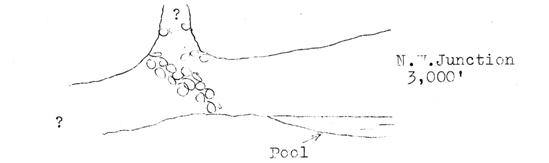
The fall is very unsafe, and explosives may have to be used
to settle it.
Yours
Scottie
(B.M. Scott)
Thanks Scottie. I
expect your news is a little out of date by now, but it is very welcome as we
have no account written yet on any of the club Aggy Aggy trips. We hope top be able to print something soon!
Pyrenees 1960 – Summer School.
A fortnight’s holiday course on the painted caves of
held in August 1960, based at Foix, in Ariege. Accommodation of hostel type; food; transport from
charge not to exceed £35. This is being
organised by the W.E.A. through Ted Mason and provisional applications MUST be
made to P.C. Fryd, W.E.A. office,
Nicholas St
1, by December 31st at the latest.
Mendip Rescue Organization.
Some years ago, a list was prepared giving details of
members who would be prepared to turn out in the event of a ¬large scale rescue
operation. It is intended to revise this
list and bring it up to date. Would any member so inclined please give me full
details of address; home and business telephone numbers, and transport
available.
K.S. Gardner. (M.R.O. Rep.)
New Addresses.
Since printing the list of members at the end of this B.B.,
some of the unknown addresses have come to light they are:-
276 J.M. Stafford,
342 R.J. Price,
Weekes Road
104 M. Hannam, “Myndeep”
This leaves Peter Stewart, Roger & Daphne Stenner and
Barry Woof whose addresses we are at present unable to publish. These will follow in the January B.B.
Belfry Binder
By Sett
When the Editor asked me to publish the recipe for Belfry
Binder, I realised that there must be many of the present club members who have
never tasted this nutritious dish, and many more who do not know of its origin
or raison detre.
Priddy Stew to use its original name was first developed
at
Barn, around the end of the war when food was rationed and meat, in particular,
was not readily available. The
advantages of Priddy Stew as it was originally prepared were fourfold. Firstly, a large number of persons can be
catered for out of one pot, hence only one source of heat is required. Secondly, when correctly cooked, it can be
eaten with a fork. Thirdly, it can be
made with practically any available ingredients, and lastly, it can be cooked
before going underground and warmed up ready for eating while the party is
changing.
By the time the original Belfry was built on its original
site, where the Shepton tackle hut now stands, Belfry Binder, as it had become
known, was cooked almost every weekend, Most cavers could obtain some food off the ration, but these additions
were not usually such that one man could eat them. One caver might, for instance, bring a tin of
corned beef or spam and no sugar, while another brought sugar but no butter. In these circumstances, the preparation of
Belfry Binder was an ideal answer to the catering problem.
By the time the Belfry was moved to its present site, there
were several good shots in the club and rabbit became the traditional meat
content. Unfortunately, this source no
longer exists, and we have to use tinned or butchers meat. One other traditional ingredient, curry, also
seems to be out of favour these days, but tastes vary and it will probably come
back in the future.
As previously stated, there are no fixed ingredients for
Belfry Binder, so a typical recipe would be given. It was left up to the initiative of the cook
to ring the changes of the various vegetables used. A word of warning here. Dont try to use fish and various members of
the cabbage family are best left out. Each person will eat the equivalent of about 17 ounces of raw material
at an approximate cost of 1/- per head. This weight should be made up as follows: – 2oz of stewing steak; 7oz of
potatoes; 2oz of onions; 6oz of other vegetables, well assorted and preferably
fresh. When totting up the total
quantity of stew required, dont forget those underground and any more
latecomers; count these in ands then add a couple more for people you
forgot. The large aluminium pan at the
Belfry, when full, hold sufficient for 17 people, so a typical recipe for this
number will be given. The pan will be
full to within half an inch of the brim with this quantity.
Ingredients
2lbs Stewing Steak
2lbs Onions
2lbs Peas
1lb tomatoes, condiments and thickening
8lbs Potatoes
2lbs Carrots
1lb Beetroot
Method
Put 1½ inches of water in the pan with two level
dessertspoonfuls of salt and one of pepper. Put the pan on the stove and light the gas. Dice the meat into half inch cubes with a
sharp knife and put them in the pan. Scrape and slice the carrots, and dice the beetroots and add to the
pot. At this stage, clean and add any
other root vegetables except the potatoes. The preparation of the meat should take about ten minutes, by which time
the water should be boiling. The first
lot of vegetables will take another twenty minutes. During the next fifty minutes, continue
preparing the other vegetables and then add all but half the potatoes. Twenty minutes, add the remaining
potatoes. From this point, stir
continuously until the last lot of potatoes are cooked. This will take a further twenty minutes or
so. Just before serving, make two
tablespoonfuls of bisto into paste and add to the stew. Serve one large enamel mug full per
person. The stew is fully cooked when
the wooden spoon will stand vertically for at least fifteen seconds.
Lady Chatterbox Cover
By Ann Gardner
We were pleased to receive recently, yet another of those
revealing descriptions of how the other half lives. This is the third in the series describing
the Stately Clifton House of B.E.C. Members.
On Monday the 16th October 1959, BY INVITATION, Lord and
Lady Chatterbox visited the home of Messrs Mosspan, Harvey and Tarling. Upon entering, we were enticed into the
kitchen and teacloths were thrust at us. We ignored them and proceeded to watch the Washing Up Ceremony, which is
usually performed on alternate Sundays during the close season. The decorations in the kitchen are many and
varied with 29 pairs of tatty socks and 5 old ones. Cooking appears to be done in B.P. Energol,
and an equal amount of milk and pure meths appears to be drunk in this
establishment. We were offered some
rather lumpy custard which was, however, politely declined, owing to an
aversion to lumpy custard in any shape or form. The ceiling of this room is orrid green and the place of honour is
taken by a large gas stove (price 2/6) two regency type velvet chairs and three
broken bits. Proceeding into the hall,
one is amazed at the number of climbing boots that can be used by so few
feet. If there were the number of feet
per boot that there are boots, the number of socks in the kitchen would be
easily explained! Two hot water bottles
only were in evidence. It is presumed
that the odd bed uses the two flat irons which were seen as foot warmers. The lounge, two bedrooms and the bathroom
open off the hall, which is the size of the average homes living room.
The lounge is tastefully furnished with a dartboard, two gin
bottles, five twisted red candles, two radios and one record player, one of
which was working. A novel idea was the
hula hoop reclining in one corner. After
careful consideration, I could not see who uses it. The floral decorations were somewhat unusual
for a bachelor flat, comprising three drooping chrysanthemums and one
deader. At the far end of the room the
size is somewhat after the fashion of Mr. Collinss residence and one can
walk for miles, a lonely beer mat poised upon the picture rail peered blearily
at the one bar electric fire which valiantly pits its strength against the
wintry blasts. There are the usual
chairs and bits scattered about and the walls are neatly papered with posters
pinched from far away places like
The bedrooms are not very large. Mr Tarlings is very bachelorish. Messrs Mossman and Harvey share a slightly
larger room. All there beds sagged
somewhat in the middle, and Mr. Mossman pointed out the notches on each
bed. (I wonder what for!) Messrs Mossman and Harvey have an interior
window into the hall. They take it in
turns to watch the assorted climbing gear in the hall. After all, it might get up and walk out one
day. The bathroom is the most gay and
tastefully decorated room in the whole flat. It is mostly a ghastly blue with repulsive maroon ironwork. To add to this, it has pink walls and green
bits here and there. The towels on that
occasion were mauve and the bath is verdigris green with decayed soap
trimmings. In short, not a room in which
one would wish to meditate on the future of the world. We thanked Mr. Mossman for his co-operation
(he had no choice anyway) and left to visit Mr and Mrs Stafford. We arrived and told that they were out. Never mind. We dont give up that easily!
Puzzle
Two cavers were holding an inquest on the seasonal
festivities the night before.
I drank one more pint than you did, said
one, but I cant remember how many I drank.
We both drank beer and screech,
replied the other, I remember thinking that the number of pints of beer I
drank, the number of pints of screech I drank, the number of pints of beer you
drank and the number of pints of screech you drank would make 210 if they were
multiplied together.
That doesnt help very much!
No, but one of us drank an even
number of pints of screech and you drank more beer than I did.
Did I
Yes, you mentioned it as we were
walking back to the Belfry.
How many pints of beer and screech did each of them drink?
A Note on Continuous Flash Powder Igniters
By P.A.E. Stewart
During the course of a recent visit to
Australia
Exploration Group of
or C.E.G.S.A.
After a lot of talking shop on cave exploration, and caving
matters in general, we came to the subject of equipment. They had shown me a large number of excellent
colour slides of the
the DIPROTODON. Upon further
questioning, the following facts were forthcoming: –
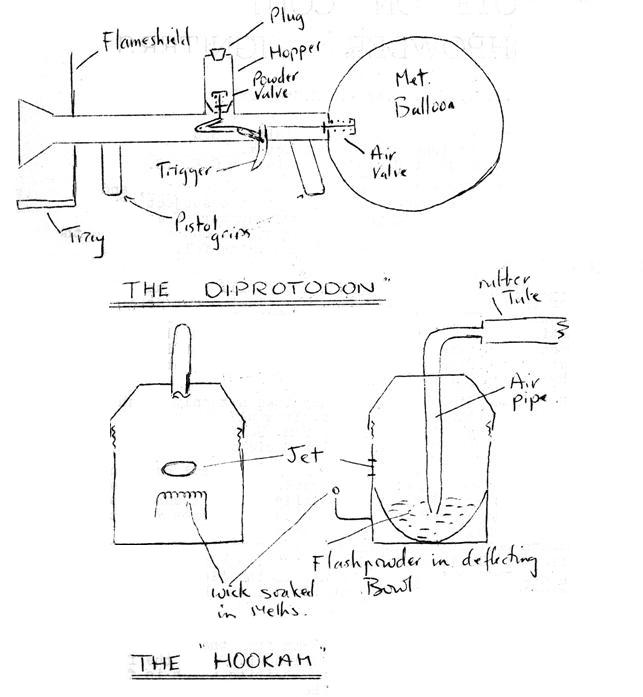
The DIPROTODON, a sketch which can be found on the next page,
is an instrument named after an ancient marsupial hippopotamus, the bones of
which are sometimes found in caves. It
is a continuous flash powder dispenser, giving an improved illumination
efficiency by ejecting the flash powder though a flame of burning methylated
spirits.
Using the DIPROTODON, one may not only take flash photos but
also continuous cine films. It would
appear that the instrument was designed by the Hon. Henry Pairlie-Cunningham of
the Victoria Cave Exploration Society.
Basically, it consists of a meteorological balloon attached
to the end of a motorcycle exhaust pipe. The balloon has an attachment for inflation by means of a lilo
pump. The degree of inflation necessary
varies with the length of run, but one should always ensure that the air
exhausts before the flash powder to prevent a flashback. The outflow of air is controlled by a valve
operated by the trigger. This trigger
also controls the flash powder admittance valve, which lies at the base of the
hopper. The hopper is sealed at the
bottom by a plug.
During operation, the air and powder valves are opened, and
powder is blown out by the air from the balloon through the exhaust pipe and
fishtail silencer. Below the fishtail is
a tray filled with methylated spirits which is fired before using the
diptrodoton. The flash powder is ejected
through this hot flame and thus ignited at a higher temperature than would
otherwise be obtained.
It would appear that the user would be faced with a terrific
glare and would need to use welders goggles or some other protection for the
eyes. A better solution would be to
provide the diprotodon with some form of reflector. If any reader should build one of these devices,
I should be very interested to know of the factor by which the normal guide
number for flash powder is increased.
I should like to thank Bob Sexton of C.E.G.S.A. for his
kindness in giving me the details of the diprotodon in
The Hookah
A smaller version of the diprotodon was described to me by
Les Southwell of the Victorian Cave Exploration Society. This was named the Hookah, for its similarity
with the Indian pipe, though this one is rather more potent.
It comprises at Kodachrome tin with a hole ⅛ x ⅛ cut in
the side. On the top of the tin is a
sweated copper tube with a mouthpiece of plastic or rubber tubing. The copper tube extends downwards almost to
the base of the tin, and terminates in a nozzle. Below this nozzle, the flash powder lies in a
deflecting bowl, on blowing through the tube, flash powder is agitated and
ejected through the hole or jet at the side. This passes over a wick which has been soaked in methylated spirits and
ignited.
Results are similar to those obtained by the diprotodon
although on a smaller scale.
It would appear that both the above devices are prone to
flashback, and some flame trap should be incorporated. The Hookah seems prone to detonation of its
contents, and great care should be exercised in experiments involving any
device of this type.
I should be very interested in the results obtained with
either of these instruments. It is
beleved that one may exist in the
and belong to C.E.G.S.A. members Ken and June Lyon at
Editors Note: Some years ago, a bloke called Johnny
Rundell and myself played about with a gadget which continuously burnt
magnesium ribbon. I can describe the
main pints of this if anyone is interested.
Proposed Combined Clubs Foreign Caving Expedition.
There appear to be many clubs who are anxious to partake in
such an expedition for their summer holiday. The main advantages of a combined expedition would seem to be: –
1. Each club could lend some tackle to the
expedition and is should be possible to tackle a major cave system.
2. Cheap travel rates could be obtained by block
party booking.
3. There should be a good chance of obtaining a
financial grant for such an expedition.
As a first step, the Northern Pennine Club propose to hold
an initial meeting on December 5th, the purpose of which will be to elect an
organising committee for the expedition. As soon as this committee has been elected, the N.P.C. as such will
withdraw from direct organisation.
Should any B.E.C. members be interested, the N.P.C. will be
pleased to send the club details of any further developments. Members of the B.E.C. should contact Bob
Bagshaw if they are interested, and he will then write for further details.
Crossword
|
1 |
|
2 |
|
3 |
|
4 |
|
5 |
|
6 |
|
7 |
|
8 |
|
|
|
|
|
|
|
|
|
|
|
|
|
|
|
|
|
9 |
|
|
|
|
|
10 |
11 |
|
|
12 |
|
|
|
|
|
|
|
|
|
|
|
13 |
|
|
|
|
|
|
|
|
|
14 |
|
|
|
|
|
|
|
|
|
15 |
|
|
|
|
|
|
|
|
|
|
16 |
|
|
|
17 |
|
|
|
|
|
|
|
18 |
|
19 |
|
|
|
|
|
|
|
20 |
|
21 |
|
|
|
22 |
|
|
|
|
|
|
|
|
|
|
|
|
|
|
23 |
|
|
|
|
|
|
|
|
|
|
|
|
|
24 |
|
|
|
25 |
|
|
26 |
|
|
|
|
|
|
27 |
|
|
|
28 |
|
|
|
29 |
|
|
|
|
|
30 |
|
|
|
|
|
|
|
|
|
|
|
31 |
|
32 |
|
|
|
|
|
|
|
33 |
|
|
|
|
|
34 |
|
|
|
35 |
|
|
|
|
|
|
|
|
|
|
|
|
|
|
|
|
|
|
|
|
|
36 |
|
|
|
|
|
|
|
|
|
|
|
|
|
|
Across
(1) Presumably these did not leap or twitch! (5,4,6)
(9) A high flying bird. (5)
(10) See 19 down.
(12) The club voted against one in
this B.B. (5)
(13) No ruddy use
.. (3)
(14) A dexterous move. (5)
(15) Mary in the garden was related
thus to her questioner. (5)
(16) These of the earth are
familiar! (5)
(22) Contrasted in rhyme with an
insect. (7,6)
(26) Advice from Gil? (5)
(28) Drink, or state the next
morning! (5)
(30) Presumably written on a brass
plate. (1,4)
(31) 28.11 Commemorates a small
scale variation of this. (3)
(33) Another dexterous move. (5)
(34) Reilly had one. (3)
(35) We get some of these upon the
ordinary route (2-3)
(36) The squire had not gone far
when this occurred. (2.7.3.3)
Down
(1) Theres a downtown
where the boys all go. (7)
(2) I had a welsh bother of the
shortened form of this name (6)
(3) When 36 across occurred, it
must have been quite a this in the passengers life! (5)
(4) The man who talked to Ivy had
no this. (4)
(5) Found in a PealoOBells. (5)
(6) Bert Iggins was undoubtedly a
this man. (5)
(7) Descriptive of the tools
associated with 1 across. (3,3)
(8) Age of the passenger in 36
across. (7)
(11) Vehicle associated with
(16) Oldfellows hold them. (5)
(17) These 16 downs are sometimes
seen on the 30 down. (5)
(18) What Enery did. (3)
(19) See 10 across.
(20) A type of this is heard at the
Hunters sometimes. (3)
(21) Two brothers owned one. (3)
(23) A woman of Hitchin did this.
(7)
(24) Hed be made of wood without
his head, but presumably he wasnt.! (7)
(25) Worn by 27 down types. (6)
(29) Did the squire say this before
lifting his hat? (5)
(30) On which 24 down presumably
lay. (5)
(31) No need for the leading seaman
to do this. (4)
(32) These clues are useless if you
cant this. (4)
Annual List of Club Members Names and Addresses
This list which follows is that used by our Postal
Department. If your name is not on this
list, or your address is incorrect, please let us know, as that may be the
reason why your B.B. has been late or not sent at all.
|
418 |
S.F. Alway |
|
|
306 |
T Andrews |
|
|
412 |
T.O. Asquith |
|
|
236 |
T. Attwood |
|
|
20 |
R.J. Bagshaw |
|
|
392 |
M.J. Baker |
Morello, |
|
358 |
D.J. Balcombe |
26 Bennett gardens, Norbury, London SW16 |
|
368 |
|
53 |
|
290 |
R. Bater |
2 Upper Perry Hill, Southville, |
|
214 |
R. Bennett |
3 Russetts Cottages, Backwell Common, Somerset. |
|
390 |
J. Bennett |
3 Russetts Cottages, Backwell Common, Somerset |
|
370 |
W.L. Beynon |
Lower Lodge, |
|
417 |
P. Bird |
|
|
364 |
P.M. Blogg |
1 Ridgeway Park, Ridgeway, Glos |
|
336 |
A. Bonner |
45 St. Albans Road, |
|
145 |
Miss S. Bowden-Lyle |
|
|
320 |
F.R. Brown |
|
|
393 |
R.G. Brown |
45 Blundells Road, Tilehurst, |
|
384 |
R.D. Brown |
|
|
320 |
N Brooks |
|
|
209 |
P. Burt |
3 Manor House, Rothamsted, Harpendon, Herts |
|
190 |
Mrs P. Burt |
3 Manor House, Rothamsted, Harpendon, Herts |
|
389 |
R. Burky |
|
|
361 |
B. Busson |
57 Southcote Rise, Ruislip, Middlesex |
|
36 |
R. Brain |
4 Lees Hill, Kingswood, |
|
429 |
R Casling |
|
|
366 |
B.R. Chamberlain |
|
|
231 |
N.D. |
|
|
398 |
A.C. Coase |
|
|
211 |
Mrs C. Coase |
|
|
89 |
S.J. Collins |
33 |
|
395 |
Cochrane |
23368196 L/Cpl, Gordon Barracks, Bulford, Wiltshire |
|
377 |
D. Cooke-Yarborough. |
The Beeches, |
|
416 |
A. Colburn |
69 North end, Clutton, |
|
71 |
A.J. Crawford |
3 |
|
401 |
M. Cunningham |
|
|
405 |
F.G. Darbon |
43 Arthur Henderson House, |
|
427 |
A.C. Davidson |
|
|
423 |
L.W. Dawes |
113 Brooklands, Avenue, |
|
350 |
Mrs A. Davies |
New Bungalow, |
|
424 |
P.V. Davy |
15 |
|
226 |
I. Dear |
76 Reforne, |
|
164 |
K.C. Dobbs |
|
|
325 |
A.J. Dunn |
70 The Crescent, Henleze, |
|
331 |
J.A. Etough |
|
|
322 |
B.M. Ellis |
Oakmead, Cher, Minehaed, |
|
263 |
D. |
|
|
426 |
P. Eyles |
|
|
232 |
C. Falshaw |
|
|
394 |
Mrs C. Falshaw |
|
|
371 |
A. Fincham |
|
|
269 |
T.E. Fletcher |
The Old Mill House, Barnack, |
|
278 |
G.A. Fowler |
|
|
385 |
R. Francis |
91a |
|
404 |
A. Francis |
|
|
251 |
K.S. Gardner |
10a |
|
388 |
J. Goodwin |
11 Glanarm Walk, Brislington, |
|
434 |
D.A. Greenwood |
|
|
346 |
G.H. Griffiths |
|
|
239 |
D. Gwinnel |
34 Gatehouse Close, Withywood, |
|
432 |
N.P. Hallett |
|
|
104 |
M. Hannam |
Address to follow |
|
304 |
C.W. Harris |
|
|
400 |
R. Hartley |
|
|
4 |
D. Hassell |
Hill House, Moorlynch, Bridgwater, |
|
372 |
M.J. Healey |
|
|
373 |
S.M. Hobbs |
|
|
387 |
G. Honey |
Giddings Caravan Site, Hemingford Grey, Huntingdon |
|
406 |
D. Hoskyns |
128 |
|
97 |
J. Ifold |
Leigh House, Nempnett, Chew Stoke, |
|
150 |
P. Ifold |
Sunnyside, |
|
363 |
M. Isles |
33 Greenleaze, |
|
374 |
J.J. Jacobs |
|
|
279 |
J. Jenkins |
|
|
340 |
R.L. Jenkins |
|
|
51 |
A.C. Johnson |
Warren Cottage, |
|
225 |
M. Jones |
|
|
267 |
Mrs M. Jones |
|
|
285 |
U. Jones |
|
|
433 |
J.F. Kembury |
|
|
289 |
D. Kemp |
|
|
316 |
R.S. King |
|
|
413 |
A.F.. Kitchen |
1st Battalion Northamptonshire Regiment, B.F.P.O. 69 |
|
430 |
C.G. Knight |
|
|
332 |
D.J. Lacy |
31 Devon Grove, |
|
260 |
J. Lamb |
|
|
429 |
R. Lewis |
Roseacre, Limpley Stoke, |
|
275 |
|
|
|
414 |
T. Marston |
|
|
106 |
E.J. Mason |
|
|
383 |
P.J. Miller |
|
|
334 |
D.W. Mitchell |
|
|
339 |
G. Mossman |
5 |
|
308 |
K. Murray |
17 |
|
386 |
A. Nash |
|
|
329 |
T.W. Neil |
Orenda, Bradley Cross, Cheddar, |
|
330 |
Mrs T.W. Neil |
Orenda, Bradley Cross, Cheddar, |
|
362 |
F. Nicholson |
Fullbrook Cottage, |
|
|
T. OFlaherty |
|
|
396 |
M.A. Palmer |
Cathedral Coffee Tavern, |
|
245 |
J.S. Pembury |
Grove View, Hambrook, |
|
327 |
J. Pengram |
|
|
22 |
L. Peters |
|
|
160 |
N. Petty |
|
|
146 |
T. Pink |
|
|
56 |
G. Platten |
Rutherfield, |
|
337 |
B. Prewer |
|
|
342 |
R.J. Price |
New address to follow |
|
291 |
D. Radmore |
|
|
241 |
A.L.C. Rice |
|
|
391 |
P.A. Richards |
|
|
344 |
T. Rich |
Frontier Geophysical, Party 8, 207, |
|
411 |
K. Robbins |
|
|
258 |
C.H.G. Rees |
|
|
157 |
Miss J.P. Rollason |
|
|
367 |
J. Rowley |
52 |
|
240 |
A. Sandall |
|
|
359 |
Mrs. A. Sandall |
|
|
237 |
B.M. Scott |
|
|
78 |
R. Setterington |
|
|
356 |
Mrs R. Setterington |
|
|
312 |
R. Setterington |
|
|
403 |
A. Sidall |
|
|
425 |
J. Simonds |
|
|
414 |
C. Smith |
|
|
402 |
D.G. Soutar |
|
|
276 |
J. Stafford |
New address to follow |
|
38 |
Mrs. I. Stanbury |
74, |
|
1 |
T.H. Stanbury |
|
|
365 |
R. Stenner |
New address to follow |
|
381 |
Mrs. Stenner |
New address to follow |
|
60 |
P.A.E. Stewart |
New address to follow |
|
284 |
A. Thomas |
Sandhill Special Residential School, Bishops Lydeard, |
|
379 |
D. Thomas |
23585478, 58/18 Troop, 5th Royal Tank Regiment, Catterick Camp, |
|
409 |
G.E. Todd |
|
|
78 |
J. Tompsett |
|
|
80 |
Mrs. D. Tompsett |
|
|
326 |
E. Towler |
|
|
382 |
S. Tuck |
Gently, East Knoyle, |
|
79 |
R.M. Wallis |
Swildons, |
|
397 |
M. Wheadon |
|
|
399 |
P.C. Wilson |
Woodland Cottage, Wrington, |
|
175 |
J. Waddon |
|
|
420 |
R. Winch |
1 |
|
416 |
B. Windridge |
|
|
435 |
B. Woof |
Address to follow |
|
341 |
R.A. Woodford |
|
|
418 |
E.A. Woodwell |
|
*****************************************
OUR COVER. this year, for those who may be interested in
such things, were drawn by a pukka commercial artist and printed by the offset
litho process. Considering that, as far
as we know, he has never been down a cave, we think he got the ‘atmosphere’ very
well, although his cavers look too neatly
dressed to be authentic!
*****************************************
WE REGRET that one tradition of the Christmas B.B. of recent
years – the inclusion of a poem by Sid Hobbs – has not been possible. Rumour hath it that we might get one early in
the new year.
The Use of a Barometer in Cave Surveying
By Roger Stenner
The altitude, or height above sea level, of a point, is a
function of the air pressure at that point compared to that at sea level, the
temperature and humidity of the air, and the local value of gravity. Allowing for these quantities, the general
formula connecting height and pressure reduces to: –
H =  +
+  +
+ 
|
Where: – |
H T
P go gn Wn |
= = = = = = = |
Increase in altitude between points 1 and 2. Mean temperature in Fo Air pressure in mb at point 1. Air pressure in mb at point 2 Local value of gravity in C.G.S.W. Mean value of gravity in C.G.S.W. Water Vapour Pressure at to x Relative Humidity |
Where h is measured in feet and Pm is the mean pressure
between the two points in the same units as Water vapour Pressure.
Knowing the latitude and altitude of a cave in metres, we
have:
G(sea level) = 978.85(1 + 0.005288sin2N – 0.000006sin22N) where N is the latitude.
go = g(sea level) 0.000309H + 0.000042kH where H is the altitude and k is the density.
The correction for gravity is usually negligible, and is
less than 0.1%. A temperature error of 5oF
gives an error of 0.9% and neglecting the humidity factor gives, at 50oF and
100% humidity, an error of 0.8%. As an
error of 0.05mb, one part in 20,000, gives an error of about 1.5 feet, it is
most important that the barometer used should be accurately calibrated. If a mercury barometer is used to calibrate
it, it is important to apply all the necessary corrections.
A capsule aneroid barometer, loaned to the club for this
purpose by Messrs Mechanism of Croydon, was used by the author, assisted by
George Honey, in St. Cuthberts in August last. A series of readings were taken which it is hoped will add to the known
data on the cave and help evaluate the usefulness of this barometer.
A number of selected stations, the air pressure and the time
were noted. The air pressure at the
entrance was noted both on entering and on leaving the cave, so that a
correction curve could be drawn, assuming a linear rate of change. To further
check the method, readings were duplicated at one station in the cave, with a
long time interval between the two of them.
The air temperature in the cave was found to be 10.5oC and
temperature measurements have shown this value to be fairly constant. R.A.
Setterington, on the 11th August, showed the temperature of most of the
important risings on Mendip to be 10.5oC. The relative humidity in the cave has previously been shown to lie
between 99% and 100% throughout the cave (See B.B. Nos 118 and 120).
The scale of the micrometer attached to the instrument
enabled readings of 0.05mb to be distinguished. This is the equivalent to a vertical error of 1.5 feet. Results were as shown overleaf: –
|
TIME |
|
CORRECTED
|
DEPTH |
STATION |
|
Hours |
mb |
mb |
ft |
|
|
1325 1345 1350 1400 1415 1515 1615 1622 2125 2145 2150 2153 2153 2200 2230 0010 |
992.85 994.80 996.25 998.45 1000.70 1001.05 1001.40 999.85 999.25 1006.10 1006.10 1005.50 1006.30 1006.60 1004.35 991.45 |
992.85 994.85 996.30 998.55 1000.60 1001.25 1001.80 1000.25 1000.25 1007.20 1007.20 1006.60 1007.40 1007.40 1005.45 992.85 |
0 55 95 157 218 231 246 203 203 393 393 377 399 407 346 0 |
Top of shaft. Window into Arête Chamber. Foot of Arête ladder. Entrance to Wire Rift. Foot of Upper Mud Hall ladder. Quarry Corner mud slope. Upper Traverse Chamber near Katchenjunga. High Chamber, Catgut entrance. High Chamber, Catgut entrance. Main Stream, Main Stream, Beehive. Lip of Great Gour. Gour Hall, Main Stream. Main Stream, First Sump. Dinning Room table. Entrance. |
Accuracy of the
Results. The assumption of a linear
rate of change of air pressure with time was borne out by the correspondence of
the two corrected pressures in High Chamber. Nevertheless, readings taken during an atmospheric discontinuity, such
as is caused by a thunderstorm, would not respond to such a correction.
Conclusions. In normal conditions, it would appear that
the instrument is capable of giving readings to something approaching the
reading error of eighteen inches. In addition to its use as a depth measuring
instrument, it would be useful to take a series of readings in unsettled
weather when the barometric pressure is changing rapidly, at the entrance to a
cave and deep within the system simultaneously. From these readings, any time lag between a pressure change at the
surface and the deep cave would be measured. Another experiment which would be possible, in connection with an
anemometer, would be to determine the pressure differences necessary to produce
the string winds which are found in some parts of cave systems. Finally, to confound all the critics, it
would be worthwhile to compare barometric readings of depth with figures taken
from an accurate survey of the same cave by conventional methods.
Conclusion
Well, that’s it again! The end of the Christmas B.B.; this size of paper and this
typewriter. Weve got a lot of work to
do now before the next B.B. can come out. The stapling machine must be altered, the new typewriter must be got
hold of, and the blocks for the cover must be finished and the printing
organised.
So January’s B.B. may be a bit late. After that, the new arrangements should be
working smoothly and we will make a great effort to get the B.B. out by the
first Thursday of each month, as we did until recently. So keep your fingers crossed, hope for the
best and a Merry Christmas.
*****************************************
THE BELFRY BULLETIN FOR CHRISTMAS 1959
Secretary; R.J. Bagshaw,
Editor; S.J. Collins, 33
Postal Department; B. Prewer,
Egerton Road