
Contents
The
Mendip
Cave
For some time now, a group of cavers drawn from nearly all
the clubs concerned with caving in the Mendip area have been engaged in
compiling a Register of information on all Mendip caves. Members of the B.E.C. are helping with this
work, which has now reached the stage at which the officers of the Registry
feel that its existence and aims should be brought to the notice of many Mendip
cavers as possible. We feel we can
assist by publishing the whole of a recent circular written by the Chairman of
the Registry. This follows below: –
The desirability of having a
central source of information on Mendip caves has become increasingly apparent
over the last few years. It is probably
true to say that as much information is being lost to the caving world as is
being gained by new exploration. Some
pioneer cavers of the early days of the century have left us, taking with them
much useful knowledge and who knows how much information is locked up in the
personal diaries of eminent cavers of yesterday?
Several individuals have thought
of, or even tried to produce, a complete record of Mendip cave information; but
it was not until 1956 that representatives of most of the Mendip caving clubs
met to consider setting up a registry. The result of this first meeting was the Mendip Cave Registry.
Since 1956, its officers have met
on 17 occasions and have, after a considerable spate of debate and experiment
evolved a system which it is hoped dill serve the needs of the¬ Registry for
many years to com.
It was recognised at an early
stage that the Register must be easily accessible to the caving public and
arrangements have been made for it to be permanently available at the Wells
County Library and at the Central reference Library,
develop into more than one volume. The
Register is based on the 2½ Ordnance Survey maps, and each map will be divided
into four quarters; each quarter sheet will form a division of the register,
and the information appertaining to each map section will follow the map.
The work of preparing the
register will never be complete while cave exploration continues and
publications are produced. It is also
inevitable the registrars will miss some references and information may be
incomplete in other ways, but the object of preserving information that might
otherwise be lost, and of making available to cavers a more complete record of
information that at present exists, will certainly be achieved.
The volume of initial work is
tremendous and it is bound to be some time before the Registers are placed in
the Libraries. There is already a very
keen and hard working team, but the more help forthcoming, the quicker will be
the Registrys progress. If any reader
is willing to offer help whether financial, clerical, or in active research, he
or she should write to the Chairman: Mr. Howard Kenny, Tudor Cottage,
If any club members want to know more about the Registry,
the club has two members on its Governing Body, M. Hannam and A. Collins.
Alfie
Personal
At 14.30hrs on Saturday, 29th March, Miss Daphne Anne
Collistep Clague was married to Roger Stenner. The Bride, who wore a traditional white wedding dress of sort of lacy
stuff, looked well and quite composed. The bridegroom has cleaned his shoes for the occasion and was dissuaded
from wearing a striking M.R.A. uniform hat by his determined parents. The wedding guests were numerous and of three
types; relations, college friends and the B.E.C. At the extremely amiable reception, after
innumerable toasts, college friends and the B.E.C. found much in common, more
particularly as the college friends were well flavoured and very feminine young
women! The evening ended at
approximately 2030hrs as Daphne ands Roger left.
R.S. King
Club Library
The following books and publications are now in the club
Library: –
The Caves of Mendip by N.
Barrington
Sandstone Climbs in South
The River Scenery of the House of the Vale of Neath
C.R.G. Occasional Publications No.1. The
International Expedition to Gouffre Berger.
Axbridge Caving Club Journal, Volume 1. No. 3
One Thousand Metres Down by Jean Cadoux
March Committee Meeting
The March Committee Meeting was attended by the whole of the
committee. Amongst matters dealt with
were the new club duplicator, the provision of mains water and the new Belfry,
the club Lantern and Slides, certificates for Honorary Life Members, the state
of the club tackle, improvements to the Belfry kitchen, suggestions for a
suitable memorial to Don Coase and the appointment of a new M.R.O.
representative. R.S. King was co-opted
on to the committee as Climbing Secretary.
Caving Log for March 1958
March 1st: Swildons. Leader Marriott
G.B. Leader Alfie (Photographic)
Cuthberts. Leader Prew (Trip to sump)
March 2nd: Eastwater. Leader Roger Burky (Beecham Series)
March 8th: Eastwater. Leader Mike Wheadon (Ifold Series)
Goatchurch. Leader Roger Burky
Sidcot. Leader Roger Burky
March 9th: Lamb Leer. Leader Roger Burky
March 16th: Cuthberts. Leader Kangy (Maypole Series survey)
Swildons. Leader Prew (Top Series)
March 23rd: Swildons. Leader Mike Wheadon (To Sump 1)
Cuthberts. Leader Kangy (Maypole Series survey)
Great Oones
Hole. Leader Prew
Goatchurch. Leader Norman Petty (Photographic)
March 30th: Cuckoo Cleeves. Leader Roger Burky
August Hole. Leader Ken Dawes (S.M.C.C.)
As will be seen from the above, it has been decided to print
a list of trips as entered in the caving log in the B.B. each month. This will be followed by special articles on
any of the trips, as in the past; or extracts from the log where the trips are
of unusual interest. In cases where the
leader of a trip is not mentioned, the person who wrote the trip up in the log
will be taken to have led the trip.
Editor
This month, all the trips were routine type trips, the only
unusual occurrence being the remark made by Norman Petty after leading the
Goatchurch trip on the 23rd. He was
heard to state that in his opinion, Goatchurch was more dangerous than
Cuthberts.
In Search Of Snow
It is sad to note that, although some parts of the country
had some of the heaviest falls of snow since 1947, none of it fell where it
would be most appreciated. In the first
two months of this year, the climbing section made three trips to North Wales
in search of snow conditions and drew a blank every time.
The first trip was made on January 18th, in a luxurious
hired vehicle and a motorcycle. The
Saturday was so very wet that shopping at Arvons in
do. That particular weekend,
at Llangollen where we bought a pint and asked to watch the match on telewele. No telewele. It was the same at the Brittannia (authentic spelling) The Victoria and
the George. So with no telewele to
watch, but with four pints of excuse apiece inside us, we headed back to the
hills and a wireless set. That evening
we met in the Bryn Tyrch.
Sunday dawned more reasonably. Overcast still but snow had fallen; enough to
make things look pretty and ruin the roads for driving. After a brisk walk round, we left early to get
clear of the snow bound roads by nightfall. Even so, the motorcycle took 3½ hours to reach
The next trip was planned for mid February, when we could
most expect snow. Meanwhile we had heard
that snow had fallen in the right place on January 23rd. Some of this lasted until Saturday, but the
only good snow was found in Cwm Glaswyn, making gullies on the north face of Yr
Wyddfa possible. By Sunday, the thaw
removed even this.
On the 14th February, two new Ford Consuls, with a
compliment of twelve, headed for the Promised Land. Some promise! The only reason why anyone at all went above a thousand feet on Sunday
was because Roy and Joan Bennett left early to walk on the Glyders. Despite protests, Johnny Attwood insisted on
dragging us through very heavy rain on an alternative route to the Glyders
because The two Bs were out in it. The two Bs (an apt appellation this time!) were not out in it but by
this time had returned without our knowing and were warmly reading in the
car. Our alternative route to the
Glyders led us into Cwm Idwal, where we photographed remarkable line squalls
blown across Llyn Idwal by eighty to a hundred mile an hour gusts of wind. Then into the Nameless Cwm where we found one
gully with the remains of a fine cornice at its head. A ceremonial line of steps was kicked up
this, and we headed splish-splash for Isaf, Mrs. Griffiths ands the Bryn
Tyrch. Sunday started with a remarkable
sunrise and continued with unremarkable trips round
Acting on a hunch (and with ulterior motives) Mossman and
King packed crampons, axes, many changes of jerseys, trousers and anoraks and
mentally prepared for the unforeseen hazards, drove to North Wales on the 1st
March. Again, snow had fallen during the
week and what remained, though only enough to outline the crests of the
mountains and cwms, enhanced our appreciation of familiar scenery.
Saturday was bright and dry, with a strong wind which moved
loose low cloud formations through the valleys and around the peaks. No snow, but who cared? We went to
and followed the Pyg Track to the foot of Crib Goch where we veered right and
followed an interesting path rounding the Red Ridge into Cwm Glas to the foot
of the Crib Goch buttress. Reades route
was dry. This route contains a step
across, rather like Knights Climb at Cheddar, with the added attraction of a
rather steep wall with a variety of small holds on it. At one point it was discovered that one can
employ a hold previously un-encountered, this was provisionally named a Right
Buttock Hold. After this climb, we made
a circular tour of our route by climbing Crip-y-Ddsgl and walking back down the
Pyg Track. Evening Bryn Tyrch for beer
and friends.
No one really believed Sunday. A high bright blue sky with a slight breeze
of sufficient strength just to move little wisps of cotton wool cloud along the
slopes. We breakfasted hurriedly. Fragile feelings were dispelled with aspirin
and we set out for a perfect days climbing in glorious weather. After King and Ulterior Motive had reached the summit of Craig Yr Isfa by
climbing the nine hundred feet of Amphitheatre Buttress, low cloud form the sea
could be seen pouring over Pen Yr Olwen and Daffyd to disperse in shreds over
Ogwen. A mist form in the Amphitheatre
and suddenly a Broken Spectre with its attendant circular rainbow appeared.
A slow walk back via Afon Llugwy gave us marvellous views of
the beautiful cloudscapes and made us quite forget that once again we had not
taken our snow and ice equipment from the car.
Kangy
A Cave at Newton Abbot
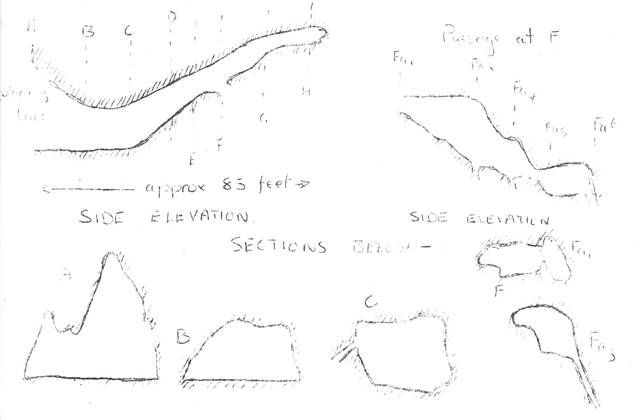
The cave is located six feet above the ground level in the
of a disused quarry off the Totnes road about one mile from Newton Abbott. It seems to have been start of a fair sized
chamber broken into by quarrying, running in level for about twenty four feet
before beginning to rise at thirty degrees or so in a due south direction.
At about sixty feet in, at section f a smaller passage
runs off downwards at the side of the main passage. From this, narrow passages drop down on the
right following the bedding plane which is at about sixty degrees in a south
east direction. The most likely looking
is at ‘fa 3’ which can be seen to drop about fifteen feet, and almost certainly
continues beyond this. Unfortunately its
position, angle and smoothness made it a more than one man job to investigate
at the time. At section c, a passage
runs off to the left, but seems likely to connect back to the quarry lace. It seems unlikely that the choke at h would
be worth following up, as it must be getting fairly close to the surface. I have found one or two other possible holes
while I have been down here, but the people Ive nattered to dont seem to want
to get on close terms with orrid oles.
Ken Dobbs
Editors
Note. Most of our readers will remember
Ken Dobbs, but for our newer members benefit, Ken played a very active part in
B.E.C. affairs before he went to live and work in
reproduce below.
Life in
Canada
Being extracts from letters written by Tony Rich to Roger
Stenner.
Tony Rich asked me to get a B.B. article from his letters to
me, and as last months B.B. suggested some letters from foreign parts might be
of interest, here goes!
Arriving in
August, three B.E.C. members, Rich, Lamb and Jenkins, found work out of the
question and crossed the Rockies to
a 29 hour coach journey. With only 25
to 30 dollars left, things looked grim, but Tony Rich was able to enquire about
guitars.
Meeting a man from Kingswood in charge of the only garage in
place) Tony got a job as a motorcycle mechanic, but was soon promoted to Deputy
Sales Manage they didnt trust him with the Harley-Davidsons! The family were they had their digs took them
to Banff National Park in the Rockies a fabulous place where one can walk up
to bear and buffalo etc., if one so desires; swim in the hot pools at 80 to 88
degrees F in the open air and small the sulphur sorry, sulphur.
Tony was then offered promotion to Sales Manage if he would
stay on permanently, but refusing to do this, he was put out of work
again. With things again very black, he
bought three long playing records and mailed them to me to keep for him. Money has very loose connections with Mr.
Rich!
Soon work came from the Frontier Geophysical Limited, an oil
prospecting firm. In this kind of work,
any, including Tony Rich, are expected to do a bit of all kinds of things such
as truck driving, surveying, manual work of various kinds, and work in
connection with life in the backwoods. Tony was almost at once shifted 120 miles north at 24 hours notice (with
an extra five dollars a day for inconvenience) for a rush job working twelve
hours a day seven days a week. Tony had
to drive a truck all the way, although he had no licence.
Hard working usually breeds hard living, and Tony can tell
many humorous stories as a result. Rival
crews, for instance, lined up in the main street of Ponoka for a real set to,
with a very cut gentleman about seven feet tall emerging to make peace, all
because of a dance hall incident.
Everything is closed on Sundays, but at a minute past
midnight everything opens again!
The weather is fantastic at times. At one stage, the temperature varied between
14 degrees of frost, with snow at 8 am and 80OF at midday. This was in September. By January, the temperature was fairly steady
at about 30 degrees below zero. Drilling
300 feet deep holes, 4½ inches diameter needs plenty of water for lubrication
and drivers are supposed to drive as fast as possible between the hole and the
nearest lake. Turning on narrow roads is
done simply by reversing fast into the ditches bordering the roads. Drivers not driving as fast as the rest of
the crew (who take hair raising risks) are invited to leave.
In February, the party Tony works with was moved right into
the bush from
– further into the foothills of the
with linx added to the fauna. The
advance party, with Tony, arrived at midnight with the temperature thirty below
and with no fuel. His mattress froze to
the bed, and in the morning he spent an hour under the truck with a propane
lamp before gearbox could be operated.
The party was hit by bad luck. Thirty thousand dollars worth of drilling rig
burnt out, the centre cog of the crew, the operator, was gassed by carbon
monoxide. Tony crashed a truck, the
seismograph failed to work, the cook left and accidents with a drill lost a
fifteen thousand dollar contract.
Life in the bush means that the money piles up, and Tony has
bought himself a complete set of photographic gear as a result. Although many things do not appeal to Tony in
he gets tired of being above ground, he likes the life, and claims it has
made him very fit.
R. Stenner
Ten Years Ago (or nearly so!)
Having a bit of spare space in the B.B., we thought it would
be a good idea to print a short extract from the B.B. of April 1948 ten years
ago, but we found that in fact, no B.B. was published for that month. Here is an extract from the B.B. for March
1949, by Pongo, who thought that the description of the Natterers bat in
British Bats by Brian Vesey-Fitzgerald was quite applicable to the
inhabitants of the Belfry.
The Natterer has much hair on its face. It goes into caves for hibernation at the end
of September and does not resume activities until the end of March. There is no segregation of the sexes during
hibernation. The Natterer is very
gregarious and sociable, living in large colonies. It is little affected by the weather, though
it dislikes a cold east wind. The time
of its evening flight is very variable. There is much squeaking before emergence.
Climbing Notes
The loose rock on the pinnacle of Knights climb in Cheddar
Gorge has become even more unstable since the winter through frost action. Climbers are recommended to climb the pinnacle
from the cleft, taking the inside wall or the pinnacle instead of its
shattered outside edge. This will help
to keep bits of Cheddar from dropping onto the weegies.
In
Williams of Gwern-y-gof-Isar has banned the Wallasey shower from his farm.
The bunkhouse at Gwern-y-gof-Isar needs to be booked well in
advance and is 2/- per person per night. Barns and camping are 1/-. The
bunkhouse at Mrs. Jones, Blaen-y-Nant, is available again and seems to be
easily booked.
Climbing Secretary.
Climbing Books
These climbing books were missed out of the January B.B. in
error. Our apologies to the climbing
fraternity, who will find them below. They were sent to us by the Caving Secretary.
Selected climbs in the range of
Mont Blanc .
By E.A. Wrangham, George Allen
and Unwin, 216 pages (18/-). Contains descriptions with diagrams over a hundred
routes. This is the first Alpine Guide
to be published in English since 1910 and if it sells well, others will be
forthcoming.
Mountain Rescue Handbook.
Is a must for mountaineers and
can be obtained from the Secretary of the Mountain Rescue Council, Hill House,
Cheadle Hulme, Stockport,
larger orders.
Mountaineering.
The price of the B.M.C. magazine
is now 2/- and can be obtained from Mr. A. Coates, Greystead, Milespit Hill,
*****************************************
Secretary: R.J. Bagshaw,
Ponsford Road
4
Editor: S.J. Collins,