
QUODCUMQUE FACIENDUM : NIMIS FACIEMUS
Contents
Editorial
Lifelines
The recent accident in Lamb Leer unfortunately provides an
example of a type of accident which might well have been minimised or even
avoided had full life lining techniques been in use. The fact that the accident occurred to a
caver of many years standing on Mendip emphasises the fact that every caver,
however experienced or fit, can come off for some reason or another, given
bad luck.
There is, or course, an understandable tendency for cavers
of experience to minimise the use of life lines. Perhaps the accident will serve to impress on
us the need for the grater use of such preventative measures.
Thin End?
The strong possibility that Somerset will require the
B.A.C.I. certificate for all leaders under its control from 1976 onwards – and
by implication will be rejecting the training scheme adopted and published by
the Council of Southern Caving Clubs – could be seen as a first step towards
that state of affairs portrayed in the Christmas B.B. last year, in which the
fictitious University of Charterhouse made its appearance. Having said this, it should not be implied
that there is anything intrinsically wrong with B.A.C.I. The point being made is that of restriction
of freedom of choice. In this
connection, it is worth noting that the approach of the C.S.C.C. scheme,
‘Caving for Beginners’ differs considerably from that of B.A.C.I. and that the
choice is therefore not one between two certificates as between two methods of
approach. Indeed, there is no reason, in
theory as far as can be seen, why a particular caver giving advice and training
under the C.S.C.C. scheme could not be a B.A.C.I. certificate holder. There is, however, a world of difference
between a state of affairs in which he MAY hold such a certificate and one in
which he MUST. The C.S.C.C., quite
rightly in the editorial opinion of the B.B., place their first priority on
experience. As an older, experienced
climber is reputed to have said to a younger man proudly displaying a
certificate, “That’s all well, but can you abseil from it?”
Round And About
Apart from a small editorial comment in the column itself it
seems appropriate to congratulate ‘Wig’ editorially for reaching his century
this month by the production of his hundredth topic under, what has become by
now, the familiar heading of Round and About.
Many people have said how useful they have found this
feature of general information, and I would like to add my personal thanks
coupled with the hope that he may go on for a very long time to come.
Alfie
At the Belfry – A Flowery Spiel
An account of some of the
happenings at the Belfry in the earlier part of this year – by Nigel Taylor
Spring and nearly, ever so nearly, summer is in the air at
the Belfry now. And with the spring come
new flowers and new faces, but nevertheless old shoots and faces have been
popping up in and around the Belfry. Chris Falshaw and family, Mike Wheadon,
Pat Ifold and family, and many others.
Again, there has been an early showing of perennial hardies,
such as Sett and family, Mary and Pete Ham and family and many, many more.
Back in the autumn, Albert Francis was even seen at the
Belfry sleeping there for the first time ever! This was due to acute hop poisoning after an excellent N.H.A.S.A.
dinner!
Club members actively participating in various digging activities
such as Hollowfield and Bucket Hole have been numerous and the club’s licensed
explosive users have been employed gardening many earthy systems.
The Belfry car park has been re-graded by mysterious loads
of quarry stone – connected somehow with an even more mysterious Hut
Warden. The Belfryites have also been
working hard on the site, and a night exercise from 9.30 p.m. through to 6.30
a.m. saw the erection of a large M.R.O. store and new Tackle Store facilities.
However, all is not roses at
ably dealt with by Rod Hobbs and Tim Large one weekend recently. Problems of sewage disposal have also reared
up and threatened to drop us all in the fertiliser. These, too, have (we hope) been overcome.
Due to two accidents in the attic roof, repairs were
necessary, and these were efficiently executed by Jock Orr Plastering
Industries Ltd. In general, members and guests have all mucked in well with
the problems and given fair periods of their time.
Belfry regulars include, at present, Andy ‘Groper’ Nicholls,
Zot, Martin Grass and female company, Colin and Angela Dooley, Chris Backstone,
John Dukes and ‘Streaking for Deakin’ Sue from Southampton – and of course your
scribe, Mr. Nigel.
On a more serious note. If you or someone is bitten by a snake, immobilise the limb – treat as
for fracture – do NOT tourniquet, DO NOT allow victim to move – Do reassure and
comfort victim – DO call 999 – DO NOT take victim to Wells. Ham Green hospital in
serum – but it is often not necessary.
Open Letter To the Club
Editor’s
Note: This threatens to be a B.B.
written entirely by Nigel Taylor! In
this open letter, he has some forthright comments to make on the Long Term plans.
The Long Term Planning Committee have done it again! Yes, they have produced – not a
representative report but another diatribe! They have completely missed the point, or rather the points of
necessity. A detailed account has been
drawn up, telling us how more paper talk and ensuing paperwork will be created
– and this is capped by a list which is not so much ‘Long Term’ as short
sighted!
Now to the ‘winter of my discontent’:-
List 1 contains the order of priority of items in groups,
and my comments are as under: –
- Comfort.
I thought the B.E.C. was a caving club, not a ruddy 5 star listed
A.A./R.A.C. hotel.
- Rubbish
storage and Waste Disposal.
This itself is rubbish, since we now have 4 dustbins and I personally come
up midweek if the local farmer cannot undertake the job on the fortnightly
dustbin day. Furthermore, I have
recently been pressing the new Mendip District Council to drive up to the
Belfry to pick up the bins.
- Cooking
Facilities and Food Storage
With 8 gas rings and one grill, and one new oven, are they really that
bad for a hut which sleeps a maximum of 25? In any case, the utilisation is usually
in the 80% bracket with a fair proportion of the users not even
contemplating cooking each and every meal. As for food storage, what have successive committees done about the
lockers? (First mooted by me over
18 months ago at a November Committee meeting.)
- Eating.
How does the sub-committee propose to improve this?…..Aaaaagh .an
answer emerges intravenous feeding!
- Washing
up, crockery storage, etc.
What is up with the shelves and cupboards Norman Petty made? They open the doors? Or their eyes?
That has withered away the first
5 ludicrous and apparently highest priority items. Having scrubbed these erroneous ‘priorities’
one is then left with something of substance from which one may prepare a
sensible list ( if one is to have such a list at all)
- (No
8) Washing self and Shower Facility.
- (No
9) Charging Facilities. Surely
this is a vital requisite for a caving hut in these days of frequent
digging and caving trips? - (No
7) Changing and Drying of clothes. The need for this is plain for all to see and comprehend.
4. (No
6) Workshop facility. For the lifeblood
of a caving, climbing – or even canoeing club, a place where tackle, digging
gear, tools, canoes or whatever can be made – bearing in mind the communal
skills and knowledge – producing a product in a sensible and well-equipped area
at the club H.Q.
5. (No
12) Administration Facility. In this day
and age, when large clubs must need to run their huts on business lines
(especially when one is dealing with monies and goods belonging to the club,
let alone the £15,000 or so of club hut) the need for proper administration
facilities rears its ugly head, let’s not play the ostrich!
6. (No
14) The Loft. Ideas for improvement to
this are often aired down at the Belfry. I refer the reader to the B.B. Number 303. (See, Editor, the B.B. is
used for references!) The club is
wasting valuable, utilisable space up there and if it embarks on extraneous
expenditure on the sub-committee’s proposals then such potential will be wasted
due to lack of funds or their allocation.
7. (No
13) The Library. Here, only a carpenters
skill and club finance are the requisites to transform this ‘near shell’ into
the condition merited by both its content and the valiant efforts of the club
librarian Dave (Wig) Irwin.
8. (No
10) Sleeping Accommodation. Here there
is even less scope for the necessary improvements to be made. However, I feel that women club members might
prefer, or deserve, better feminine conditions, yet, to back track, we must not
forget that this is a caving club and basically composed of males (But perhaps
I’m just a Chauvinist pig!)
9. (No
11) Parking. Even though I realise that
soon we can expect club members Range Rovers; Lamborghinis; Daimlers; Rolls and
the like will be replaced by perhaps H.S.125’s S.A./B.E.C. Concordes and an
array of resplendent V.S.T.O.L. craft, I feel sure that there are not many of
us who would like to see a shiny NICE macadam or LOVELY concrete car park, of
course resplendent with DIVINE tints of white or yellow lines. Besides, I, for one, don’t want to have to
read the
before the next A.G.M. – I will find my own tedious enough!
One last point – I wonder if the sub-committee could be kind
enough to tell me why in the May B.B., No 319:-
Three further lists will be compiled:
1. First to show order of priority of groups of
items.
2. Extent of improvements as costings of expense
& labour.
3. (Last but not least!) Order of priority of items.
Please, oh PLEASE, what’s the difference, between list 1 and
3, or is it to cater for inflation presumably mentioned in the intervening list
2 perhaps?
I know it is easy to knock a subject as I have just done but
I hope the reader; the sub-committee and the general committee will appreciate that
I have endeavoured to put forward counter-proposals in this letter, and I will
also have shown this letter to the sub-committee’s chairman Graham Wilton-Jones
to give him a chance to challenge any points that I have proposed. This letter is not under any circumstances to
be taken as an attempt to challenge either Graham’s views as chairman, nor for
that matter to challenge the integrity of the general committee or any of its
officers. This meant purely as a thought-provoking
article on points which the editor invited comment!
It may be questioned as to why I did not put these views
forward as Hut Warden, well, this was not possible. The committee, for some reason, decided that
the Hut Warden should not have a sub-committee say in the proposals. I say this in answer to several queries
raised to me on this point. So I must
further stress that these are not the B.E.C. Hut Warden’s views, but my own –
purely as an interested member and regular user of the Belfry.
Yours in the Club Spirit,
Nigel P. Taylor.
Editor’s Note:
As Nigel points out, I invited comment, since the way the
club decides to spend its money on the Belfry is a subject which should
interest most – if not all – B.E.C. members. Perhaps other members might like to make points – if not to the B.B.,
then to Graham who, I am sure, will be pleased to hear about as many points of
view as possible to help him in what is after all, a very difficult job.
Another Reminder about the A.G.M. and Dinner
SATURDAY OCTOBER 5th
A.G.M. starts at
10.30 a.m. at the Belfry.
Dinner will be at the
of Rockham.
FULL DETAILS IN NEXT
B.B.!
The Deneholes of Hangmans Wood
A description of a little-known
type of underground feature written by Derek Sanderson and Roger Wing.
The Deneholes are phenomena which may be of interest to
cavers – particularly as some of them can still be explored. Indeed, some members may be familiar with
them whilst others may merely have read about them. They are found in a number of counties in the
South East of England and also in parts of
and one of the main concentrations is in
occurring in the comparatively small area known as Hangman’s Wood, Greys. There is a soft spot in the hearts of the
authors for the Deneholes, as they represent an early landmark in their caving
careers.
DESCRIPTION. Basically, all Deneholes consist of a single shaft dropping vertically
from the surface through the thin topsoil of the region and the underlying
Thanet Sand, and terminating in a chamber in the chalk beneath, which may be at
a depth of up to eighty feet. These
shafts vary in diameter, but are usually between ten and twelve feet wide and
are reminiscent of a well shaft. The
chambers at the bottom vary in shape from simple bell like chambers to more
complex chamber patterns. The Deneholes
found at
variety, whilst those at Stankey are more irregular. The most common form of chamber is the
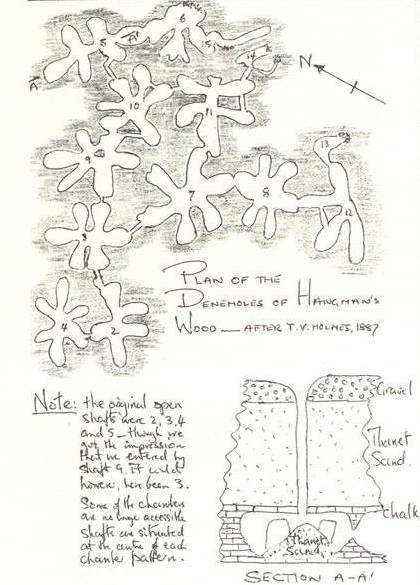
‘double trefoil’ shape as is found at Hangman’s Wood. Originally, there were many shafts at Greys,
but now there are only two shafts open (70′ ladder required for each). Below is a network of chambers interconnected
by short rabbit-hole-like crawls. All is
dry and mostly horizontal.
AGE. To establish
their age is by no means easy, but one may hazard a guess from various pieces
of evidence. In 1884 and 1887, the
Deneholes complex of Greys was fully investigated on behalf of the Essex Field
Club by two of its members – T.V. Holmes and W. Cole. An extensive report was published in which
they discussed some of their findings. They found, for instance, pieces of Niedermendig lava which was quarried
in the
imported into this country until the arrival of the Romans. This, in itself, is of dubious value, though
it may add weight to other evidence.
The most useful evidence concerning age comes from the bones
found in the deposits that have inevitably settled at the bottom of the
shafts. These include remains of sheep;
badger; ox; dog; horse and man. What is
significant is the total absence of
wolf, which were apparently common in the time of the
One may suggest, then, that the Deneholes were dug soon
after the arrival of the Normans, and this seems to be the conclusion arrived
at by Baker when he wrote, ‘
the assumption that they existed in Saxon times
will hold no more water than a chalk Denehole would.’ (Caving, p102). They do, however, predate the trees which
grow around them.
REASON FOR EXISTENCE. This leads to the engaging problem of why they are there, and several
theories have been put forward over the years.
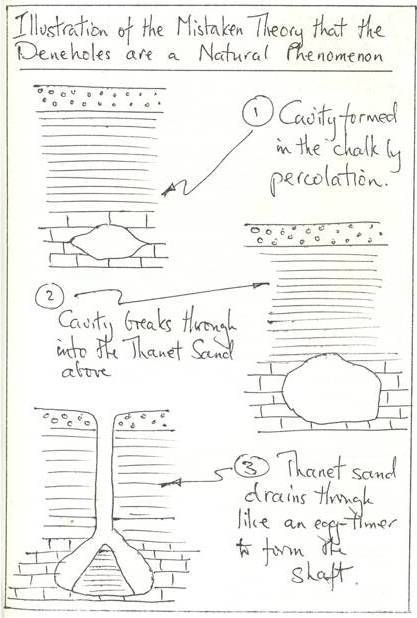
- The
shafts are, in fact, natural. This
is a recent theory. What has been
supposed is that a cavity has been formed in the chalk bed by percolating
water in a similar manner to that which occurs in Limestone. This cavity is formed close to the top
of the chalk layer. The theory goes
that eventually the roof of the cavity meets the underside of the layer of
Thanet sand above, and this drains through like an egg-timer to leave a
cylindrical shaft dropping into a semi-filled chamber in the chalk
beneath.No matter how feasible this theory may seem, it cannot hope to explain the
double trefoil shape of the chambers. Add to this the problem of balancing the infill with the volume of
the shaft, and the theory loses credibility – regardless of whether such a
formation process is at all feasible.
- An
equally implausible view is that they were gold mines. 1705, a Dr. Pert wrote a Natural History
of Oxfordshire, in passing, he referred to the Deneholes as ‘the gold mine
of Cunobeline in Essex.’
- That
they were flint mines. There are
several points against this view. Firstly, a band of flint can be seen in both the open shafts of
Hangman’s Wood, but this flint has not been touched. Secondly, there are no signs of debris
either inside or outside the Deneholes, and this would be the first time a
flint mine had been cleared up.
- That
they were Roman burial chambers. Some burial urns were found by a Mr. Neeson, but not in the
Deneholes of Hangman’s Wood, and both the dating and design of the
chambers run against this view.
- That
they were cave dwellings. Clearly,
this is wrong. Cave dwellings are
invariably littered with the remains left by the inhabitants. No such remains have been found in
Hangman’s Wood.
- That
they were places of refuge. According
to Baker, this theory seems to have gained weight from the fact that
locally, the word ‘Denehole’ is pronounced ‘Danehole’ implying a hiding
place from the Danes. However,
several commentators, including Baker, have observed that the word is derived
from the Anglo-Saxon word ‘Denn’ which simply means ‘Cave’ or ‘den’. Also, the nature of the Deneholes
themselves suggests that they are the last place that one would wish to
use as a refuge. Once in, it would
be an easy matter to become trapped.
- That
they are pitfalls, or some form of animal trap. Clearly, this is not a feasible theory,
as the Deneholes are too elaborate in construction.
- That
they were granaries. This theory
was much favour by Holmes and Cole, and they arrived at this conclusion by
drawing an analogy between the Deneholes and other under ground
constructions which are definitely silos. However, where these silos are concerned, there has always been an
abundance of evidence as to their use – evidence which the Deneholes have
not displayed.
- That
they were chalk mines, either for local marling or for commercial
uses. This theory seems to be the
most likely, and was accepted by Baker, though a few questions may still
spring to mind. Firstly, why mine
chalk at Hangman’s Wood when there is a large outcrop of the rock barely
two miles away? There may be
several possible answers to this, such as the cost or inconvenience of
transport, or different ownership of the land where the outcrop
occurs. Secondly, why are the chambers
shaped the way they are? Baker
attempts to explain the trefoil shape in terms of how far a bucket on the
end of a rope will swing from the main shaft, but this is not completely
satisfactory. Rather they are
shaped in this way for purposes of structure. Some of the walls between chambers of
one shaft and another are only a matter of feet thick, so they have been
dug with a sense of precision. There is very little evidence of collapse which implies that the
diggers knew when to stop digging ‘one chamber and start another. The trefoil shape may be the natural
outcome of the maximum removal of chalk with the minimum of risk.
SIGNIFICANCE OF AGE. It may have been noted that the Deneholes at Greys were tentatively
dated as post-Norman, while elsewhere Mr. Meeson found some Roman urns
suggesting a pre-Norman date. The
conclusion to be drawn from this is that not all Deneholes were dug in the same
period and that they were dug when and where necessary. This would imply that, whatever their purpose
was, it was an agricultural or industrial one rather than being the result of
an invasion or some other occurrence which can be accurately dated.
ACCESS. Access is
controlled by Thurrock U.D.C. who issues a descent licence for those who are
prepared to abide by a number of simple rules and fill in an insurance
slip. Address to write to is: Recreation
Manager, Recreation Department,
Lane
be done in connection with Deneholes.
References
Caving (E.A. Baker)
Forgotten Thameside (Glyn H. Morgam) 1951.
Deneholes and other Chalk Excavations (Rev. J.W. Haynes)
Journal of Royal Anthropological Institute.39,1909.
History of
Essex Field Club Report. (T.V. Holmes & W. Cole)
Naturalist. Vol 1,1887.
Round and About
A Monthly Miscellany,
by Wig
 Hollowfield. Martin Bishop, Pat Cronin et al. have
just about ended their activities at Flowerpot. Digging at various sites was proving
difficult. A survey, drawn by ‘Wig’
will appear in Caving Report Number 18, to be published in September. The cave is about 250 feet long and some
50 feet deep. An essentially
phreatic cave with some later vadose modification in the lower section.
Stal. formations are present, the best being located at the top of the 12
foot pothole leading to the low bedding chamber at the far end of the
known cave. Although small, the
discovery of this cave focuses attention again to a neglected area. A sketch plan is shown below:-
The editor apologises for
the non-inclusion of the sketch plan. The plan will be will be included in next months B.B.
- Jugoslavia. A note appeared in a recent B.R.C.A,
Bulletin stating that the Jugoslavian government has now forbidden foreign
cavers from visiting caves in their country. This applies to all cavers, whether
visiting caves by themselves or with Jugoslav nationals. Show caves are exempted.
- Ludwell
Survey. On the 10th July, 1974
a party of divers and dry land cavers surveyed Ludwell Cave to B.C.R.A.
grade 5 (Sump to Grade 3) and the survey with background notes on recent
activities at this site will appear in Caving Report Number 18. A C.R.G. grade 3 survey appeared in the
B.E.C. Caving Report No 9 several years ago. The dry cave survey was carried out by
‘Wig’, John (Bath C.G.) and John Hutchinson. The sump was surveyed by Martin Bishop,
Ken James, Neil Rigilani and Pete Eckford. The outflow of water from the Ludwell sump was merely a trickle,
much to the surprise of the divers.
- Cuthberts
21st Anniversary Trip. Invitations will be going out soon to various cavers to join in the
celebrations. The date, 4th
September 1974. The time, 7.00.p.m.
at the Belfry.
second party should contact Kangy King at 22 Parkfield Rank, Pucklechurch,
one of the first to descend the Entrance Rift in 1953. Woolies will be the disorder of the day and
the route through the cave will be Entrance Rift; Arête; Wire Rift;
Waterfall and Wet pitches; Bypass; Stal Pitch, Gour Hall and Duck. More details later.
- B.E.C.
Rescue List. The current list
is very much out of date, and so Andy Nicholls (Caving Sec.) and Dave
Turner (B.E.C. Team Leader) are compiling a new one. Members wishing to be included in this
list should contact either Andy or Dave giving brief details of
experience; special knowledge (medical, localities in or out of caves
etc.) transport, work and home phone numbers etc. AS SOON AS
POSSIBLE. Whilst on the subject of
rescue lists, two practice rescues are being organised later on this
year. The two sites chosen are the
top series of Longwood and the annual Cuthberts in November. Andy and Dave will be organising these
events and M.R.O. wardens will be invited to observe the proceedings.
- Winter
Evenings at the Belfry. Apart
from the usual jollities at the Belfry, one or two more serious events
will be taking place. It is hoped
to arrange a FIRST AID course with one of the M.R.O. doctors or the
Ambulance men. Dates and times are
still to be arranged and details will appear soon in the B. B. – so keep
your eyes skinned. We are hoping to
extend invitations to other clubs on Mendip, thus ensuring a full
house. In addition to the course,
several sessions of practice tying the M.R.O. carrying sheet will take
place at the Belfry on Sunday mornings. Details will appear in the next B.B. Arrangements for the more conventional
lectures are well under way, and two speakers have so far been fixed to
give talks: –
The
– Kangy King. Ballooning over
the
Again, more details later. Anyone knowing anyone who can give an
interesting talk should contact Wig.
- Sea
Caves in
and Dave Irwin paid a visit to Saunton Sands and
Devon
of caving interest were visited and those that could be entered were
sketch surveyed. The caves at
Saunton are in sandstone along an unconformity with the underlying
vertical beds of shales (Pilton beds.) The caves at Baggy Point are wholly in the shales and are quite
large. One, Whiting Hole, has not
been entered, although local legend says it is of a very considerable
length. A detailed paper, with the
surveys, is being published in Caving Report No 18.
- Inventory. The committee have at long last decided
to produce an inventory of our property – from equipment such as
typewriters to digging tools. This
will be presented to the club at the A.G.M. and/or in a future B.B. Anyone holding any item of club
equipment should contact Wig with the details.
- Annual
Dinner and A.G.M. The A.G.M. is
to be held at the Belfry at 10.30 a.m. on Saturday 5th October 1974 and
the DINNER will be held in Wells – details of venue, price etc later. This is a reminder just in case you
haven’t read the adverts in the B.B!
- Round
and About. The Editor has
slipped this one in unbeknowing to ‘Wig’ to draw attention to the amount
of useful information disseminated in this regular B.B. feature and
promises not to interfere again until the next century is reached!
- Sunday
Digging. Digging has started
again in Cuthberts in sump I. If
you feel like getting up early and being ready to descend the cave at 9.30
– you’re welcome. Some surveying
trips are also arranged.
- Holidays. Two parties are away to the continent –
one with Martin Bishop, Liz, Dog, Ken James et al. are off to Northern
Italy and a second party off to the
candidate, so look forward to their B.B. contributions that form part of
the conditions of grants from the fund.
- Dinner
again. In addition to the
entertainment that is being arranged for after the dinner, a small
exhibition is being installed showing some of the latest surveys and
publications available. Also
included will be a selection of interesting items recently added to the
library – including the St. Cuthberts Minery Ledger and the Longbottom
Diaries of 1934-1937. There will
also be a publications stand at the A.G.M.
- Surface
Digging. Vee Swallet is the
latest site of interest. Barry
Wilton and others are gently probing this old B.E.C. site. Last dug in the early ’60’s by Mo
Marriott et al., several interesting flints, arrow heads and axes were
uncovered there. A more detailed
account of the dig is to be found in B.E.C. Caving Report No 6.
- Resolutions. Members having items which they want
discussed in the form of resolutions at the A.G.M. are advised to start
thinking about them now – although they can, in fact, be brought up at the
start of the A.G. M. itself. I have
had a plea from the minute taker for people PLEASE to write their
resolutions on reasonably sized pieces of paper – not on tiny little
slivers of paper, which present quite a problem to store afterwards.
Some Reminders.
Martin Bishop would like any members ideas on decorating
the living room at the Belfry. Dave
Irwin would like to remind library users to return the books promptly after
use. Please remember to SIGN for all
tackle always. Those interested in
long term rent of lockers in the Belfry should let Nigel know. Barry will accept Bankers Orders for subs,
but let him know about it or you might be charged twice.
Monthly Crossword Number 48
|
1 |
2 |
|
3 |
|
4 |
|
5 |
|
|
|
|
|
|
|
6 |
|
|
|
|
7 |
|
|
|
|
|
|
|
|
|
|
|
|
8 |
|
|
|
|
|
|
9 |
|
|
|
|
|
|
10 |
|
|
|
11 |
|
|
|
|
|
|
|
|
|
|
|
|
|
12 |
|
|
|
|
13 |
|
|
|
|
|
|
|
|
|
|
|
|
14 |
|
|
|
|
|
Across:
1. Second letter sprite and short
railway make caving H.Q. (6)
6. B.E.C.s. (4)
7. Heard, perhaps in large chamber. (4)
8. Regains consciousness. (5)
9. Go Straight
is motto of U.B.S.S. (2)
10. Thus. (2)
11. Useful caving aid though not flaming nowadays! (5)
12. Progress slowly and imperially. (4)
13. Has been used as water transport in caves. ( 4 or 2,2)
14. A very Southern Cave club. (3,1.1.1)
Down
2. A helictite could be this, or
a club character (9)
3. New Mendip cave is welt proof! (9)
4. Risky Hero? (Up north perhaps!) (9)
5. Climbs up rope with aid. (9)
Solution to Last Months Crossword
|
S |
W |
A |
L |
L |
E |
T |
|
|
|
|
E |
|
|
I |
|
E |
A |
R |
|
S |
T |
R |
E |
A |
M |
S |
|
A |
|
A |
|
O |
|
S |
|
T |
|
W |
|
U |
N |
D |
O |
|
F |
I |
L |
L |
|
S |
|
S |
|
C |
|
N |
|
E |
|
A |
|
P |
R |
A |
N |
G |
E |
D |
|
G |
O |
O |
|
V |
|
|
T |
|
|
E |
|
T |
R |
E |
A |
D |
O |
N |
Club Committee
The Belfry,
Rd
Chairman S.J.
Collins
Minutes Sec G.
Members M. Bishop, D.J. Irwin, B. Wilton, G.
Oaten,
Officers of the Club
Honorary Secretary A.R
THOMAS, Allens House,
Barrows Lane
269
Honorary Treasurer B.
Clutton, Nr. Bristol.
Caving Secretary A.
NICHOLLS, (Acting)
Climbing Secretary G. OATEN,
Address to follow.
Hut Warden N.
TAYLOR, Whiddons, Chilcote,
Belfry Engineer M.
BISHOP, Address to follow. Tele :
PRIDDY 370
Tacklemaster G.
WILTON-JONES, 17 Monkhams Drive, Watton, Thetford,
B.B. Editor S.J.
COLLINS, Lavender Cottage, Bishops Sutton, Nr. Bristol. Tel : CHEW MAGNA 2915
Honorary Librarian D.J
IRWIN, Townsend Cottage, Townsend, Priddy, Wells Som. Tel : PRIDDY 369
Publications Editor D.J
IRWIN As above
B.B. Postal Brenda.