
QUODCUMQUE FACIENDUM : NIMIS FACIEMUS
Contents
Editorial
The Long Way Round ?
I wonder if anybody else picked up the item in Dave Irwins
‘Round and About’ column the other month, when he was describing the main
rescues last year? In the item for the
22nd July, 1973, the description reads: ‘a friend was stuck just beyond the
little waterfall inside the entrance at the beginning of the
of him via the Old Grotto.’
It could, of course, have been a misprint – but if not, what
was the matter with Kenny’s Dig? I have
a shrewd suspicion that there are a number of cavers today who are experts on
places like the Damp Link but who couldn’t take you to the New Grotto if you
paid them. Perhaps there is a need for
Descriptive Map of Swildons!
Future Use Of The Belfry Site
At the last meeting of the committee, Graham Wilton-Jones
outlined his Long Term forecast of use of the Belfry site and list of
priorities for future improvements to be made.
As always with this sort of document, it is a little
difficult to ‘take it in’ at first reading, but it is hoped that Graham will
have a copy which can be reproduced in the B.B so that club members can be kept
abreast of the current thinking.
Alfie
All to Pot
 A light hearted account of some
caving.
by Andrew Nicholls.
The editor has kindly given me this chance to quash the
rumour that your favourite solicitor is to be found scrounging food in the
Belfry or in an alcoholic slumber in the corner and does not, and never has
possessed any caving gear.
It’s a lie! To prove
it, Andy Nicholls and Malcolm Jarrett voyaged to Yorkshire at the end of March
for an ambitious weeks’ caving having, as members of (dare I say it?) the
Council of Northern Caving Clubs, booked several fine pots at ten days’ notice
with no more trouble than a 3½p stamp.
Most of it never got done, mainly because the car carrying
the tackle blew up and failed to arrive at the B.P.C. hut at Horton in
Ribblesdale until Monday night. When it
did, Andy found that he’d left his boots behind – a ploy he’d used with great
success on various French expeditions but now infuriating. So Pippikin, Monday’s hole, had to be
abandoned.
On Tuesday, they did get down Gravel Pot on Leck Fell, with
a
foot pitch and refused to brake-block back up. It was far wetter than he’d expected. The tails of the ladder had snagged out of reach on the far wall and had
to be freed by crazy pendulum swings, and the rig was about five feet
short. Unable to see the floor through
the downpour, or to climb back up, he calculated quickly before leaping off
into the void and causing consternation in a life lining Jarrett. The little lad’s efforts to get back up a
ladder which began at nose level were comical. No one else wanted to go down, so the descent was aborted, though they
did detour to see the fine blue-grey formations of Glasford’s Chamber and
extensions.
The return to the car was via
impressive vadose streamway. Harsh words
were said about dragging all the Gavel tackle through the crawls and Andy’s
habit of vanishing up grotty inlets ‘to study the spelaeomorphological
influences’.
Wednesday was the highlight. Malcolm and Andy, with Nigel Anderton (Southampton) and Julian Griffiths
(
disposed of Pasture Gill Pot in Langstrothdale – only 340 feet deep but a fine
Grade V pot. A thirty foot entrance
pitch and second pitch of thirty feet, breaks into the streamway which leads at
once to the third pitch – a spray-covered fifty. The water runs on to the fourth pitch, which
is a hundred and thirty five feet and, as Julian was on carbide, Andy was
thrown over the edge on a rope to see if it was wet.
What if it’s
absolutely torrential?
Youll have to climb straight back up!”
What if I can’t?
Well leave you there and go to the pub.”
(Wails and curses from eighty feet down)
But it was a magnificent pitch – just away from the wall and
dry all the way. The others abseiled
down. The Near Rift followed squeezing
and grovelling through boulders with a thrutch in the middle which halted
Nigel.
Down to three heroes, the party pushed on through Tadpole
Passage which is two hundred and fifty feet of vile, wet crawl with a duck in
the middle; and reached the fifth pitch – a wet twenty. The sixth pitch is by-passed on the right to
a climb down into the Far Rift, easy traversing through loose boulders to more
flat out crawling over cobbles to another duck. “Hey! Its not a duck. It’s
a damned squeeze underwater!”
“Blob deggle mayflibe apig dobar?”
“Slop?”
“I said, ‘What do you reckon to this grade V caving so
far?”
“Luggit!”
“What?”
“Rubbish!”
The cave’s final passage is 300 feet of sharply scalloped
crawl to a wet forty foot pitch, which would have been walking but for the
clusters of straws on the roof. Near the
end was a fascinating display of tree roots – not the piffling tendrils of
Wookey Nine, but monstrous black pythons sprouting through roof and walls,
writhing along the passage and (Get out, you beast – get OUT!) straight up your
wetsuit trousers.
Below the last pitch, the cave ended suddenly in a boulder
chamber and sump. That was it. The three set out, waking Nigel on the way,
and reaching the surface after six and a half hours of sporting caving.
Thursday was a relaxed day. Malcolm and Andy, with Nigel and a
ex-Wessex friend of Andy’s relaxed in: –
The Sportsman. (Dent)
The Fowlands Inn (Bentham)
The Talbot. (Settle)
The Craven Heifer (Stainforth)
The Crown. (Horton)
and The
(
The day’s objective, a visit to Whernside Manor to bait Ben
Lyon, had to be abandoned when it was found that the Great Man was out. Instead, we spent a couple of hours down
Ibbeth Peril I, an interesting system with surely the coldest water in the
Dales.
And that was the end of the weeks I caving except for Andy
who, as a final fling, journeyed to South Wales and led three
Entrance over the traverses to Smith’s Armoury, down Pendulum Passage, then
down the whole length of that magnificent streamway to emerge from O.F.D.
I. The deepest trip in
though not particularly arduous, undoubtedly one of the best. The Crevasse has a new bolt for the 80 foot
abseil and the 25, 15 and 40 foot pitches in Pendulum Passage can all be
free-climbed, though the last is tricky.
Caving Meets
MAY 24th – 27th – SPRING BANK HOLIDAY.
staying at Brackenbottom – the B.P.C. H.Q.
Saturday May 25th PIPPIKIN & LANCASTER/EASEGILL
Sunday, May 26th JUNIPER and NOTTS.
Saturday June 22nd. Cil Yr Ychen and Llygad Llwchwr. One Day Meet – Details later
July 13th and 14th,
of
BROOK or WIGPOOL
August 23-26th
BIRK’S FELL and SLEETS GILL.
FURTHER DETAILS OF THESE TRIPS FROM ANDY NICHOLS OR DAVE
IRWIN. NOTICES WILL APPEAR ON THE BELFRY NOTICE BOARD.
If anyone knows of any other trips planned by club members
in the future, which other members can join, please let Dave Irwin, Andy
Nichols or the editor have details.
Round and About
 A Monthly Miscellany
By ‘Wig’
-
maintain a basic rescue and first aid gear at
Lisdoonvarna. The nearest rescue
services for Clare are called out from
- Cave
Rescue Conference. This is
being held in the Mendip area on 21/22 September 1974. The General Organiser, Jim Hanwell, will
be issuing details later. - St.
Cuthbert’s Swallet. Celebrates
its 21st Birthday this year in September. A commemoration trip will be made descending the cave by the route
taken by the original explorers. Personnel on the original trips included Ray Bennett; ‘Sett’; Chris
Falshaw; ‘Mo’ Marriott; Viv Brown and John Pain. Alas, the two principal movers, Don
Coase and Jack Whaddon, are no longer with us. At this time it would not be a bad idea
to take a long and objective assessment of the impact of the Leader System
operating for the cave. Is the
condition of the cave today such that the club can claim to have at least
delayed the deterioration of the cave by means of this system? Are the leaders really aware of the
damage that, nevertheless, has been done in the cave? Are they as aware of their
responsibilities as were leader in the past? Perhaps somebody would like to comment. - Cambrian
Caving Council Handbook 1973. This edited by Noel Christopher, is available at 20p a copy. The contents include cave rescue, in
caves in
clubs in the Cambrian Council; Constitution of the Council; rules for
O.F.D., Dan-yr-Ogof and Tunnel (Cathedral) Cave. Copies available from Noel Christopher,
22, Deva Close, Poynton, Stockport,
Library. - Shepton
Mallet C.C. Journal. Series 5
No 6 Autumn 1973 is just out and follows the same style as the last few –
interesting articles on the Cueva Del Viento (suggested as being the
longest known lava tube) which S.M.C.C. members surveyed last year in
Teneriffe. Milch contributes
another of his lava tube bibliographies and T. Hayman includes a short
article and sketch survey of Eisen Hill Mines, Weddon Cross Somerset. (NGR
909371). A copy is in the club
library. - Access
Keys. Longwood./August; Rhino
Rift and G. B. are now kept at the Belfry in the Library. Keys for the
library are held by Dave Irwin and Nigel Taylor. The issue of Longwood and R.R. keys are
to the normal Charterhouse rules. G.B. key to members only. - St.
Cuthberts – Entrance Rift. During this last winter the Entrance Rift has been particularly
wet, and on two occasions cavers have not been able to return back up
it. It has been decided that the
best way to prevent this type of occurrence when the river is in full
spate is only to let people down if they have been down the cave on a
previous occasion. It is essential
that people going down know the problems of climbing back up the rift. Incidentally
the main reason for the high water is because plantation stream has been
diverted into the depression by a neighbour because – wait for it – the
noise of the water entering Plantation Swallet disturbed his peace! - Pinetree
Pot. As the key is unobtainable
during mid-week it has been agreed by M.C.G. that the club will hold a key
at the Belfry. Arrangements for its
collection are the same as for the Charterhouse keys (see 57.) - Goatchurch
Cavern. John Knops is gallantly
digging away below the Water Chamber and has reached the small Goatchurch
stream again. He is digging at the
right hand junction at the bottom of Hellish Tight (the alternative way
down to the Drainpipe). A choked
pothole has been excavated to a depth of about fifteen feet and a gravel
and pebble choked streamway reached. John is continuing the dig along this stream which is below the
level of the Terminal Rift at the end of the Drainpipe. By this means he has deepened Goatchurch
by a few feet. The stream seems to
be running along a line similar to that of the Drainpipe. A sketch map taken from the M.C.G.
survey marks the spot. Anyone with
any energy to spare should phone John and join him. His telephone number is
- Cuadernos
de Espeleologia No 7. One of
the important overseas exchanges has just arrived for the club library and
contains a wealth of information for anyone wishing to get references for
Spanish caving. Perhaps the most
interesting article for the sporting caver is the description and
historical notes on the Gouffre de Garma Ciega, having a depth of 868m
(2,860 ft). The cave, at
dOr, was located on a prospecting trip in 1965 and descended to a depth
of 250m (825 ft). In 1967 this was
increased to 340m (1,120 ft) and 360m (1,180 ft) in 1968. In 1969 another prospecting trip located
another entrance at a higher level and during the next two years increased
the depth to its present amount. The whole publication of over 200 pages is typeset and finely
printed and with many surveys and photographs makes a valuable addition to
the club library and deserves the attention of all active cavers. We have also received No 5-6 of the same
publication which also warrants special attention. - USE
OF BANG ON MENDIP AND ELSEWHERE. Ive heard from a reliable source that the use of bang is only to
be used by the licence holders. There have been occasions where bang has been handed on from a
licence holder to another caver. The police have made it quite clear that should they get hold of
any definite news that bang has been handed on in this way they will take
a serious view and prosecute the individual. The long term effect WILL (not MAY) be
the WITHDRAWAL OF MENDIP EXPLOSIVES LICENCES. - Manor
Farm Swallet. The ladder on the
entrance pitch will be removed by the time you read this – so take a 50′
ladder and the necessary lifeline! - Another
goes under! On April 5th, Tony
Tucker lost his bachelor freedom by getting hooked to Sue Gazzard. Best of wishes, Sue and Tony. While on the social line, Phil and
Yolande Kingston now have a baby son – wonder when they’ll be applying for
B.E.C. membership? Older members
will remember Foulmouth (Pete) Miller. Well, he’s now on his travels again and has obtained a post in
has it that they may be coming back to settle here in the autumn. Living at Priddy as I do enables one to
see many B.E.C. members who call in for a flying visit now and then. Recently, one older member called in for
a general chat about the club – that was Phil Townsend, who incidentally
coughed up two years subs! What
about you lot who haven’t yet paid Barry Wilton your sub for this
year? It’s £2.50, and remember – by
the club rules, your May B.B. is not sent to you if you haven’t paid up by
the end of April. I recall the
editor putting it in rhyme some years ago (he would!) and I think it goes:
–
Annual subs should all be in
Ere the month of May begin.
Any bloke who falls to pay
Doesn’t get B.B. for May.
Another member who called in
recently was Garth Dell who is now a happily married family man.
- It
takes all kinds! What goes down
must come up. This is what is
happening to Dave Turner these days – except that he is keeping up with
the club motto by not coming back up a cave but by taking up ballooning
with Tom Sage. Older members will,
no doubt, remember Tom in his old W.S.G. days when he used to some down to
Mendip with Frank Darbon (now in
Smart. Martin Hutchings, also of
the W.S.G., is now living in the Bristol Area and so, perhaps, we shall be
seeing more of him. -
well-known Mendip cavers are spending about three months caving in the
states. Martin Webster, Ray Mansfield, Martin Mills and Bob Mayhew are all
off to a grand tour of the caving areas and, as far as I can gather, the
route is South from New York to Kentucky, then to Texas and on down to New
Mexico. North again to
their escapades in the B.B. later this year. - Swildons
– Car Parking. Would members
please park cars when going down Swildons on the UPPER GREEN (Near the
church). Also inform other cavers of
this request from the villagers.
Water Into Cuthberts
The Editor ‘casts his mind back
through the ages’ to give a bit of background to the problem of flooding
Cuthberts.
The paragraph in this month’s ‘Round and About’ on the water
in the Entrance Rift in Cuthberts (No 58) has prompted me to write these notes
on the history and thinking behind the control of water entering the cave. I have not given the exact dates, although I
could have looked them up, because they are not relevant to the argument or
conclusion.
From the time when the lead works finally closed in the
first few years of this century until some time in the 1920’s, the whole of the
bottom of the depression consisted of a pool. This pool disappeared in a spectacular fashion one night, when a hole
about six feet across was found to have opened up. According to Bert Russell, it took several
cartloads of stone to fill this hole in again.
After this episode, a rather more shallow pool usually
occupied most of the depression floor. This was the case when we first came to the site in the 1940’s. This shallow pool was filled from two main
sources – A high level stream coming from Mineries Pool which brought most of
the water in, and a source of general seepage from the same source which came
down from Mineries via the area of ‘tumps’ which lies between the pool and the
bottom of the depression.
The dig of 1947 – handicapped by being ‘unofficial’ which
meant that no shoring could be used and which failed to enter the cave by means
of the present (new) entrance by about two feet – was undertaken in very dry
conditions and thus the water situation presented no problems. Indeed, one of the reasons why the original
entrance site was chosen as the place to dig was because it was relatively high
up and away from the water of the depression pool. During the whole digging phase, no problem
was experienced through water – but once the head of the Entrance Pitch was
reached water was met with coming from the direction of the origin dig (the
present entrance).
In the first flush of enthusiasm, this water was ignored and
everybody constructed drip shields for their carbide lamps to enable them to
stay alight during the descent of the very wet entrance rift. It was at this stage that Les Browne, Don and
myself took a good look at the water situation to see what could be done to
lessen the amount flowing down the rift, Don decided to concentrate on the
depression pool and repaired the old bank with help and fitted a sluice, so
that water could be kept out of the cave for a short while – long enough for
cavers to get down under dry conditions. The problem of getting back was solved by fitting a telephone which ran
from the Dining Room in Cuthberts to the Belfry – with a later extension to
the Shepton Hut – so that returning cavers could ask for the plug to be put
into the sluice.
Meanwhile, Les Browne pointed out that a much greater
improvement would be to stop the main stream from entering the depression at
all. An old trench existed which went
underneath the aqueduct which carried Priddy’s drinking water supply from Fair
Lady Well and which went into the plantation swallet. This trench had partially collapsed and the
bottom was far above the level of the stream – but Les set to work lowering the
bottom of the trench until it became low enough to act as a diversion for the
stream. The trench became known as
Browne’s Cutting – and we constructed a thick dam from the rubble we got out of
Browne’s Cutting to block the stream from entering the depression. We soon had this Upper Dam complete, and
water running merrily into
– leaving at the bottom of the depression a vast area of mud heaving with
thousands of freshwater shrimps; three smooth newts, one great crested newt and
a peculiar looking insect. We rescued
the newts and left the rest to their fate.
In spite of somebody (who has since owned up!) who used to
breach the Upper Dam regularly (and we used to mend it with equal regularity!)
the scheme worked very well. There was
now much less water to cope with, and the sluice now held the water out of the
cave for a couple of hours under normal conditions.
Unfortunately, conditions one day in 1960 were far from
normal. Two inches of rain fell in the
Belfry area in four hours and, although the Upper Dam held fast and kept the
main stream out of the depression, the seepage from the other source raised the
level at the lower dam quicker than fire pumps could lower it by pumping it
back uphill into
of the whole dam by a vital few inches that we got the party out of the
cave. Brian Prewer visited the scene the
next day reported that the lower dam was completely submerged and that the pool
was back to its pre-1920’s size and depth. It was nearly a fortnight before the water level got back to normal.
With this ‘near miss’ in mind, we decided on the present
scheme, which was designed to make sure that never again would cavers have to
risk a long stay in the cave due to a sudden and violent storm. We realised that we could not keep the water
from getting into the depression under storm conditions, so we argued that we
must get it out more quick instead. So
we dug the present entrance and incorporated a pipe straight from the sluice
into the cave, so that it would always be possible to lower the water level
behind the lower dam quicker than a storm could fill it.
With the situation described in ‘Round and About’ whereby
the main stream is now back in the depression, it is doubtful – to say the
least of future – whether the scheme could now cope in a storm situation. Even so, the present situation need not be
dangerous provided that it remains possible to put the stream rapidly back into
necessary. The danger is that Browne’s
Cutting will be allowed to fall into disrepair and the Upper Dam be completely
washed away. In the event of another
storm like that of July 1960, by the time that Browne’s Cutting is re-opened
and the Upper Dam restored, the quantity of water in the depression might have
become sufficiently large that it would take too long to lower the level. In the 1960 storm, the pump raised an
estimated 125,000 gallons into
in about 5 hours just coping with the seepage water. It would be tragic indeed if a serious
accident ever occurred in Cuthberts which could have been entirely prevented –
and one wonders how the club would come out of any enquiry which might be held
after such an unhappy event.
Reynolds Rift
This account of the cave recently
opened by the Chelm’s Coombe Caving Club has been sent to the B.B. by Their
Secretary, J. Aylott
Reynold’s Rift is situated in the grounds of the National
Tower Testing Station at Chelm’s Coombe, Cheddar and the opening up of the cave
took just under two years by members of the Chelm’s Coombe Caving Club and
friends.
It is situated under a collapsed section of the face where,
when the quarry was blasted, 1,200 lb charge of powder was laid and instead of
blasting out the face, it collapsed inwards and down, creating an unstable
boulder pile.
Some History of the Dig.
During June 1972, while clearance of the pad area of the
National Tower Testing Station was being undertaken, a small hole at the base
of the collapsed section of the face was discovered. It was noted by members of the Chelm’s Coombe
Caving Club, but little else was done. Then in early August 1972, it was investigated by J.C. Aylott who found
that the slot – only two inches by four inches had a slight draught but that
digging at the site would be impossible due to the unstable condition of the
face at this point. On the 7th of
August, 1972, digging started by J. Aylott in the floor of the station about
three feet away from the original slot. He was later joined by R. Collins. Work was greatly encouraged when, after the removal of about two feet of
material, a rift was found. It was about
two inches wide and twelve feet deep. A
ten foot shaft was sunk through this rift, and on the 21st of September 1972,
J. Aylott – on a solo trip – broke through into a small chamber with a boulder
and mud floor which still carried a good draught. The squeeze through was exceptionally tight
and was later widened in October 1972 to make the removal of spoil easier.
On the 27th September 1972, V. Gray joined the diggers,
making up a team of three. Work then
carried or through 1972 until August 1973. during which time all the digging
had been done without blasting. From
June 1973, the diggers were: J. Aylott, V. Gray and R. Barclay and these
carried on until October 1973 when P. Carter joined the team.
During August 1973, the assistance of
Taylor
up the dig with his blasting, making regular visits from then onwards.
It was during August 1973 that the second small chamber was
broken into, after digging through another two inch wide section of rift. The dig had then been in progress one
year. The team carried on digging in the
floor of this chamber by blasting and then digging out until this chamber was
made into another pitch. Then, on the
6th December 1973, J. Aylott and P. Carter broke through into an open cave
passage through a very tight crawl which was enlarged from the other side later
on.
On the 10th of December 1973, V. Gray and J. Aylott explored
all the new cave passage and started digging in the floor of Mud Alley, where
boulders could be heard falling down a pitch. On the 28th February 1974, J. Aylott and V. Gray broke through the tight
section in this rift into a fifty foot pitch, which was found to be choked at
the bottom. Work carries on.
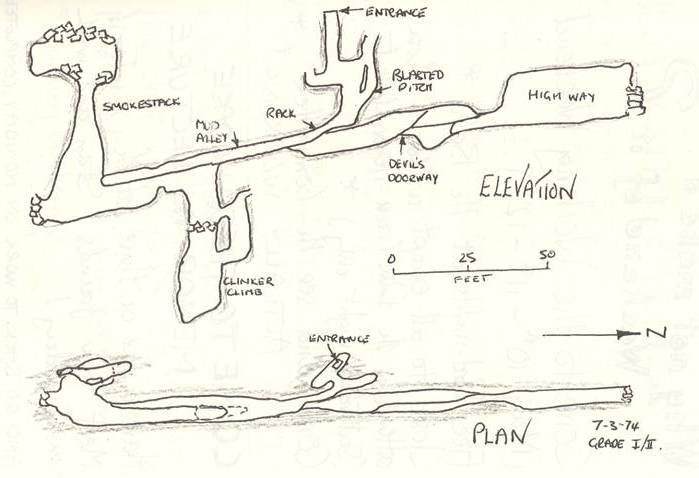
The Cave Description. Alt: 280′ O.D. Approx. Length 300′ Depth: 80 – 100′
The cave entrance is found at the base of the East Face
about fifty feet North of Box’s Cave.
It is entered through a steel gate set in concrete under
which is the first pitch, with one side made up of half 40 gallon oil
drums. This is easily climbed down to a
squeeze which drops into a small chamber. From there, one drops down the second pitch (Blasted Pitch) which,
again, can be climbed. At the Northern
end of this pitch, a passage goes nearly to the surface, but it is
impassable. At the bottom, a crawl will
be found heading in a Southerly direction. This crawl (The Rack) is six feet long and drops two feet into a larger
passage. This is the Main Passage which
goes to the north and south.
To the north, the passage soon enlarges to about five feet
square with a boulder floor, and then closes into a squeeze (Devil’s Doorway)
through stal cemented boulders. The
passage then drops down six feet to a stream sink. All this area is made up of boulders cemented
by stal. There is a large boulder
hanging in the roof over the sink which is only held up by two chocks tones –
so care should be taken.
The passage then rises, and a crawl follows over boulders in
the stream bed. After a few feet, it is
necessary to drop down into the stream bed and go through a squeeze at stream
level. From here onwards, the passage
(The High Way) is twenty feet high and three feet wide with the stream running
in the floor to a large boulder choke filling the whole passage. Care should be taken in this section of passage
as the floor is of stal and can easily be broken.
Southward from the Rack, the passage starts as a muddy crawl
then turns into a traverse on muddy ledges over a twenty foot pitch. This is Mud Alley. By chimneying down this pitch, a false floor
of boulders can be reached after which a hole in the southern end can be passed
which leads to ‘Clinker Climb’ – a fifty foot pitch in two sections which ends
at present in a choke where the stream is seen again.
By continuing the traverse, the rift floor is again reached
and from here, the passage leads to a chimney The Smokestack. This is forty feet high with a squeeze in the
middle. The whole chimney has very good
chert bands and fossils and care should be taken when climbing. The squeeze is overhanging and in loose
boulders. Digging is continuing under
the chimney in a boulder choke which is unstable and should not be entered.
Access and Notes
The cave is situated on the National Tower Testing Station,
and all access is controlled by them. Permission can be obtained by writing to the Station Manager. A maximum of four per trip is allowed. All trips are led, and it is requested that
only electrics are used. It is essential
that the tapes in the cave are not crossed as they are to protect the cave for
others.
A trip was made down the cave on the 9th February 1974 under
extremely wet conditions, and it was found that Blasted Pitch was taking a
large amount of water and that the Rack was impassable. This should be borne in mind, and any trip
arranged that meets with conditions such as these should be cancelled.
All diggers would like to thank Mr. Box for all the help and
encouragement that he has given them in opening up the cave, and it is hoped
that all cavers who visit the cave will help to maintain the good relations
that exist at the present time.
Listed below are all the people who have helped with the
dig, and the number of trips done:-
|
Name |
No. of trips. |
Hours |
|
J. Aylott V. Gray R. Collins
R. Barclay P. Carter G. Jones N. Smith F. Reynolds J. Thorpe
|
119 23 61 9 8 8 4 4 2 2 1 1 |
180 58 35 22 20 20 10 10 5 5 3 2 |
The cave is named after the late F.A. Reynolds who died
shortly after his last trip down the dig.
Why not make a weekend of it?
Come to the Working
Weekend (May 10th 11th 12th). Free
Bed-nights at the belfry *
Closed to all except
workers and those attending the Don Coase memorial Lecture (Saturday night
only)*
Come and see the
Committee ACTUALLY WORKING!*
COME TO THE DON COASE
MEMORIAL LECTURE.
Have a jar or three
at the Hunters! Meet your friends! Stay and work on Sunday!
AND GO BACK TO WORK
ON MONDAY COMPLETELY CLAPPED OUT!
Monthly Crossword Number 45
|
1 |
|
2 |
|
3 |
4 |
|
5 |
|
|
6 |
7 |
|
|
8 |
|
9 |
|
|
|
|
10 |
|
11 |
|
|
12 |
|
13 |
|
14 |
|
|
15 |
|
16 |
|
|
|
|
17 |
|
18 |
|
|
19 |
|
20 |
|
|
|
|
21 |
|
22 |
|
|
23 |
|
|
24 |
25 |
|
|
16 |
|
27 |
|
|
|
|
28 |
|
29 |
|
|
30 |
|
31 |
|
32 |
|
|
33 |
|
|
|
|
|
Across:
2. Has water twin associations on
Mendip. (4)
5. Sounds like 5 down. (2)
6. Bertie, perhaps. (3)
8. Weegie trip? (4)
10. Short-lived Mendip hole. (4)
12. Swildons Grotto not south? (3)
14.
.or N.W. (1,1)
15. Had obligations. (4)
17. First part of 33 across. (4)
19. Feature of G.B. found in Kangaroo, Zebra etc. (4)
21. Ungated? (4)
23. Correct (1,1)
24. Makes bang work in short. (3)
26. Arête this in Cuthberts for example. (2,2)
28. Reports from all quarters? (4)
30. Warm and dry and
. (3)
32. Its been this for centuries. (1,1)
33. Cats would be useful to caver. (4)
Down
2. Decided before caving? (1,1,1)
3. Once cavers staple diet. (4)
5.
example. (3)
7. Vane cave feature. (4)
9. Loosen, perhaps. (4)
11. G.B. Passage. (4)
13. Can be five or seven days, has been three. (4)
14. Stole Lane Chamber. (4)
16. One way of spelling ages. (4)
18. Write down N, S, or W. (4)
22. Hardly S.P. or S.C. (4)
25. All caves have come to this. (3)
27. Associated with buts. (3)
29. and 31. ..will
to excess (2 and 2)
Solution to Last Months Crossword
|
S |
L |
I |
N |
G |
|
C |
|
D |
|
T |
|
|
|
O |
C |
H |
R |
E |
|
U |
|
A |
|
O |
|
I |
|
N |
|
C |
A |
V |
E |
N |
A |
M |
E |
|
|
K |
|
E |
|
|
|
N |
|
A |
|
|
C |
L |
U |
S |
T |
E |
R |
S |
|
B |
|
I |
|
U |
|
Y |
|
S |
|
E |
N |
N |
U |
I |
|
|
|
E |
|
D |
|
E |
|
T |
I |
G |
H |
T |
Club Committee
The Belfry,
Rd
Chairman S.J.
Collins
Minutes Sec G.
Members M. Bishop, D.J. Irwin, D. Stuckey, G.
Oaten,
Officers of the Club
Honorary Secretary A.R
THOMAS, Allens House,
Barrows Lane
269
Honorary Treasurer B.
Clutton, Nr. Bristol.
Caving Secretary D.
STUCKEY,
Southville,
3. Tele :
Climbing Secretary G. Oaten,
Address to follow.
Hut Warden N.
TAYLOR, Whiddons, Chilcote,
Belfry Engineer M.
BISHOP, Address to follow
Tacklemaster G.
WILTON-JONES, 17 Monkhams Drive, Watton, Thetford,
B.B. Editor S.J.
COLLINS, Lavender Cottage, Bishops Sutton, Nr. Bristol.
Tel
: CHEW MAGNA 2915
Honorary Librarian D.J
IRWIN, Townsend Cottage, Townsend, Priddy, Wells Som. Tel : PRIDDY 369
Publications Editor D.J
IRWIN As above
B.B. Postal Brenda.