Any views expressed by any contributor to the Belfry
Bulletin, including those of officers of the club, do not necessarily coincide
with those of the editor or the committee of the Bristol Exploration Club,
unless stated as being the view of the committee or editor.
Contents
- 1 Mendip Rescue Organisation
- 2 Club Headquarters
- 3 Club Committee
- 4 Officers Of The Club
- 5
- 6 The Belfry Needs
- 7
- 8 Editorial
- 9
- 10 Annual Report of the B.B.L.H. & S.R.G.
- 11 The Class of 93
- 12
- 13 Grampian Dinner
- 14
- 15 Equipment for Cave Photography
- 16
- 17 A message from our Hon. Librarian.
- 18 Paul Esser Memorial Lecture
- 19
- 20 Letters
- 21
- 22 In Committee
- 23
- 24 Caves of Malta
- 25
- 26 A Decade Ago!
- 27
- 28 At the Belfry
- 29 Monthly Crossword Number 29.
Mendip Rescue Organisation
In case of emergency telephone WELLS 73481.BRISTOL
EXPLORATION CLUB
Club Headquarters
The Belfry,
Rd.
Club Committee
Chairman: S.J.
Collins
Minutes Sec: R. Bennett
Members: R. Bagshaw; D.J. Irwin;
M.J. Palmer, N. Jago; T.E. Large; A.R. Thomas; R. Orr.
Officers Of The Club
Hon. Secretary: A.R.
THOMAS, Allens House,
Barrows Lane
Hon. Treasurer: R.J. BAGSHAW,
Knowle,
4. Tel: WHITCHURCH. 5626.
Caving Sec: T.E. LARGE,
Bishopston,
Assit. Cav. Sec. R. BENNETT,
Radnor Road
627813
Climbing Sec: N. Jago,
Windmill Hill, Bedminster,
3.
Hut Warden: R. ORR. The Belfry, as above.
Hut Engineer: R.
Rose Cottage, West End, Nailsea,
Tacklemaster: M.J. PALMER.
B.B. Editor: S.J. COLLINS, Lavender
Cottage, Bishop Sutton, Nr. Bristol.
Librarian: D.J. IRWIN, Townsend
Cottage, Priddy, Wells,
Pbs. (Sales) C, Howell,
Edgbaston, Birminham.
Publications: D.J. IRWIN. Address as above
B.B. Post: Mrs. K. Mansfield, Tiny
Kott, Little
The Belfry Needs
Although we have been installed in the new Belfry for about
two years now, it is still not fully equipped. There are also a number of items which wear out and need constant replacement.
In particular, the following would be gratefully received:-
SAUCEPANS KNIVES SINGLE
MATTRESSES MUGS
Get in touch with the Hut Warden if you have any other
objects which you think the Belfry might need.
Editorial
Festive Season
As in past Christmas numbers of the B.B., some concession to
the season in the shape of allegedly humorous material has been included. We trust that those serious minded members of
the club will forgive this lapse.
Going Up!
As a result of various tasks laid on them by the recent
A.G.M., the committee have had their financial look at the state of
affairs. It was, I think, obvious to
most if not all present that the sub would have to go up. Whether or not the committee have taken the
right decision in the amount by which they have done this remains to be
seen. A more complete account of the
proceedings will be found in this B.B. Even so members can take some comfort in the fact that, over many years,
the sub has been on the right side of the inflationary spiral; and if it is now
slightly on the wrong side, it is fairly likely that future trends of further
inflation will put members back on the credit side before very long.
Images of our Club
It seems possible, judging by some of the material which has
been received lately, either praising or blaming the club that if you asked our
two hundred members what each one thought of the club, you would get two
hundred different answers. Last month,
for example, Tim hinted at a certain amount of apathy on organised trips. This month, Bob Cross puts in a plea for
more. This month again, Jock paints a
bright picture of life at the Belfry, and, no doubt, next month, somebody will
come forward with a different one. This
is not a bad thing, as the B.B. is the club is magazine and the proper place
for views to get round to a large number of members. Perhaps we might even get to the state of all
agreeing about these things!
Annual Report of the B.B.L.H. & S.R.G.
Once a year, the annual report of
a completely fictitious body creeps into the pages of the B.B. The editor apologises for allowing his other
self to disgrace the B.B. once again:!
Once more it is time for the doddering members of the Belfry
Bulletin Literary, Historical & Scientific Research Group to emerge from
their cobwebby seclusion and report on another years work.
Some time ago, as both readers who follow this ghastly
series will remember vividly; they had a measure of success in predicting the
future by means of a spereolite – or crystal ball. This would have continued had not one member,
more senile than the rest, spilt best part of . pint of rough cider all over
its surface in a paroxysm of excitement and chronic alcoholism.
Undeterred by this disaster, the B.B.L.H. & S.R.G. have
spent 1972 in growing complex crystalline devices in a little known cave, by
adding minute amounts of carefully controlled impurities to stal. The exact nature of this process is a closely
guarded secret, but is thought to include specks of cigarette ash, Cheddar
cheese and pickled eggs. The resulting
all-solid-state electronic device has been called ‘Predictor Of Trends Having
Ominous Lasting Effects Speleologically’ or, as they fondly refer to their
brainchild – POTHOLES.
Looking around for a suitably Ominous Trend, they fed into
POTHOLES all the data they could find on the subject of courses for caving
instructors. To give POTHOLES the
necessary background against which to assess the effects that a more rigid
approach to this object might have, they also fed into POTHOLES two dozen assorted
B.Bs; a pair of wet suit trousers belonging to Tim Large and two pints of
Worthington ‘E’. Giving the device a few
months to digest all this – for limestone crystals are notoriously slow – they
eventualy had the dubious pleasure of seeing (by fluorescent effects) and
hearing (by piezoelectric effects) POTHOLES version of what might well ensue in
this direction. This incredible
information they laboriously copied out onto a series of old goat skins using
quill pens, which they now offer to you for your Christmas credulity.
On, now, with this nauseous narrative.
The Class of 93
Squatting, like some collection of industrial waste and what
remains of the Mendip countryside, sprawls the
glass partitions, the cold wind howls and the rain drives remorselessly – for
it is summertime.
Inside what one might loosely call its walls, lies the main
examination hall, within which the class of 1993 sits grappling with its finals
and hoping to obtain the coveted Bachelor of Caving Instruction degree which
will enable it to indulge in lives of idleness and luxury as professional
leaders or chartered instructors.
In fact, the class of ’93 is somewhat smaller than that for
the year before which in turn, was smaller than its predecessor. A statistician would have concluded that some
factor was at work which was steadily decreasing the popularity of this course
– so vital to the public inter¬est. Fortunately, it has so far escaped the notice of those running the
university, whos Department of Statistics have been far too busy collating
useless facts to have had my time to investigate the matter.
The class of ’93, like all such classes, is somewhat of a
mixed bag. However, although its numbers
may be small, we can take comfort in the fact that they include one Noel Nowitt
– the hope of his professors and envy of his fellow students. There he sits, with his massive domed
forehead stuffed tight with unnecessary facts – bent forward, while his pen
drives steadily across the paper. It has
been confidently predicted that he will prove knowledgeable enough to lead as
many as six novices at once down a cave entirely single handed.
At the moment, he is deep in calculations, answering the
question ‘Describe in detail the measurements you would take and the
calculations you would employ to determine the most likely position for
extension of a known cave system.’
– – – – – – – – – – –
– – – – – – – – – –
Meanwhile, a few miles away, huddled round a stove which is
successfully repelling the biting cold of the summer, sit the active cavers of
the B.E.C. Their foreheads are not
noticeably domed and in their hands they grasp great tankards of foaming ale. A large, muscular lad is talking. It is Pete Pushem. He is describing the chances of extending a
passage in Cuthberts. His arguments
involve no calculations at all.
– – – – – – – – – – –
– – – – – – – – – –
Back at the
Nowitt pauses. Even he is not too sure
of the answer to this question, so high is the standard demanded of the
candidates. He reads the entire question
again. ‘Describe in detail how you would conduct a survey to C. H. G. Grade V.
(B) 4. (g) and indicate how this differs from a Grade V.(B) 4. (f).’
He wracks his brain. It is something to do with the compass. He forces his memory into action. His face clears as he writes 99 in a Grade V. (B) 4. (g) survey, a
calibration certificate for the compass as supplied by the manufacturer must be
quoted. In the case of a grade V.(B) 4.
(f) survey, however
.’
– – – – – – – – – – –
– – – – – – – – – –
But let us leave this rubbish and eavesdrop once more on the
B.E.C. A small, lithe looking man, one
Fred Ferrett, has taken over the conversation. He is discussing running a meadiumish sort of survey line to the spot
where the new dig is to start. Pushem
takes a great draught of beer and belches loudly.
With a little sigh, Noel Nowitt writes the last word on his
final sheet of paper and pushes it into the slot from whence it will go at once
to the central computer. He gets up,
noting that all the others are still hard at it, and walks quietly out of the
examination hall. Once outside, there is
time for a quick cup of coffee in the refectory. As he drinks it, he glances up at the closed
circuit television screen. The computer
seems to be taking its time. The screen
lights up. He has a First Class Honours
degree in Caving Instruction. He
finishes his coffee and goes to collect his certificate and the gear which he
will now be allowed to use. He thinks
that perhaps he might go down Cuthberts tomorrow.
By one of those coincidences without which us authors would
be hard put to spin any sort of yarn at all, Noel Nowitt arrived at the
entrance to Cuthberts the next day at exactly the same time as Pete Pushem and
his bunch of cavers. Noel, immaculate in
his new gear – looked haughtily at the scruffy looking bunch of cavers before
him. He had heard about the B.E.C. at
the university. They got away with going
underground without an accredited leader by having no novices in their
club. As long as this continued no
member of the B.E.C. could be accused of breaking the law by leading a novice
down a cave. The fact that the
membership of the B.E.C. grew slowly but steadily without any novice ever
joining it was ascribed by the B.E.C. to coincidence and by everybody else as
fiendishly clever juggling with the books.
As a fully qualified instructor, Noel could insist on
leading this ill-assorted lot, which he proceeded to do. However, since they were not novices, they
were entitled to choose the route, which Pete Pushem did by making offensive
gestures at every passage intersection. Eventually, they pushed their way through a small passage having a
rather unstable looking roof and emerged into a chamber which Noel failed to
recognise. He was about to ask why this
had not been registered when, with a fearful noise, the roof behind them
collapsed – cutting off the way back completely.
In a flash, Noel went into action. He extracted his portable
spelaeophone and erected the loop aerial. He was just about to press the speech
button when Fred Ferrett, who seemed to have panicked, lurched against him and
sent the device flying. It landed on the
rocky floor just as Pete Pushem turned to look, and crushed it with a large and
heavy boot.
There was an awkward silence, broken at last by the icy
tones of the official leader, who said in an authoritative voice, “Well,
we can’t call up the M.R.O. now, so we will have to sit here and wait for them
to find us. At least, the central
computer knows where we are!”
There was another pause, if possible, even more
awkward. Then, at last, one of the
caving band spoke apologetically. “Im afraid it doesn’t. You see, when we registered OUR trip with the
central computer, it must have been just after you registered YOURS, and the
computer reported your trip to us. I
know that I should have pressed the ADD button to get it to add our names to
yours, but I pressed the CANCEL button by mistake, so I expect it has cancelled
the whole trip, and doesn’t know we are down here.”
Noel turned pale at this news. There was no way back and nobody would come
to look for them. Pete Pushem looked at
Noel and added further information which he hoped Noel would find useful.
Even if they did decide to look, they wouldn’t look here
because we only found this passage the other day and clean forgot to register
it.
Noel received this remark in silence. He was badly shaken but still had faith in
his vast store of caving knowledge. To
quieten his thumping heart, he thought about soothing things like inventing two
more sub-sections to the C.R.G. grading system – when he suddenly realised that
he was now quite alone. In a blind
panic, he got to his feet and rushed through the chamber into a passage
beyond. Soon, he heard voices and,
rounding a corner, caught up with the B.B.C. who were sitting comfortably and
passing round a large bottle of beer. The scene aroused Noel’s indignation. His recent panic forgotten, he drew himself up proudly to his full
height and confronted the scruffy band with a steely eye.
You! he said, looking mainly at Pete Pushem, Have not
only been criminally lax in cancelling this trip and failing to report a
discovery to the proper authorities; but you have moved off without my
permission. I could have you all jailed
for this, and if I have any more lack of proper discipline from any of you, I
will report it immediately!
Go and fetch a. policeman, then!was Fred Ferretts laconic reply.
Right! I will!
snapped Noel, reaching for his spelaeophone – only to realise that it lay
hopelessly smashed further up the cave.
Have some beer! uggested Pete Pushem.
Alcohol, replied Noel, is a depressant. I rarely touch it!
Seeing that it’s a depressant, drawled Fred, why is it
that youre looking a damned sight more depressed than we are?
Noel ignored this remark, not having a suitably crushing
reply to hand, and found that the B.E.C. had got to its collective feet and was
preparing to move on.
What do you think you’re doing now? he asked with some
asperity.
Going on! said Pete. You will follow Fred here, get caving and shut up. Youre caving under B.E.C. leadership
now. Don’t worry, lad. Well get you out all right!
On they went, through what seemed miles of passages, all
completely unknown to Noel. His
companions caved without apparent effort, but emotional strain had sapped
Noels stamina. At last, in a difficult
squeeze, he found him¬self stuck, and paused for a moment.
Are you stuck? asked a voice behind him.
Noel replied that he was taking an opportunity to study rock
formation in the squeeze.
You look stuck to me! came the voice again, with what Noel
considered a rather offensive ring in it. Noel decided to ignore it, and remained in the squeeze. Suddenly, a violent burning sensation
affected his rear and he yelped and shot forward out of the squeeze. He turned round, to see a grinning man waving
a carbide lamp. Noel had never seen a
carbide lamp in action, and he started stupidly at it until it dawned on him
what had been done.
You burned me with that thing! he finally spluttered. I trust you are not deeply hurt! was the
only reply he got.
Now Noel seemed to settle into a kind of continuous nightmare. It went on and on until he lost all notion of
time. Even when he finally saw the
bluish light ahead, he failed to realize that it was daylight. He found he was walking in a sort of daze
down a lane surrounded by the ever-cheerful B.E.C. Even now, his humiliation was not complete.
They came to a pub and went straight in – just as they
were. Noel was so worn out that he had
ceased to care and just sank gratefully into the nearest chair. Still in a daze, he drank the pint that was
offered to him. After a few repeats of
this performance, he began to relax. They were not bad types really, he thought. After all, they had got him out of a nasty
situation. To his amazement, he found
that he had got to his feet and was speaking.
It’s my round, I think Whatll you have? he seemed to
hear himself say.
Much later, Noel had a dim recollection of being half
carried along, and later still, he woke up in what seemed to be a. rapidly
revolving caving hut. The motion upset
him so much that he became violently sick. This upset him even more, and he was violently sick again. He heard a sleepy voice say, That’s right,
lad! – Fetch your boots up! before he once again collapsed into a deep stupor.
– – – – – – – – – – –
– – – – – – – – – –
Very late the next morning, he woke up. The hut was now quite deserted, the B.E.C.
having gone away on its own mysterious business. Beside his bunk someone had put a thermos of
hot coffee; three aspirins and a note. Before attempting to focus his bleary eyes on the note, Noel let the
coffee and aspirins do their work. At
last, he felt fit enough to read the note, and saw that the writer had
thoughtfully written it in large letters. It was brief and to the point. DON ‘T WORRY LAD, WE WON’T SAY A
WORD. BEST OF LUCK! and, in small
letters underneath, P.S. It’s your
round.
– – – – – – – – – – –
– – – – – – – – – –
The news that their star pupil had refused all the lucrative
offers of jobs as Caving Instructors or Leaders, and was proposing to sell all
his worldly goods and become a missionary in Shepton Mallet, shook the
university of Charterhouse to what might laughingly be called its
foundations. The professor shook his
head in bewilderment and opened two letters that he had been carrying
absentmindedly about with him for some time. They were both from prospective students for the degree in Caving
Instruction. Both had written to say
that they had now changed their minds. One was going to become a bus driver and the other a builders labourer.
– – – – – – – – – – –
– – – – – – – – – –
Meanwhile, in a little known byway in Cuthberts, the B.E.C
were having a busy day. With levers and
screw jacks, they were lifting boulders and positioning them carefully in the
roof of a certain small passage. Under
the keystone they had propped a steel bar coated with fibreglass and looking
very realistic. From this arrangement, a
steel wire ran over pulleys. Pete Pushem
was talking.
You’d better put a bit more grease on them pulleys,
Fred. I thought I was never going to get
those rocks to fall down yesterday!
Fred nodded. They
say there’s been two more cancellations at the university today!
Pete Pushem grinned, and patted the prop like he would a
useful and friendly dog.
It’s all set for the next customer, Fred!
Good. replied Fred Ferrett. We made a profit on the last one, by the
way. He bought two more rounds than his
fair whack when he got tight!
– – – – – – – – – – –
– – – – – – – – – –
The B.E.C. was, as usual, winning.
Grampian Dinner
From MIKE PALMER comes this epic
tale of dinner going with a seasonal flavour.
Some of the nomadic B.E.C., along with three members of the
S.M.C.C., made the trek to Sutherland for the Grampian Dinner on the 18th of
November this year. The dinner was held at the Inchnadamph Hotel.
The journey was started on Friday, and broken in
Manchip and to lubricate dry tonsils. Here, we were met in the evening by Pope and Janet. As might be expected, one or two ‘jars’
turned into a ‘multi-pinta’ drinking session which was brought to a sudden end
at 10 pm by the ridiculous licensing laws of
mass of B.E.C. and Grampian members trying belatedly to top up radiators with
anti-freeze and to get the +”@&?% things started.
Apart from the car in which Manchip, J. was travelling in,
all vehicles arrived at Ullapool by mid afternoon. John’s conveyance persisted in boiling every
thirty miles or so due to loss of water, but despite this obvious hazard, John
and friends did eventually arrive.
A final dash was made to the hotel, calling in at the
Grampian hut en route to shout abuse at Butch, Milch and Bob Mayhew – whom it
appeared had just returned from caving, – but then the Shepton always look like
that!
Because there was no A.G.M. (would you believe that?) to
keep everybody busy until dinner time, those present retired to the bar. The atmosphere was great and since there were
so many faces from Mendip present, it was just like a Hunters evening – only
much, much colder.
Towards dinner time, who should appear from behind the bar
(the normal route of access on these occasions) but SNAB and his wife.
The food was excellent, hot, and plentiful and the
proceedings only lowered themselves to the tone of a caving dinner when Milch
(the guest of honour) was called upon to make a speech on behalf of the
guests. The speech was like something
out of Tom and Jerry, being punctuated by the odd slurp of beer and
unprecedented belches.
Later in the evening the drinking orgy continued and the
rather hallowed residence was shattered by Mendip songs which, surprisingly,
didnt raise any objections from the proprietors, despite persistent use of
‘they words’!
John Manchip retired early, being incapable. Pope and wife retired early because they
werent tired enough. Phil Kingston was
left passing out on the lounge floor, and Pat and I went to bed because we
couldnt remember any more songs.
The next day, Sunday, was really magnificent and after a
very fortifying breakfast (which was a near repeat of the dinner except for the
speeches) the BE.C. contingent went sightseeing. All the mountains were covered in snow and
looked very impressive – particularly Quinag and Suillvan, as we drove to
Lochinvar and then to the beach at Stoer.
Plans were made for future trips in the spring, when it is
intended to walk; drink; cave and possibly canoe. Canoeing on the lochs will probably require
permission, but it is intended to find out more details early next year.
For those people who think that such an expedition is a
little insane at this time of year, I can only say that the experience is your
loss because the whole of the area is truly magnificent.
It was reported that Milch never emerged from his bag,
except for a honk, until late on Sunday disgusting!
The return journey was quite eventful in that we drove
through a blizzard; floods and high winds and it was often questioned whether
this might be considered the ultimate in dinner going!
Equipment for Cave Photography
Having more space than usual this
month, we are printing the entire remaining portion of ALAN COASES paper on
photographic equipment for caving.
Readers of the September B.B. will recall that in that
B.B. Alan dealt with Transport and
Protection of photographic apparatus for caving, camera supports and flash
equipment.
FILM
This is very much a matter of personal choice, there being a
very wide range of suitable material, especially in the black-and-white range.
In the colour field, distinction must of course be drawn between reversal
(transparency) and negative (print) films. The latter group is very small and very limited in speed range, viz. the Agfacolour products from 40
A.S.A. (CN 17) to 80 A.S.A. (CN 5) which encompass the range which also
includes Kodacolour X (50 A.S.A.) and Prinz Colour (64 A.S.A.). Artificial light variants are not, in fact,
mentioned at all as their application in cave photography is limited. Further details of these and other available
colour films can be obtained in the colour review published in Amateur Photographer
each year.
The range of colour reversal films is much wider and it is
not intended to describe them all. Most manufacturers produce a basic stock of
50 or 64 A.S.A. which provides a reasonable general purpose film for cave
photography. Except for close ups
however, I prefer to use a faster speed. Two particular manufacturers specialise in the production of these,
notably Kodak, whose High Speed Ektachrome (160 A.S.A.) is in my experience an
excellent film for caving use, and Anscochrome, whose high speed range includes
200 and 500 A.S.A. material. These I
have also used very satisfactorily, although in using 500 A.S.A. one is either
confined to very large chambers or passages or to very small light sources. Both makes, like Ferrania (50 A.S.A.) can be
home processed with a considerable saving in cost. On this point, Amateur Photographer suggests
that the normal processed cost per slide of High Speed Ektachrome is 1/5. (This article was originally written in 1969
and I have not considered it worth translating into our present damm-fool
monetary system because of the general rise in prices since Alan wrote this
paper. The figures will, presumably
still give a relative guide. Editor.) That for Anscochrome 200
is 1/1d and for the 500 A.S.A. it is 1/9d. Costs with home processing are hard to estimate, but it is worth noting
for the budget conscious cave photographer that costs can be reduced to about
8d per slide for the 50 A.S.A. Ferrania material. Ansco also supply their 64 A.S.A. stock in
bulky easy loader, which I found lives up to its name. This cuts costs considerably in conjunction
with their home processing kit. (For
comparison, the normal range of costs per slide varies from 10d (Perutz) to
11½d (Agfa colour CT 18, Kodacrhome II and Kodachrome X) while Boots Gratispool
and Prinzcolour cost about 8½d to 9d. per slide processed.
CAMERAS.
In selecting a camera for use in a cave, personal opinions,
differing objectives and basic economics all play a large part. However, such a camera clearly needs to be
portable, have flash synchronisation, a good viewfinder and be reasonably
reliable and robust. Simplicity of
equipment may also be regarded as a virtue as it generally implies compactness,
but on the other hand the serious worker may be more interested in
versatility. The accompanying table on
the next page, is an attempt, inevitably subjective, to classify cameras
initially by film size and secondly by interchangeability of lenses, and to
assess their suitability for the requir¬ements of cave photography. The three point scale out¬-lined is selected
purely for the sake of simplicity and clarity; there are many points at which
some overlap exists and there are probably several assessments with which other
users would strongly disagree. However,
in presenting such a table I feel some of the conclusions of choice facing
present and future cave photographers may be presented in a fairly simple
manner and that it will help in the remarks given below. I should add that at no point in the table is
any assessment of quality or value for money implied. No consideration has been given to plate or
large format cameras.
Compactness, low cost and simplicity are the chief
advant¬ages of the cartridge loading cameras. Many also have a built-in rotating flashcube socket and offer much as a
basic caving camera. They are, however,
limited in format and in the availability of cartridge films. The latter point does not apply to half frame
cameras, for all 35mm cassettes will fit them. They are also very compact and economical with film. However, their format is also limiting and
special mounting, projection and enlarging facilities are often necessary. With the introduction of really compact full
frame cameras, one advantage has disappeared, leaving only their ability to
offer twice as many negatives or slides as a normal camera. In caving circles, this may be regarded as a
mixed blessing!
One particular half frame does deserve fuller
attention. This is the Pen F/Ft range, a
unique single lens reflex. It has a full
range of interchangeable lenses and accessories and a rotary shutter which
permits full synchronisation. It is of
course much smaller than any full frame single lens reflex camera, although
costing much the same.
|
Film Size |
Camera Type |
Size & Port |
Viewing |
Synch |
Versitility |
Application |
Cost |
Remarks |
||
|
|
||||||||||
|
Basic/Gen/Adv |
||||||||||
|
Cartridge |
Instamatic |
1 |
2 |
2 |
3(1) |
1 |
2 |
3(1) |
A(C) |
#1 |
|
|
Half Frame |
1 |
½ |
2 |
3 |
1 |
1 |
3 |
A/B |
#2 |
|
|
Pen F/FT |
1 |
½ |
1 |
1 |
1 |
1 |
1 |
C |
#3 |
|
|
Fixed Lens |
½ |
2 |
1 |
3 |
1 |
1 |
3 |
A/B |
#4 |
|
|
I/C Lens |
|
|
|
|
|
|
|
|
|
|
35mm |
rangefinder |
½ |
½ |
½ |
1 |
2 |
1 |
1 |
A-C |
#5 |
|
|
I/C/ lens |
|
|
|
|
|
|
|
|
|
|
|
reflex |
2 |
½ |
2 |
1 |
2 |
1 |
1 |
B/C |
#6 |
|
|
Nikonos |
|
|
|
|
|
|
|
|
|
|
|
Calypso- |
½ |
1 |
2 |
3 |
1 |
1 |
3 |
C |
#7 |
|
|
Nikkor |
|
|
|
|
|
|
|
|
|
|
127 roll |
Twin Lens |
1 |
2 |
1 |
3 |
1 |
1 |
2 |
B |
#8 |
|
film |
reflex |
|
|
|
|
|
|
|
|
|
|
|
Twin Lens |
2 |
2 |
1 |
3 |
1 |
1 |
2 |
A-C |
#9 |
|
|
Reflex (fixed) |
|
|
|
|
|
|
|
|
|
|
|
Twin Lens |
|
|
|
|
|
|
|
|
|
|
120 roll |
Relfex (I/C) |
3 |
2 |
2 |
1 |
3 |
2 |
1 |
C |
#10 |
|
film |
S/H/ folding |
|
|
|
|
|
|
|
|
|
|
|
I/C single |
1 |
3 |
1 |
3 |
1 |
1 |
2 |
A |
#11 |
|
|
lens reflex |
3 |
½ |
⅔ |
1 |
3 |
2 |
1 |
C-C++ |
#12 |
KEY: 1 = Good. 2 = Average. 3 = Poor. A = Low cost (under £25). B =
Moderate (£25-£50).C = High (Over £50).
ABBREVIATIONS: I/C =
Interchangeable lenses. S/H = Second
Hand.
#1 A wide range
exists including interchangeable reflexes. Film scratch proof.
#2 Economical on
film. Compact.
#3 Reflex with I/C lenses.
#4 Some have
semi-wide angle lenses. Limited number
covering wide price range, viz. Leica-Zorki.
#5 Very wide
range. Very versatile.
#6 Choose good lens
range.
#7 Worthy of own
column as only designed for rough use.
#8 Price A second
hand. Film may decrease in availability.
#9 Wide price range.
#10 One make (Mamiyaflex). Good range of lenses. Versatile.
#11 Only second hand. Very compact.
#12 Generally bulky and very expensive.
The increasing trend towards compactness in full frame
models is seen at its most extreme in the Rollei 35. This is smaller than many half frames, but
such miniaturisation does demand a high price (just over £100). A very similar Japanese compact is the
Petri-Colour 35 which costs about two thirds of the Rollei’s price. Both are magnificent little cameras with
slightly wide angled lenses (40mm) though of differing apertures. Fractionally wider lenses do exist on a
number of readily available compacts, 38 to 40 mm being apparently an optimum
size. Few, if any, possess coupled
rangefinders, though this is partially compensated for by very clear bright
line viewfinders. One word of warning is
necessary. With the increasing trend
towards automation evident in cameras as well as in flashguns, some new
introductions are fully programmed i.e. totally linked to the exposure system
and without a manual override. Some also
have a simplified (?) flash system where a guide number is obtained in
conjunction with distance and/or aperture. No doubt, a certain amount of wool could be pulled over the machine’s
eyes (cogs?) but for caving purposes the photographer’s cont¬rol over his
lighting must be absolute and such cameras should be avoided.
One camera in this compact class that does, at least on
paper, seem worthy of note is the Kowa SW. This possesses what I regard as the ideal focal length for a 35mm camera
at 28mm. This has considerable depth of
field, so there is a greater justification for the absence of a range
finder. It is not a reflex, though its
viewfinder is claimed to have a viewing angle identical to the taking
lens. Although roughly 25% larger than
the Rollei 35, it is only fractionally bigger than the average half frame. Despite strenuous efforts I have not been
able to obtain one from abroad (they are not marketed in the
70 dollars and do seem to have many of the attributes of the ideal fixed lens
caving camera).
In view of the prices already quoted, the interchangeable
335mm cameras offer much in terms of versatility. They can broadly be divided into two classes;
the rangefinder and the reflex.
The first is a comparatively small group, but includes the
Leica family, one of the most famous and reliable of all cameras. The Cannon range offer some superb lenses often
with very wide apertures (e.g. fO.95) while the Zorki typifies many Russian
imports in being heavily subsidised and so offering excellent value, albeit the
designs are sometimes equally heavy and rather dated. Another interesting member of this group is
the
which can occasionally be obtained with its attendant interchangeable front
element lenses for a very reasonable price.
The reflex group is extremely large, a reflection of current
popularity. It is worth noting that some
have non-interchangeable lenses, but this is really self defeat¬ing in view of
the loss of versatility. Indeed, the
price range is now so wide that quite excellent reflexes may be obtained now
for considerably less than the price of many of the programmed compacts. Before choosing, it is as well to check that
a wide variety of lenses etc. are available. Thus I find that the Miranda range are very good as, quite apart from
other advantages, their optics are extremely good; they are very reasonably
priced compared with other manufacturers lenses, and all offer a good maximum
aperture. Similarly, the Praktica range
is very robust and offers good value as well as taking a very wide variety of
screw fitting lenses. Numerous other
models exist higher in the price ranges – Pentax, Nikon/Nikkormat, Topcon all
being of particularly high quality, some with metal bladed focal plane shutter
affording higher electronic flash synchronisation speeds.
At the lowest end of the price range, mention of the Exa 500
is also pertinent. This fully
interchangeable camera is currently available with a fully automatic f2.8 lens
for less than £25, while £35 brings a Tessar F.A.D. as standard. This is excellent value for a very compact
reflex, for which a large number of accessories are available.
Within the full frame 35mm group, a further camera exists
which deserves special mention. This is
the Calypso-Nikkor II (and its predecessor, the Nikonos) for apart from its
three-figure price tag (which might well be justified if used for diving as
well as caving) it could be regarded as the ideal caving camera. It is fully waterproof and built specifically
to withstand rough or gritty conditions. Furthermore, the controls are easily read and it has an admirable
viewfinder and a 35mm wide angle lens. The latter is interchangeable with a 28mm underwater lens, but
unfortunately, the rumoured 85mm short telephoto lens does not seem to have
materialised, for it would greatly increase the versatility of this excellent
model. One other drawback does seem to
exist in that synchronisation and tripod sockets appear to be effectively the
same. This however, I have not been able
to establish on the new model though the importers have promised the
opportunity to assess one in the near future.
In moving this assessment into the roll film sphere, two
particular disadvantages emerge. The
average roll film camera provides for 12 shots per film, and reloading roll
film underground can be a rather more difficult process. The film is also rather more prone to
scratching. Admittedly, some cameras can
be obtained which provide 16 frames on 120 film, and newer cameras are being
designed to accept 24 exposure 220 film. This, however, is difficult to obtain and currently limited to one black
and white stock.
The principal advantage of the format is, of course, its
large negative size, which may well be essential for advanced workers. This in turn implies that all such cameras
are heavy and bulky. This is not really
true of the basic twin-lens reflexes. Certainly those using 127 film, i.e. the Yashica and Rollei 44
(second-hand prices about £15-£20 and £35-£40 respectively) are extremely
compact and have the additional advantage of producing colour slides
(super-slides) that can be projected on 35mm equipment. Even their larger relatives using 120 film
and producing Gem x Gem format (with optional 35mm kits available) are at least
as compact as many current 35mm single lens reflexes. Their waist level viewing system (and
reversed viewing) does have difficulties, notably a greater propensity to steam
up, but they are excellent cameras in many ways and worthy of
consideration. None of those mentioned
have interchangeable lenses but for caving purposes it is worth mentioning the
special wide angle Rollei. This
unfortunately is no longer produced, but its value and reliability are
reflected in the high second-hand prices (about £150) that it commands. Its 55mm lens is especially suited to our
purpose, although its max. aperture of f4 may be rather marginal. (There is also – as with all Rolleis – a
direct vision viewfinder in the hood.)
When moving into the ranks of the interchangeable lens roll
film cameras, one moves up both in bulk and cost. The Mamiyaflex is the only interchangeable
twin lens reflex. Although it has a wide
range of lenses and accessories and is modest in price compared with the single
lens reflex of its format, it is still an expensive item. These latter are an increasingly numerous
breed but they are bulky, generally have slow synchronisation speeds and, in
some cases, prices are astronomical. Until recently, it was impossible to obtain one much under £200 but
although the Japanese and Russians have entered the market with Budget
models, the Kowa 6 and the Zenith 80, list prices still start at approximately
£150.
To come down to earth in this format is to suggest that
perhaps the best values are the folding 6 x 6’s that are now only available
second-hand. These reached their peak
immediately before and after the war years and their advantages are fully
outlined in British Caving. Most
models have full synchronisation (including a built-in delayed action device)
and many have coupled rangefinders. Finding one with a good viewfinder for cave purposes is a little more
difficult although some were fitted with optical and some with folding bright
line viewfinders. Condition is an
important factor in buying second-hand, but excellent value can be obtained for
about £10, while £20 to £25 should suffice for the later models of the super
Ikonta class.
LENSES
Considerable attention has already been paid to the subject
of lenses. With fixed lens cameras, the
trend towards the wider angles available in the new 35nm compacts has been
pointed out. In the reflex 35mm field, I
have stressed my preference for a 28mm objective as the basic one for cave
work. This is because, in addition to
having m angle of view of about 75O, it also possesses a very broad depth of
field, so that a considerably larger band will be in focus than with a standard
lens. Wider lenses do exist, but
distortion becomes very apparent from 25mm upwards, although with fish-eye
lenses, this is often the prime objective. The 35mm lens is a good normal wide-angle having the advantage of all
angle of field (about 650) shared by most flashguns. With a 28mm lens or widerit is usually
necessary to fire the flashgun from behind the camera or obliquely across the
area being photographed or to use multi-flash techniques to illuminate the
whole scene.
To supplement the wide angle, I find a short telephoto lens
(say from 85 to 105nm) more useful than the 50-55 mm standard lens. This allows selective framing of scenes
slight imposition of different planes and, where necessary photography of
inaccessible features. Lenses longer
than 105mm tend to be of limited value except for exceptional circumstances.
Translating such lenses to the 6 x 6 format, one would be
selecting focal lengths of approximately 55mm (28mm equivalent), or 65mm (35mm
equivalent) and 180mm (nearer to 135mm than to 105mm). In half frame terms, the PenF/Ft is the only
camera to offer a really wide choice, although some members of the Cannon Demi
range offer a slightly wider than average standard lens and interchangeability
with a moderate telephoto.
An increasing use of tele-converters on interchangeable
lens cameras is also apparent. These
have particular advantages underground, although it is stressed that some loss
of quality is suffered with any supplementary equipment, particularly at short
focal lengths. These converters double
or treble the focal length of the lens without altering the closest focussing
distance. The reduction of the apertures
from 2x or 3x (i.e. from a maximum of f1.8 to f3.6 or f5.4 to a minimum of say
f16 to f32 or f48) has both advantages and disadvantages. It is particularly useful where using
close-up flash to be able to shut down the aperture well below the normal
minimum, but it is some-thing of a disadvantage to be reduced to a maximum
aperture approaching f4 or smaller. As
with prime lenses, it is desirable wherever possible to retain automatic lens
facilities, which most current converters offer for very little more than the
non-automatic versions.
MISCELLANEOUS EQUIPMENT
Several of the items mentioned here might equally come in
the section on the camera or on protection. Three in particular are concerned with protection and cleaning of the
lens. The simple rule here is
DON’T. At least, not underground! Fit a. UV or Skylight filter permanently to
your lens and clean THAT. It is best
done by first brushing off any grit and then cleaning with a suitable
cloth. I find the Calotherm cloths of
particular value, for they also minimise condensation and can also be used for
cleaning the viewfinder. The small hand
towel which I always carry is intended for the hands rather than the
camera. Another aid in this respect is
to use polythene gloves when handling the camera.
CONCLUSION
In conclusion, I would like to repeat my earlier observation
that the nature of one’s objectives; the state of one’s finances, and the
nature of the caves one is most interested in clearly play a major part in
selecting a camera. If cave photography
is merely an occasional aside from normal work then almost any existing camera
can be utilised for the purpose. If one
is selecting a camera specifically for caving but is financially limited, a
wide choice exists, particularly in the second-hand market.
If selecting for research or publication purposes, format
may be an important factor. I have found
personally that 35mm material is readily accepted for press purposes and that
the versatility and compactness of a 35mm reflex outfit (currently a Miranda G
body; 28mm 208; 105mm 2.8 auto lenses) is an invaluable combination for
advanced work, while a 120 roll film super Baldax with a coupled rangefinder
provides an excellent ‘trip’ camera. Possibly I would find the Kowa SW even more satisfactory in the latter
role, while a Calypso-Nikkor II with 35mm and 85mm lenses might fulfil most of
the requirements for advanced photography and at the same time relieve the
problems of internal disintegration and cost of regular cleaning. This prompts a final word – wherever you go
for a camera, dont choose a fellow caver!
Alan Coase.
A message from our Hon. Librarian.
The National Caving Association has produced a Handbook of
Equipment suppliers. We have only one
copy at the moment which is in my possession. Until we have a copy in the Library, I shall endeavour to answer any
queries by return of post.
*****************************************
The committee would like to thank Garth Dell for his gift of
assorted karabiners, links, chain, etc.
*****************************************
Sub-Committee On Voting Procedures
This consists of Mike Palmer as Chairman, Alan Thomas, Joan
Bennett, Nigel Taylor and Barry Wilton. Send YOUR views on this subject to any
of them.
Paul Esser Memorial Lecture
OLIVER LLOYD sends in this
notification of a lecture which might be of interest to members of the club.
This is an annual lecture given in the
on some subject connected with one of the water sports, caving or
mountaineering. It is in memory of Paul
Esser, a medical student who lost his life while cave diving in Porth yr Ogof
in February 1971 and who was particularly interested in those sports.
The next lecture will be given on Wednesday, 14th February
1973 at 8.15 pm in the Tyndall Lecture Theatre, Department of Physics,
by Professor W.R Keatinge, who is Professor of Physiology at the
on the subject Hazards of Cold Water.
Professor Keatinge was studying the cardiac and repitory
reflexes to cold water on the skin in
so became well qualified to study the effects of the Lakonia disaster of
December 1963. This ship caught fire in
the
crew and passengers, a large number of whom died in the water. Professor Keatinge was able to show that the
principal cause of death was not drowning so much as cold exposure.
I met him at a symposium on “Exposure and
Survival” held at Loughbough in 1967 and immediately appreciated what a
good lecturer he was. He continued his
study of the effect of cold on survival at
and at the
attention to some of the reasons why people were unable to swim in cold water.
The relevance of all this to swimmers, canoeists and divers
is obvious, and climbers and cavers are becoming increasingly aware of them
too. Club members should find the
lecture both interesting and relevant.
Letters
BOB CROSS sends us his point of
view about organised trips to various parts of the country
I would like, through the medium of the B. B., to express
some long-felt opinions about the organisation of club meets off Mendip.
We hear; speak and read a lot of facts and figures about
Belfry costs; library books, voting procedures etc., etc.; but now let us cast
our minds over the nitty-gritty of an Exploration Club – the incidence and
variety of club activity and the support it gets – the very thing which, I
hope, makes us want to belong to the club.
Over the past few years, organised trips off Mendip, with a
fair number of participants, have been conspicuous by their near absence. This is due mainly, I would say, to a degree
of apathy and lack of skill on the part of both our Caving and Climbing
Secretaries.
By ‘organised’, I mean well advertised meets drawing
positive support from all groups within the club. It is no good to have little elitist groups
going off in twos and threes. What is
needed is a group spirit, and a set up where everyone has a chance to
participate, whether he or she is a tiger – wanting to dance up hard severes or
someone simply content to amble over ridges. In short, we ought to be considering all interests; age groups and
capabilities within our membership. Good, memorable, club trips have to be well planned – they do not spring
from chatter in the Hunters the weekend before!
There are four main headings for consideration here. Venue and campsite; Transport; Food and
Equipment and Notification.
When you go away on a club trip, it is best if you all camp
or stay at the same place – then everyone knows what everyone else is doing and
there are no delays. Camping is a cheap,
healthy and enjoyable means of getting into the mountains or moorland. Most farmers will react favourably to a
politely written letter, and on several occasions, I have found pleasant
campsites far from the squalor of places like Wall End, Langdfale and Skirwith
Farm, Ingleton – often with great privacy; fresh milk; water and eggs and
costing little simply by adopting this approach. An amusing scene took place at a farmhouse in
year. I went to the farmers wife to
purchase some eggs and was amazed when she explained timidly that she did not
know what to charge. Needless to say, I
got a bargain!
Some folk do not possess a tent. This is natural, for they are expensive and
not used often enough to justify forking out for one – especially if you have
only just left school and havent much money. Why doesnt the club purchase a large one to cater for such people? I borrowed one recently for a club meet –
again to
bodies sleeping in it. Grand fun,
practical, and space saving.
Naturally enough, people dont want to camp during the cold
winter months, but this should not deter things. I remember a great weekend spent with the B.E.C.
in some cottages belonging to a certain hostelry in Eskdale,
by the time we’d burned half the furniture on the fire!
Where can we go? The
Severn Bridge, the M5 and M6, northwards to Scotland and soon to bore into the
depths of Devon and Cornwall, brings the magnificent caves of South Wales; the
terrific rock climbing of North Wales and the classic fell walking of the Lake
District together with the tough severe potholing of the Dales and the gentler
charms of the Peak District all within six hours driving from Bristol. There really should be no lack of enthusiasm
amongst members!
Everyone has a car, so that should be no problem? Rubbish; when I started as a probationary
member, I had Shanks Pony and little money, and I am sure that there are
plenty of members in similar positions now. When people get together and either pool their car space or hire a
minibus, costs are sliced. More beer
money in other words!
Troops cannot march without plenty of good grub.
“Glue” packeted soup; “Bullets” tins of beans and other
pre-packaged foods are no good for ravenous ‘potters’ or ‘rock hoppers’
returning after a hard day on, or under, the mountain.
Good grub, bought cheaply in bulk at supermarkets is far
better than fodder bought at exorbitant prices in villages and again, when
people cater collectively, costs are slashed.
By far the best means of cooking in the wilds is the Primus
stove. It is ridiculously cheap, ultra
efficient, and knocks spots off camping gas. Again, not everyone can afford one but I am sure it is not beyond the
means of a club like ours to purchase, say, two double burners for use on
official club trips.
Notification speaks for itself – or does it? There are four good channels for notifying
members of forthcoming events. Notices
in the B.B.; The Hunters; the Belfry and the Seven Stars. The notices must contain details of the
venue; the date; the rendezvous; the activities and the transport arrangements
and a rough estimate of the cost. The
people are left in no doubt as to what to expect.
Some of the suggestions I have made will cause people to
disagree and maybe even to put pen to paper to pour scorn on what I have
written. Good! Let’s have a rousing argument. I feel that it is the sort of thing that
should fill our columns – then we can throw all the other verbage out of the
Editor’s window and “Get deep down to things “.
Editor’s
Note: Any
replies, particularly constructive ones, will be very welcome. The subject of organised meets is one of long
standing, and perhaps something we should pay more attention to stimulating.
*****************************************
There being no replies to the advertisement for a BELFRY
ENGINEER, the committee elected the only volunteer to come forward at the
December Committee Meeting – Rodney Hobbs – who has thus been co-opted to the
committee as Belfry Engineer.
In Committee
No apologies are made for the length of this feature. The subject is one a great importance to
members, and the Editor feels that all should know how this decision was taken.
The main feature question of the December committee meeting
was the question of club finances. All
the officers had been asked to provide facts and figures, and come to the
meeting well prepared.
It soon turned out that two of the largest spenders – The
Belfry and Caving Publications – confidently expected to pay their own way in
1973 and would need no money from club funds to subsidise them. This left expenditure to be financed on the
B.B. (faced with rapidly rising costs and unable to make more than marginal
savings without reducing size, frequency or quality) on Tackle (which has been
deteriorating of late and now needs a fair amount of money) on Secretarial
expenses (necessary postages, paper etc.) on subscriptions to other bodies; on
urgent repairs to the Tackle Store roof (a capital, not a running cost, so one
which does not come out of Belfry funds), and on small amounts required by the
Caving and Climbing Secretaries and the Hon. Librarian.
The arithmetic soon revealed that the clubs income was not
going to meet the clubs expenses in 1973, even with some pretty drastic
economies all-round. An increase in the
sub was the only answer, but by how much should it go up? This had to be decided by the committee there
and then, since subs are due in January and some notice has to be given before.
Some members of the committee were in favour of the minimum
amount necessary to balance the books, while others were in favour of a sub
which could allow the club’s facilities to be improved in line with recent
years. A long discussion took
place. Most of the points which came out
are set down as follows:-
If the 1945 sub is taken as reasonable (it was 10/- then)
inflation would make this somewhere between £1.50 and £2 today. Our present sub is less than this and the sum
mentioned would only get us the 1945 facilities – and present day members
expected rather more than did the members of thirty years ago. However, the membership is now three times
what it was then, and so one would expect a more efficient use of money, and thus
a lower relative sub. Against this, it
was argued that the club has grown because of improvements, and that these
should be kept going. Older members were
more liable to object to an increase other than a minimum one, and these people
are the ones on whom we have relied heavily in the past. On the other hand, nobody objected when the
sub was doubled a few years back – but then this was to pay for the new Belfry and
so on.
Eventually, a resolution was formally proposed and seconded
by two committee members suggesting a sub of £2.50. An amendment was proposed and seconded making
the sub £2.00. A vote on the amended
proposal was defeated by one vote, and a vote on the proposal in its original
form was then acceptted with one abstention. The annual subscription due on January 31st will thus be £2.50 and all
other subs go up in proportion.
Some editorial comment on the above seems to be called
for. The increase, which now makes our
club one of the most expensive en Mendip is made up of two parts. That which we had to have to pay our way (a
£2 sub) and the EXTRA 50p which the committee felt was necessary to be able to
keep the B.E C. on a suitably upward path. It is this 50p which is, if anything, a bone of contention.
Younger members, not on the committee but present at the
meeting were in favour of the extra 50p. Older members, with heavier commitments, may not look on it with the
same degree of enthusiasm. I would,
however, urge such members not to contemplate taking any drastic steps. Inflation will, no doubt, soon cut it down to
size and, if anybody feels strongly about a policy of budgeting for a surplus,
it is of course possible to constrain future committee action at an A.G.M. and
thus avoid future increases over and above those due purely to inflationary
trends. Life members on the committee
were evenly split on the vote for or against the extra 50p. The views of members on this subject will, of
course, be welcome in the B.B.
Caves of
Malta
PETE MILLER sends in this article
which seems appropriate in this wet and windy season to remind us of warmer
caving climates
the largest of a group of islands in the middle of the Mediterranean about 60
miles from
up almost entirely of limestone, which rises to a height of 800 feet above sea
level. Two main kinds of Limestone are
found in
and these are known as the Globigeria and Coralline limestones. The basic stratigraphy of the rock shows a
layer of 250 feet of Upper Coralline at the top, followed by thin layers of
greensand and blue clay. Below that is a
layer 200 feet thick of Globigeria and finally at least 500 feet of Lower
Coralline. The tendency is for water to
percolate through the semi-crystalline Upper Coralline limestone until it
reaches the impervious layer of clay. The water then emerges as springs.
There are many caves on the island, though few of them are
of any great size. It would seem
pointless to list every small rock shelter or sea cave, and only caves of
some importance are mentioned.
The most important cave in
is Ghar Dalam (
rich deposits of animal bones including dwarf elephants and hippopotami – were
found. These are now housed in a museum
near the entrance. This cave also
produced important remains of the activity of prehistoric man. The cave consists of a passage 20 feet across
and 181 high which runs straight in to the hill. The first 200 feet is artificially illuminated,
but it is possible to continue for a further 500 feet, although the main
passage divides into smaller and muddier ones which are eventually blocked by
unwashed clay.
Close to Ghar Dalan is another cave which I understood to be
called
the translation from the Maltese. At the
entrance to the cave were snakes and lizards and about fifty feet inside the
cave is a chamber which contained, without exaggeration, at least a thousand
bats. It was obvious from the deposits
on the floor and roof of the chamber that the bats had been there for a
considerable time. Unfortunately, we
disturbed the bats as we passed through the chamber, and they accompanied us
during our subsequent exploration of a boulder ruckle and a muddy climb into a
passage which led back to the bat chamber.
It came as some surprise when I visited
again a week later to find there was not a single bat in the entire place. This same day I visited another cave three
miles away known as Ghar Hassan. The
entrance to this cave is high in a cliff overlooking the sea but is easily
reached by a path. The cave consists of
a high main passage with numerous side passages leading off at right
angles. As I reached the end of the main
passage in this cave. I suddenly realised
where all the bats from
particularly high rift passage in Hassan’s Cave.
One side passage in Hassan’s Cave leads to a dramatic
opening a hundred feet above the sea and a chamber where Hassan – a legendary
Saracen – is supposed to have lived with his harem. Apparently, if one of the women did not
satisfy him, he threw her from the opening into the sea where she died either
from drowning or a broken heart.
A cave entrance in a valley just East of Ghar Hassan leads
to a roomy passage which, after about two hundred feet, ends in a large window
high in a vertical sea cliff.
One of the largest caves in
Inquisitors Palace, which is located near Siggievi. An entrance in a small cliff gives access to
a passage which continues for about 800 feet. For much of its length the passage is about four to eight feet high and
at many points a bedding plane can be seen on the right. The passage is eventually blocked by boulders
although the way on can be seen. About a
hundred feet from the entrance, an opening on the left of the main passage
leads, via a muddy crawl and a squeeze, to another opening in the cliff.
If one follows the coast road from the Inquisitor Palace
towards Dirgli, one passes another cave. There are several entrances among boulders at the front of a cliff. Much of the cave is loose boulder ruckle,
although two passages lead to climbs (one needing a rope) into chambers which
look solid enough.
Another cave to be found in the Siggievi area is
Ghar-il-Kbir (which means simply the big cave). This cave was inhabited until 1835 when the
British resettled the residents. The
only modern inhabitants are goats. The
cave was clearly formed by the collapse of the roof of a chamber.
A place well worth a visit is il-Maluba. This means turned upside down, and is near
Qrendi. It is a huge circular depression
some three hundred feet across and a hundred and fifty feet deep, with vertical
walls formed by the collapse of an enormous cave. I suppose one must also mention the
alternative theory that the depression was formed by an angry God scooping a
large piece of rock (40,000,000 cu. ft.) out of the ground and throwing it into
the sea to form the
read in an old Maltese book that, between this depression and a deep gorge
leading to the sea, small but very deep hole had been reported. However, when I searched the area, I was
unable to find this hole.
The largest sea cave to be found in
bay consists of sheer cliffs. By
following these cliffs for about a hundred yards (swimming) one comes to a
small opening about six feet above sea level and a very large entrance about
fifteen feet below sea level. Both
entrances give access to a huge chamber. Daylight filters through the large underwater entrance, but at the far
end of the chamber one is in darkness. At this point, about fifteen feet below the surface of the water,
another passage leads to a second smaller chamber from which a further
submerged passage leads back to the main chamber. It was impossible to tell if anyone had been
in this cave before, but I doubt whether anyone had entered the second
chamber. The
Club
this cave.
There are two other Caves in
known. One is in the
and is used as a shrine to Our Lady of Lourdes, and the other is Ghar Lapsi,
which means ‘the cave of the Ascension’. It is a popular beach, but the cave is in fact an insignificant rock
shelter.
A Decade Ago!
JOHN RANSOM reminds us of what
life at the Belfry was like over the Christmas season ten years ago
I joined everyone at the Hunters fairly late on the Saturday
night and had the usual few laughs.
Sunday was a loafing day (ruddy cold out!) and we managed to
drift up to the Hunters again in the evening. Our crowd was gradually increased as the days got nearer Christmas.
Monday morning was spent charging wildly about Wells for
food and other objects. Garth and Spike
disappeared in the direction of Winking Daniels for some seats (old bus) of
which we by then had about a dozen. The
weather kept on getting colder. Cars
froze up. Fires were stoked harder.
Up to the Hunters again in the evening to collect a barrel
of beer. Rotten, Alfie, Roger Jarman,
Rosemary, Carol and Julie went to the midnight service at Wells cathedral. It was bitterly cold, freezing b—-y hard
and the roads very tricky.
Christmas Day began with hot coffee and getting the stove to
burn cherry red. Alan Thomas came
bursting in through the door at about ten oclock. Time crept on, then chaos. Everyone frantically dashing about in a mild
panic trying to get ready. Shouts of
Ill do that @f:?£9;:I1£ who is wearing my tie! etc. Finally, everyone got sorted out and
transport shoved off to the Hunters at about half past eleven for a drop of
breakfast and a Merry Christmas to Ben and family.
On to the Star at Wells for dinner. Those who were there were, Alan Thomas,
Alfie, Spike and Pam, Garth, Rosemary, Roger Jarman, Graham and Julie, Gordon,
Nigel, Jim Hill, Rotten, Len and Phil Dawes and son.
Also in the same room were Frank Darbon, Prew and Brenda
with family. A very good and hilarious dinner, and I am sure we all enjoyed
it. After this, it was time to move once
more, dash out into the cold air, climb into freezing cars (someone needed a
push) and then back to the Belfry where we found Noel who had the stove under
full power and a very welcome coffee waiting.
After a couple of hours of indolence, we all started to come
alive again. Spike and Pam had arranged
a great feast for the evening – a wonderful layout. Bottles of various concoctions were waiting
to be drunk (and they were, Ha. Ha.) and the happy throng were joined by Sally,
Ron and Pat Bater, Bob Price and John and Jane Lamb. We all had a damn good time eating and
drinking as much as we wanted. We even
had dancing, with Spike and Rotten doing a special weegee dance! The usual bottle walking session was, I
think, won by Garth.
Then came the climax of the evening. The Great Climb. Three brave men tried the practically
un-climbable traverse round the inside of the Belfry. Starting near the door, our intrepid three
roped up.
The party consisted of Noel, leading; Garth, seconding and
Alfie as tail end Charlie. Roped to each
other by the neck they started off, clinging by teeth and eyebrows they climbed
around large trees (holly) and had great difficulty in passing the door, where
near disaster struck the third man. A
piton (coat hook) gave way and Alfie made a mid-air grab for the next one
which, luckily, took his weight before any part of him touched the floor.
On they went, proceeding with great dispatch across the lake
(sink) until they came to the corner when due to a misunderstanding between
numbers 2 and 3 while on the verglas (plates of discarded jelly), Alfie came
off with the hell of a crash.
Saddened by the loss of their companion, the remaining two
pressed on with great determination. Speeding along the back wall they came to the crevasse (Womens Room
door) which had been left open deliberately. They passed this easily to reach the active volcano (stove). Number 1 un-roped and climbed on, leaving No.
2 in an impossible position but he made a supreme effort and with much
scrabbling and cursing finally landed back in the Mens Room, having completed
the traverse.
Amid much hilarity the party finally broke up, without
leaving any bodies around. Boxing day
was spent clearing up and thanks to a few who had started this after the party,
there was not all that much to do. Unfortunately most of us had to leave on Boxing Day, but about a dozen
members stayed on. The following
Saturday, we had the Great Blizzard, which trapped us all at the Belfry until
the following Thursday.
This story has been taken from notes written at the time and
I hope it may have amused some people. The climb really did take place and, if you can remember the old Belfry, it was quite a difficult one. I might add that anything damaged or broken
was repaired or replaced by those responsible.
Anyhow, I hope you enjoyed this little tale, and I wish you
all a very happy Christmas from Val and myself.
At the Belfry
Most people know that I am not usually lost for words, but
when it comes to describing the scene at the Belfry during the last few months
– the slide shows, talks, barrels and other functions; while all the time the
place has been full of people covered in mud from caves and digs, or getting
ready to go into them; I find it hard to convey this activity suitably.
Bed-nights from the end of the clubs financial year until
now have been UP on the figures for the same period last year. We have, it is true, had slightly fewer
guests but this has been offset by an increase in the number of club members
staying at the Belfry.
I should like to thank those members of the Spelaeo Rahl
Caving Group for their help during our collection of logs for the winter, and
all those who have helped to make the Belfry such a success of late. I conclude by wishing all club members a
personal Happy Christmas and feel sure that we can all work towards making and
keeping the Belfry as the best caving hut on Mendip m 1973.
*****************************************
Well, that’s yer lot for 1972. Once again, a very Happy Christmas to all and
a Happy and Prosperous New Year.
Alfie
Monthly Crossword Number 29.
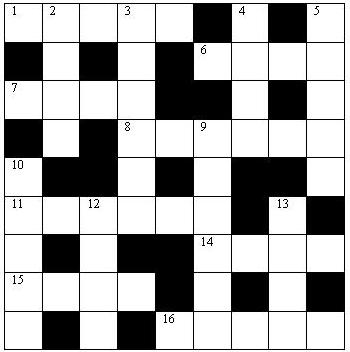
Across:
1. Pebble or Stony in Stoke. (5)
6. Farinaceous Hunters Pot? (4)
7. Different pots. (4)
8. Caving in stream passage? (6)
11. Fed Ray a duff rope? (6)
14. Ropes have many this underground .(4)
15. Every cave does this. (4)
16. M.R.O. Weather? (5)
Down:
2. Found in ever open passage?
(4)
3. Swildons passage. (3,3)
4. Am I Able? (3,1)
5.
.or egg, perhaps. (5)
9. Subtract. (6)
12. Backward Dai has ladders etc. (4)
13. Part of Mendip smirk? (4)
9. Awkward moments underground may seem to take this.
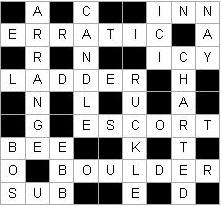
Solution to Last Months Crossword