
Any views expressed by any contributor to the Belfry
Bulletin, including those of officers of the club, do not necessarily coincide
with those of the editor or the committee of the Bristol Exploration Club,
unless stated as being the view of the committee or editor.
Contents
- 1 Mendip Rescue Organisation
- 2 Club Headquarters
- 3 Club Committee
- 4 Officers Of The Club
- 5
- 6 Editorial
- 7 Members Addresses
- 8
- 9 Letter from the North
- 10
- 11 A Knotty Problem
- 12
- 13 Ski Mountaineering
- 14
- 15 Caving News
- 16
- 17
- 18 Letters
- 19
- 20 Library Additions
- 21
- 22 The Dig in Gour Rift
- 23
- 24 Water Tracing in Cuthberts
- 25
- 26 Fairy Cave to Hilliers Link up
- 27
- 28 Library Requests
- 29
- 30 Roman Mine
- 31 Caving Meets
- 32
- 33 Monthly Crossword Number 23.
Mendip Rescue Organisation
In case of emergency telephone WELLS 73481.BRISTOL
EXPLORATION CLUB
Club Headquarters
The Belfry,
Rd.
Club Committee
Chairman: S.J.
Collins
Minutes Sec: D. Turner
Members: R. Bagshaw; W. Cooper;
D.J. Irwin;
N. Jago; T.E.
Large; A.R. Thomas;
R. Orr; R. Hobbs.
Officers Of The Club
Hon. Secretary: A.R.
Thomas, Allens House,
Barrows Lane
Hon. Treasurer: R.J. Bagshaw,
Caving Sec: T.E. Large,
Bishopston,
Climbing Sec: N. Jago, 2 Broughton
House,
Redcliffe,
1.
Hut Warden: R. Orr. The Belfry, as above.
Hut Engineer: R. Hobbs, Rose Cottage,
West End, Nailsea,
Tele
77368
Tacklemaster: W. Cooper,
77368.
B.B. Editor: S.J. Collins, Lavender
Cottage, Bishop Sutton, Nr. Bristol.
Librarian: D.J. Irwin, Townsend
Cottage, Priddy, Wells,
Publications: D.J. Irwin. Address as above
B.B. Post: Mrs. K. Mansfield, Tiny
Kott, Little
*****************************************
One of the M.R.O. NiFe cells is missing. It is marked No. 10. If any member happens
to see this cell anywhere at any time, the M.R.O. would be interested in any
information which might lead to its recovery.
The price of the DINNER this year will be £1-10 or 22/- in
proper money.
Editorial
Belfry Binder?
The open session with the committee has taken place, and
from what we hear, comments have been mainly favourable. Apart from one or two preliminary questions,
the whole session was taken up with discussing problems of how to run the
Belfry. Although it would be foolish to
suggest that everyone now sees eye-to-eye; at least everyone now has a clearer
idea of the problems involved and the ways by which they might reasonably be
solved.
The editor has been sounding out opinion as to how much club
members want in the B.B. on this subject. The main feeling seems to be that we have now done all the talking and
should get down to the job of running the place. In view of this, we shall be keeping the rest
of our material on this subject – including ‘Sett’s’ excellent paper – in
reserve, should it become necessary to re-open the subject in these pages.
Out-Of-Date Dates
This business of providing club members with information
about future events is not as easy as it might seem. Apart from slips in printing dates, there
seem to be a number of other snags to contend with. For instance, the survey course is now one
week behind the published dates, as it had to be moved back at the last minute
for the open committee discussion to take place. The barbecue cannot be published because the
decision to go ahead with it came too late for last month’s B.B. – and this one
will be too late. Even when a slip about
the open committee session was included in the last B.B., there was still some
confusion about the actual starting time. Etc. etc.
Just how one solves this problem is not clear at present,
but we shall go on trying!
Alfie
Members Addresses
New Members.
John Murray, Latyner House, Hill
Close, Wincanton,
Jo & M.R. Upsall,
Rd
I & P.J. Calder,
J. Dunston, Tolcarne, 90,
J. & M. Coleman, Orchard House, Burnwell,
G.C. Williams, 90,Greville Rd, Southwell ,Bristol BS3 1LJ
P.J. Miller, 60 Elmtree Rd, Locking, Weston-super-Mare, Somerset.
Mr. & Mrs T.W. Neil, Woodville Lodge,
Corrections to members’ addresses.
Frank G. Darbon,
B.C.,
G. Wilton-Jones,
Monkham Drive
Changes to members addresses
Miss C. Salisbury, 24,
Andrews,
6. C.E.A02,
K.R. Glossop, D08205, No 4 Petty Officers’ Mess, H.M.S. I,ynx, c/o B.F.P.O.
Ships,
*****************************************
The Tacklemaster and committee would like thanks to STEVE
GRIME for his donation of twenty foot nylon rope to the club.
Why not write for the B.B.? Any length of article can be
used, but there is a need for small pieces of useful information to fill up
spaces like this one. If any member
knows of some useful fact to pass on to the rest – write it down and put it in
the B.B. box at the Belfry.
Letter from the North
An. article by J.
ABBOTT, keeping us touch with his doings in the North.
As some of you know, the B.E.C. now has a permanent member
in the Yorkshire Dales. I moved up here
back in January perhaps the worst time of the year to be introduced to these
far off Northern Lands
and certainly the weather has been pretty bad up here at
times. However, when the sun DOES shine,
it brings out the best in these northern Landscapes which are many, varied and
beautiful to behold.
One scene in particular which stands out in my mind is that
of the Lune valley and
western slopes of Gragareth late at night. It was after trip down Marble steps – itself a very impressive pot a
¬trip which this particular fellow found intriguing, amusing and knackering. It was after climbing out of the entrance
rift at the end of the trip, which could be made into a separate narrative in
itself (how about it, then? Ed) that I found myself staring out over a
moonlit shallow valley containing the odd friendly light which marked each
outpost of civilisation. These pinpoints
of light continued out and beyond the Lune valley and could still be seen on
the plains beyond until some of them coalesced into what must have been small
towns – places such as Carrforth and
in Kendal perhaps. However, beyond even
these lights one could make out a barrier where one texture of light finished
and another started. That which
continued, until meeting the horizon, was of a more silvery nature. It was of course, the sea –
some twenty five miles away.
It is not only sheer beauty which makes the dales such an
attractive part of the country. It has
many pleasant facets which appeal to all manner of folk. One, naturally, is its atmosphere. It was a couple of weeks, back in mid-March
that found three of us – two Bradford pothole Club members and myself
-venturing over into
after gaining both a hitch hiker and a puncture in a rear wheel and losing the
use of the handbrake, we eventually made it up over the
Fountains Fell bathed in sunlight under a cloudless sky. I stopped the car in a lay-by high above
Penyghent Gill where the three of us had a look at a stream which sank into a
fissure – obviously an active dig. It
was surrounded by neat spoil heaps and the streamway contained several freshly
constructed dams. (The natives must have
stolen the idea from Cuthberts!) However, after poking our noses into the dig, we set off once more to
drop into Littondale. In Litton itself,
we came across a pub, the Queen’s Arms. Consequently I stopped the car. After all, the air was warm and our throats were dry so it was the only
solution. It was in this pub that I met
some of the atmosphere I mentioned ear1ier. The pub itself was set at the end of a short row of terraced limestone
cottages, all of which were built in a solid, practical Dales fashion. The interior of the pub reminded me of home
(the Hunters, of course.) The walls were
bare stone and the roof was supported by a. large and very ancient beam. The thing was held together by two metal straps
placed on either side of it. At one end
of the room there was a fine coal fire and, although it was warm outside, we
were immediately drawn towards it and sat around supping pints of mild. There were two other characters in the bar,
local coalmen, who were taking advantage of their dinner break to partake in a
liquid 1unch. I listened in on their
conversation which seemed to consist of a mixture of grouse moors, twelve
bores, market towns, mixed nuts and anthracite. Our chatter? That too was just as
varied and quite as idle. As the
afternoon wore on it seemed to get more and more idle, as did ourselves. Indeed, so idle did we become that it was not
until about 3.15 pm and numerous pints later that we were forced to shift our
backsides. Such was the atmosphere in
that pub that I was very loath to leave it at all.
Talking of pubs, a terrible thing happened to me the first
weekend I ventured into the dales back in January. I was stranded in the ‘Hill Inn’ all
night! Cries of “Shame!” It happened like this. Upon arriving at Brackenbottom the B.P.C.
headquarters – on a Saturday morning and introducing myself as a B. E. C. club
member and a fellow mate of Bob Cross’s – they stoned me No. Seriously, they made me very welcome, despite
mentioning Bob Crosss name. I was
invited to join a digging party. I
accepted this invitation and spent a pleasant afternoon excavating dead sheep
and about three million tons of spoil. During the course of the afternoon, I chatted to various diggers and it
transpired that most Saturday nights started off in the ‘Chippie’ in Settle and
finished up in one pub or another. That
evening, after giving the ‘chippie’ a visit, a number of us eventually made it
to the Hill Inn in Chapel le Dale via pubs in both Settle and lngleton. Once there, we drank numerous Younger’s milds
and sang, shouted, croaked and wailed a number of folk songs. Towards the end of the evening, well after
closing time, the local constabulary decided to pay the pub a visit, finding
fifty or sixty characters still inside drinking. To a man, when asked, everyone declared themselves
to be residents, which baffled the constabulary for a few minutes. It was not long, however, before they decided
that they would take the number of every car in the car park to make sure that
none moved during the night. This was
the dilemma which confronted us. We were
faced with the awful prospect of having to remain in that pub ALL NIGHT,
possibly even drinking all night or to take the easy way out and walk eight
miles in the dark and pouring rain back to Brackenbottom. You will be glad to hear that I faced the
situation courageously as a true B.E.C. member should. I put my beer glass in my hand, strode up to
the bar – head held high – and asked for another pint.
Needless to say, since I have been up here I have managed to
get a bit of caving done. All of it has
been done with the Bradford, who I have now come to think of as the B.E.C. of
the North. The weekend of the 22nd of
January this year saw a number of us in the Birkswith area of Ribblesdale
venturing down Calf Holes – Browgill, Old Ing and Sell Gill holes. The first
consisted of a short through trip following a fairly large stream and
containing an impressive twenty five foot waterfall. The second was merely a downstream canal
ending in a sump. The third, and perhaps
the most interesting of the three consisted of an open entrance shaft of 25
followed and 50 and 60 ladder pitch. This deposited one at the end of a very impressive main chamber of G.B.
proportions into which flowed, from a hundred and fifty foot up, a fairly full stream. This was also an alternative entrance to the
cave – an alternative that I did not fancy! The stream flowed on through the chamber to continue in a short stream
passage to a final sump. The following
weekend, on the Saturday, five of us decided to pay Bull Pot in Kingsdale a
visit. The weather was bitter and snow
lay everywhere. However, the views of
Kingsdale from the slopes of Gragareth more than made up for the cold. The pot was descended in fairly rapid time
despite some of the pitches being quite damp. The following day was the Bradford Club Meet. There was to be an exchange of parties in
G.G. via Flood Entrance Pot and Stream Passage Pot. I elected to join the party laddering Stream
Passage. The weather was very much the
same as the day before so we were all very glad to get underground at about
midday. The first pitch of 25′ held the
party up for some time, but once past this we progressed quite rapidly to climb
a wet 85 followed by a 110 and finally by a loose 75 pitch which got us into
the stream passage in G.G. Once
assembled at the bottom, the party moved off to the Main Chamber via Mud Pot
and Sand Chamber. Undoubtedly, some of
you have seen the main chamber before, but I’ll not apologise for my
description of what you already know. We
entered the chamber from a low balcony to be met by a great void penetrated at
the centre by a shaft of light filled by a roaring plunging waterfall. It fell with such violence that the resulting
spray was blown to the further reaches of this huge chamber. We walked across the remarkably flat floor of
this vault toward the waterfall to gaze up and out of the entrance shaft – 360
feet up to a blue sky. The Fell Beck,
after plunging over the lip of the entrance winds its way across the floor of
the Main Chamber only to sink under a pile of boulders at the chambers
edge. The water is next seen again at
the bottom of South East Pot. This too,
was our destination; only we were to go by a drier route. We passed the members of our complem¬entary party
on their way to Stream Passage as we left the Main Chamber. We soon arrived at the top of South East Pot
to be greeted by the sight of a ladder of 140 free-hanging over the depths of
South East Pot itself. This is a really
impressive pitch in true
apart from being knackering, was a sheer pleasure to climb. This was followed by a fifty foot pitch and
after a length of twisting passage containing a couple of sporty climbs, the
bottom of the last pitch of 70 was reached. From the top of this pitch it was only a short climb to the
surface. It was dark as the time was
about 7 pm when we emerged from the shakehole, but the sky was clear and the
air crisp. The moonlight shone down
brilliantly on the snowscape as we eight weary cavers plodded our way slowly
through the snow, down off the allotment to Clapham, heavily encumbered with
ironmongery that was freezing to the touch.
If this, and the other experiences are indicative of what
life in the Dales is all about, then here is one Mendip man who will be happy
in his exile.
A Knotty Problem
The account of the practice rescue by Chris Howell seems to
have brought some comments in. Since we
believe that all members should be in no doubt about tying a bowline, we make
no excuse for printing everything we have received.
OLIVER LLOYD writes: – I enjoyed Chris Howell’s account of
the practice rescue down St. Cuthberts, but was rather mystified by the bit
about the double bowline, at least that’s what I call it. He calls it a bowline on a bight. The method of tying this knot that I recommend was to double back some six or seven feet of rope and then tie
an ordinary bowline, which can be adjusted if necessary. The patient’s thighs are placed in the two
loops created by the knot and the remaining knot and the remaining loop passed
round the chest. He said he found it
hard to follow and would recommend instead to double back some six or seven
feet of rope and then tie a straightforward bowline, which can be adjusted if
necessary etc. Personally, I don’t see
the difference!
A correspondent who calls himself DRIPSTONE takes up the
business of the knot and goes on to discuss other problems raised in CHRISS
article as follows:-
First of all I must admit a sneaking admiration for Chris as
he volunteered to be a victim, which is more than I would! As to Chris not understanding Dr. Lloyds way
of tying the knot (which is a bowline on a bight) probably Dr. Lloyd would be
only too glad to demonstrate at a convenient time, but I agree that his
description is quite straightforward. I
would advise using all three loops, especially in wet weather conditions. However, if any kind of bowline jams in an
awkward spot and it is desired to release the victim, it could be one hell of a
job, and rescuers might well be advised to carry a knife for cutting ropes if
necessary ( I bet the tacklermaster will be pleased to hear this! – Editor.)
I don’t think it is bad practice to strap a person up,
remembering that on a real rescue, the victim may be very capable of helping
one moment and then suddenly go into delayed shook just when you are on a
tricky bit and have counted on his helping out. It is probably better to treat him as a dead load right from the word
go if possible. Again, the odd remark
like ‘Can we get someone below the stretcher in case it slips may not inspire
confidence in the victim, but may be very necessary for the rescuers. The victim of a real accident probably has
other and more pressing things to worry about.
I am not writing merely to criticise what was an excellent
account which I found instructive, so much as to point out that the victim on a
practice rescue cannot really be expected to act and feel like a real victim.
would.
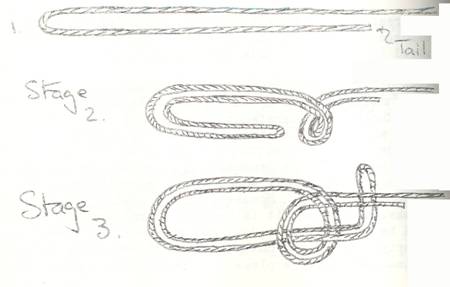
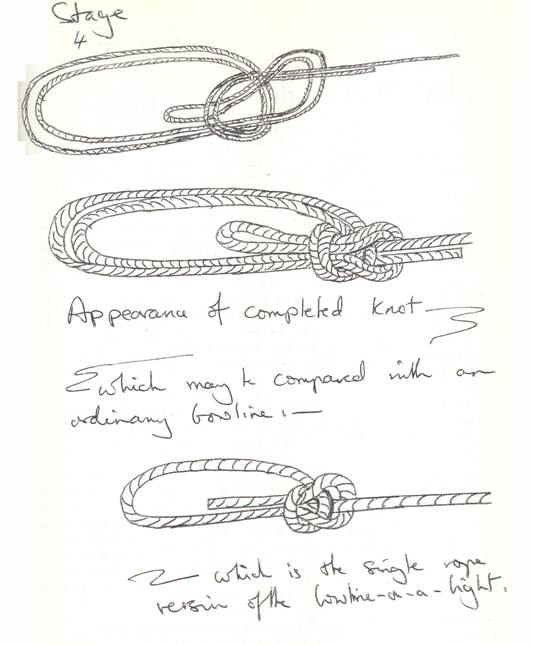
Finally, since it is well known that the B.E.C. consists
entirely of experts in one field or another (mainly the other) we asked our
expert on seamanship JOHN RANSOM – for some instruction on the tying of bowlines
on bight and reproduce his sketches as follows: –
Ski Mountaineering
Another article by one of our most regular and reliable
contributors, RON KING – or KANGY to most members, who says that he likes the
new B.B. and the new cover.
We went to the Marcadou, a wide pleasant valley in the
National Park due South of Lourdes, hoping to climb to the Wallon Refuge on
Saturday and then to climb as high as we could on the Sunday, because youve
got to have altitude, potential energy and all that. Metres, man, metres!
Disaster struck at Cauterets. No sealskins to hire for the skis. Deep thinking produced the dreaded yellow wax
(Fart Shune, if youre not too shy to ask). This, at five bob, gives quite a good adhesion up to ten degrees of
slope, after that you pull muscles you didn’t know you had. Well, dont say you
havent been warned.
This cross-country, with seal skins are what it’s all
about. Picture a laden Englishman
following equally laden, but nicely equipped Frenchmen. The distance increases, the sun beats down,
the slope steepens. Nine degrees – nine
and a half ten SPLATT!! The rucsac,
carried high and weighty, sinks into the snow, pining the flattened, wriggling,
reddened, enraged and overheated Englishman with the remorseless pull of
gravity. The French, equally laden but
nicely equipped, have vanished over the next horizon. Even when, with the stubbornness of his race
the Englishman makes effort after effort (and is not last) his energy
expenditure is frightful, with slipping skis and the accumulation of snow piled
on his downhill style planks taking their toll.
At the refuge, the lessons learned are remembered and the
developed cross-country ski examined with some respect. I’m glad I made do because now Im quite
sure that, as a result future sorties will be less frustrating. However, all that was forgotten in the
magnificence of the evening meal. We had
the ambiance of the Old Belfry, crowded with mates, binder bubbling on stove
and beer to hand except that, in their unique French way, they produced in
addition the magic of Haute Cuisine. The
wood fire was started, the doors closed, the candles lit and the veloute de
champ¬ignons warmed (what you and me do call mushroom soup.) Meanwhile, Bernadette mixed the legumes
Macedoine with tartar sauce and Jean prepared the Crabbe Mayonnaise. We waited. One does. Conversation started
and the first of the one -and-a-half litre bottles of Margnat was circulated
and the soup begun. Just when we had
started on the crab, three strangers entered and gazed in admiration at the
scene. As they made up their powdered
potato, Jean Gay enquired gently whether they were on a diet. Well, no, they said, but you? What are you doing to-morrow with a meal like
that inside you? Gay riposted instantly
Us? Why, nothing! We are a group of
gastronomes from
here to assess this refuge to decide whether we should give it a two or a three
star rating. – and we all, each one,
dissolved in excruciating laughter and served each other with delicious
saucusse cooked on the wood fire and helped each other to more wine. We invited Francoise to share our omelette
flambé (with rum) and generally, and then more and more hilariously, sang and
joked until it was time to retire to the upper shelf of the refuge with a vast
rum-grog apiece to keep out the cold or something.
As it is inclined to do, the next day dawned. Bright light from a blue sky shone off the
sparkling, untouched snow. The
ski-a-randonee were put on, and the first away headed towards a high
coombe. The Englishman considered and,
deliberately and with experience, strapped his skis together and, carrying
them, climbed – kicking steps in the firm snow.
The coombe was large and ringed with high peaks. The French paused and relaxed in the
sun. An arête led temptingly to a hidden
lake. We followed it and, at the
terminating point, ate an orange, drank in the view and left our skis. It was only eleven o’clock and a rocky peak
was just temptingly near enough to go and have a look at.
A steep slope led to a balcony, another to a small plateau
hard against a rock wall. The edge of
the wall proved to be climbable in the sun, but with a biting wind which
chilled. A traverse proved necessary,
frightening in crusty snow, but necessary. Long minutes of caution passed before the rather unwise traverse ended
in a couloir which ran, narrowed by perspective, to the summit ridge. The powder snow in the lower couloir settled
it. Not to-day! We hesitated, sadly but firmly. Too risky. A ski baton each and no rope didn’t seem enough and, turning to go down,
my heel crunched in excellent snow. A
glance at the time ¬12.30 – a look at the sky – not a cloud – a shout of Death
or Glory’ – and the couloir went with a steep line of good steps. There was a small check at the ridge where a
thirty foot field of snow spelt danger but, fortunately, a small wind-blown ridge
that was less hard gave a good footing. The last few yards to the summit of the Montaigu, (8, 300Ft) were a
sheer joy. A seat for the persistent in
the gods.
Going down is, always, surprisingly less difficult than
imagined and we soon arrived at, and put on the skis. The snow had softened and the dreaded yellow
– fart – caused some anxious moments on steep turns due to uncertain friction
characteristics.
Skiing by traversing backwards and forwards, savouring the
effortless movement, then through the trees cautiously, we arrived back at the
refuge. The others had gone minutes
before. We brewed a mighty bowl a tea
and supped it while sunbathing.
Then, packs on backs, we slid, legs braced mightily, down
the narrow twisting upper track and into the beautiful broad lower valley. Through this, trudging rhythmically, until
got to the final wide, evenly graded track to our starting point. This made a splendid final run, braking
furiously with deep snow ploughs, batons held wide to counter the heavy rucsacs.
And still the weather held, and, sitting in the cafe du ski
at Cauterets, spent a long time in the sunshine, drinking beer.
Caving News
Another run-down on what is happening on Mendip, by TIM
LARGE, our Caving Secretary.
EASTWATER
The stream is sinking in a position just in front of the
entrance. A small collapse has resulted,
with an almost cave-sized hole leading into the boulder ruckle. The result of this is seen at the squeezes
just inside the entrance – the boulders have moved in the area of the second
squeeze. This is also where some of the
water re-appears. From the beginning of
the route-marking line, there appears to have been no movement until the lower
end of the ruckle is reached just before the climb into the 380 Way. Here, there are several loose slabs and some boulders
that move under foot. Caution has always
been the password in the ruckle and now even more care is needed as it seems to
be on the move more often since the cave was re-opened.
CASTLE FARM AREA
A small hole by the side of the road in front of the field
where Castle Farm Swallet was, has recently opened up. It takes the road drainage, which has
excavated a small tube in the topsoil causing a collapse. The hole goes back under the wall towards
some large depressions, probably all part of the Castle Farm Swallet drainage
system. The hole has since been filled
in by the County Council.
BUCKET HOLE Grid Ref. 5480 5336 Approx. Altitude
920.
This is a dig started late in 1971 by Tony Tucker and
others. It is situated at the top of Smitham Hill, not far from the
are several depressions, the dig being located in the largest of them which
takes a small stream. The depression is
about thirty feet deep and is in lias. The site has been fenced off and various mechanical contrivances set up
to aid digging. The dig has been
designated an official club dig. Work
has ceased through the winter months.
ROOKERY FARM SWALLET
This is in the Greenore area. I have recently obtained
permission to dig at the site which has been dug by M.N.R.C., S.V.C.C. and
A.C.G. groups on and off since about 1952. The stream sink was dug out to a small chamber, but this has silted up
as the dig has not been looked at for some time. Just South of the sink is the other half of
the dig, a fifteen foot shaft in conglomerate, which leads via a squeeze to a
very small chamber with one inlet passage of about eight feet leading to
boulders. The stream appears to use this
route in wet weather, much mud having choked at the end, where there is
evidence of banging having been used by previous diggers. At this point, the cave enters the limestone,
and a small tube leads off westwards towards an area of large depressions – one
being quite recent, when the farmer Mr D. Thompson’s combine fell down into a
twenty foot collapse. The stream has
been dammed and then diverted into the shaft, where it disappeared without
backing up. The first job, which has
been started, is to remove the mud etc. which has fallen in from the sides of
the loose entrance shaft and the stream deposits lower down the regain the
actual end of the dig, where chemicals may be needed to aid progress.
CUTHBERTS – GOUR RIFT
Dave Irwins Dig at this site is progressing slowly, the
right hand end having been probed to solid rock on all sides, but indications
show that the passage is going to the left and digging is to be concentrated
here. Shoring is being used to stop
slumping and help prevent flooding of the dig by seepage through the gravels
from the stream. Digging takes place on
Sunday mornings, meeting at the Belfry at 9 am and I am sure that Dave would
welcome and enthusiastic diggers on this site.
*****************************************
PLEASE NOTE: In future, ALL rescue operations, HOWEVER
MINOR should be reported at the time to the M.R.O. The reason this is that rescuers are COVERED
BY INSURANCE as long as the rescue is official. If you fail to notify the M.R.O. injured in rescuing, you are NOT
covered. It has been policy not to call
the M.R.O. if you are sure that that is quite competent to effect a rescue
unaided, but the matter of insurance has altered matters. PLEASE NOTE.

Letters
St. Andrew,
To the Editor, Belfry Bulletin,
Dear Alfie,
I have read the article on the club history in the March
B.B. with very great interest. I would
like to comment the following: – It was stated that Stoke Lane Slocker was
transformed
..by the discovery of Browne’s Passage by Pat Browne and the
forcing of the sump by Don Coase, Sett, and Pat Browne.
This is not true. The
first party through the sump was composed of Don Coase, Graham Balcombe and
myself. We had gone through Browne’s
Passage to look at the pool to see if (a) there was any outlet from it and (b)
if so, could we get diving gear to it. We went to the pool and, after feeling around the wall, Don found the
sump. He was the first man through,
Graham was second and I was tail end Charlie. It is debateable if that first party as indeed a BEC one, as we were all
three of us members the C.D.G. Don and I
were, of course, B.E.C. while Graham was
The second Belfry was originally the property of the Navy
and was situated on Rame Head in
it to Mendip was one of the early club highlights. The cash needed and above that available from
club funds was loaned by Mrs Stanbury.
One more club first. In 1948 (Easter, I believe) I was fortunate enough to be the first to
climb the waterfall in Fynnon Ddu. I
remember reading in an earlier B.B. that this was attributed to Colin
Lour. The party was, fact led by Bill
Weaver of
I hope you will find these odds and ends of interest. All the best, Harry Stanbury.
*****************************************
Thank you very much, Harry. One hopes that, since the article on the club’s history appeared there
are no club members, however new, who don it know that Harry was the founder of
our club – and hence in a better position to put us straight on club history
than anyone.
The
clanger was entirely my own fault, since I was around at the time and should
have remembered what happened. If anyone
is interested, and mainly to keep the record straight, the events were as
follows: –
Sunday, June 1st, 1947. Pat Browne, D. Sage and J. Umeach from
Bruton. Pat was showing the cave to the
other two and demonstrating how the ends of known caves are probed for further
passage. To his surprise and delight he
found Brownes Passage and they explore as far as Cairn Chamber.
Saturday 7th June, 1947. Pat Browne, Don Coase and Sett repeated the
trip, forced the DUCK and find the sump pool.
Sunday 22nd June, 1947. The party which Harry describes took
place. They do some exploration of Stoke
II.
Weekend 28/29th June 1947. Don, Harry, Sett etc. in a general
exploration of Stoke II.
Monday, 30th June, 1947. Monty, Alfie and Luke
Devenish read note left in Belfry and find their way to cave but fail to find
sump.
Tuesday 1st July, 1947. Same team find sump and look round Stoke II.
So I should have noticed the error! Incidentally, there was a joke around at the
time when some newcomer asked Don how he knew that the sump was so short. Don said that he thrust his arm through and,
when he pulled it back, saw that his hand was dry. This was believed by the newcomer for a short
while – but in fairness, we were all a bit slewed the time.
Library Additions
 More information on what can be found in the club library,
by our Hon. Librarian, DAVE IRWIN.
New publications in the library include RED ROSE POTHOLE
CLUB NEWSLETTER, volume 9 No. 4 and the first two issues of a new exchange, the
PLYMOUTH CAVING GROUP NEWSLETTERS Numbers 42 and 43 for Feb and 1972. The Red Rose include a report on their A.G.M.
and the Plymouth include an interesting article on the chemistry and
maintenance of caving accumulators, going into reasonable detail that is often omitted from this type of Article. Problems of rescue in Afton rift; a
description of Coombesend Chasm and other material can all be found in the
February number while in the April one can be found notes on Hexworthy mine.,
demolition of archaeological remains in the Tamar Valley and interesting
extracts from 18th Century books.
DIE HOHLE, Volume 22, numbers 3 and 4 (1971) includes
articles such as the Expedition in the Ojo Guarena system on Spain;
Trollgatera, a cave in granite in Sweden; Gruberhorn Hole, Salzburg, and many
other items worthy of attention.
CAVES AND KARST Volume 13 Number 3 from the
part 1 of the Application of Stable Carbon Isotope studies to Karst
research. The second part is in Volume
13 No 4. Those interested in water
tracing will find this publication of immense va1ue. Incidentally we have several other copies of
this series in the library which should be read by members. For example, in Volume 12 Number 1 will be
found The Chemical Evolution of Cave Waters, Inner Space Cavern,
number 6 contains Volcanic ash Horizons in Layered Dripstones and Cave
Sediments.
Perhaps the most important addition to the club library for
some time are the three volumes entitled CURRENT TITLES IN SPELAEOLOGY for the
years 1 969,1970 and 1971. From the
caving literature both national and local, from magazines and newspapers, books
and any other literal source that one may like to suggest, Ray Mansfield has
combed the lot to produce these three immensely valuable volumes. Each of them lists, for its respective year,
all articles and books that have been published in the
deals with foreign or local caves or with fringe activities.
Taking Mendip as an example. Do you know that there is a
description of Wookey Hole cave in 1840?, hat
has possibly been rediscovered? Or do
you want a description of Priddy Green Sink? If you want information regarding caving in
Carlsbad Caverns; a new karst area in
Bat studies in
Styrian caves; free diving the first sump in Pollaraftra,
and much more you will find all the reference details in these volumes. For anyone needing any information from any
article written between 1969 and 1971, its all there! Remember that these volumes are in the
library, and if anyone is after a specific reference, he can check it in the
C.T.S. and, with luck, we may have that particular publication also in the
library.
Each volume of C.T.S. is subdivided into a number of
sections: Inter- and Non-Regional Topics
(Cave Rescue, Archaeology in Devon and
Pennines; Northern Pennines;
Miscellaneous Areas;
and Shropshire;
Foreign. At the moment, C.T.S. does not
carry information gathered from foreign publications, but the 1972 C.T.S. is to
be expand to included these – some undertaking!
Members interested in having these for their own reference
libraries should obtain copies from Tony Oldham, 17, Freemantle Road,
Eastville, Bristol BS5 6SY at 50p each. Printed by Gestetner – 60p for 1969 and 50p for the other two.
*****************************************
Make a note of the ANNUAL DINNER. Saturday, 7th October the Cave Man
Restaurant. Good Food. Plenty of it. SOME FREE BEER. Entertainments. ETC. ETC. All the best people will be there!! Price £1.10 ONLY per ticket. Dont miss this unique opportunity of
hob-nobbing with the cream of Mendip caving society!! Make a note in your diary. Tie knot in something. Keep saying to yourself, Saturday, 7 of
October
The Dig in Gour Rift
A more detailed account of this dig by DAVE IRWIN.
The end of Gour Rift has interested the author for some time
– in fact when John Cornwell dug a pit there in 1966 it had the feel that it
was only time before it went but ¬the site was temporarily abandoned due to
lack of help. In 1963, the author and Bob Craig, persuaded Dave Searle to help us remove a flake
at the small pocket at the very end to enable us to see what happened beyond.
The result was not encouraging enough at the time to make one want to pick up a
shovel and dig. Still the site
niggled. In 1970 just before departing
for the U.S.A., Dave Turner, Colin Clarke and myself had another scratch and
later, with Roy Bennett’s help, removed more rock, but again, the necessary
push was not there, as Cuthberts II had still to be fully investigated, and
sump II looked the more promising.
In the autumn of 1970, a scratch group of us went down to
the end again and this time, armed with buckets; picks and shovels, bailed the pool
at the end just below the aven to the Bank Grill and began digging. Very soon it became obvious that at some time
in the past, large quantities of stalagmite had been deposited at this point
and only now were being uncovered. Just
a short distance beyond the end of the gours in Gour Rift, almost opposite the
duck, a large gour three to four feet across was found about a foot below the
gravels. Smaller gours were found to the right, each arching towards the left
hand wall. Here was the incentive that
was needed. At some time in the past,
water trickles that formed the gours had flowed down the rift and away under
the left hand wall (looking down cave) some of the water possibly coming out of
the sump passage!
At this point in the rift, several lines of weakness were
noted and it was decided to follow one – which ended shortly in a phreatic hole
in the roof of an overhang that had its supply of water from the updip
side. Anyhow, with this information
available that the water had flowed away from this point, a regular visit to
the site became imperative to keep the dig on the move – so the Sunday Morning
Digging Team was formed. Its nuc1eus
comprised Dave Turner, Doug Stuckey, Chris Williams, myself and any other
likely looking ‘mug’ at the Belfry. A
change of digging site was suggested, and an attack at the extreme end seemed
to offer a better position for digging. The site enabled us to get away from the roof overhangs which forced the
diggers to a kneeling position, and made the spoil easier to move. However, this was not to be. A rock floor was found some two feet below,
and so it was a case of ‘back to the original site’. To prevent slumping, shoring has now been
installed and its back to the pick, shovel and the well-known cry of
“Wheres the bloody bucket?”
Anyhow, if anyone is prepared to get out of bed early on
Sunday mornings ready to descend the cave at 9.30 AM. (not pm) and be
guaranteed to be out again before lunch time closing – come along to the
Belfry. Even if we dont get Cuthberts
III this year – so what! It makes a
pleasant mornings caving.
*****************************************
Wig also notes that this dig is not the only activity going
on in Cuthberts. There are other digs;
plus surveying and water tracing. On the
latter subject, ROGER STENNER keeps us up-to-date in the short article which
follows: –
Water Tracing in Cuthberts
The most recent set of results are of some importance
because they prove that the Fair Lady Well stream enters St. Cuthberts
Swallet, which I have suspected for some time, but have not been able to
prove. To the west of the Belfry, the size of the stream decreases very
quickly, and it is now known that water
entering the cave in the Long Chamber series is derived from the Fair Lady Well
stream. Furthermore, the stream
continues to enter the lake. The next
water tracing experiments will be made to find if water from the lake enters
the Main Stream in the known cave.
The Main Stream (Everest Passage)
drip inlet, and the small stream near the foot of the Rocky Boulder Pitch all
gave negative results.
The method used for tracing the water was the same as
published earlier (B.B. for March, 1972). The difference was that this time the work was done at the Belfry, where
the U.V. lamp caused some interest among the members present, especially when
they saw the fluorescence produced in a few different minerals.
Editor’s
Note: The entry of Fair Lady Well
water into Cuthberts must be of fairly recent origin, at least in recent
historical times, because until the time – not so very many years ago – when
mains water became available in Priddy, the Fair Lady Well stream supplied
drinking water to all the farms and cottages between the Belfry and Priddy
Green. The clearance of the stream
channel – a completely artificial one,
incidentally – and the stopping up of any leaks into the depression was an
annual job tackled by all the able-bodied villagers. Of late, the water to the west of the Belfry
has become rather more of a nuisance to locals than an advantage, and so the
stream is no longer maintained, and may even have been encouraged to leak.
Incidentally, in the days when we used to drink from this
stream, we used to have the water analysed and, whether or not its miraculous
origin is fact or myth, it always amazed the analyst by its almost complete
absence of my form of bacterial content. Judging by the muck which is usually present in Fair Lady Well nowadays,
I should imagine this is no longer the case.
Fairy
Cave
(A FRIDAY NIGHT CLUB TRIP)
Readers may not be aware that
and Hilliers are now linked. This is a
brief account of the first B.E.C. trip, written up by NIG.
On the 17th of April this year, a staggering number of no
less than seventeen cavers turned up at Fairy Cave Quarry. The B.E.C. were well represented with Leader
Brain Prewer (“Prew”) Mike Palmer, Nigel Taylor and a latecomer –
Doug Stuckey.
The connection from
to Hilliers had only been forced a fortnight beforehand, and I believe that we
were the second party through.
Hilliers was excessively dirty with quarry sludge~ and
crawling through it was like Jelly Caving. The grottoes have been re-taped, and Cambridge Grotto was still in a
good state of conservation, and is still well worth a trip.
The actual connection, via a boulder squeeze in loosening
boulders and banged passage looks worse than it actually is, and adds a little
sport to the cave. With seventeen
cavers, the trip took quite a time, and I personally learned to watch my tongue
when I learned that the kindly old I gent ahead of me was a vicar!
On exit, a suitable adjournment was made to the Waggon and
Horses – when gestures of thanks (!!) were made to our Cerberus/B.E.C. Leaders.
*****************************************
The SURVEYING COURSE is still going on each Saturday at the
Belfry between 7.30 and 8.30 pm as follows:-
Saturday, 1st July, Detail and
Survey Presentation.
Saturday, 8th July, Survey
Drawing.
Sunday, 16th July, Practical
Surveying in the flue tunnels.
*****************************************
FUTURE ARTICLES
Articles lined up for future B.B.s include an account of
last years expedition to the Picos de Europa; some surveying articles by Dave
Irwin and Alfie and a long article on Cave Photography by Alan Coase. We could always do with smaller articles,
especially ones that take up half a page or so. These are very useful and enable a B.B. to be planned so that no space
is wasted.
Have you got any LIBRARY BOOKS at home? Have a look through your bookshelf, as there
are quite a. few books which appear on older library lists which the present
Hon. Librarian has no trace of in the library.
Library Requests
With the library just about completely catalogued and many
of the exchange journals and newsletters bounds we are finding that a large
number of periodicals have either been lost or never received by club
librarians in the past.
Below is a short list of items that are missing (more will
be published later) :-
BRITISH CAVER
Volumes 1 to 14, 26, 28
CAVE PROJECTS GROUP NEWSLETTERS
From No .3 to date.
CHELSEA S.S. NEWSLETTERS,
Vols 1 to 4. Vol 5, Nos 1, 3, and 6 to 12. Vols 6 to 9. Vol 10, Nos 1 to 7, 9. Vol 11 nos
6 & 12. Vol 14, No 4.
M.N.R.C. JOURNALS
Vol 1 No.2. All between 1964 and 1971 except June
1970. Bulletin Vol 1 No.2. Newsletters pre No. 45.
C.G.
Newsletters Nos 1 to 7 & 9 to
41.
RED ROSE C.P.C.
All journals except Nos 1 and 5.
Any newsletters except Vol 1 Nos
10 & 12, Vol 2 No 2, Vol 4 No 12, Vo15 No 1. December 1967, Jan, Feb, Nov & Dec 1968,
Jan, Feb, Mar, Apr, Jun & Nov 1969.
SHEPTON MALLET C. C.
Occasional papers Nos 3 & 6.
Newsletters Nos 1, 4, 15, 18, 19,
26 to 40, 46 to 50 and 53 onwards.
CAVE CLUB
Journals Nos 1, to 26, 29, 30,
32, 42, 45, 106 to 109, 111 to 113, 118 to 119, 131 to 134, 138 to 139.
Any members having duplicates of any of these missing items,
or who would be willing to donate copies should contact the Hone Librarian,
DAVE IRWIN, who will be pleased to hear from them. If librarians of other clubs notice this list
of missing items, it should be pointed out that we do have duplicate material
we would exchange (particularly B.B.’s). B.B.’s are available from Number 100 to date. Back numbers other than for exchange are
available to any purchaser at the Belfry at 10 new pence each from number 110
to 169; at 5 new pence from 170 to 237 and at 7 new pence from 238 to
date. The income from any such sales
will contribute towards additions for the library.
Roman Mine
by J. & N. TUCK. Caving Report No
15. Price 60p
While they were looking for a 19th Century lead mine at
Draethen, between
of great antiquity. With the help of Dr.
Savory of the National Museum of Wales,
it was established that the mine was of Roman origin. Work done in the mine has resolved many
uncertainties concerning Roman mining activities in the district.
The report includes an account of the discovery of the mine;
its geological situation, and a history of mining in the area. The mining technique used by the Romans is
explained and archaeological finds are listed and discussed. Fifty pages of text are printed by offset
lithography on 10 x 8 inch paper. The
report is illustrated with two maps of the district; a survey of the mine;
thirty line drawings and four photographs. The pages stapled between card covers. At this very low price, the report should appeal to those interested in
the geology or the history of the area.
Copies and further information may be obtained from R.D.
STENNER,
Caving Meets
The will be a CAVING
MEET – AUTUMN BANK HOLIDAY
25th – 28th of
August.
TO YORKSHIRE – INCLUDING GAPING GHYLL WINCH MEET AND IT IS
ALSO INTENDED TO BOOK TATHAM WIFE HOLE; SWINSTO;
AND VARIOUS OTHER SMALLER
UP ON FRIDAY NIGHT. IF SUFFICIENT DEMAND A MINI-BUS WILL BE HIRED.
Will all interested cavers PLEASE contact TIM LARGE as soon
as possible, so that all arrangements can be made
Monthly Crossword Number 23.
|
1 |
|
2 |
|
3 |
|
4 |
|
|
|
|
|
|
|
|
|
|
|
|
|
5 |
|
6 |
|
|
|
|
|
7 |
|
8 |
|
|
|
|
|
9 |
|
|
|
|
|
|
10 |
|
|
|
|
|
|
11
|
|
12 |
|
|
|
13 |
|
|
|
|
|
14 |
|
|
|
|
|
|
|
|
|
|
|
|
|
|
|
|
|
15 |
|
|
|
|
|
|
|
|
Across:
1. Was e my rat in underground
river? (9)
6. Describes outdoor scientific work even underground. (5)
8. Cuthberts run. (3)
9. Furthest point underground. (3)
10. No southern spot up north. (3)
11. A Belfry brew? (3)
13. Take it easy in an Cuthberts itinery. (3)
14. Make small hole? (5)
15. Tempers be upset in this Cuthberts chamber, (9)
Down:
2. Right One foot for this cave
feature. (4)
3. Erratic O.E. Ailment. (9)
4. Progress along 1 across, perhaps. (4)
5. Found in bare terrain in Cuthberts. (5)
7. Old workings sound finished on Mendip. (5)
12. Take this in mineries or see it in rockface. (3)
13. Mendip House. (4)
Solution To Last Months Crossword
|
A |
B |
O |
V |
E |
|
D |
|
O |
|
|
A |
|
|
|
D |
R |
O |
P |
|
S |
T |
A |
I |
N |
|
A |
|
E |
|
|
S |
|
|
O |
|
I |
|
N |
|
F |
|
P |
I |
T |
O |
N |
|
S |
|
L |
|
O |
|
E |
|
|
C |
|
|
O |
|
O |
|
S |
T |
R |
A |
W |
|
W |
E |
L |
L |
|
|
|
V |
|
|
S |
|
S |
|
F |
O |
X |
E |
S |
The Editor regrets that, while he can think of nothing
sensible to put in this spce, it goes against his nature to leave it actually
blank. It would, of course, have filled
up more had he actually typed an a in the word space. Oh, well! Honour is satisfied!