
Any views expressed by any contributor to the Belfry
Bulletin, including those of officers of the club, do not necessarily coincide
with those of the editor or the committee of the Bristol Exploration Club,
unless stated as being the view of the committee or editor.
Contents
- 1 Mendip Rescue Organisation
- 2 Club Headquarters
- 3 Club Committee
- 4 Officers Of The Club
- 5
- 6 Editorial
- 7
- 8 Water Tracing Cuthberts 1971
- 9
- 10 A Short History of the Bristol Exploration Club
- 11
- 12 Recent Caving on Mendip
- 13
- 14 Book Review
- 15
- 16 In Committee
- 17
- 18 Just a Sec
- 19 Dates for your Diary
- 20
- 21 Ian Dear Memorial Fund Meeting
- 22
- 23 Monthly Crossword Number 20.
Mendip Rescue Organisation
In case of emergency telephone WELLS 73481.
EXPLORATION CLUB
Club Headquarters
The Belfry,
Rd.
Club Committee
Chairman: S.J.
Collins
Minutes Sec: D. Turner
Members: R. Bagshaw; W. Cooper;
D.J. Irwin;
N. Jago; T.E.
Large; A.R. Thomas;
R. Orr; R. Hobbs.
Officers Of The Club
Hon. Secretary: A.R.
Thomas, Allens House,
Barrows Lane
Hon. Treasurer: R.J. Bagshaw,
Knowle,
4. Tel: WHITCHURCH. 5626.
Caving Sec: T.E. Large,
Bishopston,
Climbing Sec: N. Jago, 2 Broughton
House,
Redcliffe,
1.
Hut Warden: R. Orr. The Belfry, as above.
Hut Engineer: R. Hobbs, Rose Cottage,
West End, Nailsea,
Tele
77368
Tacklemaster: W. Cooper,
77368.
B.B. Editor: S.J. Collins, Lavender
Cottage, Bishop Sutton, Nr. Bristol.
Librarian: D.J. Irwin, Townsend
Cottage, Priddy, Wells,
Publications: D.J. Irwin. Address as above
B.B. Post: Mrs. K. Mansfield, Tiny
Kott, Little
Editorial
History
Since this year marks the twenty fifth anniversary of both
the Belfry and the B. B., we make no apology for printing as our main article
this month; a further version of the history of the B.E.C.
The last such article appeared twelve years ago in the B.B.
for May, 1960 – number 147. In that
year, we reached the twenty fifth anniversary of the founding of the club. A lot has happened during the last twelve
year’s and it seems to be a good point in time to record it. We hope that the article will remind older
members and acquaint newer ones with some of the background to our present
position as a club.
In Print
Given good luck, this should be the first ever B.B. to be
printed rather than duplicated. We hope
that all goes well, and that you approve of the result. Several people have
already been kind enough to tell us that they approve of the new style
B.B. The change to printing is one more
step in the moves to improve the B.B. in all directions.
Hint Weekend
Arising from the paragraph headed Hint Taken in these
notes last month, John Manchip raises his voice in defence of the other point
of view and writes:- Dear Alfie, I am
interested in the “wasted paper” in the Christmas B:-B. Keep up the good work. It is difficult, if not impossible to please
everybody at once.
Alfie
Water Tracing Cuthberts 1971
Most readers will know of the work which has been carried
out for some years now by ROGER STENNER on water tracing and analysis. This article describes some recent work.
Two water tracing experiments were carried out, both of
which were connected with earlier water tracing results. The first was concerned with the Maypole
Series sink, and the second with Plantation Swallet. In each case, about 5 gm of pyranine conc.
was added to the streams indicated in the text, and activated charcoal
detectors were used in the sites in the cave. Small portions of the charcoal were subsequently treated with 20 ml of a
10% solution of potassium hydroxide in methanol. The solutions were then examined under a
ultra-violet lamp. The presence of
strong characteristic green fluorescence showed a positive connection. In both tests, the positive results were all
sufficiently strong to make a spectrophotometric check unnecessary.
1. The Maypole Sink
The results of hardness measurements made in May 1965 quite
unexpectedly located the source of the Maypole Series stream. It was a depression at the lower end of an
over¬-flow channel from Plantation Stream into St. Cuthberts depression. This sink is now called the Maypole Sink. Since this result was published in the
January 1967 B.B., there have been two developments. An article on the variability of limestone
hydrology and a negative result of a water trace using pyranine conc. They will
each need to be discussed at some length.
An article in the March 1969 B. B. may be thought to cast
doubts on the assumptions on which the Maypole Stream arguments were
based. The essential data was this. Total hardness figures are in p.p.m. CaCO3
+ or – 1 p.p.m.
St. Cuthberts Pool 148 p.p.m.
Maypole Series Stream 143
p.p.m.
Other streams in the cave coming from St. Cuthberts Stream
showed an increase in hardness. Temperature measurements showed that the Maypole stream came from a
surface stream. The stream sinking in
the Maypole Sink (water from St. Cuthberts Stream mixed with overflow water
from
stream) was the only stream which met this criterion. The assumptions were that the hardness of St.
Cuthberts Stream remained fairly constant throughout the sampling programme,
and would not become supersaturated. The
large area of marshy ground which is the source of St. Cuthberts stream acts
in such a way as to damp effectively hardness fluctuations. The variance of its hardness is considerably
lower than that of Plantation Stream. The bicarbonate content of St. Cuthberts stream is too low to enable
photosynthesis by water plants to make the water strongly supersaturated, which
happens for example downstream of the Rodney Stoke risings. In November 1967, three sets of samples taken
from St. Cuthberts Stream at four-hourly intervals had a maximum variation of
106 p.p.m. CaCO3. Confidence
in the earlier conclusions was unshaken.
The second development was the tracing experiment carried
out using pyranine conc. in November 1967. The dye was placed in the stream well upstream of the upper dam, and the
result from the Maypole Series stream was negative. This also supported the earlier conclusion,
since at the time of the test, the Maypole sink was dry.
A further test was designed to find out more about the
Drinking Fountain stream, confirming the earlier result at the same time. In January 1971, David Turner and Martin
Webster placed detectors in the Maypole Series stream; Disappointment Passage
Stream, and the Drinking Fountain Stream, Pyranine conc. was placed in the
Maypole Sink, which was taking water from St. Cuthberts stream. All three detectors gave positive
results. The three sites all gave
negative results in 1967 when the Maypole Sink was dry. These results need further discussion, since
the streams in the cave do not immediately dry up when the Maypole sink dries
up.
The Maypole Series Stream
The St. Cuthberts stream overflows into the Maypole sink in
wet weather, or whenever the top dam is left in place. In unusually wet weather this water supply is
joined by water overflowing from Plantation Stream. The water flows fairly quickly through the
Maypole Series, the temperatures being similar to those of the Main Stream
while flowing from the surface to Traverse Chamber. I suggest that beneath the Maypole Sink is a
large depression filled with rocks and a large quantity of mud. This mud acts as a reservoir, which is
‘topped up’ in wet weather and, when the sink dries up, drainage from this mud
enables the Maypole Series Stream to flow for many days afterwards. A full hydrological study of the Maypole
Series stream would check this suggestion and also allow the calculation of the
effective volume of the reservoir, enabling an estimate to be made of the
volume of mud that would have to be dug out to enter the Maypole Series from
the surface. I also suggest that except
in unusually wet weather, additions to the Maypole Series stream from other
sources are negligible.
The Disappointment Passage Stream
In January 1971, the stream was moderate in size, but it is
usually very small – a mere trickle. This would suggest a single effective source, the Maypole sink
overflowing its normal course in high discharge conditions. This is a reasonable explanation for the
rapid reduction in stream size compared with the more gradual reduction in that
of the Maypole Series Stream with the same source. The upper end of
Disappointment Passage is very close to
‘ Swallet. It is possible that small
trickles here come from plantation stream, but this is pure speculation.
The Drinking Fountain Stream
This stream flows strongly when the Maypole series stream is
almost dry. This suggests that the
stream has more than one source. There
is not enough evidence to permit speculation about the remaining part of the
stream.
2.
Plantation
Swallet
The present state of knowledge dates from July and November
1961, with the results obtained by Bryan Ellis, using rhodimine B and treated
cotton hank detectors. In November 1971,
Plantation Stream was diverted into the depression, and no water was reaching
Plantation Swallet itself. Dave Irwin
placed detectors in the Main Stream upstream of Plantation Junction, and in
Plantation Stream just upstream of the Junction. It was possible that Plantation Stream in the
cave has a large source besides the surface plantation stream, and this
occasion gave a very good chance to test this. The pyranine conc. was placed in the surface stream well upstream of the
diversion. Both detectors gave positive
results. This means that there is no evidence
of a large additional stream. The
conclusion to be drawn from temperature and hardness results is, in fact, that
Plantation Stream in the cave does only have a single source, with additions
from elsewhere being negligible.
I would like to thank Dave Turner, Dave Irwin and Roy
Bennett for placing and retrieving the detectors in the cave, and Tim Atkinson
for advice with the method for racing water with pyranine con.
A Short History of the
Bristol
Exploration Club
.based on an account
by T.H. Stanbury and others.
Since the early records of the club were lost in the blitz
during the last war, and since there are very few members who are accessible
and whose association with the club goes back to those days; accounts of the
very early years of the club are bound to be a little hazy.
The story of the founding of the club is an established part
of Mendip folklore by now but, like most folklore, is probably greatly
embellished. At any rate, a small group
of fellow employees of our founder, “Harry” Stanbury formed
themselves into a caving party in the summer of 1935 and visited
Goatchurch. The trip was a success and,
after acquainting themselves with the procedures of the existing societies,
they decided to form a new club.
Initial membership was about a dozen, and an inaugural
meeting was called later in the year at which a set of rules was drawn up, and
the bat adopted as the emblem of the new Bristol Exploration Club. The basic phraseology of the aims and objects
of the club in our present constitution comes straight from these original
rules, and it is flattering to think that at least one other club – the
heavily upon this wording of 1935 in formulating their own constitution over
twenty years later.
The few years between the founding of the club and the
outbreak of war in 1939 found the infant club constructing tackle – rather
differently from the methods we use today! – and running trips to most of the
caves which existed on Mendip at the time. The membership remained small and steady, as the club made little or no
attempt to persuade others to join them until they felt they had acquired
enough experience to be able to offer new members a reasonable standard of
caving knowledge.
At the outbreak of war, club membership was 15 – a figure
which the subsequent call-up soon began to reduce, until it was hardly possible
to get a caving trip together. The
Emplex Caving Club, composed of employees from the Bristol Employment Exchange,
found themselves in a very similar position, and in 1940 the two clubs agreed
to combine. The combined clubs agreed to
retain the name of Bristol Exploration Club.
Matters continued to get worse, even with the extra manpower
provided by the merger, and by 1943, the club existed in little more than
name. All its forces members were not
available for caving, and the few left behind found it almost impossible to
carry on.
Just when it seemed that activities would have to be wound
up and hopefully started up again when the war was over, one or two additional
cavers contacted Harry Stanbury, and a meeting was held at which it was decided
to renew caving activities. The club
membership numbers date from this meeting, at which Dan Hasell, who usually presides
at our annual dinners, was present. His
membership number is 4, Harry Stanbury’s being 1.
The end of the war in 1945 found the club shaky but still
functioning. On most occasions, since
nearly all the early members lived in the Knowle area of
trips were organised from the Stanburys’ house in
would change at
Barn at Priddy. It was these visits to
‘The Barn’ by some members of the B.E.C. which were mainly responsible for the
dramatic growth of the club during the next two years from a handful of cavers
to one of the major caving clubs of Mendip.
Barn in 1945 was the home of a collection of cavers from a variety of
sources. The only actual club
represented was the Bridgwater Caving Club, who were in the main employees of the
Puriton explosive factory. Don Coase was
one of these. Another of the organised
groups was a small band of ex-U.B.S.S. cavers who had found the Burrington hut
too far from the caves of the Priddy area in those days of little, if any,
personal transport. This group provided
members like ‘Sett’, ‘Postle’ Tompsett, ‘Pongo’ Wallis and ‘Alfie’.
As these cavers got to know each other, it became obvious
that it would be a good thing if they all banded together into one club. The obvious choice was the B.C.C., but there
were fears that this club would be disbanded as soon as the Puriton factory ran
down on explosive manufacture. It was
the few B.E.C. members who visited the barn – like, George Lucy – who provided
an alternative club round which the inhabitants of the barn could rally and in
the end, they all joined the B.E.C. This
increase of membership was rapidly swollen by returning forces members, many of
whom brought friends along with them. At
about this time the Mendip Speleological Group were also absorbed into the
B.E.C. and, by the end of 1946, membership had risen to 80 and the B.E.C. had
become a major Mendip caving club.
The need for a permanent Headquarters was now becoming of
great importance and, accordingly, money was lent to the club by some members
and a small wooden hut purchased. This
was the original Belfry, which started life as a sports pavilion on Purdown in
pieces and erected by the club next to the small stone hut by the slag heap
near the Shepton Headquarters. (This
was, of course, long before the Shepton arrived on Mendip). On Saturday, 1st February 1947, Don Coase
spent the first night under the club’s own roof at the Belfry. Exact records have not been kept, but
something approaching a total of 25,000 bed nights have been spent at Belfries
by club members and guests since that date.
January 1947, the first issue of the Belfry Bulletin was
published – Edited by Dan Hasell. This
number is 293, which seems to need no comment.
With the possession of a hut, the club continued to attract
more members. An active group from
discovery of new caves on Mendip. In the
summer of 1947 Stoke Lane Slocker was transformed into a large cave by the
discovery of Browne’s Passage by Pat Browne and the forcing of the sump by Don
Coase, Pat Browne and ‘Sett’. It is a
sobering thought to realise that ‘Sett’ is the only living survivor of this
trip. At about the same time, club
members assisted the Brownes in digging out Brownes Hole and the nearby
Withybrook Swallet was entered by the club.
At about this time, the Bridgwater Caving Club was formally
incorporated into the B.E.C. For many
years after this, a B.C.C. membership card and key to Swildons used to hang in
the old Belfry to commemorate this event. The significance of the Swildons key was that, in the days of
of us could only get down Swildons by courtesy of the B.C.C. who had an
official key.
By 1948, membership had risen to 98 and the club’s
activities grew in proportion. A survey
of
was exhibited at a caving exhibition held in the
the Clifton Caving Club were absorbed into the B.E.C.; a London Section of the
B.E.C. was formed and a new loan amongst members resulted in a new and bigger
hut being purchased. The old original
Belfry was bodily moved; towed down the road and re-erected on the present site
and the ‘new’ Belfry built nearby. This
was the hut which was finally destroyed by fire. Meanwhile, the club’s interests continued to
expand an active Climbing Section spent most weekends in North Wales and
elsewhere; the club supplied most of the Somerset Section of the Cave Diving Group,
and club trips began to be organised to
countries.
By 1949, the membership had reached 120 and the meetings at
begun to suffer from overcrowding. The
idea of holding meetings on a Thursday was so that club members could organise
the coming weekend’s caving and climbing. A room was therefore hired at Redcliffe Church Hall, and remained for
many years the focus of the club in
post-war expansion of the club. From
1949 to 1961 membership remained virtually steady, dropping in most years by
one or two until a low point of 110 members was reached in 1961. In 1950, the first annual dinner was held at
the Hawthorns Hotel in
Belfry by the Belfry Engineer – Tony Johnson.
In 1951, the club ran a stand in the ‘Our Way of Life’
exhibition in
as part of the Festival of Britain arrangements. The stand aroused considerable interest. In this year, a number of changes were made
in the way in which the club was run with the object of distributing the work
of running the club amongst a greater number of people. The present system of club officers and the
makeup of the club committee date from this time.
In 1953, accommodation on Mendip was again improved by the
addition of a six foot length to the Belfry. This was used to enlarge the kitchen and the Womens’ Room. This year also saw the most important
discovery which the club has yet made. By permission of Mr. T.C. Cunane, excavation was started in the
depression near the Belfry and after a few months continuous work, a cave
system was entered in the October of that year. St. Cuthberts is too well
known to need any further description or comment.
In 1953 and 1954, the club surveyed
the city engineer. The work on this
survey was written up and published as the first of the B.E.C. series of Caving
Reports. Caving work of the time also
included the opening of Hunters’ Hole in 1954.
During 1955, the land on which the Belfries stood came onto
the market and was purchased by the club in 1956.
The future of the Belfries had been worrying members ever
since the Town & Country Planning Act had come into force but now that the
land belonged to the club, all was well and the renovation of the ‘new’ Belfry
was put in hand.
Thus, during 1957, the Ladies’ Room and the Mens’ Room were
decorated and mains electricity connected to the Belfry. This year also marked the final demolition of
the original Belfry, which had served the club so well, to make room for
permanent stone building – the first permanent building to be erected by a
caving club on Mendip. In this year, the
B.B. first came out with a printed cover and the size was increased from four
pages to six. On the caving front, the
club assisted in the re-opening of Pen Park Hole in
of the digging required to get in. After
running one tourist trip, the club had to abandon its co-operation with the
other societies involved owing to a disagreement with the management. This, however, was offset by the new
discoveries in Cuthberts of The Maypole Series and the Rabbit Warren
Extension.
January 31st, 1958, Don Coase died after an operation. A simple plaque in Cuthberts was erected by
the club as a permanent reminder of his work. On the Whit Monday of the same year, ‘Herby’ Balch died. He was an honorary member of the club and the
father of caving on Mendip.
Much work continued to be carried out in Cuthberts and on
the Belfry. The new stone hut gradually
grew and work was done Tankard hole and other smaller caves. Apart from this, 1960 saw no new activity of
note – except possibly the claim that the Belfry was the only Mendip hut which
never closed which accommodated more people than all the other caving huts
combined – a state of affairs which will probably never occur again. Club ties and car badges were introduced at
about this time.
By 1961 the stone Belfry had been completed externally. The internal fitting out scheme involved the
construction of a shower, but this never came to pass.
The next few years, from 1962 to 1965, were marked by steady
if unspectacular progress. Membership,
for some inexplicable reason, rose steadily over this period from 110 in 1962
to 185 in 1965, at which value it again stayed steady. In 1963, a record number of bed-nights was
reached at the Belfry – an impressive total of 1,861. It is very doubtful whether this will ever
again be reached and if so, not by such a relatively small band of
regulars. During this period of time,
much work was put into the Belfry and this was balanced by a steady amount of
new discovery in Cuthberts – a good example being that of the Coral
Series. Members of the club took leading
parts in inter-club activities in communications and surveying. A new entrance was made to Cuthberts to
avoid past snags due to flooding of the entrance. Sad events of the time were the untimely
deaths of Jack Waddon on a practise dive in Mineries and Ian Dear, who left a
sum of money in his will for the use of younger members caving or climbing
abroad. A feature of the B.B. over this
period was the regular contributions by ‘Stalagmite’ whose identity became a
favourite guessing game amongst members and the B.B’s best kept secret.
In 1966, Belfry charges, which had remained constant ever
since the Belfry first opened in 1947 at 1/- per night and had done so in spite
of inflation because of the sheer number of people staying there, were at last raised
to 1/6. Some discussion as to where to
site the proposed new toilets led to a few members suggesting that a long term
plan for the Belfry site would be a good idea. A semi-¬official team of three men was set up and at the 1966
A.G.M. This body was enlarged and made
official. Also in 1966 the club bought
the barn which it later sold to the Shepton who have made it into their new
permanent headquarters. A new survey of
Cuthberts was started at this time.
In 1967 the idea of a definitive report on Cuthberts was
conceived by Dave Irwin and planned as the most ambitious documentation of a
Mendip cave ever attempted. Work on this
report began as a 15 part publication A
fund was started for a new permanent Belfry, and the Long Term Plan was passed by
the 1967 A.G.M. This was started in 1968
by the cutting and opening of a new track for the local farmer. The early part of 1967 was marked by an
outbreak of foot and mouth disease which led to the closure of most of the
caves on Mendip. This lack of caving was
made up for later in the year by the passing of the sump in Cuthberts and the
opening of Cuthberts II. Publication of
the Cuthberts report started this year and, at the A.G.M., it was announced
that the fund for the building of a new Belfry now stood at £751.
On the evening of Monday, 15th September 1969, some visitors
who were staying at the Belfry returned from a visit to the Hunters to find the
building in flames. The Belfry was a
write-off, although the main shell remained intact. Within days, a special committee had sorted
out the necessary admin and got an insurance claim filed with the insurance
company. They also prepared a report for
the A.G.M. which, luckily, was only a few weeks away. Meanwhile, other club members had tidied up
the site and organised the Stone Belfry into a temporary headquarters complete
with sleeping and cooking arrangements – thus gallantly maintaining the
tradition of a Belfry which never closed. At the A.G.M., the fact that there was already in existence a
cut-and-dried plan for rebuilding which had already been passed by all the
relevant authorities enabled the club to swing straight into action without any
delay. After the A.G.M. and dinner, a
party was held in the ruins of the Belfry.
On the 9th of May 1970 – two hundred and thirty six days
after the fire – the present Belfry was ceremonially opened and the whole of
the £3,000 or so which the building had cost was paid by the club without any
from of help from any outside body whatsoever.
Almost inevitably, after an effort of this magnitude a
period of relative quiet followed in 1971, which brings us to the present
day. This point in time, as your present
club historian sees it, is likely to prove one of the more difficult in the
club’s history. We have got to learn how
to and use our new headquarters properly: we have got to learn how to adapt to
these times of rapid change; we may well have to adopt a more professional
approach as befits our status as property owners. At the same time, we must somehow manage to
preserve all that is best in our club – which, is in many ways unique. Luckily, there are signs that many club
members – both on and off the present committee – are becoming aware of the
situation and the need to find a formula which will enable the club to preserve
its reputation for good fellowship and informality while at the same time
running as an efficient organisation. Given the usual mixture of good luck and judgment which has brought us
all the way from that small band of cavers who went down Goatchurch in 1935 to
a body nearly two hundred strong whose assets run into thousands of pounds, we
should be able to find our way once more round any snags which may arise – as
we have done so often in the past.
In this account, a few people’s names have been mention from
time to time. This should not be taken
to mean that only those so listed have played exceptional parts in the
formation and building up of the club. To list all those members who, through their hard work and enthusiasm
have produced the club we have to-day would be an impossible task. Many more, who have played no direct part in
the building and running of the club have nonetheless made equally important
contributions in fostering the friendly atmosphere which has been so typical of
the B.E.C. and which represents an asset as important if not more so than mere
property or cash. All these people’s
names should, by rights, be included but to do so would involve a list of most
of the 700 odd members and past members of the club. If we are to have a spokesman to represent
this great crowd of friendly and likeable characters, I will let George Weston
speak for them in the words which he wrote to win our first song competition
and with which he so unerringly laid a finger on the pulse of the club.
We are the B.E.C.
And this we must confess
Whatever is worth doing, we
Will do it to excess.
Providing that we continue to recognise what things are
worth doing and to pursue them with the enthusiasm which more timid souls might
regard as excess, we shall not go far wrong.
*****************************************
If any members have EMBASSY COUPONS or GREEN SHIELD STAMPS
which they would be prepared to donate to the Belfry, they will be used to
obtain CHARGERS for nife and oldham cells. Please give or send coupons and or stamps to the HUT WARDEN – JOCK ORR –
at the Belfry.
Recent Caving on Mendip
An up to date review of
caving activities by Tim Large.
Discoveries In Stoke Lane Slocker
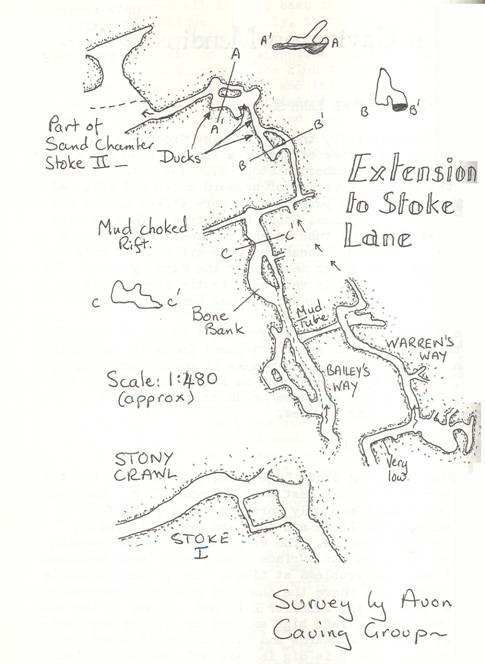
During November 1971, the Avon Caving Group dug into a
tight, aqueous series of passages leading from the stream inlet near Sand
Chamber in Stoke II. The entrance was
effected through a series of awkward ducks and followed along a narrow rift
passage with more stream inlets and meanders in the typical
another inlet running in a parallel direction. These passages are named Ward’s Way and Bailey’s Way after members of
the digging team. The end of Bailey’s
Way is very near to the stony Crawl in Stoke I, and an oral connection has been
proved.
It is unlikely that it will ever be a bypass to sump I due
to its tightness and the awkward ducks at the Stoke II end, which would
probably make it worse than sump I. This, of course, would depend on the water level in the cave, but would
in any case be undesirable from a preservation point of view.
Hunting Lodge Slocker
This shaft, in the
Lane
West London Caving Club. When work
began, the Shaft was only forty feet deep, the floor consisting of boulders and
farmyard debris including horse and cow remains. The W.L.C.C. set about removing all the
debris to the surface – some very large boulders caused numerous problems at
times. The present depth is about sixty
feet where the shaft is gradually narrowing. The two side rifts, Fusilier Rift and the one in the wall opposite, are
now left high and dry as digging work continues – still downwards and over the
whole shaft area. Not far away from this
dig is East End Sink which flows to St. Dunstan’s Well. Also the Upstream Series in Brownes Hole – a
foul place – (This was spelt ‘fowl’ in the MS, presumably no place to chicken
out of – Ed.) leads in the direction of Hunting Lodge, being about four hundred
feet away. Hopes are still high of a
discovery and work continues.
Editor’s
Note: Members
may be interested to note that Brownes’ Hole was largely dug out with B.E.C.
labour, under the direction of Les Browne. His son Pat, who was the discoverer of Brownes Passage in
B.E.C. member and he also discovered the Upstream Series in Brownes’ Hole up
to the first chamber. After Pat’s death,
two B.E.C. members – John Bindon and Alfie – pushed the second drainpipe and
discovered the Condemned Cell. The idea
by then was to establish the connection between Brownes Hole and Hunting Lodge
Swallet. They enlarged the second
drainpipe and carried on beyond the Condemned Cell before retiring from the
dig. Work was then carried on by Dave
Mitchell – a member of the B.E.C. at the time who broke through into the
further portion of the Upstream Series (Fred’s Passage, The Parade, etc.) Later, as a member of the East Somerset
Caving Group, they attacked the problem from the Hunting Lodge end. At that time, Hunting Lodge Swallet was full
of rubbish almost to the top. They
removed some forty feet of rubbish. The
present team are therefore following a long tradition – and the best of luck to
them.
The Tuesday Night Digging Team and Cuthberts II
Since Sump I was safely opened with a good airspace during
the winter of 1970/1971, work could begin on exploration projects in Cuthberts
II. To begin with, Sump II was seriously
attacked. To aid this, another two dams
(would you believe – courtesy of ‘Crange’ ?) were built just upstream of Sump
II. These are to facilitate bailing of
the sump, which was accomplished several times, enabling the sump passage to be
entered for about twenty to twenty five feet to a murky pool with a steeply
dipping underwater passage partially blocked with boulders, gravel etc. This area was greatly enlarged, not without
causing many and sometimes very hazardous problems. All went well during the drier months, but bailing
became impossible during the winter and so work has been temporarily
stopped. At one stage the team witnessed
a strange happening. With the sump
nearly bailed and no water running into it, the water level rose on one
occasion nearly trapping Roy Bennett who was working at the end of the sump.
Martin Webster has attempted to dive the underwater passage
but found the entrance too tight due to boulders in the stream bed. Meantime, the height of the dams is being
raised, which now means that a squeeze has to be negotiated over the top of the
Gour Rift dam because it was built underneath a large jammed boulder –
purposely, I might add. In the summer,
another attack will be launched. One
line of attack could be to drain the sump as far as possible, remove the
boulders, and attempt another dive.
Until work on the sump is resumed, the team has started
another maypoling and climbing programme; systematically working upstream from
just below the ten foot pot. So far
three holes have been investigated, but did not yield anything. The system of working used is to climb where
possible, or maypole to the roof level at selected sites and then traverse
along the passage inspecting every possibility. At roof level, large quantities of mud have been encountered, ranging
from dry powder to thick glutin¬ous accumulations which have made conditions
difficult. Lumps of charcoal have been
observed on the surface of mud banks at roof level up to sixty feet above the
streambed. There are plenty of holes in
the roof all along the II streamway and it is intended to work over its whole
length. We are also improving maypoling
techniques to enable us to rise to even greater heights!
Anyone interested in joining us on Tuesday evenings is very
welcome. The Cuthberts II streamway is
well worth a visit. We meet at the
Belfry at about 7 pm.
Book Review
The book reviewed here is new addition to our library and
may prove contentious. It is hoped that
a further, review may be received for the B.B. stating the case somewhat
differently
“QUARRYING IN
(1971). Published by
Council. Price £5 plus post and packing
from County Planning Department,
349 pp. 66 plates. 28 maps. 23 figs.
Some idea of the scope of this report may be gauged by the
fact that the report is on A4 size paper and well over one inch thick. At the price quoted and bearing in mind that
the edition is a limited one, it is doubtful whether more than a handful of
copies will find their way into the personal libraries of cavers. As a library book, which will shortly become
available to all members, it certainly deserves careful reading.
The report is divided into seven main parts which are
followed by a number of appendices which provide more in the way of background
to the main report. Together, they cover
almost every aspect of the quarrying industry – its background; history; future
prospects; geological importance; relationship to the rest of
England
of the findings of the survey.
Apart from the relationship between quarrying and caving,
there is much of general interest in this report, whose text is liberally
embellished with tables of statistics, diagrams, and maps. These range from the distribution of wind
velocity and direction with season over Mendip to flow diagrams of a modern
stone crushing plant.
However, it is the relationship between quarrying and caving
which will, no doubt, be of greatest interest to cavers, and it is in this
respect that the views of individual cavers are likely to differ in their
reactions to and interpretation of this report. The first thing which strikes one is that quarrying on Mendip is a large
industry of national rather than regional importance and, as such, cannot be
airily dismissed with a wave of the hand. On the other hand, caving views are well represented – indeed, it has
been said that on looking at the bibliography at the end of the report, too
great an emphasis might have been given to caving views. Certainly this bibliography contains a large
proportion of caving authors, but when this is compared with the sources of
information given as acknowledgements at the front (pages 5 and 6), it will be
realised that the bulk of the information has been acquired from commercial and
public sources.
As far as conflicting interests are concerned, I personally
feel that the report is as objective and free from any kind of hysteria as one
could expect. Items of special pleading
(which include caving interests) have been properly confined to the appendices
whose contents are briefly summarised in part 6 – that part which deals with
conflict¬ing interests. The findings of
the survey – in part 7 ¬are presented with commendable brevity when one
considers that they cover the entire scope of 230 pages of report and take just
over one page to do it. A précis ratio
of over 200:1 is not the easiest thing in the world to achieve! As an example of this, it is probably
worthwhile quoting the paragraph of most interest to cavers in its entirety, as
follows: – The conflicting interests are many and will have to be evaluated
and the merits of some are such as could affect the continued expansion or the
opening of new units within the production areas. Of the conflicting interests, it would
appear that the conservation of water sources will take precedence over the
quarrying interests – at least for the foreseeable future. In the Central and
Mendip
interests could outweigh the regional and national claims of the extractive
industry. In the
Mendip
interests.
One is left with the general impression that quarrying is
seen as an important industry and that the intention is to cater for its
requirements wherever possible. The
report, says, in effect, that while doing so, attention must be paid to other
interests – including our own – and that a balance between the exploitation and
preservation of the region must be achieved. The big question must be that of asking oneself how much weight the
arguments in favour; of preservation will have in practice when weighed against
the growing national demand for stone. The report lays down no rules here.
In Committee
A Brief Review of the main
activities of the club committee.
The March meeting of the committee dealt mainly with routine
matters. The detailed investigation of
the Belfry is well under way, and it was agreed to deal with this at some
length at the April meeting. Joan
Bennett, as club auditor, pointed out that if any changes to the Belfry
required a lot of money, then the committee should refer this to the A.G.M. It transpired that the committee has no
legally defined limit of expenditure but the chairman assured her that any
scheme involving large amounts of money would in any case be referred to an A.
G. M. for their approval or otherwise.
*****************************************
MENDIPS VANISHING GROTTOES is now on sale. It is hoped to include a review of this book
in the next B.B. Meanwhile, the price as
announced in last months B.B. is in error. The FULL price is 50p, but members will be able to obtain copies for 40p
up till the end of May. Get in touch
with DAVE IRWIN and secure your copy without delay!
*****************************************
Have you any club library books – or club tackle – or any
thing belonging to the club in your possession? There are a few items missing. Have a good hunt round your shed or attic and send anything you might
find to any committee member of the relevant club officer.
*****************************************
Spares for NIFE lamps and CARBIDE lamps are now
available. These spares, particularly
for carbide lamps, tend to be more difficult to come by as time goes on. Why not dig out your carbide lamps and give them
a birthday? Even if you only use them
during power cuts, a few spares could make all the difference. Spares are kept
at the Belfry.
*****************************************
Read any good books lately? Why not send us in a REVIEW of
any interesting caving, climbing, fell walking etc. books that you may have
read and think would interest club members?
Just a Sec
Notes from our Hon.
Sec. – ALAN THOMAS.
As you will have read in last month’s B.B., the committee
are going to look into the Dinner business in view of the dissatisfaction over
last year’s dinner and the fact that the pattern of club dinners seems to be
changing. As Hon. Secretary, I get
invited to a number of dinners, and I am being forced to the conclusion that
dinners just ain’t what they used to be. This year, the season opened as usual with the B.E.C. dinner which I
have already said was a poor meal. The dinner
was nonetheless enjoyable, but this is because the B.E.C. have a great capacity
for enjoying themselves despite adversity. The committee expressed our disappointment to the restaurant and we have
finally settled for a sum less than we were charged. The difference will be sufficient to provide a
drop of free beer at the next one. Make
a note by the way of the 7th October 1972 at the Cave Man. The agreed price seems good value indeed.
I attended the W.S.G. dinner (which was £2) and the U.B.S.S.
dinner (in the star at Wells for £1-70) so perhaps we need to rethink the price
we now pay. The W.S.G. dinner coincided
with a rescue, so that we dined at 9 pm and there was a superb Punch and Judy
show at the U.B.S.S. dinner by Oliver Lloyd which he has promised to repeat for
our next.
The most important piece of information to my mind that
comes with the M.R.O. report this year is that the police have taken out an
insurance policy through the county treasurer to cover civilian personnel used
on cave rescue work. It is therefore
imperative that all rescues are reported to the police if there is any possible
risk to life and limb. The police have
to pay £2 per day in respect of every rescuer below ground and £1 per day for
everyone above ground. After a rescue,
therefore, we must inform them immediately of the people involved. The policy provides £10,000 for death; £5,000
for loss of one eye or limb; £30 per week for temporary disablement and £1,000
p.a. for permanent disablement. If
anyone wants further details, I can provide them. There is no cover for such things as mileage
expenses, loss of earnings etc.
Editor’s
Note: Alan Thomas has just become an
M.R.O. Warden and Tim Large a team leader.
Dates for your Diary
26th MARCH
Box Stone Mines. Leader, Jock Orr. Meet at the Belfry at 9.30
a.m. (Sunday).
1st APRIL
(Easter Saturday) Little Neath
Leader, Dave Irwin.
8th APRIL
Stoke Lane Slocker. Meet at the Belfry at 11 a.m. Leader Tom
Gage. (Saturday)
30th APRIL
Reservoir Hole. Meet at the Belfry at 10 a.m. Leader Dave
Irwin. (Sunday). N.B.THIS PARTY IS
LIMITED TO FIVE.
Aug SEP
Sutherland. Caving, Climbing,
Walking etc. Contact Jim Abbott at 34,
Kirkgate, Shipley,
for further details.
Ian Dear Memorial Fund Meeting
This was held at the Belfry on the 12th of December
1971. It was chaired by R.A.
Setterington and the minutes taken by M.A. Palmer. N. Jago, R. Bagshaw and A. Thomas were also at the
meeting, whose purpose was to discuss the existing rules of the I.D.M.F. and
how they could best be publicised.
The meeting was reminded that IAN DEAR had bequeathed a sum
of £300 to the club for the purpose of assisting young members to visit the
continent to cave, climb anal visit places of interest. It was generally agreed that greater use
should be made of the I.D.M.F., since it was felt that IAN’s original intention
was that the money should and would be spent fairly rapidly.
To this end, the meeting agreed on a three point plan as
follows: –
- Improve
Publicity. - ALTER
THE RULES - Foster
more trips abroad.
The improvements in publicity were covered, the meeting
felt, by the insertion of more notices in the B.B.; by including more
information in any club advertising and by supplying information about the
I.D.M.F. with application for membership.
Changes in the rules were agreed by the meeting, but will
need to be covered by the next A.G.M., since the committee (who had the new
rule changes submitted to them by the Ian Dear Memorial Committee ) ruled that
the I.D.M.F. committee was a special committee rather than a sub-committee and
was therefore responsible to the A.G.M. The changes proposed to the rules will be published in full in a later
B.B. and this will give all club members roper chance to study them well before
the A. G. M.
In general, the changes in the rules are designed to let the
I.D.M.F. adopt a more flexible attitude by relaxing the annual ‘deadline’ by
which applications have to be in by relaxing the age qualification, subject to
certain provisions. The maximum amount
to be paid in any one year remains unaltered, but the maximum individual amount
may be increased under the new rules at the discretion of the I.D.M.F.
Committee.
The meeting considered probable that some older club members
would be prepared to foster younger members when making trips abroad, and felt
that this should be encouraged. Any
intending trips abroad by members prepared to carry out fostering should be
publicised in the B.B. for the benefit of younger members.
As already stated, the minutes of the meeting were submitted
to the general committee and it was agreed by them to give this subject
publicity in the B.B.
*****************************************
Tim Reynolds says in the latest Wessex Journal. Dont tell your troubles to your beer mug or
a passing stalactite. It’s unlikely that
they will be able to do much for you. It’s much more likely that something will be done if you WRITE TO THE
B.B. ABOUT IT (Tim didn’t say, that bit – I did.) It doesnt take more than a few minutes to
write a short note and put it in the post or the B.B. post box in the
Belfry. Get YOUR views over to the
club! The B.B. is YOUR magazine after
all, why not use it?
Monthly Crossword Number 20.
|
1 |
2 |
|
3 |
|
|
4 |
|
5 |
|
|
|
|
|
|
|
6 |
|
|
|
7 |
|
|
|
|
|
|
|
|
|
|
|
|
8 |
|
9 |
|
|
|
|
|
|
|
|
|
|
|
|
|
|
10 |
|
11 |
|
|
|
|
|
|
|
|
|
|
|
|
12 |
|
13 |
|
|
14 |
|
|
|
|
|
|
|
|
|
|
|
15 |
|
|
|
|
|
|
Across:
1. Twit Sue for comfort
underground. (7)
6. Everyone in Mud Hall. (3)
7. Step in Eastwater. (4)
8. Hole with sailors added is unaltered. (6)
10. Remove 7 down manually. (6)
12. Sore old Mendip product. (4)
14. Night before. (3)
15. A camera tripod does. (7)
Down:
2. Above ground again on the
blackboard. (1,1,1)
3. New metric units, five hundred and small bed for a Mendip cave. (6)
4. Often triggered off by itself beheaded. (4)
5. Stops rope slipping off pulley. (7)
7. Many chambers have these large stones. (7)
9. Cave type five with medicinal draught. (6)
11. Diving or climbing at no cost? (4)
13. Appropriate word for this position? (3)
Solution To Last Months Crossword
|
|
N |
|
O |
|
|
|
B |
|
|
D |
O |
W |
N |
B |
E |
L |
O |
W |
|
|
T |
|
M |
|
|
|
N |
|
|
|
A |
|
A |
R |
E |
T |
E |
S |
|
|
Q |
|
P |
|
S |
|
S |
|
|
R |
U |
C |
S |
A |
C |
|
L |
|
|
|
A |
|
|
|
A |
|
O |
|
|
D |
R |
A |
I |
N |
P |
I |
P |
E |
|
|
T |
|
|
|
E |
|
E |
|