
Contents
Shove Ha’penny Tournament.
A grand Tournament has been started on the lines of
everybody playing everybody else, to run from a fortnight ago until the day of
the Annual Dinner (First Saturday in October). All who wish to take part, see the organiser at the Hunters.
Bed Nights.
The all time, record is about 1,430 odd. We reached 1,400 last weekend, with a full
two months to go. Looks as if the Belfry
is popular this year.
Belfry Redecoration.
This will be going on full steam over the fortnight either side
of August Bank Holiday. Members staying
over this period are asked to keep out of the way of the decorating activities
as much as possible.
Thanks.
Thanks to those who have sent in articles. We are doing a bit better now and may be able
to have a bigger B.B. next month. Keep
it up!
Letter
To the editor, Belfry Bulletin.
I recently received my February B.B., which miraculously
arrived after about four re-addressings including one due to a 12,000 mile
removal, hence the delay in writing this letter.
I was interested to read once again of the editor’s amazing
system for writing B.B. articles and wish to vouch for the fact that it
actually works, in case anyone should doubt it.
The literary activities of Bert Bodge were placed before us
a few years ago as a shining example. Reading this caused an Idea to be planted in my mind, which, after about
six months to mature, gave rise to an article. This article in turn gave rise to correspondence. If six months is about the average time for
ideas to mature into articles, I’m afraid that this letter extolling the system
will be crowded out by the avalanche of articles which must be arriving now. I feel that the possibility of producing
correspondence is worth mentioning and should be included in the table of
weights and measures as follows; 2 articles = 1 screed = 1 correspondence
producing article.
Norman Brooks.
P.S. Although there may be those in the club more qualified
to comment on the drinking habits of the antipodes, the most startling thing
that I, as a new arrival, noticed was not that the pubs close at 6 pm – I was
prepared for that – but that they dish out the beer with a long hose reaching
all parts of the bar and drink it out of little glasses not much bigger than
eye baths. I have never seen this in
print, maybe the B.B. could claim a first on it!
Bath
Mines – Their History and Method of Operation
by Mike Calvert.
This article is intended as a follow up to the trip to the
difficult to understand if you did hot come on the trip.
History: This is very difficult to follow up as there
is an acute shortage of information available. Legend has it that in the VIIth Century A.D., Adhelm, later to be St.
Adhelm, came to Box and dug the ground there. It is said that he thus discovered the stone now known as Bath
Stone. The first positive material is
that in 1727 Ralph Allen came to
commenced underground quarrying of Bath Stone on Coombe Down which was used to
build such places as the Circus and the
industry, and Bath Stone was being used for many of our stately homes all over
the country. From the 1880s onward,
nearly all the so-called Bath Stone was obtained at Box or Corsham, as the
Coombe Down supplies had been exhausted as a commercial prospect. The rock at the former places came in bigger
blocks that that at
and was considerably more stable in quarrying. Hence less roof supports were needed and the cost of mining the stone
was cheaper.
The Quarrying Process:
The method of quarrying Bath Stone by underground means changed very little
from 1880 to 1930 and one description will fairly cover all cases. I take my extract from the Bristol Master
Builders Association Journal of September 21st, 1904.
The article concerns a visit to Monks Bark Quarry at Corsham. The quarries were owned by Bath Stone Firms
Ltd., later to become the well known Bath & Portland Stone Co. Ltd.
This firm has quarries at Combe Down, Farleigh Down, Box
an. in Corsham. The stone is extracted
from the quarry as follows: – The first procedure when at the rockface is to
drive adze shaped picks six to seven feet into the top foot of the rockface,
putting longer handles on the pick as it goes further into the rock. The width of the hole thus formed varies
according to the width of the bed. In
these are twenty five to thirty feet wide. In the Box workings they are from twelve to twenty feet wide.
Next, a one handed saw is brought into action. These saws are in lengths of four, five, six
and seven feet. They are broad at the
head or extreme point. The saw is first
worked in horizontally, dropping a little as it goes in, and thus opening the
rock down to its next natural parting. When this has been done on either side, the block is separated laterally
from the parent rock. Levers are then
inserted into the bed or natural parting at the bottom of the block and these
levers are weighted and shaken until the block is forcibly detracted from the
back. It is then drawn down by crane
power and the broken end and the bed dressed with an axe so as to make the
block shapely. It is then placed on a
trolley and allowed to run to the loading platform.
After the first block has been removed, it is evident that
the workmen have access, by that opening, to the back of the bank of stone and
they avail themselves of this to work the saw transversely which, separating
the block from the back or hinder attachment, renders all further breaking off
unnecessary, so the first block of each face is the only one which is broken
off.
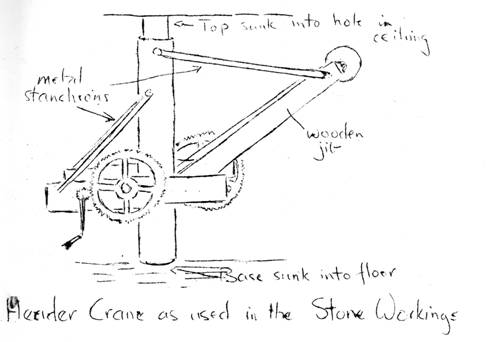
To each face, or heading of work, a ten ton crane is erected
in such a position as to command the whole face. These cranes are now constructed
telescopically so as to accommodate them to slight variations in the headings
arising from different depths of the valuable beds. After the block of freestone has been
loosened in situ, a Lewis bolt is let into the face of the block, the chains of
the crane attached to it, and the block then drawn out horizontally.
In one quarry at Monks Bark there is a machine worked by
compressed air for picking the rock above the face at the roof. It is estimated that three million cubic feet
of rock per year is dug out by the firm
This description gives a fairly good idea of the method of
extraction but it misses out several details. I have gathered together a fair number of these details from a number of
sources and rolled them into one illogical article, but I was pushed for time
when trying to please our editor and write him an article.
The entrances to the workings vary immensely in character,
the type of working which has its entrance going into the side of a hill
generally has a horizontal or very slightly inclined entrance but those which
enter the surface generally have sharply inclined shafts which may drop a
hundred feet or more before the main workings are encountered. Other connections with the surface are
ventilation shafts. These are usually
narrow, vertical and round shafts which were dug from the surface downwards. These may be up to one hundred feet in depth
and remember, there were no pneumatic drills in those days! The shafts were dug with a pick and shovel
and a winch to take away the rubble. Yet
a third type of connection with the surface are vertical shafts about ten feet
square dug to extract the stone when the workings became very extensive. These are encountered in the Box workings.
Now to the inside of the workings. These are of two types which depend on the
extent of the beds. They may be either
single passages following a bed or, where the bed is very extensive, the
workings are one mass of interconnecting passages. Generally, the passages are ten to twelve
feet square in section. In the former
type of working, the roof is generally a little insecure and is propped
regularly by short wooden poles near the ceiling. In extensive workings, blocks of rock are
left periodically to support the roof.
As the quoted article suggests, transport in the workings
was by trolley. These were of various types
– flat low ones for transporting the stone, boxes for transporting horses and
carts for the men. The trolleys were
pulled by horses in the main, but one reference I found for 1883 mentioned a
steam engine pulling the trolleys. The
trolleys had flanged wheels and ran on lines similar to railways. In some workings, traces of sleepers can be
found, in others there are no such traces. If an inclined shaft was used as an
entrance, the trolleys were pulled out by winch, and once the horses were down,
they stayed down like pit ponies. The
stones cut averaged thirty to forty cubic feet and the miners used benzoline
lamps in the 1880s but turned to acetylene lamps at a later date.
There were stonemason’s shops in Box where stone could be
cut to order and this became of great importance in the 1920’s. Previous to this, the stone was sent out the
same size as it was cut. There were also
machine shops of various types for making trolleys, engines and cranes. Once the stone had been quarried, it was
dried before use. The usual procedure
was to stock all the stone quarried during the summer months of in large piles
outside the workings. These then
provided the supply for the following winter. The winters stockpile was used during the up summer.
For anyone who is interested, the author will be willing to
take people round the workings at Kingsdown near
face crane left in position when the workings were abandoned. There are also numerous one handed saws and
some double handed ones. There are a
mixture of passages, mostly straightforward although some are complex.
On The Hill
or T.W.T.M.T.W.
Mendip, the world of beauty that few ever see. So reads a headline of the
a quite factual article on Mendip and its caves now well written, thanks I’m
told, to Kevin Abbey who deleted some rather imaginative passages such as
“..at the top of the Gorge in G.B. is a permanent flashing red beacon to
guide cavers back to the surface.” Mr. B.J. Iles goes on to cover some of the larger swallets, vandalism
and even B.E.C. leaders. I see that only
the B.E.C. is mentioned, could the ‘editor’ be biased?
Another article recently appearing in print was an item on
photography underground by Nick Barrington in the Amateur Photographer with, so
the experts tell me, quite good shots of Balch, Swildons and Cuthberts. It strikes me as odd that none of our well
known club photographers have not already exhausted this theme.
News from the other clubs is at its lowest ebb and I suspect
that my gleanings will already be common knowledge. Cerberus, on
Mendip
current rumour is that it is going! Incidentally, I am told that no committee meeting has been held by
C.S.S. since their A.G.M. in April! This
apparently leaves an annoying state since their Trip Sec. retired and to date
no new appointment has been made. It is
rumoured that “Prew” is taking over this vacancy.
The C.D.G. have been diving again in Stoke, surveying their
previous discoveries. Were these
discoveries in any other cave, I’d be quite interested in a speedy opening up
of these extensions but in Stoke Lane Slocker – I ask you!
The S.M.C.C. have – apart from Family ties with the C.D.G.
been very quiet lately. The
this month appears to have been a takeover over by Tony Oldham & his nom de
plumes (or should it be noms de plume? – Ed.) with several articles in his own
right plus a report on Mr. Jiffre’s underground sojourn. What price written by other than Alfie? Rumour has it that the M.C.G. are blossoming
forth again, but still no news of the S.C.O.T.(M.N.R.C.) O.T.W.N.H.A.A.S., the
U.B.S.S., the A.C.C. and others.
The Mendip Cave Registry held a meeting in June and I gather
that results so far are very satisfactory and reports, with few exceptions, are
rolling in. I for one will be very
pleased to see the end product.
The Charterhouse Caving Committee, which started in a legal
frenzy, seems not to have progressed any further than reiterating the rules
pertaining to G.B. It should be noted
that Mr. Young at Longwood will now permit only two parties down at any one
time. Better give him plenty of warning!
News of the club is also limited. The Annual Barbecue on June 22nd went with a
swing and no doubt an article will be forthcoming on this subject. There were several suited gentry present from
the Chelsea Speleological Society present – no doubt on holiday from Aggy
Aggy. In case no one else remembers to
thank the organiser – my thanks!
From Clapham comes news of a cave guide – Mike Boon. With the marriage stakes we hear of Jug
Jones (R.I.P.) recently wedded and legal
like, a point of interest to a recent rescue at Dow Cave, stated by a radio
announcer, was that it cost the rescued several pints. Obviously well informed! Thinking of pints, one of my informants,
snooping round a certain Saturday Meet hears whispers of promised barrels later
in the year. No doubt the usual
grapevines will bear out the truth of this.
Thought for the month: To date, O.T.H. has incited no
comment by way of reply to the B.B. If
you agree with all that I’ve said, think how humdrum you really must be!
Stalagmite