
In accordance with tradition, an attempt each year to make
the Christmas edition of the B.B. larger than normal. Equally in accordance with tradition, this
page is written long before it is know whether or not we shall have succeeded. It only remains to hope that we have and to
wish all club members and all readers:-
A Very Happy
Christmas
*****************************************
The B.B. questionnaire was filled in and returned by a
gratifyingly large number of members. The editor would like to thank all those who replied. In view of this, no apology is made for
taking up an amount of space in this B.B. to explain what your views were; how
they differed from what is published now, and what we are going to do about
this in the future.
*****************************************
DON’T FORGET the removal of cutlery & crockery from the
Belfry on January 1st. Also the removal
of unwanted gear from the Belfry and site.
Contents
- 1 Questions Department.
- 2 The Belfry Bulletin in 1963
- 3 Notice of Jollification
- 4 Caving Log
- 5 Geyser Stalagmites
- 6 Report Of A New Discovery In Cuthberts
- 7 Weekend in North Wales
- 8 What happened to the Mammoth?
- 9 The Ghosts of Rookham Hill
- 10 Cuthberts Crossword
- 11 Jugs Journeyings
- 12 The Education of H.M. Forces
- 13 Annual List of Club Members Names and Addresses
- 14 Excuses Reasons for Not Caving
Questions Department.
What is Priddy Round House? It is marked on the six inch O.S. map in the middle of a field to the
left of and almost at the top of
Barrows Lane
suggests, is circular in shape. If one
visits the spot (or as near to it as can be judged from the map without taking
measurements, there is a roughly circular patch of stinging nettles which may
mark the spot. Perhaps some of our
archeologically minded readers may know the answer? It certainly had me slightly intrigued when I
saw it on the map, as I could not imagine the use to which a rather small round
building could be put, sited in the middle of a field and apparently not
connected with any other buildings. If
anyone knows the answer we shall be pleased to print a reply in next month’s
B.B. as, even if it is unconnected with caving or archaeological activities, it
is good to know as much as possible about the area in which we spend so much of
our time.
*****************************************
A fund is being organised for Jack Waddon’s widow, Dorothy
and the children. Similar funds are being organised by various other caving
clubs and the aim is to collect a really respectable sum of money. All
donations should be sent or given to R.J. Bagshaw,
The Belfry Bulletin in 1963
As explained at the time, the B.B. Questionnaire was
produced to give the editor a chance to find out whether the B.B differed from
what the club wanted in the way of a magazine, and to stop him having constantly
to refer to the B.B. in the B.B.
Response was quite good, and much useful information was
collected, for which the editor would like to thank all who filled in the
forms. These forms have been studied and
averages worked out. From this, it is
possible to see what the majority of readers would like in future.
Starting next month, the requests and suggestions made by
the members who filled in the forms will be put into effect and it was felt,
that readers might like to know what changes in the B.B. are contemplated.
The Cover will
remain as at present. When present
stocks run out, the bat’s face will be improved and the blocks redesigned for
better registration. The date and serial
number will not appear, as this proved wasteful and also expensive in the
past. Only one member asked for them
this time. It may be possible to include
the odd ‘special’ cover from time to time as requested by some, if a suitable
excuse arises.
The Format will
also remain unchanged. Members were
unanimous on this point. It also saves
stencils, and enables us to use easily available paper.
Publication will
remain monthly as at present. A few
members preferred every other month, but in addition to pleasing the majority
here, it was felt that as the B.B. is the only Mendip caving journal to appear
monthly, it would be a good thing to continue the practice. It would not do to make every journal too
similar.
Contents. It is here that the changes will occur. The system of relying entirely on articles
sent in by members is not working as well as it did. The new system is based on a number of
‘features’ which, we hope, will be collected by a number of volunteers and
which will appear at different intervals – some nearly every month and some
only now and again. These will form the
‘backbone’ of the B.B. to which articles will be added.
It was interesting to compare the percentages of space which
members wanted with the amount each subject regularly gets in the B.B. The biggest discrepancy was under the heading
of club news. If we include all matter
pertaining to the club, rather than to caving, climbing etc which appears in
the B.B., we find that it has been as high as 41% of the entire year’s contents
(1951) and that it averages over the years at about 30%. In case it is felt that this percentage has
been getting worse of late, it is interesting to find that the reverse is the
case. Last year it was 27% and the year
before 21%. The amount the club want is
9%. Part of the reason for this
discrepancy is that it has been the policy since 1957 to produce a minimum size
B.B. every month. If not enough articles
are available, space has been filled up with ‘padding’ of various forms. By removing this padding, the percentage
drops considerably.
It will not be possible to get the amount down to what has
been asked for, however, since one of the main functions of the B.B. is to
distribute club news. In future, this
will collected up into one ‘feature’ and notices will be tucked into odd spaces. In addition, all ‘padding’ will be dropped,
and this should bring the total down considerably.
The percentage of caving asked for was 26%. In the past, this figure has varied
considerably, from a minimum of 8% in 1951 to the present record amount of 42%
in 1961. By pruning the caving log, and
restricting it to trips having an unusual feature or reporting work or a
discovery, it should be possible to comply with members wishes and still
include all the caving articles offered.
A new subject put into the questionnaire was that of news of
the activities of other clubs. The
surprising answer obtained was that the club wanted 14% of the B.B. to be used
on this subject – nearly twice as much as was wanted of news of the B.E.C.! Again, this type of news will form the
subject of a feature which will appear in most of the B.B.’s. Volunteers have already agreed to provide the
material for such a feature.
Normal articles will, of course, still be needed just as
much as ever, as a guide to the subjects which are most popular, the club want
more articles of a scientific or informative nature (18% is wanted as against
9% in 1961 and a maximum of 17.5% in I951). More articles on archaeology are wanted (6% as against a maximum of 4.5%
in 1961). In contrast to this, the club
are not keen on articles describing members travels or personal news of
members. 3% on each of these subjects is
considered by most members to be ample.
Climbing has been erratically reported in the past. It has varied from 17% of the B.B. for 1951
to nil in a number of years. The amount
required is 8%. Humour is in a similar
position, with a maximum of 22% in 1952 and a minimum of 2.5% in 1961. The club want 6% but many members make the
proviso that a really good humorous article will always be welcome. It is now down to the club humorists to see
what they can produce in the way of really good stuff!
As a result of further requests, an occasional feature
commenting on some aspect of caving or club life will appear. It should be understood that any opinions in
such articles may not necessarily be those of either the editor of the
committee. Manuscripts for this feature
should contain constructive comment and be designed to stimulate discussion
rather than to ‘ stir’ for the sake of stirring.
All this may mean that the minimum size of the B.B. may
occasionally be reduced. At present, it
is never less than 8 pages, although sometimes this has only been achieved by
the liberal use of ‘padding’. However, we
hope that the size may be kept up, and that it will be possible to print the
odd ‘special number’ now and again – possibly with a special cover.
The only minority which it has not been found possible to
cater for are those few members who would like to see the B.B. come out much
less often, and have the appearance of a big” journal. Some of those members did make the point that
they realized that the caving reports performed this function in the
B.E.C. to some extent and we would like
to emphasise that, while we are proposing to copy some of the ideas contained
in other caving club journals, it is not intended to make the B.B. a carbon
copy of any other journal. However, it
may prove possible to go some way towards satisfying members who would like to
see a large, less frequent B.B. without altering the B.B. as it stands. If this scheme proves workable, a suitable
announcement will be made in a future B.B.
It now remains to be seen whether the new layout of the B.B.
proves popular in practice. Time will
tell!
Notice of Jollification
There will be a “bring your own bottle” party at
the Belfry on Christmas day. All members
and friends are welcome. The party will be held in the evening.
Note; The Belfry has been specially enlarged for this
function.
Caving Log
(Trips of interest extracted from the B.E.C. Caving Log by
Mike Luckwill.)
On the 27th of June, John Cornwell led a trip of 11 people
down
brown things in the stream!’
Also on the 27th, Mikes Palmer & Wheadon, with Albert
Francis and John Swift investigated, Lots of disappointing rifts in Victory
Passage which we were rather optimistic about. They report the result of this investigation in September Series as
being ‘lots of loops’. Again on the
27th, John Ransom did a trip as a weegee to
colourful’.
Mike Holland and three visitors report from Cuthberts on
Whit Monday descended to Dining Room and out via Rat Run. On the way out of the Wire Rift, the wire
finally gave way under the weight of El Grosso and was coiled up in a tangled
mass at the top of the rift.
On June 12th, Mike Baker, Mike Boon, John Cornwell plus two
others did a photographic trip to Cascade Chamber, while Mike Boon investigated
the sump. When lying full length in it,
he couldn’t get his boot upright.
The Swildons Diving Op on the second of June consisted of
divers Mike Thompson, Fred Davies, Mike Boon and Steve Wynn-Roberts with a
support party of – Mike Holland, Bob Pyke, Ron Teagle, Jim Giles, B. Johnson, D.
Turner and several M.N.R.C. types. The
support party entered the cave and rigged the pitches and proceeded to sump
IV. A second support party and the
divers went to sump II when the divers continued downstream and were, met by
the support party in Series IV. Marriott,
Pyke and Turner assisted the divers to sump VI while the remainder left the
cave.
leaving Pyke and Turner to operate the kitchen for the divers. The divers succeeded in passing sump VI and
entering Series VII (with the exception of-Davies whose equipment snagged up in
sump VI at a constriction). In Series
VII, preliminary exploration was carried out and a rough survey made. Sump VII was inspected and reported to be
‘tightish’. For further details see
S.M.C.C. Journal.
A working party in Priddy Green was held on the 19th of June
and consisted of Mike Boon, D.A. “Grassy”
Thompson’s recent banging.
A Cuthbert’s party of Jim Giles, Grassy Greenwood and D.
Smith wrote ‘Taking advantage of M. Boon’s good work in clearing the duck, a
further examination of the terminal sump was carried out. Conclusions reached: Sump and side passages very
unpromising. J. Eatough’s Maypole:
Three sections moved to the bottom of the Entrance Rift while remaining section
left at
an interesting addition to the sport of the Entrance Rift.
On the First of July, a very large party went down G.B. on a
photographic trip. J. Cornwell, A.
Collins, T. Philpott, A. Sandall, J. Lamb, J. Wathen, Graham & Julie
Robinson, Mike Baker, R. Jarman, G. Tilley, D. Smith, N. Petty, B. Robins, N.
White, C. King, D. Ager, P. Board, T. Blanchard and four others. The aim was to take photographs for the
photographic competition.
On the 6th of July, Richard Roberts and R. Croft did a trip
to the Maypole Series and Main Stream Passage in Cuthberts collecting water
Samples and bugs. The next day, Mikes
Wheadon and Palmer with Albert Francis and Dave Stevenson went dawn to Sugar
Bowl Chamber after moving the boulder in the Entrance Rift. They report that they managed to bring walls
of Sugar Bowl Chamber down (literally) around our ears. There is no longer a hole in the floor but
through ruckle leads back to Quarry Corner. The same day, Mike Luckwill, John Cornwell, Sally Featherstone did a
tourist trip round Cascade, Fingers, Cerberus and Rat Run. John Cornwell reports shattered after early
morning exercise with some athletic types.
On the 11th of July, during a tourist trip to September
Series, consisting of P.M. Giles, R. Williams and G. Bell, the telephone line between
Kanchenjunga and Pillar Chamber was removed and left coiled at the entrance to
Pillar Chamber. The same day a well in
Flax Bourton was investigated by R. Bennett, N. Petty, K. & P. Franklyn and
S. Tuck. The well proved to be some
twenty feet deep with five feet of water in the bottom and no apparent way
through. Ten feet down, a passage was
revealed after removing deading. R.
Bennett explored it for some fifteen to twenty feet. The air was bad and it ended in a tight
rift. The first part of the passage
appeared to be mined and not natural.
On the 29th July, M. Baker, N. Petty, J. Cornwell and R.
Bagshaw went down Cuthberts. M. Baker
and J. Cornwell went digging in Cerberus Series in a small solutional passage
and reported easy digging but an awful large amount of ‘sand’. R. Bagshaw and N. Petty fixed up a new
rawlbolt on the Water Chute to secure the chain.
The September issue of ”
of our members contained an article entitled “Estalagmitas de Geiser”
written by Professor Antonio Nunez Jimenez and was accompanied by some
excellent photographs and drawings. The
article which follows attempts to provide a partial summary and report of
Professor Jimenez’s findings.
Geyser Stalagmites
(Translated by M.
Luckwill)
The Gran Caverna de Santo Thomas is situated in the Sierra
de Quemado, in the province of Pinar del Rio and its ten and a half miles of
passages make it the largest underground system in Latin America. In 1955, Professor Antonio Nunez Jimenez and
his party were exploring the system when they came across an unusual formation
never before reported in the
stalagmites, conical in shape, and in whose tops appeared craters similar in
shape to those of volcanoes. These were
a notable discovery in the field of speleology for they were not at all like
the solid structures formed from water drops falling from the roof and slowly
building up a large deposit.
At first they thought their discovery would have the
following explanation: after the formation of a normal stalagmite by the drop
process, the solution, having lost its carbonate content, would be acid and
this acid solution, when dropping onto the stalagmite, would produce a hollow
crater in them. However, this hypothesis
was rejected for, of the 234 stalagmites studied, the immense majority had
neither stalactites nor water drops above. Also a few of the formations had a crater, not at the top, but on the
side the side of the stalagmite which clearly indicated that they had not been
formed by any falling water.
Their curiosity grew when they observed new characteristics
in the formations which also compared with the big volcanoes on the earth’s
surface, a more careful examination of
the stalagmites showed them that the edge of the little craters possessed marks
which seemed to indicate that the force which made them came from the inside of
the stalagmite and proceeded outwards. A
microscopic analysis showed that the cones were formed from a porous mass of
calcite very different in structure from that associated with the normal
process of stalagmite construction. They
also found together with the Calcite, intrusions of Limonite and clay
impurities.
It seemed, therefore, that the solution which had formed
these deposits had been in the form of geysers and jets of water which had
opened up fissures in the cave floor and left sediment of cones of calcite
around the water vents, a process similar to that of volcanoes.
A search of the caving literature of the world over a period
of years verified that only in the Grotto of Arragonite in
had such formations been reported. There
is no doubt that
is the second country in the world to possess these geyser stalagmites.
As in the Czechoslovakian caves, the geyser stalagmites are
aligned above a clearly visible fissure in the passage floor known as the Salon
y del Abono. The largest of them is
nearly five feet in height, with an inner circumference of over a foot and a
crater depth of some fifteen inches.
All photographs and drawings which accompany Prof. Jimenez’s
article on these formations are well worth looking at. A copy may be seen in the club library. It is interesting to note that the carbonate
occurs as Calcite. The idea of geysers usually brings to mind hot solutions and
under these conditions one would have expected the carbonate to have been
deposited as aragonite.
Report Of A New Discovery In Cuthberts
by R. Bennett &
J.A. Eatough.
On the 6th,May, 1962,
Roy Bennett and I were making a thorough investigation into Coral Series, when
we came to the conclusion that …further passages probably lay above the then
known limits of Coral Series, and so a systematic search was made. During this search, many, small holes were
probed. In Long Chamber, I managed to
find a way into a boulder ruckle, and pushed through into what was obviously a
very large chamber. I immediately went
back for
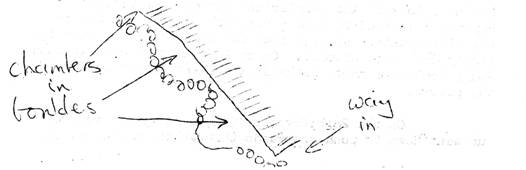
and together we made a preliminary investigation. This large chamber was found to lie along the
fault which forms the western limit of the St. Cuthberts system, in a position
between Curtain Chamber and Coral Series and thus fills a gap in the
survey. We soon found that the chamber
was of considerable size and in places was divided into smaller chambers by a
tremendous confusion of boulders lying against the hanging wall of the fault as
shown below….
We went into the boulders at the north end of the chamber
into a further large chamber, then into more boulders which have so far halted
progress to the north. We left a cairn
at this point.
Back in the second boulder ruckle we entered, we found a
pile of stones which, after much discussion, we decided might be a cairn left
by a previous party, but a very careful search revealed that no previous party
had entered the system by the way that we had entered it. We decided that further investigations were
required.
On the way out of this chamber we had a quick look at the
boulder ruckle at the south end of the chamber, noting a small passage which
was not entered, but we did see a very fine nest of cave pearls and quite a lot
of good formations. Following the
discovery of this chamber I made two more trips to the area, this time
accompanied by John Attwood and Kangy. During these trips, we pushed on in several directions and found quite a
lot more passage including a finely formed and finely decorated solutional
passage which ascended steeply to a stal barrier as shown below…..
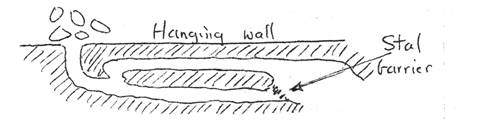
This was some sixty feet up. While Kangy was having a look at the barrier and the chamber visible
beyond, I managed to find a parallel passage and bypass the obstruction. After a flat out squeeze, I got into the
richly decorated chamber. On my fourth
trip, John Attwood and I took some photographs in this last discovery and of
the pearls.
On the 28th October 1962, a party of eight of us went down
to push downwards through the boulders, in an effort to find a way on and solve
the mystery of the cairn. We pushed on
downwards, past the cairn and suddenly came to a large passage which was
discovered to be Fracture Rift, above the way into Coral Series. Due to the extremely dangerous state of the
boulders here, we did not push through into the passage, but left a lighted
candle, then beat a hasty retreat and went to look for the candle from the
Annexe Chamber end of the passage, from which the candle could be seen.
This, then, is a preliminary description of the latest St.
Cuthberts discovery, which can be safely said to be the most important since
the discovery of September Series, and one which has added some five to six
hundred feet to the total length of the cave.
Much remains to be done here, but would be explorers are
warned, of the extremely dangerous nature of the huge piles of boulders, many
of which have no visible means of support. This is most certainly the diciest part of the cave system so far found.
We have decided that the cairn was probably left, in the
early Cuthberts days, by a party who climbed into the boulders from the Annexe
Chamber end, noted the danger built a cairn and then left, having come within a
hairs breadth of finding the new chamber, which is probably the second largest
in the cave and may well prove to be the largest.
We have named this chamber Upper Long Chamber
provisionally. Exploration, photography
and surveying are continuing.
*****************************************
All of which goes to show, amongst other things, the
importance of WRITING UP trips where future exploration parties can read them
and compare notes! Ed.
Weekend in
North Wales
(19th 21st October, 1962)
by Roy Bennett.
In spite of last minute changes in plan, fifteen people
ascended into the
Wellingborough Mountaineering Clubs jointly owned hut at Yefnant near
locating this, but the hut, which was comfortable and commodious, was worth the
trouble and coped reasonably well with the influx plus about a half a dozen of
the owner members.
Saturday dawned clear, tempting some members out of bed at
the unusual hour of eight am and eventually the entire expedition assembled in
Ogwen for various purposes. Messrs Turner,
Keys, Bater, Petty and Sybil went walking, Mike and Lourie ascending Tryfan and
Crib Goch with intermediate motor transport, while the Tucks and Bennetts
ascended Glyder Fawr via the (I can’t read Roy’s writing! Ed).
Meanwhile, Messrs Marriott, Mossman, Sandall with Mrs’s
Bater and Sandall led by the invincible Anthony J. Dunn attacked chasm route on
Glyder Fach. Some difficulty was
experienced by some on a little obstacle known as the Vertical Vice, but after
considerable effort all appeared on the summit. At this point Tony, Alan and Mo decided to walk back to the hut via Y
Garn etc as the way appeared easy and the map distance insignificant. When the remainder of the party returned to
the hut, an enquiry from one of the owner members indicated that darkness would
fall ere they returned. Consternation
almost reigned and it was wondered if the B.E.C. could stand the simultaneous
loss of three committee members. The
Tucks and Bennetts rapidly departed to the house of
in case a rescue party should be required and John undertook to ring up the
Mountain Rescue first thing Monday morning if necessary. However, all was well and the summit party
returned to base under their own steam after traversing numerous bogs
(vegetable) and other obstacles with consummate ease.
Sunday also proved rainless and was again spent in
Cgwen. Some traversed Tryfan South to
North and Sybil had a bad moment on the mountain. The climbers did various routes on Bochnydd
Buttress of increasing difficulty but no one actually fell off and the
assembled company made for home after a very enjoyable weekend.
What happened to the Mammoth?
by K.S. Gardner.
Every one is acquainted with the hairy long tusked mammoth
that was part of this country’s fauna during the last Ice Age. A tooth of one was found in St. Cuthberts
Swallet a few years ago by Jack Waddon.
That the mammoth was contemporary with man we know from the
lifelike representations on the walls of the French caves, paintings and
engravings ten to twenty thousand years old. But what happened to this great beast when the polar front retreated
from the
position? Of his contemporary companions
many remain accepted as present day occupants of this earth; the reindeer the
arctic fox and the lemming did not become extinct, they merely moved north, as
must the mammoth have done initially.
It is widely known that some years ago, a frozen carcase of
a mammoth came into the hands of a scientific institution in
much was learned from its study. The
general impression was that this was a stroke of luck – one mammoth preserved
by chance and fortuitously delivered into the hands of science. This is not quite the case, however, for
“superstitious peasants” and people who “must be mistaken”
had been taking such happenings for common place for centuries previously.
The word mammoth is alleged to have been derived from
mammantu meaning the underground giant. Throughout all of Lapp and Siberian folklore are legends of a monstrous
hairy beast who sleeps beneath the snow and slowly emerges when it melts. A more material form of evidence is the long
established trade in ivory carried out by Siberian peasants. At the beginning of this century the
pairs of mammoth tusks per year. The
trade is not new either; both pre-Christian Chinese chronicles and Pliny the
elder refer to ivory being dug from the ground in
In 1611 in
J. Logan exhibited a huge elephant’s Tusk from
discovery of carcases and the legends of burrowing elephants. In 1724, Peter the Great sent a
representative to investigate and he found a putrefying carcase. In 1802, another was seen by Prof Adams and
at last in 1901, the Imperial Academy of Science at
scientific study of an almost whole carcase.
A study of the stomach contents revealed that, far from
being a tundra beast, this hairy elephant fed on lush forest plants. Its remains were found when the forest had
retreated – perhaps been stripped even by the vast hordes of mammoth, more and
more of whom must have been slowly concentrating on N. Siberia ten thousand
years ago. But did they all drop dead
with no descendants, even though the Siberian environment of the time must have
been ideal for them?
Three million square miles of
is covered with the world’s largest and least known forest – the Taiga. A forest which could hide
the size of the
mammoth still survive? How old were the
ice preserved corpses – ten thousand years? – a thousand years? – a hundred years?
In 1580 a Don Cossack reported having seen a large hairy
elephant beyond the
followed tracks into the Taiga for several weeks. His quarry eluded him but not before he had
seen them. Shown pictures of the
mammoth, he had no difficulty in identifying them!
After the discovery of the so-called extinct coelacanth, who
knows what other ‘extinct’ fauna may prove one day not to be so.
The Ghosts of Rookham Hill
by P.A.E. Stewart.
It is the custom, my masters, on a winters evening when the
lamps are trimmed, the wind is moaning in the chimney and the snow lies crisp
outside that the talk turns to things supernatural and strange.
As you sip your ale in the “Hunters” and read your
Christmas B.B., here is a little tale for your entertainment. A true account of a rather weird experience
on Mendip top (an experience which I hope never to have again!) and its
interesting sequel.
In the autumn of the year 1956, I had been to Wells for a
meeting and was returning late at night by the old
stronger – and was quite cheerful, thinking of a future caving programme and
the prospects for some digs that were in progress.
I came round the bend at the bottom of Rookham Hill and had
just changed down for the long slope up to the top when I felt a prickly
feeling on the nape of my neck. This
sensation gradually intruded itself on my thoughts until I became fully aware
of it. My first thought was of a draught
so I automatically felt for the side window and it was closed. This perplexed me rather and by this time the
effect had become more intense – I realised that all my hair was standing on
end! The next stage is difficult, to
describe and consisted of: –
(a) Trying to control rising nervous tension.
(b) Driving the car.
(c) Looking for the cause of “all this
ere”.
The answer to part (c) was even worse. I realised that there was someone (or
something) in the nearside back seat! By
this time I had reached the top of the hill and was passing Bishops Lot
Swallet on the run down to the Hunters. I don’t quite know how if realised that there, was something in the
back, but I was completely certain.
By this time, things were beginning to get a bit tough and
the over-riding impulse was to stop the car and get to heck cut of it! However, I realised that this would not solve
any problems, as I would have to get back in again and drive on to
much harder. Mendip at 11 pm in the
middle of the week is not particularly over populated. I was stuck with it!
There was only one way to resolve this and this was to look
in the rear view mirror and check the back seat. However I could not bring myself to do this
as I knew it would only confirm the situation and most certainly would mean a
crash stop with all anchors out. By this
time I had my foot hard down and was going like the clappers past the Hunters,
over the cross roads and up towards the Mineries. I was hoping that if I drove on whatever it
was would eventually disappear.
At the forestry houses I must have been touching 55 and at
the last moment remembered the wicked right hander ahead. Brakes, two wheels, grass verge and I was
round, but only just! Foot hard down
again past Waldegrave Pool, the Miners and the Castle until just at Land Leer
it wasn’t there any more and the tension suddenly lifted. I coasted down to the top of Harptree Hill
and mopped a dripping forehead. I quite happily looked in the back seat and of
course there was nothing there. Everything was quite normal.
The whole thing was not subjective, of that I am quite
sure. I have been in worse situations
without any trace of the “heebies” and I sincerely hope it never
happens again. The nest day, I mentioned
the episode to an acquaintance from Wells and he told me this story. A friend of his was in a combination and had
just passed the Hunters going towards Wells. He saw what he took to be the weak headlights of a car at some distance. The sudden appearance of a coach with four
black horses and two sidelights going towards the Hunters put him in the ditch.
When you leave the Hunters these dark evenings, cast a
glance towards the top of Rookham – you never know what you may see!
That is just how it happened, my masters, anything in the
car that night? I will never know.
Cuthberts Crossword
|
1 |
|
2 |
3 |
|
4 |
|
5 |
|
6 |
|
|
7 |
|
8 |
|
|
|
|
|
|
|
|
|
|
|
|
|
|
|
|
|
9 |
|
|
|
|
10 |
|
|
|
|
|
|
11 |
|
|
|
|
|
|
|
12 |
|
|
|
|
|
|
13 |
|
|
|
|
14 |
|
|
|
|
|
15 |
|
|
|
16 |
|
|
|
|
|
|
|
|
|
|
|
|
|
|
17 |
|
|
|
|
|
|
18 |
|
|
|
|
19 |
|
|
|
|
|
|
|
|
|
|
|
|
|
|
20 |
|
|
|
|
21 |
|
|
22 |
|
|
|
|
|
|
23 |
|
24 |
|
|
|
|
|
|
|
|
|
|
25 |
|
26 |
|
|
|
|
27 |
28 |
|
|
29 |
|
|
|
|
|
|
|
|
|
|
|
|
|
|
30 |
|
|
|
31 |
|
|
|
32 |
|
|
|
|
33 |
|
34 |
|
|
|
|
|
|
35 |
|
|
|
36 |
37 |
|
|
|
|
|
38 |
|
|
|
|
|
|
|
|
|
|
|
|
|
|
|
|
|
|
|
|
39 |
|
|
|
|
|
|
40 |
|
|
|
|
|
|
|
As many Cuthberts names as possible have been incorporated
in (ignoring all two letter words where they occur). The clues are in the form of a trip
description which should prove very m simple to Cuthberts experts. The trip description starts below.
THE TRIP. The
entrance shaft goes straight down, not like a 34 down and leads to the
entrance pitch. This doesn’t require
much CARE and you could make a 4 down of it. When you get to the 19 down go to the
last part of it and down the ladder. You
are now are 14 across 19 down pitch and should keep 21 across dry
unless a lot of 9 across has fallen lately. On through the Wire Rift and down the 24
across to Upper Mud Hall. Past the 7
down to Quarry 10 across. From there to Upper Traverse Chamber to visit 18 down Series
where 22 down Chamber is visited on the way to the 36 across. Back in Upper Traverse Chamber; go through a
hole in the floor and past 8 down to Bypass Passage in the 14 across
Series and on down the stream to Everest Passage. This stream is not the 18 across. From there, go through the 39 across
to the 1 across Series and so into the Dining Room. Here, a meal can be cooked and the 17 down
thrown into a hole which acts as a 3 down. Go on, when ready, through the 26 down 17
across taking care not to finish up in the 2 down by mistake or to
get to Plantation Junction the hard way via 5 down. Now to the 32 across Hive Chamber, up
the stal bank to see the 36 across. An impressive 31 down. On
to the duck, where anyone wishing to go on would be advised to consider a 28
down suit. Coming back, 38 down
the 26 down 17 across extension pass some mere 30 across on the
way to Chain Chamber. Ahead is the 37
down 23 down from which no 12 down has been extracted! Coming up through Catgut, rather than down to
see the 33 across flake you pass through the 38 across and have
to 11 across in many places, sometimes on your 16 down! Finally, staggering out, you reflect, that you
are suffering from 29 across 27 across and it seems a long time 15
across that the trip started. The
Wire Rift and the Ledge Pitches prove 23 across but you take time at
Arête Pitch to go and 6 down through the window and see 7 down
pitch as well. Finally, come up the 40
across pitch in the last part of it in time for 13 across
(especially the leader who has collected several 35 across!)
What of 1 down and 20 across? They didn’t fit into the trip but, if you
want to finish the puzzle, 1 across was not a 20 across and 1 down without its
middle letter comes from a 23 down.
Alfie
Jugs Journeyings
by “Jug”
Jones.
During the few occasions that I attended Mendip, I did very
little caving (whatever that is). However, recently I’m proud to say, I’ve done even less. Nevertheless, I’ve decided to contact you and
let you know how I am wasting time and the taxpayers money in just travelling
around.
After finishing our refit period at
allow the landing of a motor boat, so regrettably we had to leave. We were all very sorry about this as the
flower picking season had just begun. For those who have never heard of this cult – let me explain – that
English, French and possibly young ladies from other places of repute gather
here to pick tulips: etc. As one may
well imagine, this causes great festivities, being the only, place in the world
where the foreman shouts “Come into the garden, Maud”.
However, we sadly slipped anchor and shot through to
Portland Bill. Here we did our Working
Up exercises for the beginning of the commission. This includes exercising every dingle piece
of equipment and sailor (even me) on board. To give you some idea, I will list a few that come to mind.
Firstly, landing parties (a mild form of assault
party). Men were landed with 24 hour
packs, weapons and shovels etc. and fought the Marines the possession of a
cliff top. As the poem goes
“Bootneck, Bootneck, can’t catch me, “Who can’t?”, “You
can’t!” EEEEEEEE! Then we took part
in an exercise called “Aid to civil power”. We practiced landing complete field kitchens
and stores in anticipation of an earth quake or other such civil disaster (such
big words!)
We chased submarines. They chased us. We fired at
aircraft and vice versa. We chased
surface raiders and had star shell illumination at night until we were sick of
the sound of gunfire. Abandon ship
exercises followed and a team of wreckers joined the ship, throwing smoke bombs
around and writing FLOOD on the bulkheads and generally making nuisances of
themselves. My mate got DEAD chalked on
his back twice, but still drew his tot of rum.
We exercised with the French fleet (a cowardly bunch in my
opinion) and sped on to
we were “sunk” by subs four times en route. We arrived at Rosyth and everyone enjoyed the
break and took the chance to visit such notorious places as “The
Thistle”, “The Black Bull” and the infamous “Fairlies”
in
foolish; to visit
but enough of caving! We visited Loch
Glass where I chased and caught a lamb, but being a lamb and not a sheep, I let
it go. We left here and went further
north to the
with live ammunition (to the Englishmens delight). Durness was quite near, so I asked permission
to go and have a look at SMOO cave. Permission was refused. As simple
as that. Two of us then promised to do a
caving trip during the middle watch and return on board at 1630, so help us,
but permission was again refused. This
time, we demanded a reason (through the official channels and all that). The reason – “We are afraid you will use
this expeditionary training period as a convenient excuse for a pub crawl”
Our next port of call was
here. Beer was a half to one kroner per
half pint bottle, but I averaged twenty bottles a night for the next four
nights, then finally slipped into a Horrible state of suspended animation. (For non Biospeleologist this means a deep
kip). Places of interest to visit in
Aarhus are
a tiny section called the
we passed on to
Now, if the cost of living in
was high, in
it leapt to Skyscraper proportions. However, the girls who were tall and blonde, crowded around our ship for
all of our four day stay (day and-night). I have seen the midnight sun before, up in the Arctic Circle, but this
is the first time I have actually been ashore and found daylight for four days
and nights. As a matter of interest, one
finds one finds it very difficult to sleep, yet looking back on it, nobody
seemed to feel tired!
After a short break at home for pre-overseas leave we sailed
for
approximately 6d a bottle. Viva
España. We visited the bullring and I
had my first glimpse of the “leetile Spanish donkee” (50cc) fully
equipped with double pannier bags and smelly boy.
After Gib and many adventures (did fail to visit St.
Michaels mount or grotto) the ship headed for
bandits. The bandits wives (so a naval
officer tells me) spend all day making lace. The place was generally filthy – the water had to be analysed before
being shipped inboard – and the French were as filthy as ever! All the sewers were of the open disposal type
(they just ran down on to the beaches).
seemed an improvement on
but here again, the cost of living seemed to have risen considerably (sailor’s
wages remain stable). The port we put
into was Rapello. This is a sort of
toned down
and Geoff Duke lived here when he rode for M.V.s. For my money, it was more like a glorified,
souped-up, sunlit Southsea. The beaches
however, were perfect and swimming was the order of the day (nothing more than
a delicate paddle for yours truly!)
I actually managed to pack my rucksack and get some leave
here. For potential campers, the water
is supposed to be dangerous for English stomachs, but I gulped gallons of it
and remained O.K. Still, that doesn’t
prove anything, does it?
The sunshine faded so did we, and the seas were once more
crashing beneath our bows. Great schools
of dolphins seemed to be racing us beneath the beautiful blue sky. The flying fish also entertained us with
their graceful leaps from wave to wave. Trouble overtook us here. A
sailor went down with appendix trouble. The doc decided not to operate, but make for port.
the nearest place, so the victim was landed here. No leave was granted, but from what I could
see of the harbour, the Isle of Love is garbage.
The Education of H.M. Forces
On Tuesday, 13th of November, a team of speleologists, all
experts comprising of John Cornwell, Sybil Bowden-Lyle and myself, undertook
the arduous journey into Wogland accompanied by stout hearts, unwavering
devotion to duty and a good supply of cigarettes.
The object of this expedition was to educate the uninitiated
wogs (i.e. those stationed at Compton Bassett doing penance for the queen) in
the arts of caving and the like.
The ceremony was held in an establishment known as “The
Tenants Club” which is in effect a luxurious type of N.A.A.F.I. A slide show and lecture were presented by
John Cornwell and were received with great enthusiasm. The slides were of the highest possible
standard whilst the lecture was most enlightening
Sandwiches, and the always sought after beer were provided
by our hosts afterwards. The expedition
made a slight detour on the way home to partake of some of “Gaff”
Fowler’s coffee.
Garth.
Annual List of Club Members Names and Addresses
This list is the one currently used by the B.B. Postal
Department and is the official list of members addresses. If yours address is not correct, please get in
touch with Bob Bagshaw or Kangy as otherwise your B.B. is likely to be sent
to the wrong address.
|
418 |
S.F. Alway |
|
|
306 |
T Andrews |
|
|
236 |
T. Attwood |
|
|
486 |
P.J. Badcock |
|
|
20 |
R.J. Bagshaw |
|
|
392 |
M.J. Baker |
Morello, |
|
358 |
D.J. Balcombe |
|
|
290 |
R. Bater |
|
|
214 |
R. Bennett |
3 Russets Cottages, Backwell Common, Somerset. |
|
390 |
J. Bennett |
3 Russets Cottages, Backwell Common, Somerset |
|
451 |
D. |
|
|
370 |
W.L. Beynon |
Bulimba Hostel, |
|
|
J. Binden |
|
|
417 |
P. Bird |
|
|
364 |
P.M. Blogg |
1 Ridgeway Park, Ridgeway, |
|
336 |
A. Bonner |
|
|
515 |
J.M. Boon |
9 Landsdown Close, Garston, |
|
460 |
P.J. Borchard |
|
|
145 |
Miss S. Bowden-Lyle |
Garden Flat, 36 Lower Oldfield Park, |
|
320 |
N Brooks |
Falloden, |
|
506 |
Miss R. Burnett |
|
|
209 |
P. Burt |
3 Manor House, Rothamsted, |
|
190 |
Mrs P. Burt |
3 Manor House, Rothamsted, |
|
488 |
M. Calvert |
2 |
|
429 |
R Casling |
|
|
366 |
B.R. Chamberlain |
|
|
471 |
D. Causer |
19 Kenmore crescent, |
|
211 |
Mrs C. Coase |
|
|
89 |
S.J. Collins |
33 |
|
377 |
D. Cooke-Yarborough. |
The Beeches, |
|
494 |
J. Cornwell |
|
|
521 |
Miss M. Counsell |
|
|
71 |
A.J. Crawford |
3 |
|
405 |
F.G. Darbon |
43 Arthur Henderson House, |
|
464 |
J. Davey |
|
|
350 |
Mrs A. Davies |
|
|
472 |
R. Davies |
|
|
423 |
L. Dawes |
|
|
424 |
Mrs L. Dawes |
|
|
226 |
I Dear |
Tudor Cottage, |
|
449 |
G. Dell |
|
|
517 |
J. Dennis |
Hut 376 W, A Sqdn, R.A.F. Compton Bassett, |
|
164 |
K.C. Dobbs |
|
|
457 |
J. Downie |
Dimlands, Llantwit Major, Glamorgan |
|
505 |
D.P. Drew |
|
|
325 |
A.J. Dunn |
|
|
331 |
J.A. Etough |
|
|
322 |
B.M. Ellis |
|
|
263 |
D. |
|
|
232 |
C. Falshaw |
|
|
394 |
Mrs C. Falshaw |
|
|
496 |
P.G. Faulkner |
|
|
371 |
A. Fincham |
|
|
269 |
T. Fletcher |
The Old Mill House, Parnack, Nr. Stamford, Lincs |
|
453 |
D.C. Ford |
Department of Geography, |
|
|
|
|
|
278 |
G.A. Fowler |
|
|
469 |
K. Franklin |
|
|
468 |
P. Franklin |
|
|
404 |
A. Francis |
Keedwell Cottage, |
|
251 |
K.S. Gardner |
The Grampains, Shepherds |
|
476 |
M.C. Garton |
H.M.S. Brave Swordsman, G.P.O., |
|
470 |
P.M. Giles |
Hut 350, A; Sqdn, R.A.F. Compton Bassett, |
|
510 |
A.P. Godfrey |
21 Reynolds Close, |
|
90 |
D. Gommo |
11 Glenarm Walk, Brislington, |
|
388 |
J.W. Goodwin |
|
|
434 |
D. |
|
|
346 |
G.H. Griffiths |
|
|
478 |
S.H. Grime |
The Spinney, Rickman Hill, Coulsdon, |
|
491 |
M.H. Grimes |
34 Gatehouse Close, Withywood, |
|
239 |
D. Gwinnel |
|
|
432 |
N.P. Hallett |
Myndeep, |
|
104 |
M. Hannam |
|
|
304 |
C.W. Harris |
|
|
519 |
R.P. Harte |
Hill |
|
4 |
D. Hassell |
|
|
480 |
C.J. Hawkes |
|
|
436 |
J.W. Hill |
|
|
373 |
S.M. Hobbs |
|
|
440 |
M. Holland |
128 |
|
406 |
D.W. Hoskyns |
Apt 21, 1 |
|
|
D. Hunt |
Leigh House, Nempnett, Chew Stoke, |
|
97 |
J. Ifold |
Sunnyside, |
|
150 |
P. Ifold |
|
|
444 |
B.J. Isles |
89 Broadwalk, Knowle, |
|
|
M. Isles |
|
|
438 |
Miss P. Irwin |
Jable, |
|
522 |
R. Jarman |
|
|
516 |
V. Jewell |
Warren Cottage, |
|
51 |
A. Johnson |
|
|
486 |
R. Jones |
|
|
285 |
U. Jones |
1a |
|
439 |
W.F. Jones |
|
|
513 |
G.M. Joyner |
22 Parkfield Rank, Pucklechurch, |
|
316 |
R.S. King |
1st Batt. 2 E. Anglican Reg., Mercer Barracks, |
|
413 |
R. Kitchen |
|
|
456 |
T. Knight |
|
|
260 |
J. Lamb |
|
|
475 |
|
14 |
|
463 |
|
7 Staff Cottages, |
|
483 |
A.G. Lee |
|
|
495 |
M. Luckwill |
|
|
466 |
B. Lynn |
|
|
487 |
P. Mack |
|
|
511 |
N. McSharry |
C.S.D.F., R.A.F. Compton Bassett, Calne, |
|
275 |
|
|
|
416 |
T.K. Marston |
|
|
106 |
E.J. Mason |
|
|
383 |
P.J. Miller |
|
|
334 |
D.W. Mitchell |
|
|
308 |
K. Murray |
17 |
|
386 |
A. Nash |
23714348 Pte A.G. (Int) H.Q. East African |
|
329 |
T.W. Neil |
Bradley Cross, Cheddar, |
|
330 |
Mrs T.W. Neil |
Bradley Cross, Cheddar, |
|
|
T.OFlaherty |
|
|
396 |
M.A. Palmer |
Cathedral Coffee Tavern, |
|
496 |
Miss S.E. Paul |
Flat H, |
|
327 |
J. Pegram |
333, 5th S.E., |
|
22 |
L. Peters |
|
|
160 |
N. Petty |
|
|
499 |
A. Philpot |
|
|
146 |
T. Pink |
|
|
56 |
G. Platten |
Rutherfield, |
|
450 |
G. Pointing |
|
|
337 |
B. Prewer |
East View, West Horrington, Nr. Wells, |
|
342 |
R.J. Price |
2 Weeks Road, Bishop Sutton, |
|
458 |
L. Pritchard |
|
|
484 |
J.M. Pullman |
Badgers Wood, Brockley, |
|
291 |
D. Quicke |
|
|
481 |
Mrs D. Quicke |
|
|
358 |
D. Radmore |
|
|
452 |
J. Ransom |
15 South View, Lenthay, Sherborne, |
|
552 |
C.H.G. Rees |
|
|
241 |
Mrs Rees |
|
|
443 |
A.L.C.Rice |
|
|
489 |
A. Rich |
c/o Pox 126, |
|
391 |
P.A. Richards |
|
|
361 |
Mrs P.A. Richards |
|
|
157 |
R.J. Roberts |
|
|
240 |
Mrs Robinson |
|
|
359 |
G. Robinson |
|
|
237 |
Miss J.P. Rollason |
|
|
482 |
A. Sandall |
43, |
|
508 |
Mrs. A. Sandall |
43, |
|
78 |
B.M. Scott |
14 Devon Close, Tottenham, |
|
|
P. Scott |
|
|
482 |
G. Selby |
|
|
533 |
A. Selway |
|
|
78 |
R. Setterington |
|
|
213 |
R. Setterington |
|
|
425 |
J. Simonds |
|
|
414 |
C. Smith |
|
|
473 |
D. Smith |
|
|
276 |
J. Stafford |
Wern Isaf, Pethel, Cearns |
|
38 |
Mrs. I. Stanbury |
74, |
|
1 |
T.H. Stanbury |
|
|
365 |
R. Stenner |
|
|
381 |
Mrs. Stenner |
|
|
60 |
P.A.E. Stewart |
|
|
514 |
E.P. Tackle |
29 |
|
284 |
A. Thomas |
|
|
|
D.M. Thomas |
|
|
497 |
M. Thompson |
Ashen Hill Cottage, Priddy, |
|
479 |
J. Tierney |
Flat 3, 37 Hawley Sq., |
|
|
G. Tilley |
Jable, |
|
409 |
G.E. Todd |
Sundayshill Cottage, Falfield, Glos |
|
74 |
J. Tompsett |
Mallins, |
|
80 |
Mrs. D. Tompsett |
Mallins, |
|
326 |
E. Towler |
|
|
512 |
N. Tuck |
|
|
382 |
S. Tuck |
|
|
462 |
Mrs. S. Tuck |
|
|
|
Miss J. Wathen |
Theresa Cottage, |
|
79 |
R.M. Wallis |
|
|
441 |
G.O. Weston |
|
|
442 |
Mrs. G. Weston |
|
|
397 |
M. Wheadon |
|
|
520 |
C. Wildgoose |
|
|
509 |
R. Wilmut |
|
|
420 |
R. Winch |
1 |
|
518 |
J.G. Wolff |
83 Newbridge Hill, Walk, |
|
341 |
R.A. Woodford |
|
|
418 |
E.A. Woodwell |
|
|
501 |
A.M. Wring |
|
|
477 |
R.F. Wyncoll |
9 St. Christians Croft, |
Excuses Reasons for
Not Caving
by Jug Jones.
We shall deal first with the medical section, because it the
first that springs to my mind, and this class of reason is almost always a good
one.
BROKEN ARM. Here, the
crafty use of plaster of Paris is very helpful, or perhaps a sister, mother or
daughter who is a trained nurse. Male
nurses can be useful but cavers usually find more important work for these
people to do.
SEPTICAEMIA. This is
always good for the indolents, as the failure to wash or bath will help nature
considerably by breeding the necessary germs, e.g. “I’ve got a boil on my sitting down
machine and I can’t crawl very well!” (but note how these types always manage to crawl painlessly into
someone’s transport to get to the Hunters!) Another version of this is the sceptic thumb. This is cleverly bound in a variety of pink
lints, white cotton wools, four 4″ bandages and other more subtle forms of
disguise such as little leather pockets, pouches or, even more clinical, a
rubber glove. But here one must be
careful not to get trapped for .a dig in Priddy Green by passing Shepton Malletiers. On one occasion, I used a simple sling,
carefully knotted (
elbow. Failing this, water on the joint
is good but care must again be taken or one of the more aspiring docs of the
B.E.C. may diagnose lack of exercise and prescribe a dry cave.
PULLED MUSCLE. This
one is excellent, as it invariably attracts sympathy from older members of club
a strong smelling balsam or liniment is recommended, and the colours brown,
green and purple give the best effects.
SLIPPED JOINT. (Or
dislocated bone any will do!) Is to be
acted on as for pulled muscle, but care must be taken NOT to let the
phizziotherapists take charge of the limb in question (pun intended). Then we come to such other forms of bluff as
Internal or ‘”Off colour” or Overworked” (/weight) and some
others that I can’t write about as I intend to keep them for further use.
TRANSPORT. This section is, of necessity, a brief one, as
only lately have I had transport. To
begin with, you must be careful that no one lives near you, or offers of help
will begin pouring in: “Big ends
gone” or “Chains snapped” or simply “No
transport”. A popular, but much
overworked one, at the Belfry is I pranged!” (Crafty use of R.A.F. jargon here makes it
sound authentic, doesnt it?)
GEAR. This chapter
too is rather short, but there are endless opportunities for types who like to
get screaming shattered in the Hunters but who wish to avoid anything
unpleasant connected with caving SUCH AS CAVES! Some good ones are “Lamps duff”, -“Somebody’s pinched my
goon suit”, “Lamp pox” “No lamp” etc. (sorry, no more
room: Ed.)
*****************************************
The Belfry Bulletin. Secretary. R.J. Bagshaw, 699,
Editor, S.J. Collins, 33, Richmond Terrace, Clifton, Bristol 8
Postal Dept. R.S. King, 22 Parkfield Rank, Pucklechurch, Nr. Bristol.