
Contents
Jack Waddon
It is with very deep regret that we announce the death of
Jack Waddon, after diving in Mineries Pool on Saturday, 3rd of November.
With his passing, many cavers in all parts of the country
have lost a good friend; the B.E.C. has lost an old and valued member and the
caving and cave diving world has lost one of its most experienced and
enthusiastic explorers. He will be
greatly missed by all who knew him.
On behalf of the club, we offer our sincere condolences and
deepest sympathy to Dorothy and his family.
Jack Waddon We are urgently in need of articles for the
Christmas B.B. as most members will know; we try to make this issue of the club
magazine somewhat larger than normal. Unless a few (preferably long articles are received within the next week
or so, this may not be possible.
Caving Meets
by the Caving
Secretary.
In the past, the B.E.C. has tended to fight shy of any form
of organised caving and has relied on personal contacts and the use of the
grapevine to spread news of future caving trips. However, a recent increase in membership –
particularly of young members – has resulted in a number of requests for club
meets to some of the lesser known caves, both in the Mendip area and
elsewhere. After all, how many members
of club have visited
Brownes Hole Etc? There must be a fair
number of people in the B.E.C. who have not visited any of these.
In view of this, it has been decided to attempt to organise
a number of club trips over the next year. The following points will indicate how the meets are to be organised.
(a) The
more well known Mendip caves will not be visited.
(b) It
is hoped to run 8 meets in a 12 month period.
(c) Wherever
possible, a leader who is well acquainted with the cave to be visited will be
appointed.
(d) Where
necessary, transport arrangements will be thrashed out in club or at the Waggon
& Horses on the Thursday preceding the meet.
(e) Three
categories of trip are visualised. 1.
Easy trips that could be done in an evening. 2. Moderate trips on a weekend day to lesser known Mendip caves and 3.
Whole weekend trips to caves in other areas.
Details of the trips will be published for each half year,
thus giving everyone the maximum notice.
The
Batu
Caves
by Steve Grime.
The caves are located in a plateau seven miles north of
vertically bedded, and seems to be inorganic (not one fossil or trace of a
fossil was found by the party all the time we were underground.) The cave system is very old, as most of the
passages of four feet and under in cross section were completely blocked by
calcite, although the temperatures inside the caves must accelerate the
precipitation to some extent, as they were in the region of 75°F and relative
humidity was very low. Life is abundant
in the caves – diagrams of the creatures found appear later in this report.
As we did not know, and did not have time to find out, the
names of the main caverns explored, we decided to substitute some British names
for them. I think that, under the
circumstances, the original explorers (whoever they may be) will excuse us poor
ignorant sailors.
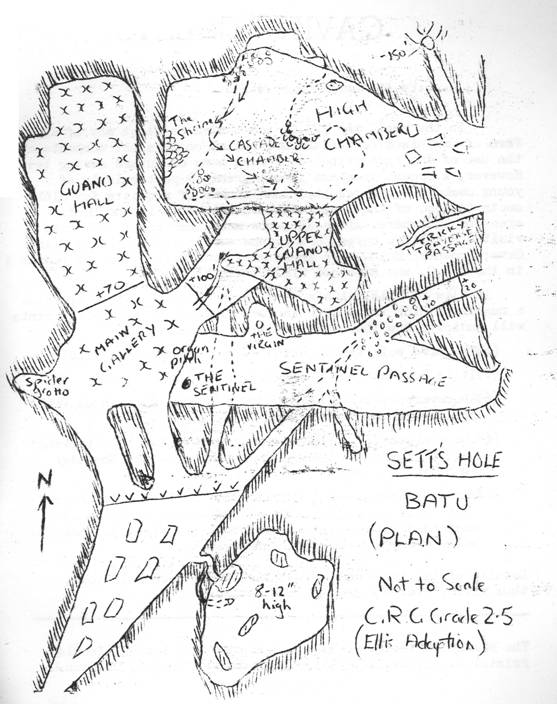
The cavern that we named Sett’s Hole, with which this report
is mainly concerned, is entered by a high rift about fifteen feet above the
cliff base. This soon opens out into (by
Mendip standards) a gigantic cavern. Frank Mercer – a
potholer – and I were wondering at this stage what would be coming next! We named this great hall the Main Gallery.
Just before the dark zone is reached, a squeeze can be
pushed. The way on lies through a pool
of water – at 75°F – and into a very low chamber eight to twelve inches
high. This we called something sounding
like Grass Hole – for obvious reasons. On returning to the entrance passage, three passages can be seen to lead
off. The right hand and centre ones are
dead ends, although in the right hand one, an interesting squeeze doubles back
to the right. It was here that the two
forms of life were found in a pool in which the body of a bird was also lying.
If one faces north on reaching the Main Gallery, two large –
and I do mean large – galleries can be seen. The left one heads due north and the right one heads E.N.E. These two chambers were named Guano Hall
(politely) and Cascade Chamber respectively. Although these chambers both close down after about two hundred feet of
very open walking and scrambling, they are both worth mentioning on account of
their very individual characteristics. Guano Hall, as is suggested by its name, is liberally covered with
guano. The-entrance to it is up a 30°
slope that is made into just about a v. diff climb by the bat dung. Spiders and millipedes were found in this
chamber. Very little time was spent in
this chamber, which was a pity as it is now my belief that it is from here that
the way on lies.
Cascade Chamber is totally different. For one thing, there are no bats whatsoever
although the gallery (as can be seen from the rough survey) opens out into the
same chamber as Guano Hall. After a
certain distance up the series of small vertical pitches into the chamber, no
bat dung is found at all a trickle of water appears half way up the ascent
(100) and it was suspected at a later stage of the exploration that this is
part of a stream that sinks in the Upper Series about fifty feet higher and
about two to three hundred feet to the cast of this resurgence. However, everything in fact points away from
this suggestion. Firstly, the limestone
is vertically bedded and does not seem to take to horizontal corrosion too well
and secondly, the stream is flowing to the east at the sink.
At the top of the pitch, the cave floor levels off for a few
yards then drops seven feet. Dead ahead
can be seen a cascade which must be all of a hundred feet high. It is 132 feet round the base and is
estimated to have a diameter of about forty feet! Photographs of this formation were taken, but
it is doubtful whether they will come out, as the light from the magnesium
ribbon used did not seem at all adequate.
On returning to the Main Gallery, if one looks to the left
and up from the bottom of Cascade Pitch, the Sentinel can be seen in a high
level passage at the top of a vertical pitch. The Sentinel is a stalagmite boss that is pear shaped in its horizontal
cross section. It has a circumference of
some nine feet. The climb up this pitch
probably comes to about diff. standard, and is best attacked on the northern
side. All attempts on the southern side,
ended in failure, although I dare say that a climber – with a bit more
experience and guts should be able to push a route up the other side. The pitch itself is a series of flutings
ending in spires, looking very much like the mountains of the moon. From its resemblance to organ pipes as well,
this pitch was called Organ Pitch. Almost exactly opposite Organ Pitch is a small alcove about three feet
high above the floor level of the Main Gallery. This was named Spider Grotto on account of the weird looking variety of
spider type creature found there. N.B.
No webs were found. Going up Organ
Pitch, Sentinel Passage is reached, and then a steeply inclined slope takes one
out on to the cliff face, at an elevation of 150 – 200′. Turning to the left, an enormous cave
entrance can be seen, looking like Alum turned sideways. This holds the entrances to three high level
galleries. From left to right, Tricky
Traverse Passage; High Chamber and Disappointment Passage.
Tricky Traverse is just what its name implies. The team were just too dead beat to tackle it
(or chicken?). A slab eighteen inches
wide leads to a point four feet away from and two to three feet below the start
of the passage, which is a dried up stal flow. From the slab to a foot below the stal flow – which slopes at an angle
of about 70° – is a small ledge three to six inches wide, sloping at about
30°. This is made more difficult by an
overhang of about two feet, jutting out from the ledge and some two feet above
it. The passage seems to go.
Going down the 50ft brings one into High Chamber. This is an extremely large chamber, in fact
the largest in this particular system. There are many entrances from the plateau to be seen in the roof, and
the dangers of travelling on the plateau were emphasised by the number of dead
animals lying about the cave floor in different degrees of pheeeeeeew.
Facing west, a waterfall sixty feet high can be seen – this
is the stream mentioned earlier in this report. Right at the far end of the cavern is a huge flow (The Shrine) at the
bottom of which are gours, some being thirty, inches high. To the left and across a sandy beach Upper
Guano Hall is reached. It was in this
chamber that one patch of dung four feet deep was found and again the bats only
used one cave out of the three available in this series (any ideas as to why?).
Disappointment Passage is entered by way of a narrow rift
which soon opens out into a passage of decent proportions. This ends in a pitch of about a hundred and
fifty feet deep. Two passages can be
seen leading off into the depths but to traverse round the pitch walls is
virtually impossible, so the pushing of this passage will have to wait for
some- chap with a fixed ladder.
At this point, the party turned round and made its way back
to Sentinel Passage where a speedy rappel to the bottom of Organ Pitch took
them to their spare fag supply, which was at once ransacked.
Formations Etc.
Only stalactites were seen in any abundance, the cave floor
having been well dug by the “Awld man”. What they must have dug for, we do not know,
only knowledge of geology, being very basic, was not sufficient to allow me to
identify any mineral ore. In places the
cave floors have been dug to a depth of six to eight feet, and the old floor
level could be seen as a band of calcite six to eight inches think. This thickness of stal flooring seemed to be
just about average throughout the cave. To my way of thinking this points to a distinct but gradual climatic
change, as great torrents could be required to scour out the great chambers of
this system. Also, scallop markings five
feet across were spotted in some parts of the cave. Then, to form the great sheets of calcite,
many dry years were required. One
stalactite that was found broken in two had a cross section showing four
concentric circles. Many clusters of
helictites were found, the majority of these were seen to be connected to small
stumpy stalactites and all of them ended in a pear shaped swelling. During the whole of the trip not one curtain
was seen, but there were many dried up flows.
Fauna.
Creatures were seen like a version of Niphargus Fontanus
(See British Caving Plate XV b page 268) but measuring only 1 mm in
length. Other forms were a type of
Ancryophorus Aureus (ibid Plate XVII e) and a form of Perga masus Crassipes
(Plate XVII j) also Blaniulus Guttulatus (Plate XVI d) was found and measured
about 1.5 inches. The bats seen were
like Natterers Bat.
Editor’s
Note: Plans of this hole follow in
this B.B. Perhaps some members with
knowledge of these caves can identify.
Notices
Second warning!!!
Please remember that all cutlery and crockery will be
removed from the Belfry for a trial period starting on January 1st. Also, all
unidentified gear left around will be disposed of by the Hut Warden. If in doubt, get in touch with him before it
is too late!
Tackle.
We have lost several ropes and some ladder recently. If any members know of the whereabouts of
B.E.C. equipment, the Tackle Officer, or any committee member would be very
grateful for information leading to its recovery!
*****************************************
The Belfry Bulletin. Secretary. R.J. Bagshaw, 699,
Editor, S.J. Collins, 33,
8.